


This newsletter is brought to you by the donor acquisition approach that helps you turn $1 into $2.
Howdy hi hello; Scott here. 👋
If you work in politics, you’re likely crunched for time and budget. And with all of the focus on organic social media, it may feel like just another thing. Unfortunately, if you want to understand politics in 2026, you also have to understand what’s trending online. More times than I can count, I’ll see something go viral and have no idea what’s driving it. So, Who Broke It — a newsletter written by veteran Recount journalist Grace Weinstein — has become my go-to for figuring that out. This week, Grace and I caught up about how to decode your feed and why campaign staffers need to care about digital culture.
More on that below, but first…
Digital ad spending, by the numbers:
FWIW, U.S. political advertisers spent about $13.4 million on Facebook and Instagram ads last week. Here were the top ten spenders nationwide:
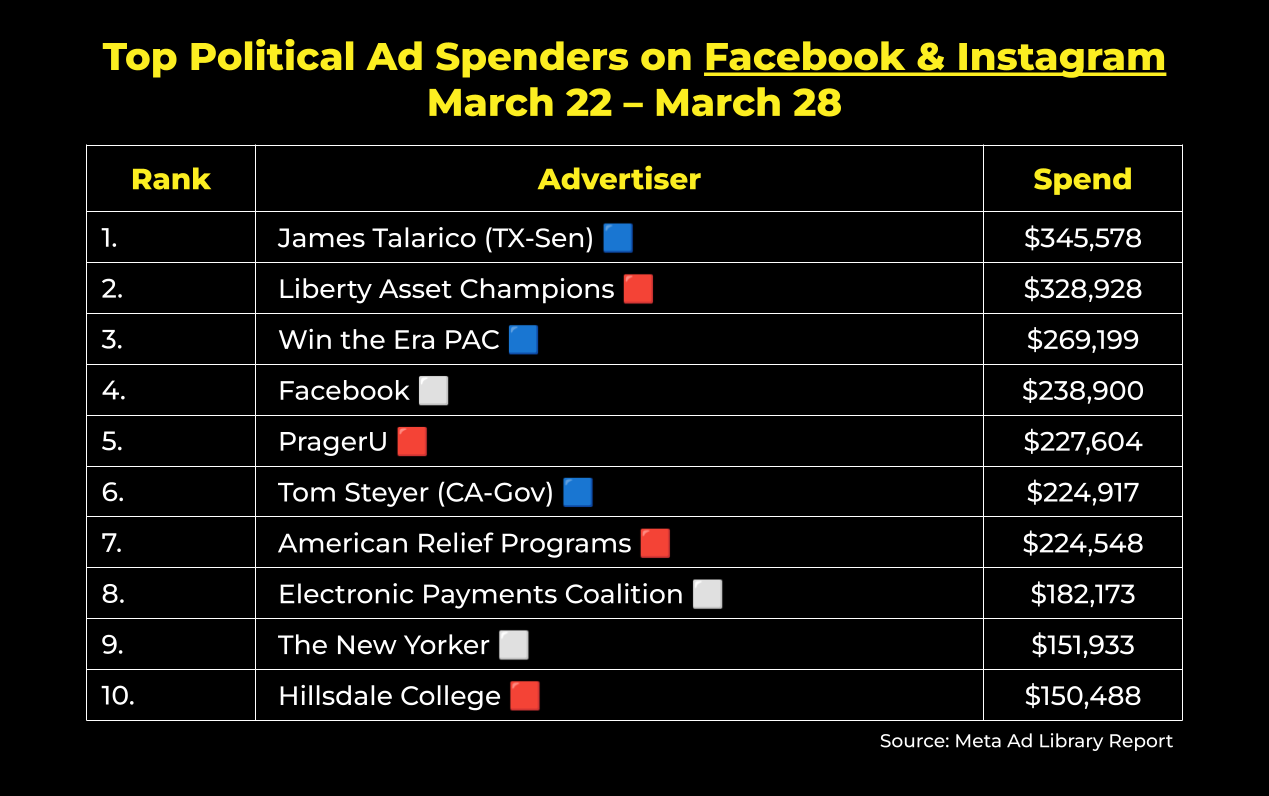
While this week features most of the same players as last week, the spending went up significantly (5.6m → 13.4m) in the final days of Q1. Pete Buttigieg’s Win the Era PAC was the only new spender to last week’s list. Otherwise, Talarico and Steyer continued to occupy top spots for the Dems, while PragerU continues to lead Republicans asking for donations and driving audiences to its conservative-leaning history content.
Meanwhile, political advertisers spent just over $6.8 million on Google and YouTube ads last week. These were the top ten spenders nationwide:
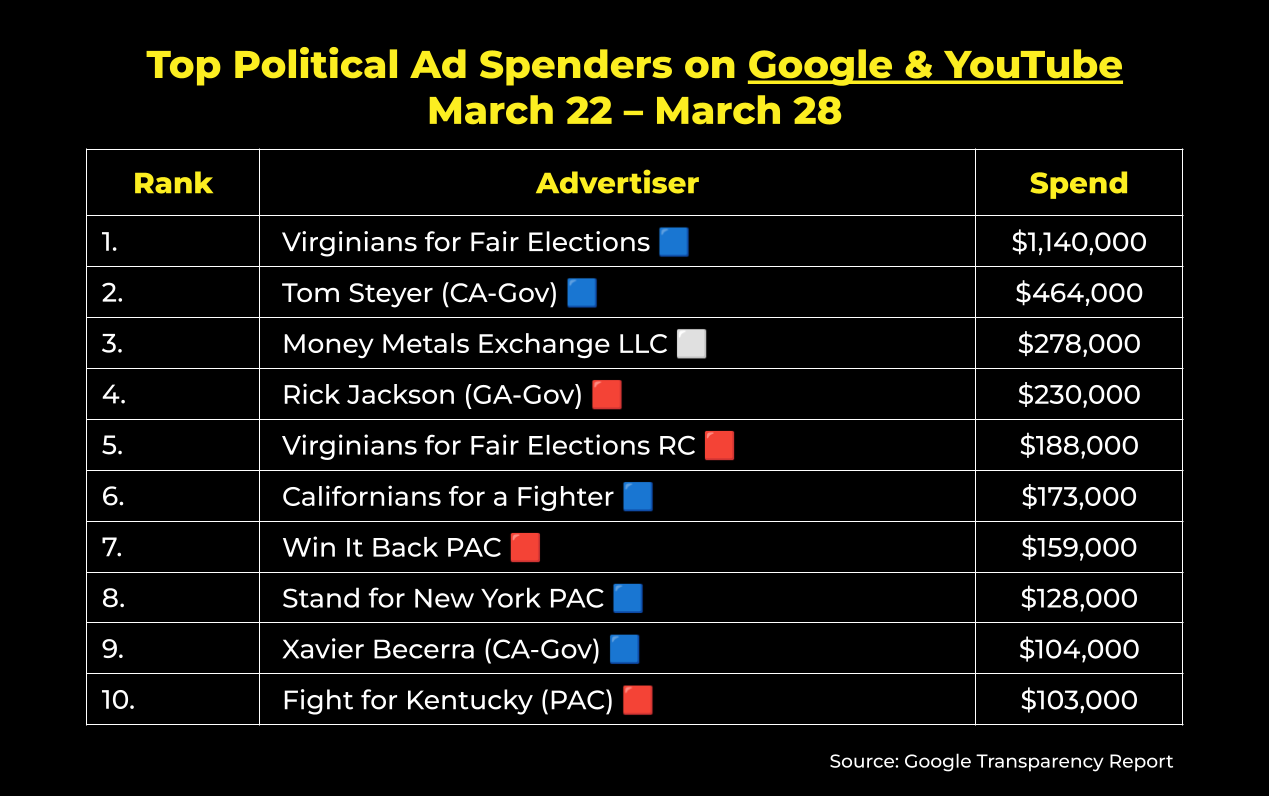
A top story to watch this month is the battle over whether Virginia will redraw their electoral maps to favor Democrats ahead of the midterms. That election is scheduled for Tuesday, April 21. The Democrats’ Virginians for Fair Elections >$1 million ad spend continues to far outpace the Republican Virginians for Fair Elections RC’s $188k.
The Democrats’ highest-spending ad features President Obama telling Virginians “we’re counting on you” to stop Trump and Republicans from stealing seats to continue wielding “unchecked power.” The Republicans’ highest-spending ad argues that Democrats “defied a court order” to enable policies that put “criminal aliens back on the streets.”
Meanwhile, as a follow up to last week’s story about California’s gubernatorial primary mess: Tom Steyer, Eric Swalwell (“Californians for a Fighter”), and Xavier Becerra all cracked the top ten spenders this week. The primary is in 2 months, mail ballots will be sent out in 1 month, and the two Republican candidates continue to poll at the top of the field. We’ll keep tabs on how this evolves.
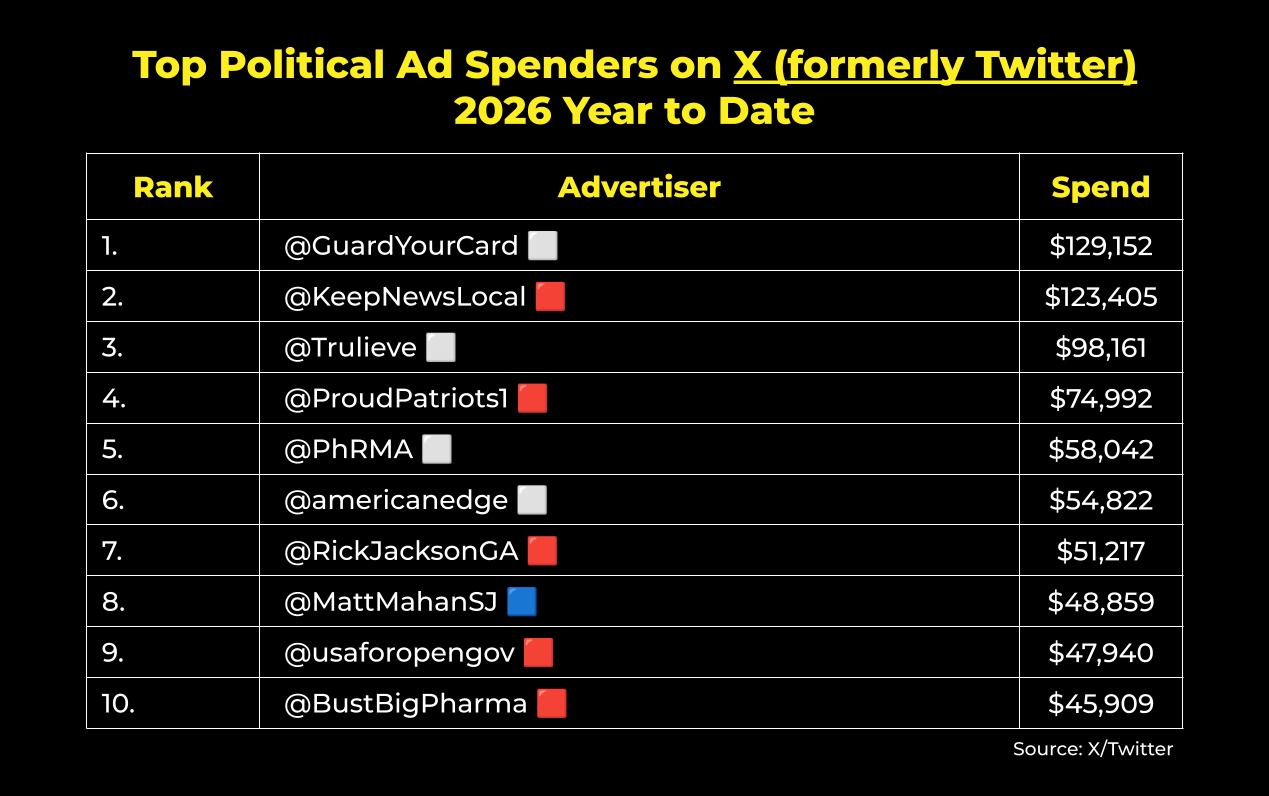
There appears to be a glitch in X’s political ad disclosure and the numbers have not been updated, so as of last week, political advertisers in the U.S. had spent just over $1.8 million on ads in 2026. Here are the top spenders year to date:
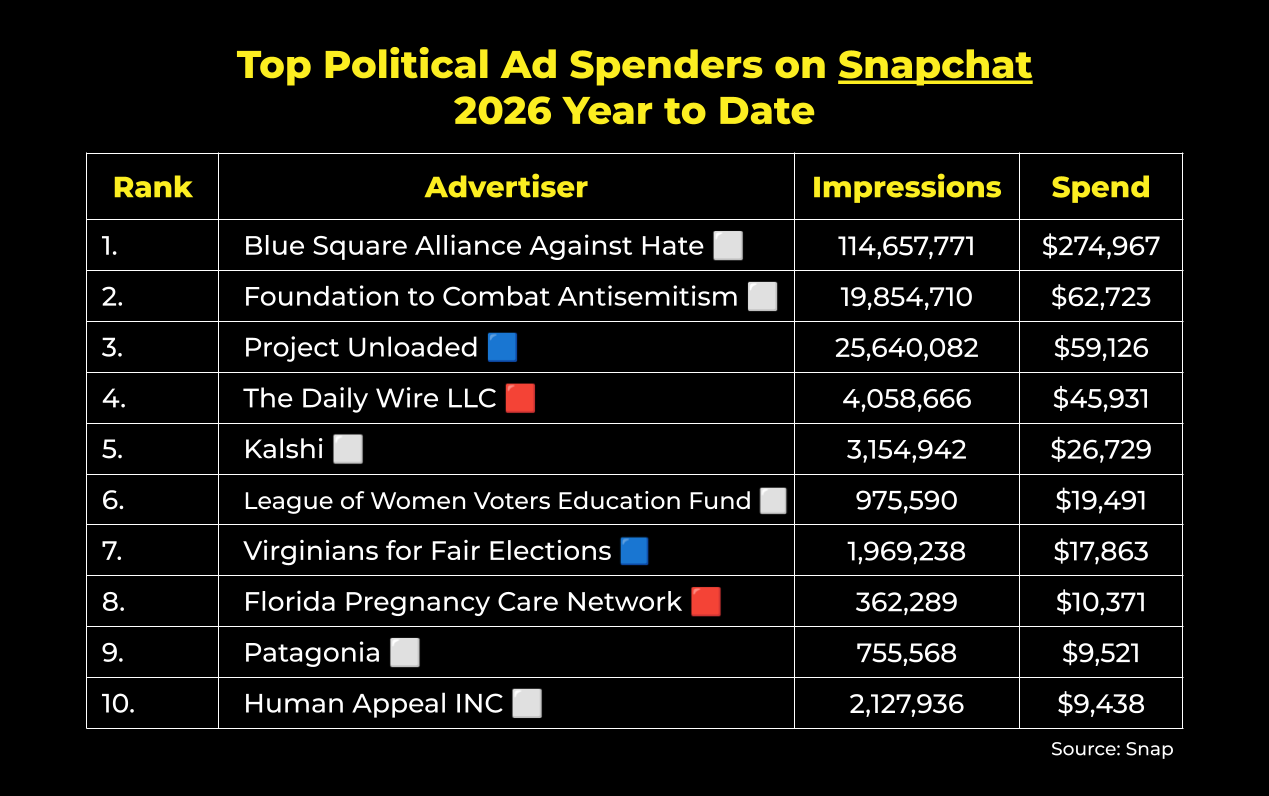
…and lastly, on Snapchat, political advertisers in the U.S. have spent around $644,000 on ads in 2026. Here are the top spenders year to date:
Please take our money…
We’ve actually heard this before, and you’d say this too if you finally found an ethical list-growth platform that helped you turn $1 into $2 like clockwork. Join over 900 groups like Everytown, Amnesty International, and Mercy Corps that have found a better way to nail their fundraising goals. Learn more >

What’s Going On Behind Your Social Media Feed
The following conversation has been edited for clarity and brevity.
Scott: To start us off, what is Who Broke It, and who are you?
Grace: I’m Grace, and I’ve worked in digital journalism for seven years. Who Broke It is my Substack publication that catalogs, contextualizes and entertains about the world of political content creation and alternative media. My goal is to cut out the chaos, and deliver something that’s readable and helps explain what’s going on. There’s too much to tackle if you try to do it alone. And as politicians and creators get deeper into the content space, somebody has to make sense of it. That’s what I was born to do!
Scott: How do you decide what is important enough to cover?
Grace: There are some days and some weeks where there’s an obvious answer. For example, if Trump announces that we are going to put boots on the ground in Iran. For non-obvious issues, I want to make sure that our audience is tapped into something that they wouldn’t necessarily have understood on their own.
Scott: We all have filter bubbles. How would you describe yours, and how do you recommend exploring what’s happening in other bubbles?
Grace: I’m the type of person that’s not satisfied until I’ve heard every argument about something. My absolute life blood is burner accounts. I have so many. Burner accounts are better than Twitter lists (which I do have) because they allow you to manipulate the algorithm. I have made a concerted effort to put a lot of effort into influencing what I need that algorithm to be.
Also, I do a lot of analysis on packaging. I wrote one piece about how all of the liberal YouTube stars are using the exact same set of evocative words in their headlines. It makes you understand that there are not a ton of lone wolves in these environments. These are networks.
Scott: How does this compare to the right?
Grace: It’s funny. After the 2024 election, the panic among the left was to figure out what our media space is, and how to become attractive to viewers at home. And now, two years on, there is so much cohesion on the left.
The right has fragmented into all of these smaller offshoots. You have the sort of Fox-affiliated corporate podcasts. You have Tucker Carlson spinning off, and the visuals are like, “I’m a regular American.” Or you have The Daily Wire which is filming on sets that cost millions of dollars.
Scott: For folks trying to understand this space you cover – the intersection of politics, culture, and digital media – what are suggestions of habits to build or sources of information to track?
Grace: Number one: Familiarize yourself with a key voice in every different faction. The main ones I lay out are leftists and DSA, progressives, liberals, centrists, conservative, MAGA, and then farther right. And if you can find one person that you’re checking their feeds every day to see what movements they’re making and what they’re focusing on, that’s going to give you a much wider scope than just listening to MSNBC or watching Fox News.
Number two: Build the muscle that helps you determine what is authentically viral and what is a manufactured campaign. This is all about reps. With reps, you’ll be able to see that these three right-wing major platforms all use the exact same wording to describe a presidential executive order. The more you start seeing with some sort of skepticism or curiosity, the less likely you are to be duped by some online information or disinformation campaign.
Number three: Build up your referential knowledge and institutional history. I’m not talking about Congress; I’m talking about which specific creators have been on a specific beat for a long time. For example, when Pete Hegseth was going viral for leading prayer services at the Pentagon, people were like, “Who are these dark, shadowy figures he’s praying with?” And I’m like, this all started with [conservative theologian] Doug Wilson from Moscow, Idaho. He is the patriarch of the sort of denomination of churches that Pete Hegseth belongs to.
Finally: Understand that the lifespan of a digital trend is much shorter than you think it is. So if you’re two weeks late to something, don’t do it.
Scott: That’s tough because I’m constantly four weeks late to everything. Really drilling in now – political campaigns have limited finances and even more limited time. Why should busy staffers care about what happens with influencers?
Grace: I think that there are two types of lawmakers. There are engineers and there are salesmen. Almost nobody is both. And this idea that everybody has to be a salesman has led people in office to make some really bad, inauthentic decisions. Bringing influencers into the fold is one surefire way that you get time back in your schedule. If everybody’s going to be breathing down your neck that you have to have a social presence, outsource that work to pre-existing influencers who know how to message to their audiences better than a lawmaker ever will.
Scott: I love this. Influencers are an organizing target to build genuine relationships with, not a new substitute for paid media. Speaking of, what are some of the best or worst examples you’ve seen of elected officials engaging online?
Grace: First, Ro Khanna. A lot of people generate hype around digital content, but are not asking what the mechanics are. I got to ask him about his social strategy and how he’s trying to create a brand online. The biggest and most important thing he said was that he’s not afraid to make mistakes. This hyperfixation on the right trend or aesthetic is so uncomfortable. There’s nothing personal, and the whole point of social media is to be personal and showcase who you are and what you believe.
I got a lot of shit for saying it – I did not like Gavin Newsom’s Trump imitations when they first came out. I know every liberal thinks that it is the best thing since sliced bread. But it is going to create a problem for him when he’s running for the White House. A year from now, he will have to start his own brand. It will, no matter what he chooses to do, look like he’s copying someone else or taking ideas from someone that’s not necessarily authentic to him.
Scott: I appreciate the take because that’s forward thinking. Consuming Newsom’s content at face value I think, “Ah, this is funny.” But you’re right; this may create a long-term problem for him.
We talked about how a lot of things seem synced up on the left versus different factions on the right. This lines up with my general perception of the Democrats being a party that is trying to empower policies that support working people, but functionally operates as a top down machine. Contrastingly, the Republicans have policies that make the rich richer, but they have an impressive amount of tolerance for letting their online advocates cook. How does that line up with your perception?
Grace: 100%. It’s like, you have these dark forces on the right disseminating money or influence whatever. They’re very open and honest about it for the most part. On the left, it’s very taboo. It’s very secret, but we all know that it’s there, which is why campaigns like Track AIPAC have been so successful.
Scott: Looking to the future, two years from today, how will today’s intersection of politics and digital culture be different? Is caring about creators a fad?
Grace: There are certain regressions in culture at large, but we’re never going back to the way that things were. And I think the slowness to accept that has doomed a lot of the legacy media. I think the money will run dry in those places. Culture has shifted so far into the world of opinion and no standards, and I just can’t see that going back.
As for creators specifically, 2028 will be the first non-incumbent year since 2016. So I think candidates will actively seek not just collaborations but endorsements. We got a little bit recently with Hasan Piker. Axios was asking 2028 candidates whether they would go on his stream. This sort of thing will be used carefully at first, and then it will snowball from there. That’s my prediction.
Scott: Grace, thank you for doing this!
Grace: Yes, thank you. I’m so excited! So glad we could.
Please take our money…
We’ve actually heard this before, and you’d say this too if you finally found an ethical list-growth platform that helped you turn $1 into $2 like clockwork. Join over 900 groups like Everytown, Amnesty International, and Mercy Corps that have found a better way to nail their fundraising goals. Learn more >
That’s it for FWIW this week. This email was sent to 25,672 readers. If you enjoy reading this newsletter each week, would you mind sharing it on X/Twitter, Threads, or Bluesky? Have a tip, idea, or feedback? Reply directly to this email.
Support COURIER’s Journalism
With newsrooms in eleven states, COURIER is one of the fastest-growing, values-driven local news networks in the country.
We need support from folks like you who believe in our mission and support our unique journalism model. Thank you.
