


This newsletter is brought to you by Action Network Boost, a new set of features built for the most advanced digital programs.
Hi, I’m Nourbese Flint, president of All* Above All, an abortion-forward reproductive justice organization working toward a world where abortion care is affordable, available, and supported for everyone who needs it. COURIER handed me the keys to the newsletter this month, so buckle up. We’re going for a ride with this repro girly.
More from me below, but first…
Digital ad spending, by the numbers:
FWIW, U.S. political advertisers spent around $13.4 million on Facebook and Instagram ads last week. Here were the top ten spenders nationwide:
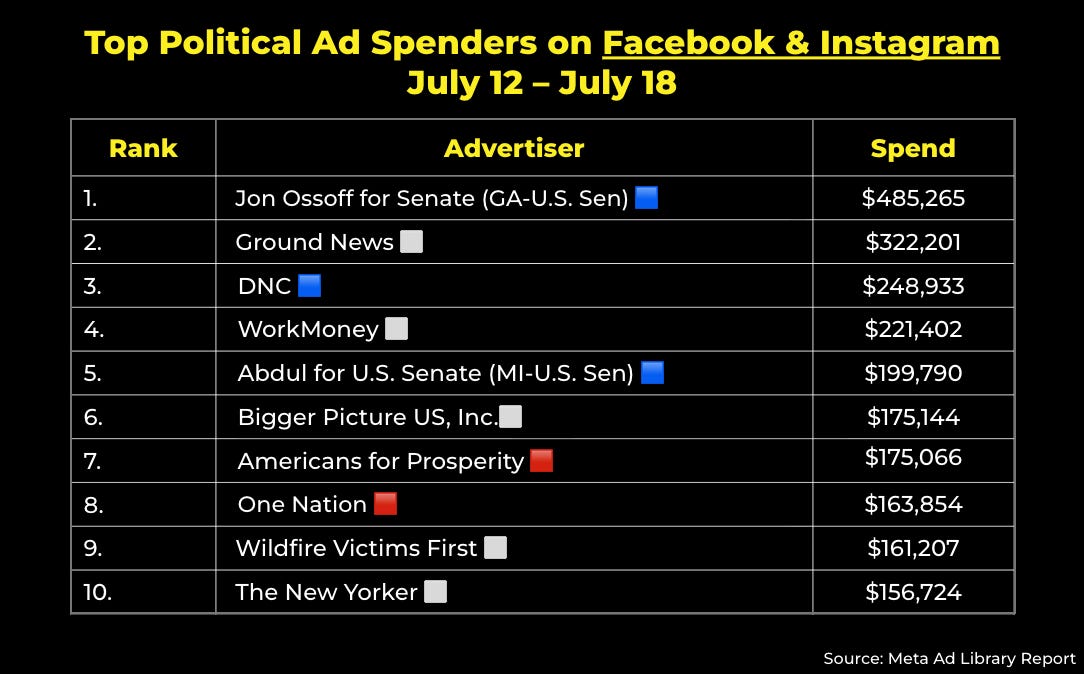
Jon Ossoff leads the pack on Meta this week by a significant margin, outspending the next closest advertiser by more than 160k — a sign that Georgia’s Senate race is heating up fast. The question now is whether Ossoff’s war chest is loud enough to drown out Trump’s ridiculous primetime address and bogus claims that China interfered in the 2020 election.
As we take a collective deep breath this week, now that we’re on the other side of the Unhealthy Air Quality alerts ushered in by the Canadian wildfires (mayhaps we shouldn’t have defunded the National Weather Service, Mr. Trump!), a new name has climbed to the top of the charts. Wildfire Victims First is a utility-funded advocacy group that is facing pressure from wildfire survivors who allege the group is disguising industry lobbying as victim advocacy.
Meanwhile, political advertisers spent around $11.4 million on Google and YouTube ads last week. These were the top ten spenders nationwide:
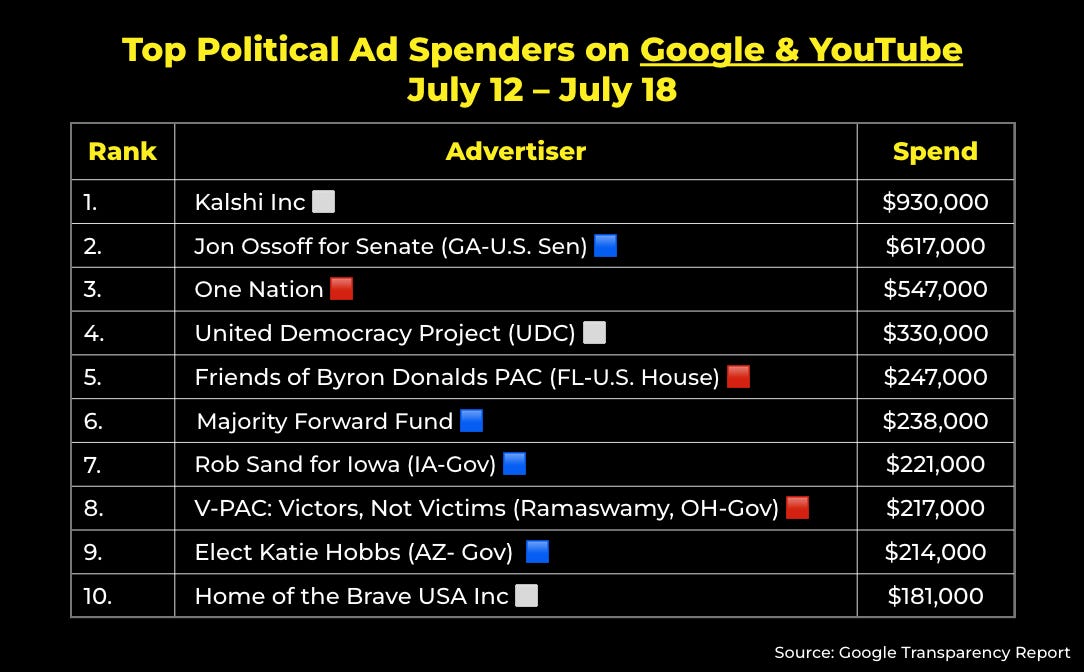
He’s a recurring character on these charts, but we just haven’t been ready to talk about Vivek Ramaswamy of DOGE fame (read: weather service). But we’re sucking it up this week in light of new reporting from the Ohio Capital Journal, which found that Ramaswamy — backed by the likes of Elon Musk and Bill Ackman — spent nearly $9 million on ads over a six-week period during which his Democratic opponent Amy Acton had spent just $100k.
And shoutout to Katie Hobbs, another reliable here, who now officially knows who she is going to be spending her $$$ against. Andy Biggs handily defeated David Schweikert (73.6% to 14.7%) in Tuesday’s primary and now heads to the general, bringing his Trump endorsement and election denialism along for the ride.
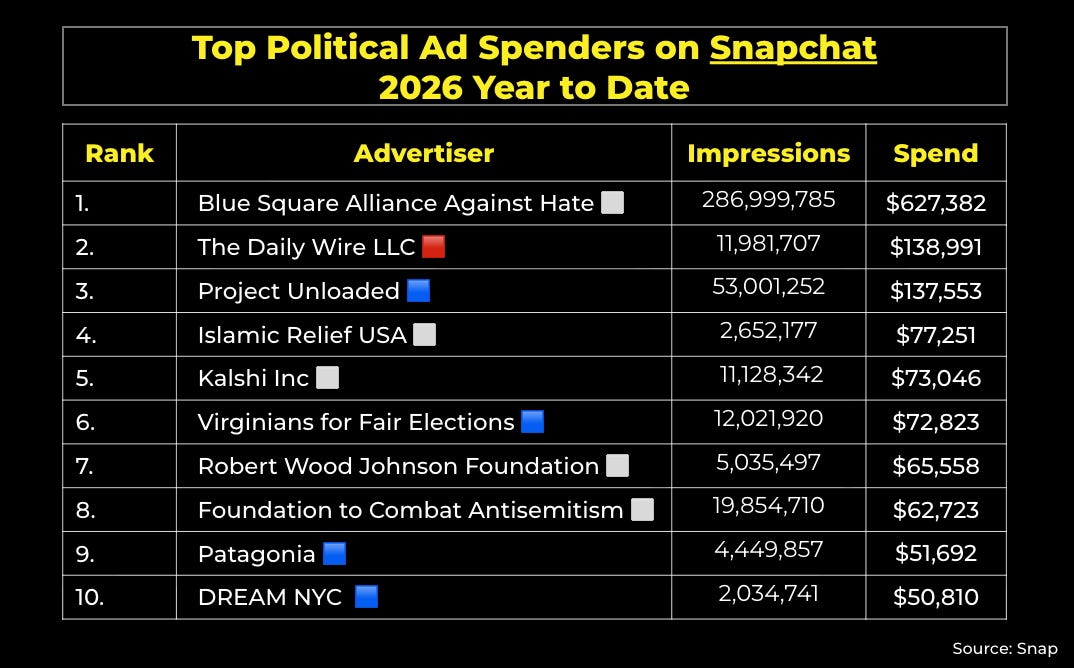
…and lastly, on Snapchat, political advertisers in the U.S. have spent about $3.06 million on ads in 2026. Here are the top spenders year to date:
Supercharge your program with Action Network Boost
Powerful features for the most advanced digital programs, including deliverability reporting, priority support, a new way to dig deeper into your data, simplified email customization, and much, much more. Sign up and get 10% off Boost here >

What we can learn from zombies, body snatchers and vampires
One of my favorite movie genres is mystery horror, especially when science fiction or the supernatural is involved. Not the kind where humanity immediately splinters into factions and starts killing each other. I prefer the slow-burn stories where something is clearly wrong, but no one can quite name it yet. Think Invasion of the Body Snatchers, World War Z, or Sinners: the clues are scattered, the threat is hiding in plain sight, and a small group of people is racing to understand how it’s all connected.
There’s always a moment near the beginning when the audience can see the danger, but the characters cannot. A door is left open. A familiar person begins acting strangely. A warning is dismissed as paranoia. I find myself willing the characters to listen. You in danger, girl. Run. Hide. Do something!
Which brings me to my point.
In recent years, reality has mimicked fiction. When it comes to women’s health and rights, we’re in the opening act of a deadly horror mystery movie - except this one is real.
The threat isn’t a horde of mindless zombies. It is a coordinated campaign to shrink women’s freedom, control our bodies, and make gender inequality feel inevitable or grotesquely, desirable.
It is quite simply a war on women, updated for the algorithmic age.
Walk with me for a moment.
At first, the clues don’t seem connected. A woman tells a doctor something is wrong and is told it’s probably stress. Another spends years fighting for a diagnosis. A pregnant patient enters a medical emergency and discovers that the law has followed her into the exam room. A woman’s body is kept functioning as an incubator after she has passed away. Clinics close across the country. Women, particularly Black women, are killed by the men who claimed to love them. Algorithms tell women that their value is only as servants. An online platform teaches men how to drug and rape their wives. Roe is dismantled while states push legislation trying to equate abortion care to homicide. Federal policies make it harder for women to vote.
Viewed one at a time, each story is easy to dismiss as a bad policy, an isolated tragedy, a fringe opinion, or just another grotesque corner of the internet.
But mysteries teach us to ask a better question:
What if these are not separate events?
What if they are clues?
When we look at all these incidents in totality, a different, much darker picture emerges.
The modern attack on women is not one villain sitting in a dark room somewhere. It is an ecosystem: white Christian nationalism; decades-long legal strategies backed by enormous wealth; anti-abortion extremism; the manosphere; “tradwife” propaganda; pronatalist attacks on LGBTQ+ people; and politicians eager to convert resentment into power. Social media and massive data sets tie these movements together like the Power Rangers’ Megazord.
These forces do not agree on everything. They don’t need to. But they do share a central belief: that women’s bodies are meant to be controlled, policed and subjugated, much like a farm workhorse used for servitude.
And why is this central to the fight for reproductive rights? Abortion is an important pillar of this story because bodily autonomy is a linchpin right. When the government can compel the use of your body against your will, every other freedom becomes less secure: the freedom to work, to learn, to leave a relationship, to care for the children you already have, to protect your health, to imagine the life you want and then build it.
Pregnancy can have multiple outcomes; abortion is one of them. Comprehensive pregnancy care is connected to maternal health systems. Maternal health is connected to racism in medicine. Gender-based violence is connected to economic security. Economic security is connected to childcare, paid leave, housing, and the ability to leave an unsafe home.
Mental health, physical safety, spiritual well-being, LGBTQ+ freedom, racial justice, disability justice, voting rights, and reproductive freedom are not competing causes. They are chapters in the same story about who gets to live safely, fully, and freely.
That is why we cannot fight these battles in silos.
So what do we do?
Turns out, we can draw a little inspiration from the movies here as well. Take the Zombie rule of threes: 1) Stay Alive 2) Stay Together and 3) Build Tomorrow.
Stay Alive
Very similar to most good horror films, we need to learn the rules of engagement. Similarly in real life we need to learn the rules of the game. Then we fight back. That means showing up in statehouses, clinics, schools, workplaces, faith communities, and group chats. Protect one another. Fund local organizers. Tell the truth about what is happening. Refuse to let the villain’s evil- doing go unanswered.
For us in the digital world, that means learning the rules of the algorithms and robin hooding them. Build out your own networks of people who are willing to amplify stories, social media posts and other important issues online to make sure truthful information spreads just as (or more) effectively as misinformation.
Stay Together
Horror movies always go sideways the moment someone says, “Let’s split up.” Our opponents benefit when we’re divided by issue, race, geography, income, generation, or identity. We need durable, committed relationships across movements and neighborhoods that are resourced for the long-haul, not just emergency coalitions that spring up when the monster is already inside the house.
At All*, we started a virtual book club as a way to create a cultural home/community. More than a year later, many of our book club participants have become some of our most reliable volunteers, helping us turn out votes between reads. People are hungry for community, and they are looking to find it through the things they love to do. Using the full spectrum of tools to world-build online, helps us create community, both online and offline, in ways that scale with our work and our budget. You can start by simply polling your email actives about their hobbies and interests and seeing where that leads you.
Build Tomorrow
Unlike the movies, our lives don’t stop at the end credits. Our goal isn’t just surviving the apocalypse; it’s building something worth surviving for, both for ourselves and the generations to come. We have to stop organizing only around what we’re trying to prevent and become equally clear about what we’re trying to build: a world where healthcare is accessible; abortion is available without shame or financial barriers; pregnancy and childbirth are safe and supported; families have what they need to thrive; and no one’s destiny is dictated by gender. Survival without purpose, survival without joy, survival for the sake of survival, is just another kind of death.
As with most horror movies, it’s not the people with the biggest shotguns that win the day; it’s the ones who notice the patterns, follow the clues and interrupt the looming crisis. I only hope America recognizes its unfurling women’s rights horror story before it’s too late.
Supercharge your program with Action Network Boost
Powerful features for the most advanced digital programs, including deliverability reporting, priority support, a new way to dig deeper into your data, simplified email customization, and much, much more. Sign up and get 10% off Boost here >
That’s it for FWIW this week. This email was sent to 25,850 readers. If you enjoy reading this newsletter each week, would you mind sharing it on X/Twitter, Threads, or Bluesky? Have a tip, idea, or feedback? Reply directly to this email.

Came to your Substack via this FWIW newsletter, and checked out All Above ALL - LOVE the website! It’s beautifully done.
What is the “at all” book club?