



Hey y’all, it’s Max Levy, an independent digital strategist and author of The Short Answer newsletter! I’m back again, this time as your personal usher into the brave new world where Democrats get to feel hope again. Today we’ll take a look at how campaigns and advocates used the internet to turn a blue wave into a tsunami, and how to make sure our wins don’t wash away with the next tide.
More on that below, but first…
Digital ad spending, by the numbers:
Over the next few weeks, we’ll use this space to cover some broader trends in the 2026 election, but for now, there’s one last week of spending to go over!
FWIW, U.S. political advertisers spent around $67 million on Facebook and Instagram ads last week. Here were the top ten spenders nationwide:
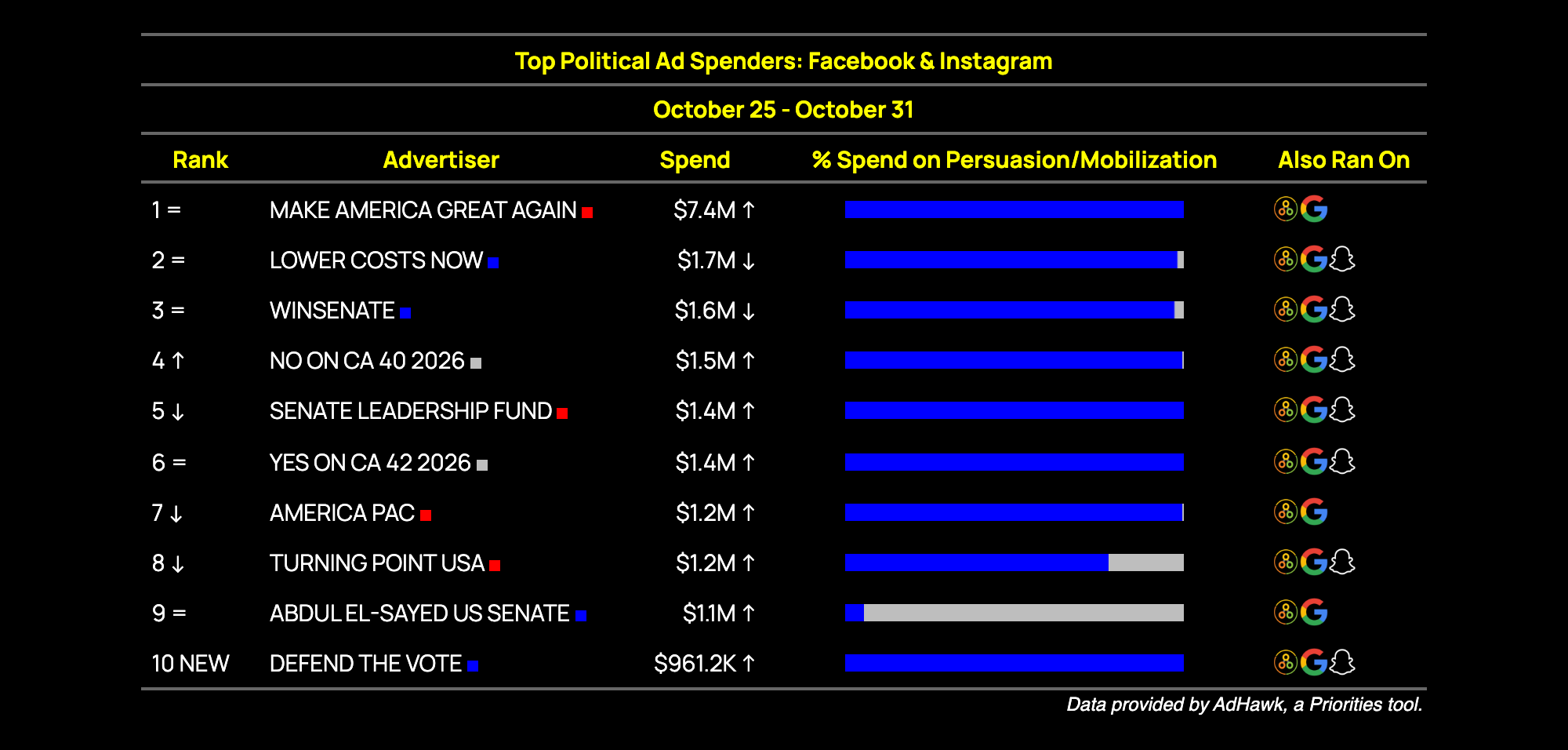
There’s nowhere to go in the final week but up—and MAGA Inc. was the clearest example of that on Meta, where they dominated late spending. Trump’s name-brand PAC moved money across dozens of races, and what’s interesting is not how much it spent, but where the money landed relative to prior weeks:
Up: Virginia ($600k, 2x previous); Pennsylvania ($540k, 2.5x previous); North Carolina ($260k, 2.5x previous)
Down: Texas ($870k, down 20%); Iowa (down 10%); Alaska (down 20%)
Though the spots were still focused on getting out the vote, it was clear that the $400 million war chest was being concentrated in races the GOP was convinced it could still play in, largely at the House level.
There were a few notable late entries, each spending north of $100k in the final week:
Together for Michigan (R): first spent on 10/22 in support of Mike Rogers, with ads focused on Democrats crossing the aisle and Israel/Iran
Double Tap (D): a creator-focused group that launched on 10/22 with generic mobilization spots
Meanwhile, political advertisers spent around $156 million on Google and YouTube ads last week. These were the top ten spenders nationwide:
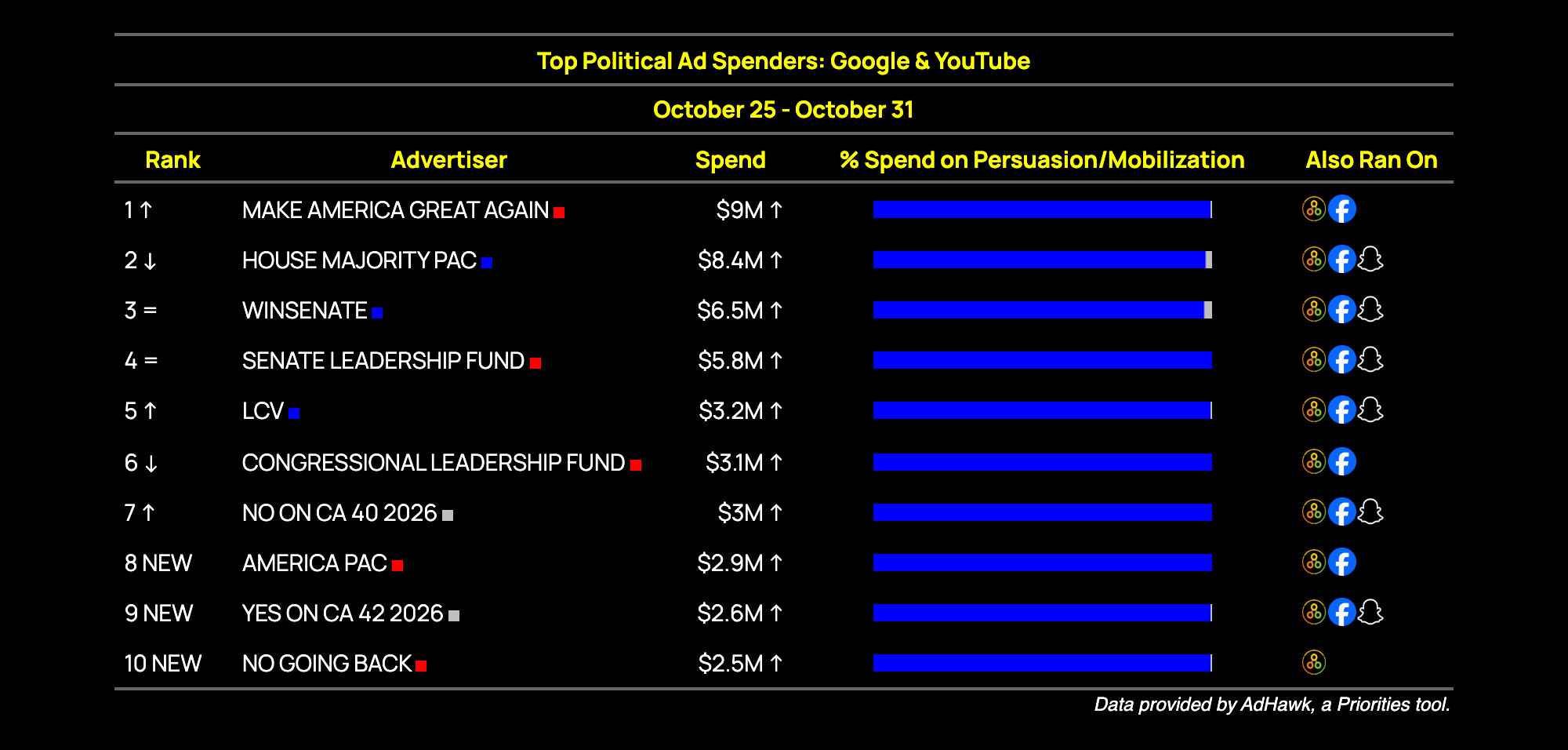
Democrats made a big push in South Carolina in the final week—and, as we know, it paid off. On Google, the party flipped the spending advantage, going from a 1:2 ratio against the GOP the previous week to 2:1 in the final week. Total spend also skyrocketed, from $1.1 million between both parties to $4 million on Google alone.
All of the late money came from new groups:
Edge Action Fund ($1.1 million, launched 10/25): targeting Darline Graham on data centers and her establishment ties
WinSenate (an SMP affiliate, spent $800k, launched 10/30): a contrast spot on data centers, corruption, and healthcare costs drove most of the spending
Black PAC ($50k, launched 10/26): running a positive GOTV ad for Annie Andrews
While we don’t know the result of the Mississippi Senate race yet, Democrats made a similar late push on Google there. This was a fight between Senate Leadership Fund and WinSenate, the two major Senate players on the soft side:
Senate Leadership Fund ($250k, launched 10/24): sticking to their usual anti-trans messaging and outside extremist support
WinSenate (SMP, $300k, launched 10/27): focusing on contrast, calling Hyde-Smith a “do-nothing”
Outside of Google, we also saw Democratic pushes on CTV from the DSCC (launched 10/29, $200k) and Ready for the Fight (launched 10/28, $130k), among others.
On CTV platforms, U.S. political advertisers spent an estimated $234 million last week. Here were the top ten spenders nationwide:
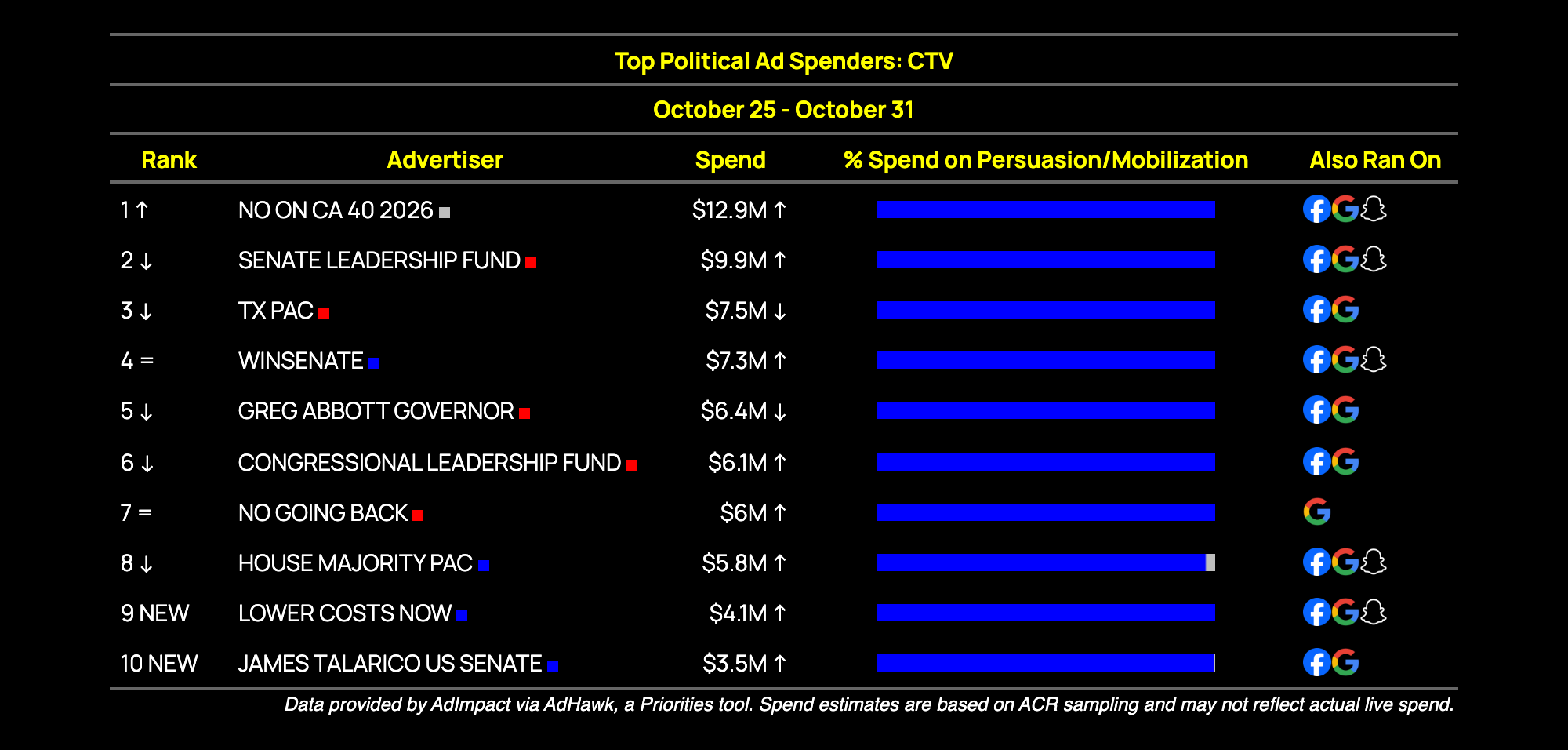
This was the first time Democrats took the lead in the Kansas Senate race on CTV, though they led on overall digital spending throughout October. Much of the late shift came from a change in which groups were spending for the GOP: SLF remained a constant, but Club for Growth and Main Street Fund went dark, replaced by Plains PAC and the NRSC. A light breakdown of the late launches:
Plains PAC ($260k on CTV, launched 10/27): a Senate control ad (we all know how that went) and a brief foray into the church camp messaging lane
NRSC (launched 10/28, $72k on Google): a repeat of the Marshall campaign’s Deb spot
…And lastly, here’s Snapchat YTD data for the top 10 spenders:
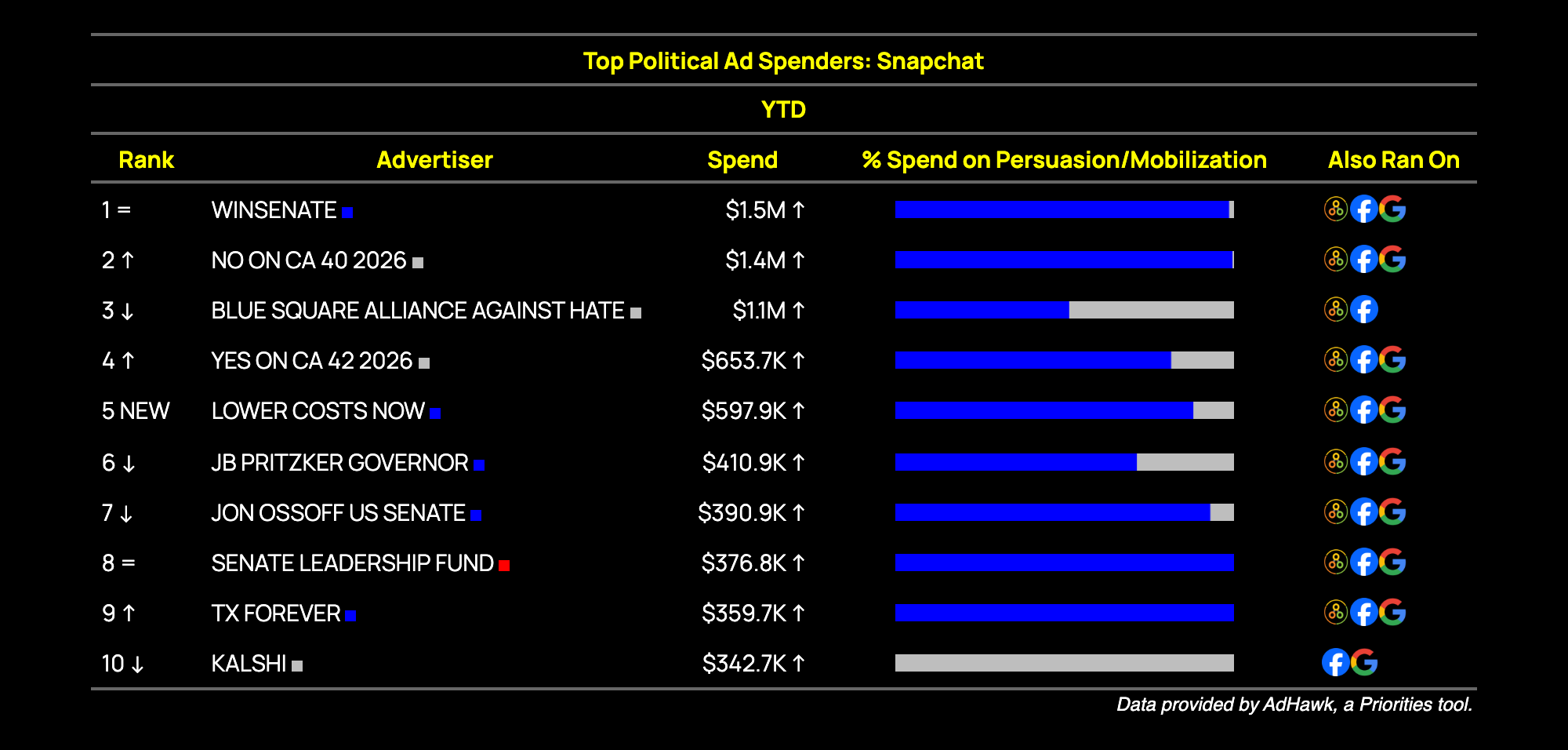
We’ve covered Lower Costs Now (an entity of Future Forward) a few times since they launched, but their rapid growth on Snapchat deserves a final note. 98% of their digital spend has been on persuasion, totaling $32 million since launching at the end of September.
On Snapchat, though, they’ve eclipsed most other spenders in record time. On 10/30, they swapped out their final Snapchat creatives:
Iowa ($350k since 10/27): “zombie movie” for “Hinson’s flock”
Kansas ($350k since 10/27): “sex predators” for “check that box”
In just two weeks, Lower Costs Now broke into Snapchat’s top ten spenders of 2026, with most of its spend coming in the final two days. That’s an astonishing ramp on any platform, but Snapchat’s secondary role in political advertising means late money represents a much larger share of the total spend than comparable pushes on other platforms.
This is despite evidence that Snapchat should play a larger role; as we’ve noted previously, 65% of voters ages 18-24 use the platform at least weekly.
What the Left Got Right Online This Year — and What Comes Next
The digital tactics that built this week’s Blue Tsunami
Yes, it’s true that the two best things you could be in the 2026 elections were 1) NOT Donald Trump and 2) NOT a Republican. In the face of skyrocketing prices, an unpopular war, and a corrupt president who just wanted to talk about his ballroom and men’s asses, the conditions were ripe for the left to have a good night. But you don’t get the truly incredible results we saw by coasting on the fundamentals alone. You get them by doing a whole lot of other things right, too. Let’s look at some of the ways Democrats up and down the ballot got the internet right and built a tsunami this cycle.
Innovative campaigns merged siloes
Gone are the days when ‘digital’ or ‘organizing’ or ‘communications’ could be relegated to their own lanes. Take just one moment from James Talarico’s campaign:
Last month, Talarico participated in a town hall hosted by both CNN and Jubilee (the YouTube-first media company known for its “Surrounded” debates, among other series) — bringing traditional and new media together. The several-hour TV hit was important, but its real value came from the sheer volume of clips the campaign was able to distribute in the days and weeks that followed. Each of those clips became an opportunity not just for persuasion, but also for organizing and fundraising via comment-to-DM tools and other activations.
Other campaigns and groups also found ways to mix and match traditionally siloed tactics. Oppo researchers pitched stories to influencers and social aggregators. NextGen America developed VOTE-E, a voting information tool that could function as a chatbot in Discord channels and Twitch streams. Digital teams worked more like organizers than paid media vendors in their outreach to creators. The internet is everywhere, and the strongest campaigns figured out how to use digital tools to advance any and all of their teams’ goals.
Scrappy teams made strong digital-first content
Video continues to be the gold standard for campaigns that need organic content to break through before they have the budget for paid media. That doesn’t mean you need to perfect the Jon Ossoff hero shot or hire fancy consultants (although that doesn’t hurt!), but it does mean you have to figure out other ways to stand out.
Mississippi Senate candidate Scott Colom posted Wednesday that his campaign directed and edited its viral “Pick another protein? I’d rather pick another Senator” ad entirely in-house.
North Carolina Congressman-elect (!) Richard Ojeda, who defeated the chair of the NRCC, has a TikTok feed full of simple direct-to-camera videos.

And state legislative candidates like Jen Wiles reached deep into their communities by showing up like real people online.
Our candidates are finally starting to become digital natives themselves, or really empowering staff who already are. Those are the campaigns that are able to break through online, rather than just posting an ad and fading away.
Armies of amplifiers got the tools they needed
Today’s algorithms are such a mess that sharing a video from a candidate’s page alone is no longer enough to make that clip to break through. You need to get that moment shared out across as many accounts as possible, from as many different kinds of accounts as possible, with each one remixing the clip to fit their own particular audience.
This cycle, campaigns and advocates across the country realized they were already good at doing the hard part (finding clippable moments) and just needed to get better at distribution. The DNC filled a Signal chat with more than 500 creators, regularly sending them clips, while also building out a standalone clip library. The Movement Clips Library and The Amplifier daily newsletter played a similar role for the outside game. And I know individual campaigns set up their own distribution pipelines, too, relying on both organic manpower and paid efforts.
Now, we have to govern – loudly
We did it! We won the seats! Now, we have to prove we know what to do with them. And in today’s media environment, it’s not enough to just do good work. We have to make sure people know we’re doing it, too.
Fortunately, we already have a roadmap for that from state and local electeds who have learned that lesson. Just look at the sitting Democratic governors who have made long-form appearances on Jubilee, Kyle Kelce’s podcast, and Track Star, or New York City Mayor Zohran Mandani’s seemingly endless run of appearances on different short-form social series. You don’t even have to rely on other creators’ channels; you can (and should) continue to build out authentic online presences like state legislators from West Virginia to Ohio to Maryland and beyond.
After two years of work, our message resonated with voters, and they’ve given Democrats a chance. Now, we have to take actions that show we deserve that trust — and keep breaking through however we can along the way.
That’s it for FWIW this week. This email was sent to 25,788 readers. If you enjoy reading this newsletter each week, would you mind sharing it on X/Twitter, Threads, or Bluesky? Have a tip, idea, or feedback? Reply directly to this email.
