

This newsletter is brought to you by Action Network Boost, a new set of features built for the most advanced digital programs.
Hey everyone, Denny Carter from BadFaithTimes.com here. A while back I wrote for FWIW about media – particularly TV ads – reflecting a supposed right-wing culture shift in the early days of Trump’s second term. My background is in journalism and social justice issues, while my day job is as a sportswriter and football podcaster. I can be found posting incessantly on Bluesky, which I have dubbed The Official App of Sports, at @dennycarter.bsky.social.
Today I look at just how dramatically our information environment has changed since 2020, when guardrails on social media platforms and news outlets stopped Republicans from overturning a fair and free election.
More on that below, but first…
Digital ad spending, by the numbers:
FWIW, U.S. political advertisers spent around $15.4 million on Facebook and Instagram ads last week. Here were the top ten spenders nationwide:
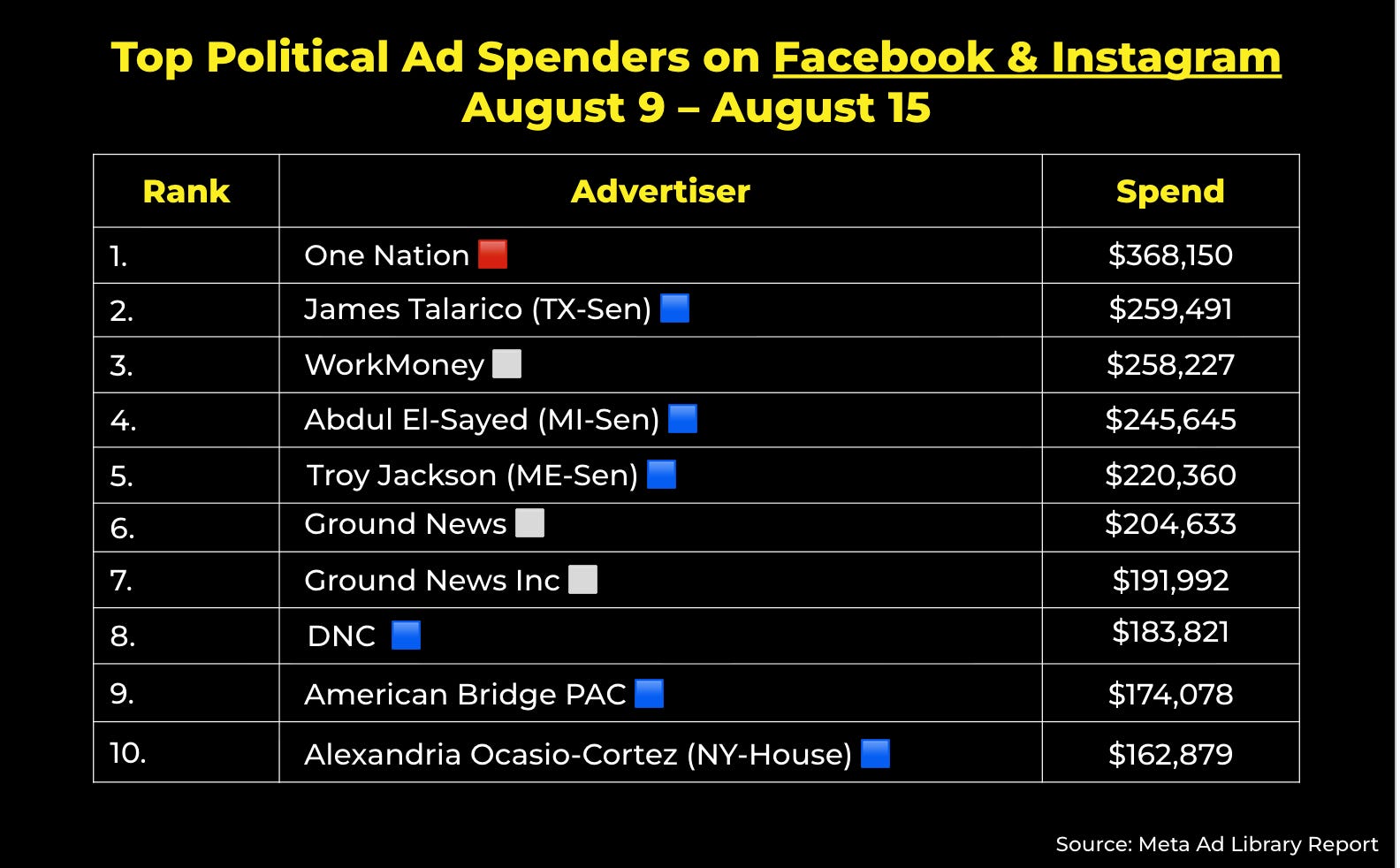
One Nation, a GOP dark money group, takes the top spot this week; otherwise, it’s mostly business as usual. American Bridge PAC, the Democratic super PAC that has spent the past year studying working-class voters, is kicking off a roughly $50 million ad campaign targeting Republicans in more than a dozen House districts and four Senate races — most of them in traditionally red territory. So this probably won’t be the last time we see them on this chart. Here’s hoping their efforts pay off in November!
Meanwhile, political advertisers spent around $19.8 million on Google and YouTube ads last week. These were the top ten spenders nationwide:
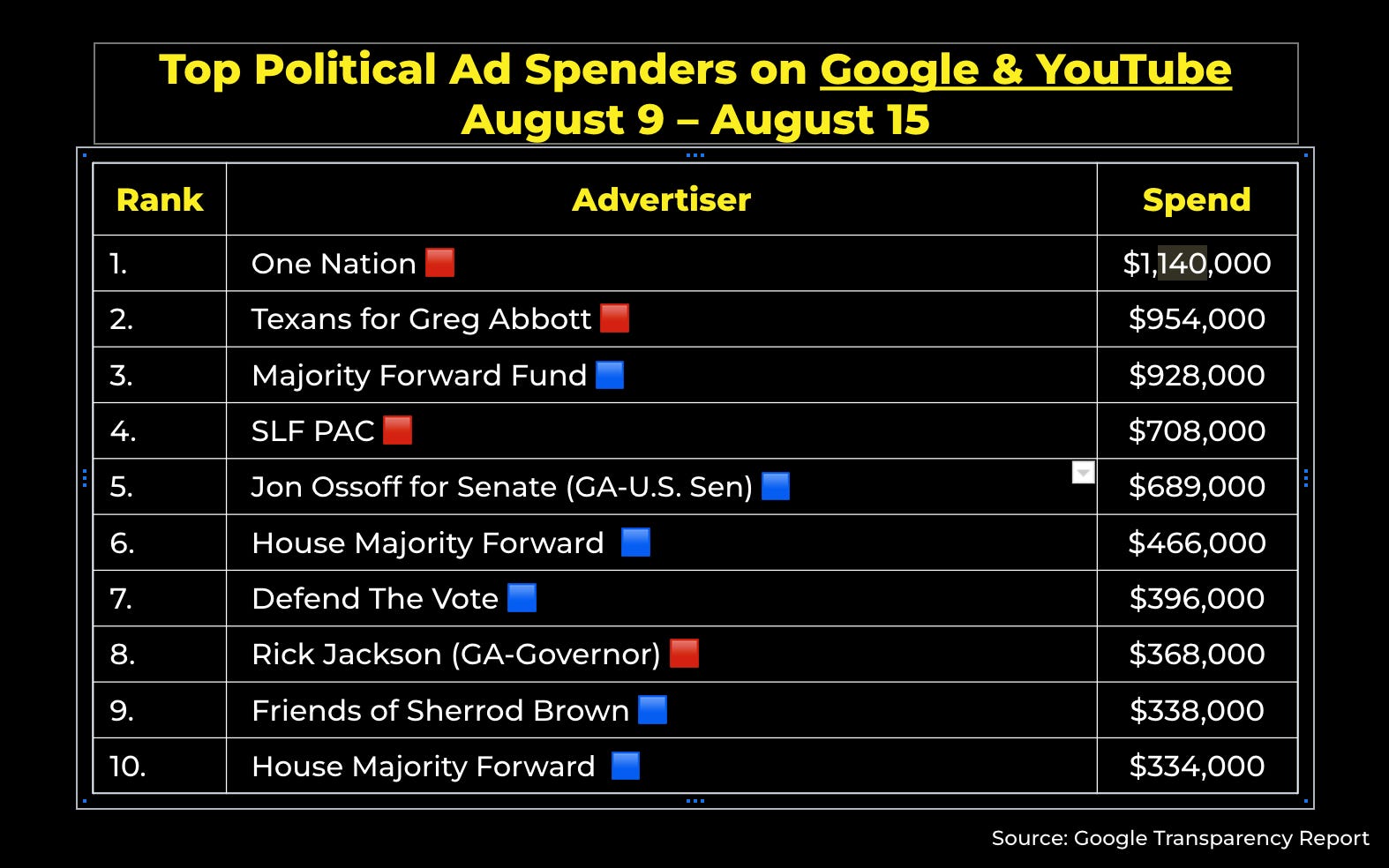
One Nation tops this chart too, with $1.14M in spending. Texans for Greg Abbott comes in second as the Republican governor faces Trump in a showdown over the former’s decision to pause new data center projects pending a state audit. OpenAI sent Abbott a letter this week committing to pay their own infrastructure costs, along with a bunch of other stuff. Worth a read if data centers sucking up power and water, spiking electricity bills, and tech companies making promises to politicians are your idea of a relaxing evening (no judgment here!).
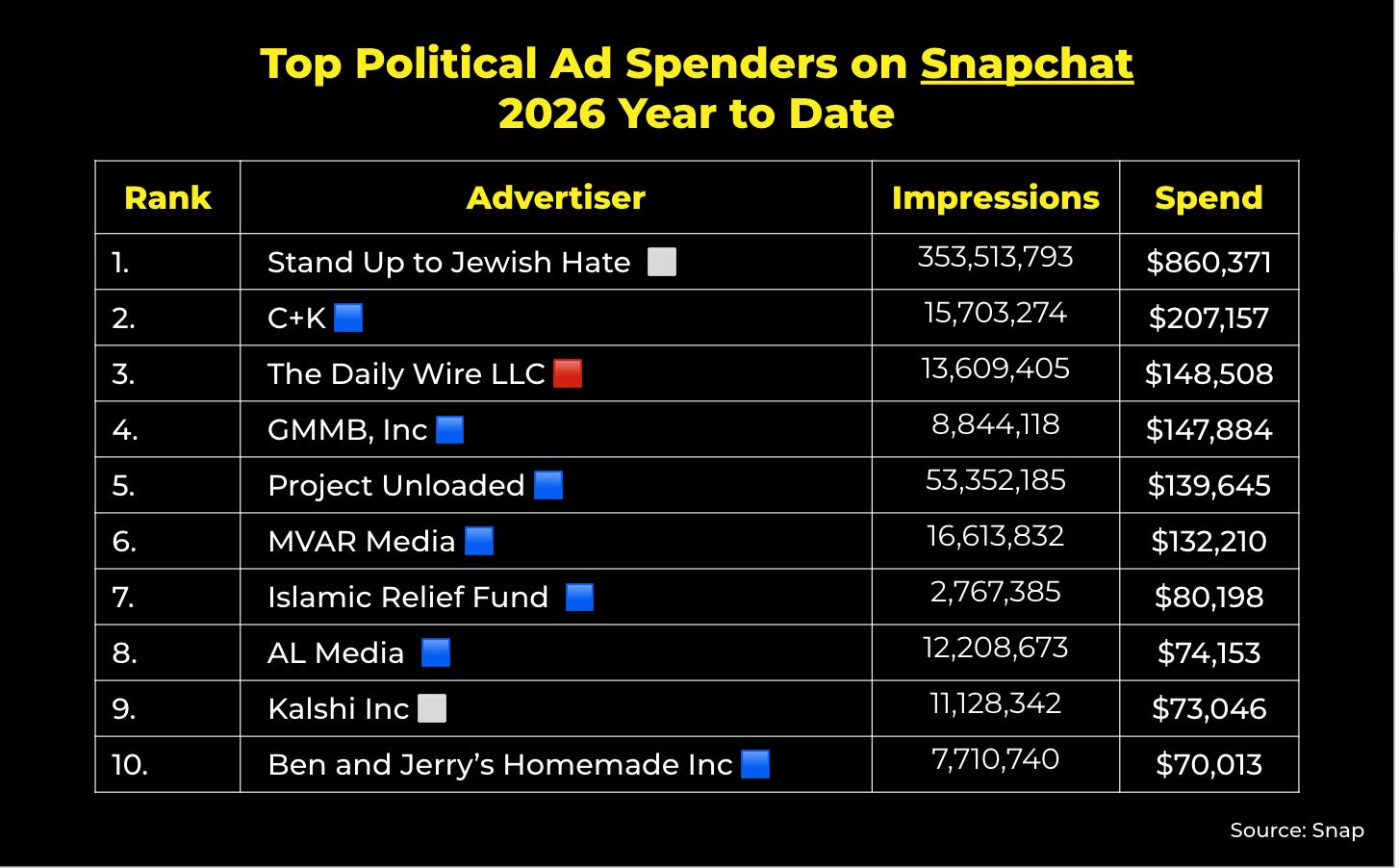
…and lastly, on Snapchat, the glitch continues, so we don’t have the total YTD, but here’s the data for the top 10 spenders:
Supercharge your program with Action Network Boost
Powerful features for the most advanced digital programs, including deliverability reporting, priority support, a new way to dig deeper into your data, simplified email customization, and much, much more. Sign up and get 10% off Boost here >

What a poisoned media environment means for the midterms
There were information environment guardrails, however shaky and battered, in the run-up to the 2020 presidential election and in the aftermath of Joe Biden’s victory, as the Republican Party and its vast media apparatus became increasingly coup-curious.
Those guardrails on the American right’s election lies have since been crushed by those who simply could not accept that Donald Trump had lost his re-election bid. Elon Musk parted with $44 billion to ensure Twitter – the veritable nerve center of American politics – would no longer have the informational guardrails necessary for a functioning democracy. Mark Zuckerberg did away with any and all political fact-checking in the years after the 2020 election. Together, Musk and Zuckerberg – obscenely wealthy men who control the algorithms of our lives – made a conscious decision to let misinformation run free across our timelines, normalizing lies and half-truths about election integrity.
The result, as intended, is that any Democratic victory is seen by much of the U.S. voting population as illegitimate and corrupt. Headed into a 2026 midterm election that could be an historic wipeout for Republicans, our information environment – poisoned by a billionaire class hell-bent on ending representative democracy in the Western world – is going to matter. The guardrails are gone, replaced by algorithmic boosting of lies and conspiracies that are now treated with the same respect as the truth. Chaos could reign in the weeks after November’s midterms.
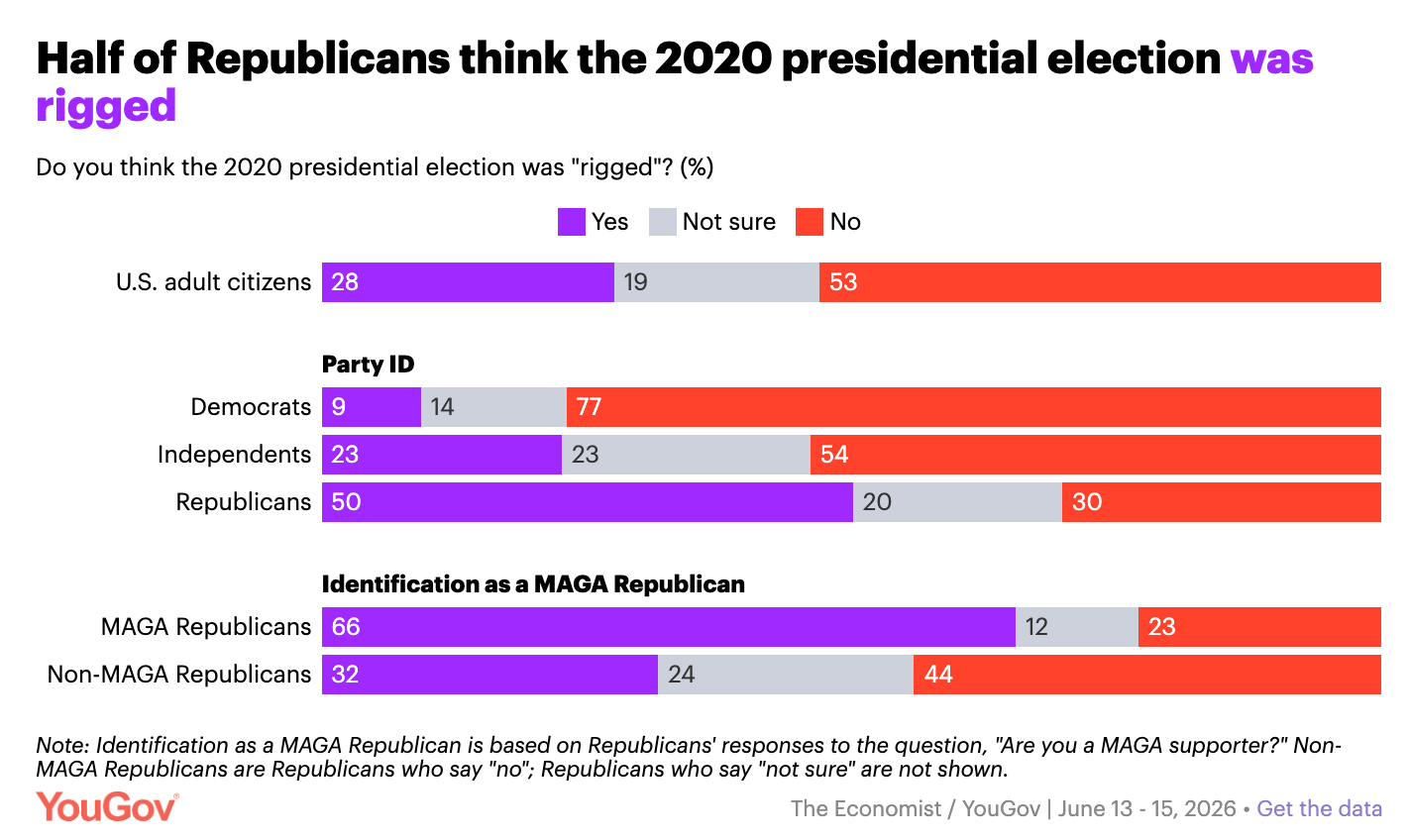
With election denialism now a feature of the Republican Party and right-wing media telling its gullible audience that Democrats steal elections with regularity, nearly half of Republicans now believe the 2020 election was stolen from Trump. Fully two-thirds of co-called MAGA Republicans say that election was illegitimate, with just 2 in 10 MAGA Republicans conceding that their guy – wildly unpopular outside his hardcore base – did, in fact, lose his re-election bid.
It’s hard to exaggerate just how insidious the idea of stolen elections has become on the American right over these past six years. Recent polling from Bright Line Watch, an organization that measures Americans’ views on the strength of the country’s democracy, showed that a mere one in four Republicans believe “elections are free from pervasive fraud or manipulation, down from 50% in February 2025.”
It’s not just GOP voters who won’t acknowledge the results of the free and fair 2020 election. The president’s judicial nominees have humiliated themselves before U.S. Senate subcommittees by carrying on the farce that the Biden campaign somehow cheated its way to victory. Asked by Democratic senators to say affirmatively that Biden won that race against Trump, these judicial nominees – afraid of drawing the ire of the tyrant who appointed them – dance around the question.
They say Biden was “certified” as the winner of the Electoral College. They say Biden was sworn into office. What they won’t say: Biden won a fair election against the kingpin of their party. The language is careful, calculated, meant to never concede for a moment that the results of the 2020 election were legitimate.

It is a matter of dogma among every part of the American right that Donald Trump cannot fail; he can only be failed. Jurists – upholders of the constitutional order – engaging in outright election denialism is a deeply dangerous development, made possible by the acquiescence of major media outlets and the outrage-fueled social media algorithms that often (tragically) serve as assignment editors for the country’s foremost publications and news networks.
It’s notable that the right’s rampant election denialism – supercharged by loyal Trump allies Musk and Zuckerberg, along with the rest of Silicon Valley’s anti-democracy oligarchs – has not yet broken containment and significantly affected self-identified Independents and Democrats, according to polling data. But even that should be cold comfort: 23% of Independents and an absurdly high 14% of Democrats are “not sure” about whether the 2020 presidential election was free and fair. That’s because their social media timelines and the news they consume have winked and nodded and suggested for years that something fishy went on in Georgia and Michigan and other states in which Biden pulled off narrow wins.
Maybe these Independents and Democrats couldn’t even tell you what exactly happened to put Biden over the top in those critical swing states. But something happened. Maybe. No one knows for sure. The uncertainty is the whole point, and creates a path – however narrow – to denying Democrats’ election victories.
America’s information environment is about to get even worse, somehow, just in time for a potentially apocalyptic midterm election for the GOP. Meta, the parent company of Facebook, announced in July that it would partner with far-right conspiracy outlet NewsMax as part of Meta’s AI news-content partnership. Meta, according to a press release, “will be able to draw upon Newsmax’s significant current reporting as well as archived content across its platforms to support Al queries across Meta’s apps and devices.”
What this means in practical terms is that Meta will train its AI news products using information from an outlet that violates the most basic journalistic standards as a business model, carries water for the president and his allies, and floods its audience with lies about Democrats and pro-democracy forces not only in the United States, but across the world. Newsguard, which ranks the reliability of news outlets, gave NewsMax a score of 20 out of 100, correctly charging that the outlet “is unreliable because it severely violates basic journalism standards.”
Perhaps your parents or grandparents watch the nightmarish NewsMax cable channel and you are aware of all this. I would guess most people consuming news on Facebook, Threads, and Instagram are not. I would guess they’d never know the CEO of NewsMax is a close friend of the president who regularly dines with him.
There also looms the threat of election-denying bot swarms on social media sites, particularly microblogging platforms like Threads and X. These bots are trained to mimic not only right-wingers, but constituencies aligned with the Democratic Party. Bot swarms, according to research from Harvard Business School, are “deeply embedded manipulation that lets operators nudge public discourse almost invisibly over time. ... In cognitive warfare, AI’s relentless operational endurance becomes a weapon against limited human efforts.”
These bots learn how to talk like specific online communities before subtly suggesting that an election may have been crooked or outright stolen. The Harvard paper on bot swarms says:
Reinforcement-learning agents could run thousands of experiments per hour, iteratively adjusting content while mining engagement and responses to infer voting intent and tactical success. Taken to extremes, coordinated doubt may corrode institutional legitimacy and invite ‘emergency’ rule. By coordinating subtle, growing doubts about electoral commissions, courts, or statistics bureaus, swarms could corrode procedural trust. As confidence falters, “emergency” measures (such as postponing elections or rejecting certified results) may become palatable, especially if deepfake endorsements from fabricated civic leaders amplify the call.
None of this is going to be regulated by the Trump regime, which relies on a corroded information environment now free of the loose guardrails we had at the end of Trump’s first term. How elected Democrats deal with an information ecosystem that is in no way compatible with representative democracy is going to determine whether election denialism persists as a mainstream political idea or whether it’s reigned in, as we’ve seen in stronger democracies, namely Brazil.
An unregulated social media environment in which election lies are spread to millions without consequence represents an existential threat. Here’s hoping Democrats treat it as such.
Supercharge your program with Action Network Boost
Powerful features for the most advanced digital programs, including deliverability reporting, priority support, a new way to dig deeper into your data, simplified email customization, and much, much more. Sign up and get 10% off Boost here >
That’s it for FWIW this week. This email was sent to 25,879 readers. If you enjoy reading this newsletter each week, would you mind sharing it on X/Twitter, Threads, or Bluesky? Have a tip, idea, or feedback? Reply directly to this email.