


This newsletter is brought to you by the donor acquisition approach that helps you turn $1 into $2.
Hey there! I’m Chanda Daniels, a former Congressional aide and longtime communications strategist for mission-driven causes, working for organizations including the Mayor’s Office, the UN, and Human Rights Watch. I write the newsletter ok so hear me out…, where I explore the intersection of politics, culture, and identity. Excited to be back!
For today’s FWIW, I’ll be diving into how social media is reshaping not just how conflicts are covered, but how they’re perceived and responded to.
More on that below, but first…
Digital ad spending, by the numbers:
FWIW, U.S. political advertisers spent just over $12.8 million on Facebook and Instagram ads last week. Here were the top ten spenders nationwide:
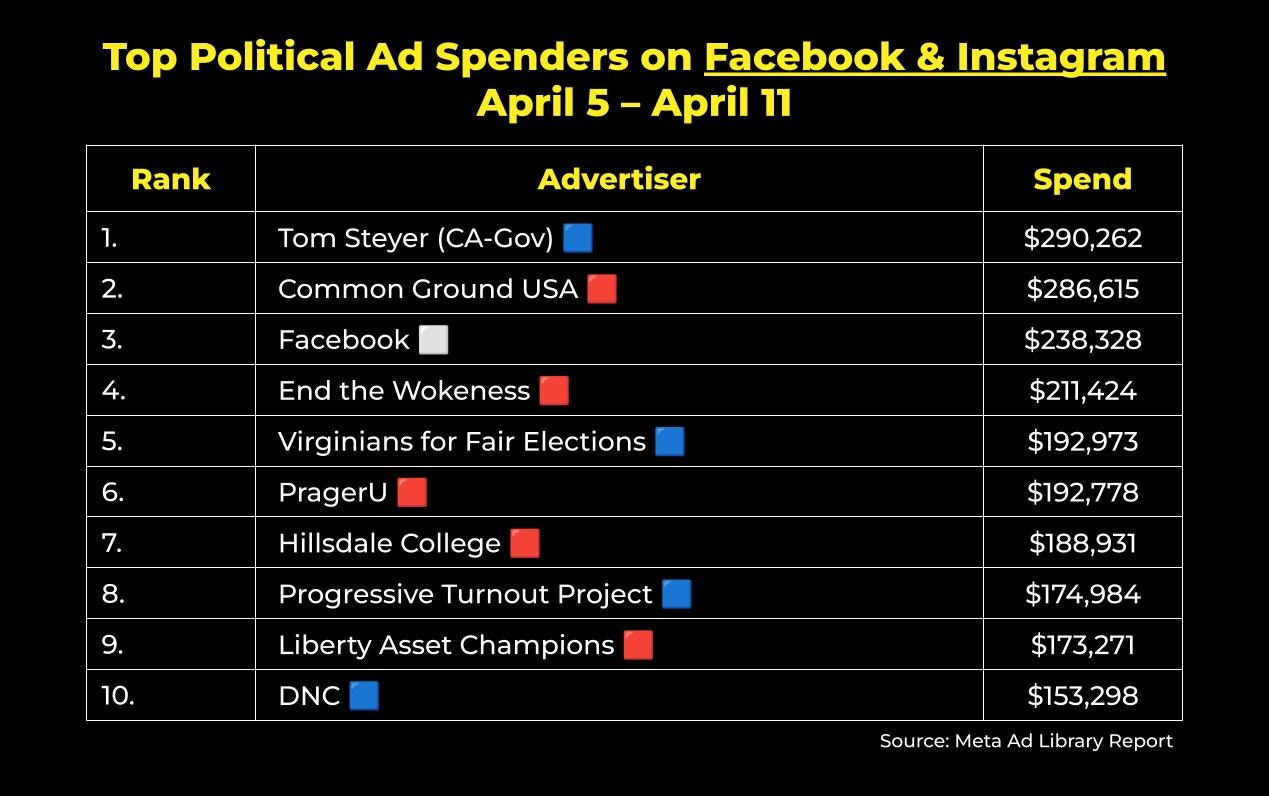
The top spot on this list is occupied by none other than 14% of California’s favorite gubernatorial candidate: billionaire Tom Steyer. With the exit of former congressman Eric Swalwell from the race, Steyer has seen his support jump incrementally. But polling shows that Xavier Becerra, former CA Attorney General and US Secretary of Health and Human Services, saw the biggest boost, with his support more than tripling what it was last month.
Unfortunately, most polls still show the two Republicans leading the pack, which could spell disaster, but also, who knows where we’ll be a week from now? Watch this space.
Meanwhile, political advertisers spent around $9.6 million on Google and YouTube ads last week. These were the top ten spenders nationwide:
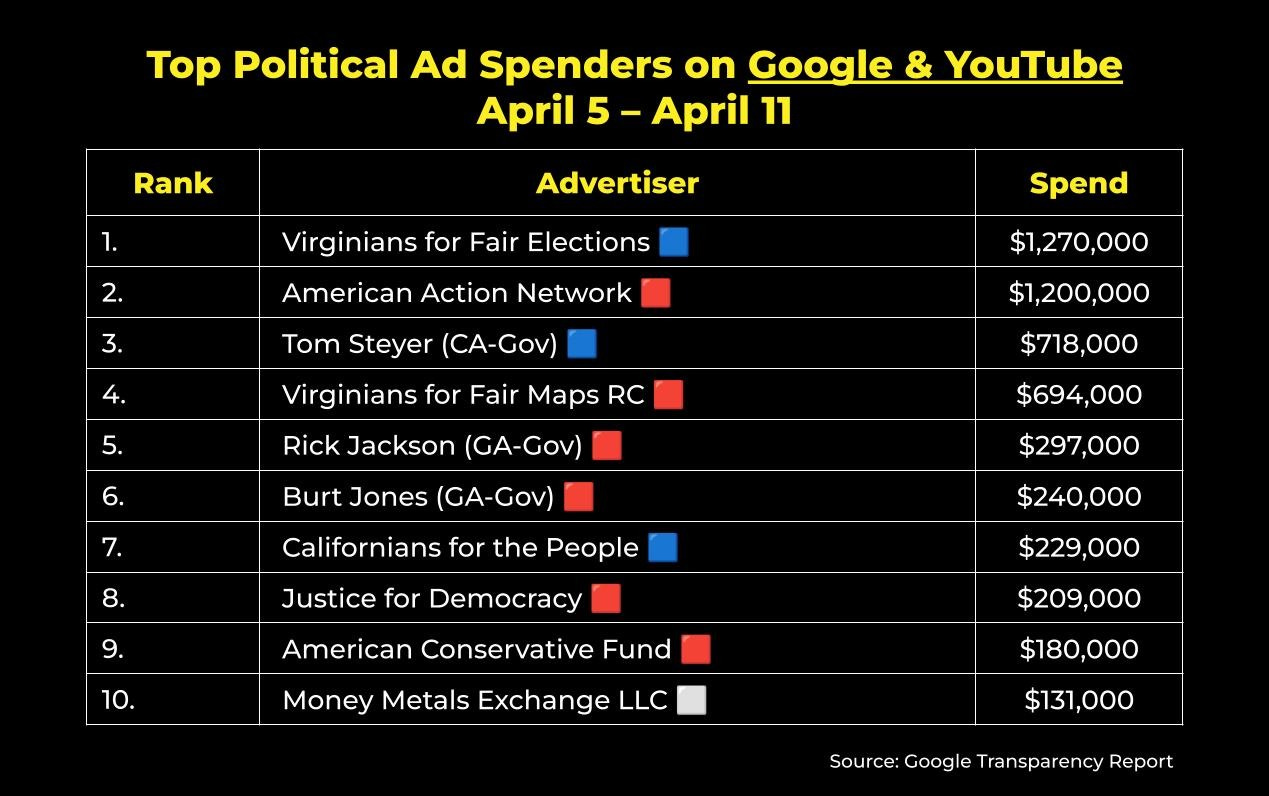
Advertising on Google and YouTube was oddly balanced last week amongst the biggest spenders. Both the Democrats’ Virginians for Fair Elections PAC and the GOP’s Virginians for Fair Maps RC made the list, though Democrats outspent the Republicans by nearly double. Tom Steyer is also on here (of course), but he is joined by the anti-Tom Steyer Californians for the People PAC. And the two Republicans running for governor of Georgia, once again, each spent upwards of $200K on attack ads against one another.
Now onto the “Justice for Democracy” PAC, which is very misleadingly named seeing as it’s being bankrolled by an outspoken democracy hater. Peter Thiel, the 40th richest man in the world, who once wrote, “I no longer believe that freedom and democracy are compatible” has decided that he needs to make his voice heard in Virginia’s special election. And it probably won’t shock you to hear that the way he’s going about it is more than a little sketchy. Lisa Graves did a deep dive on the whole operation in this week’s edition of Grave Injustice—it’s worth the read.
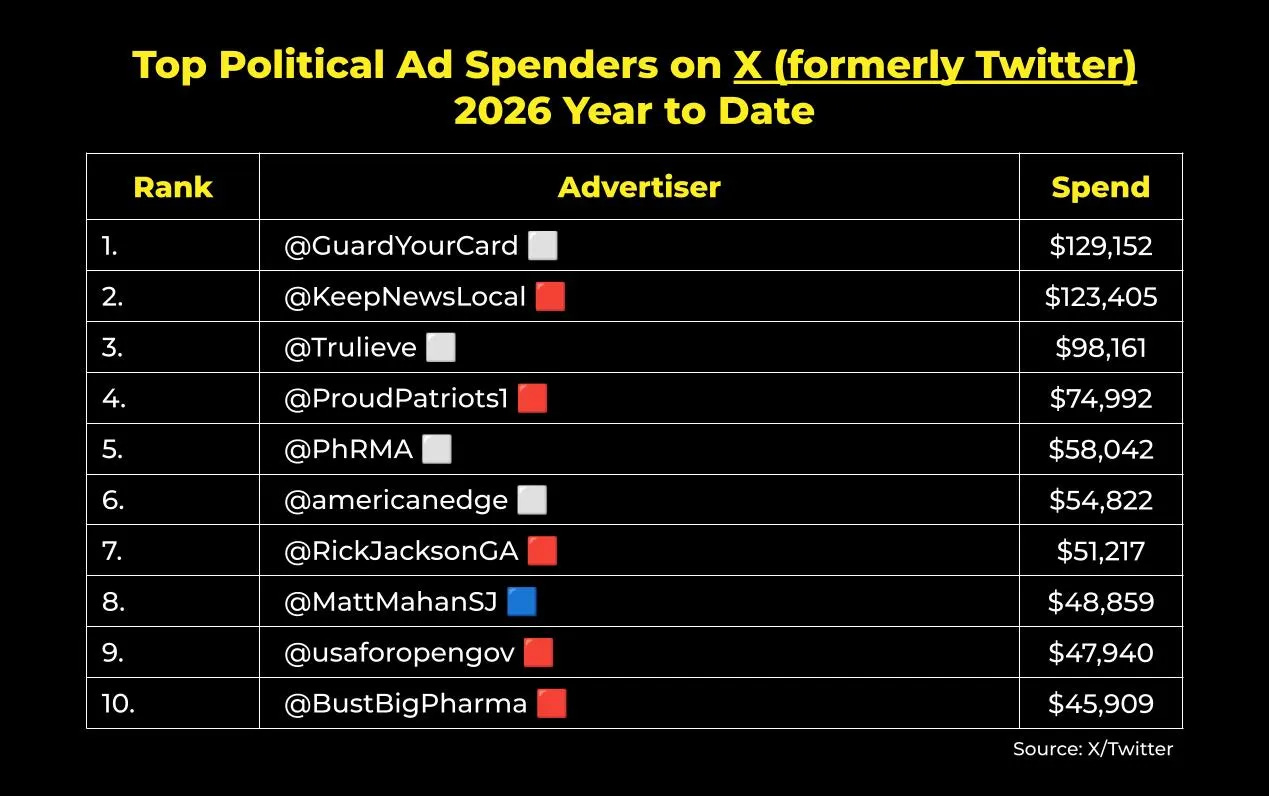
Alas, the glitch in the Twitter/X reporting matrix continues… so as of last month, political advertisers in the U.S. had spent just over $1.8 million on ads in 2026. Here were the top spenders year to date:
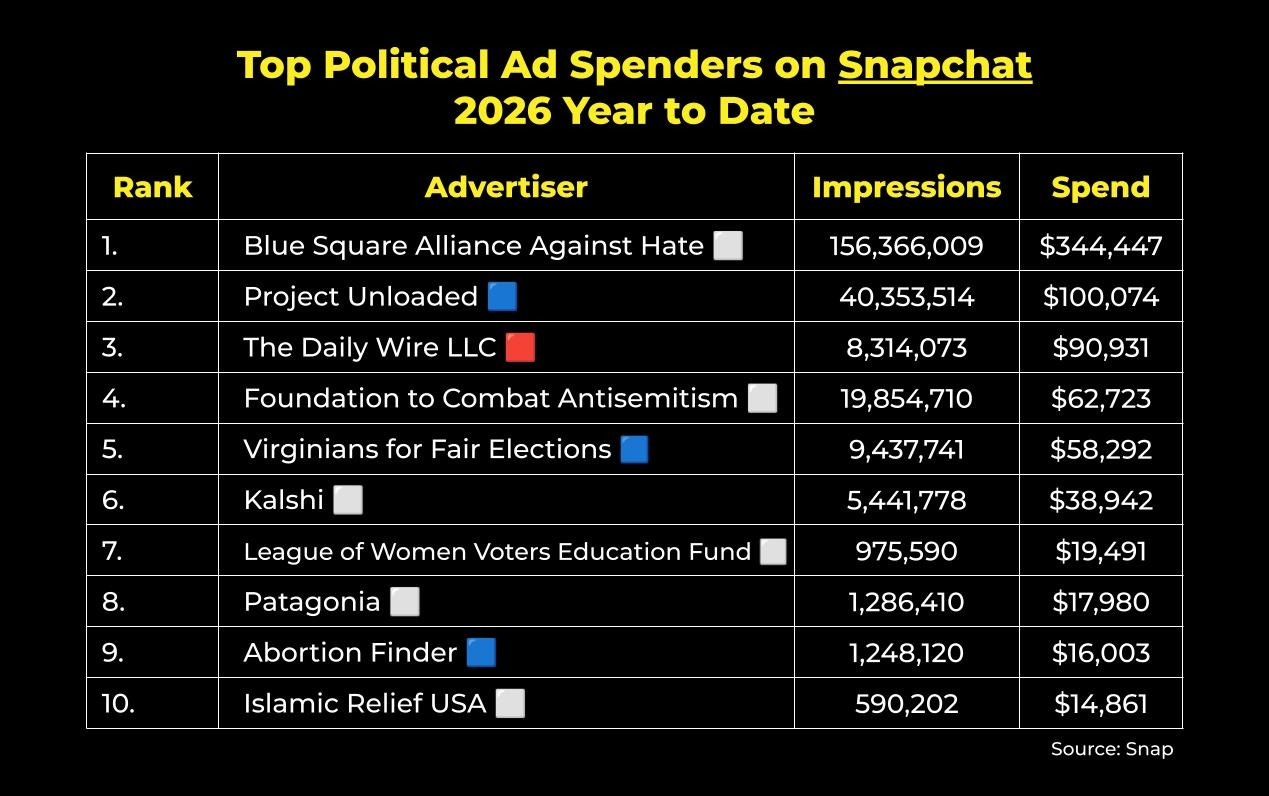
…and lastly, on Snapchat, political advertisers in the U.S. have spent just over $923,000 on ads in 2026. Here are the top spenders year to date:
Please take our money…
We’ve actually heard this before, and you’d say this too if you finally found an ethical list-growth platform that helped you turn $1 into $2 like clockwork. Join over 900 groups like Everytown, Amnesty International, and Mercy Corps that have found a better way to nail their fundraising goals. Learn more >

War, in 280 characters or less
The TV abruptly cuts to a breaking news broadcast, my confusion replacing the sitcom that had been playing moments before on my screen. It’s May 2011. I watch President Obama start the long procession to the podium. With each step, the immense gravity of whatever he’s about to say next becomes more apparent. He announces the operation that killed Osama Bin Laden. Quiet outside—then pandemonium.
I walk past the construction of the Oculus, a landmark that sparks flashbacks to the announcements that shaped my childhood as a New Yorker: 9/11, the endless stream of footage, President Bush declaring that we were going to war, and later, the fanfare of a warship banner prematurely declaring his “mission accomplished.” These moments formed my expectation that major military news would be delivered with gravity, in primetime addresses, press conferences, or sit-down interviews with journalists.
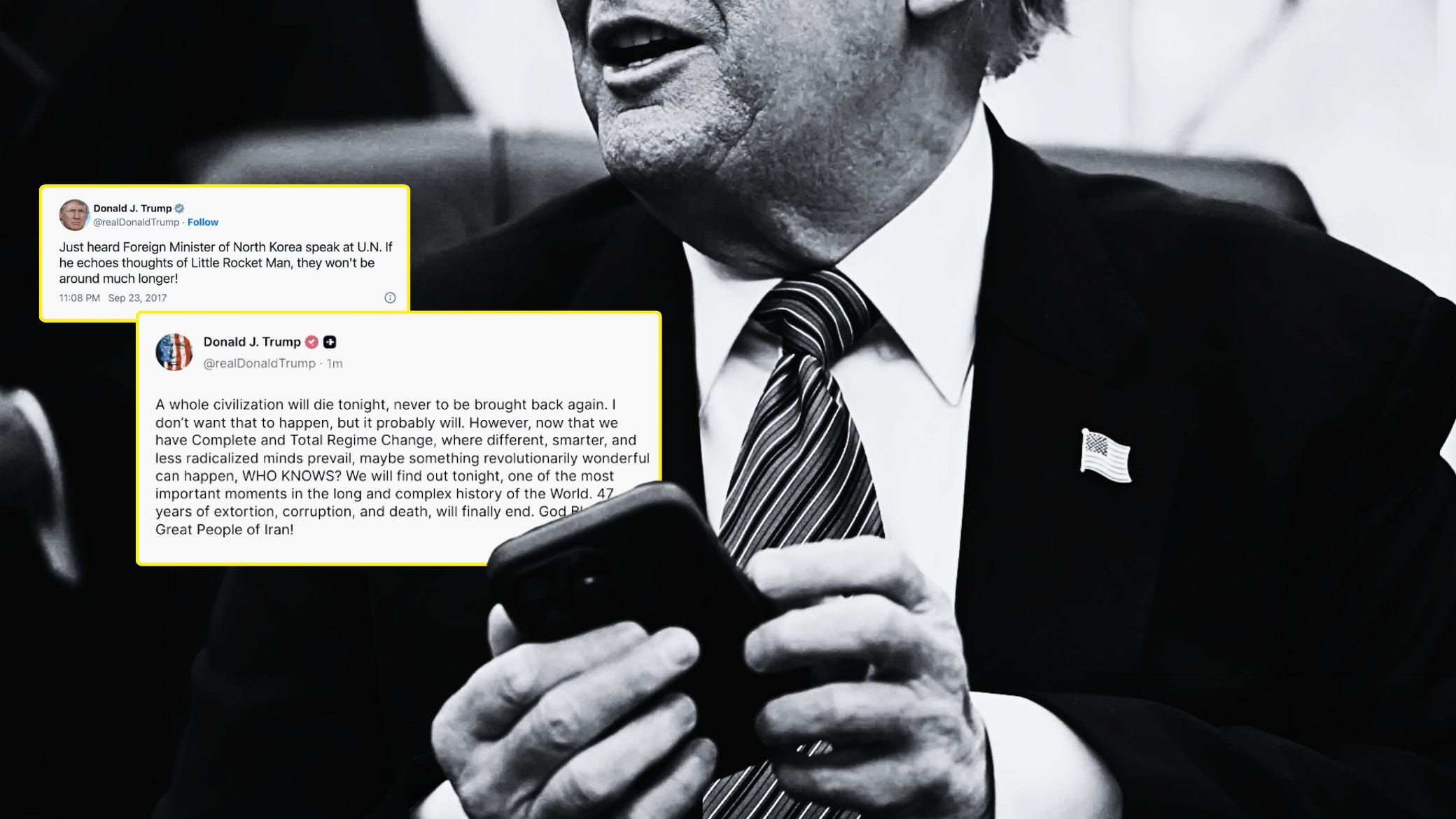
Cut to 2026, when that understanding came crashing down with a social post from the president stating he planned to “end a civilization” in under 1,000 characters. It wasn’t the first time a world leader (or Trump himself) had posted something like this, but it marked a clear shift in how conflict is communicated and what we have to do to respond to it.
We are faced with a bombardment of what one would consider important messages from Trump, but the sheer volume and speed dilutes their significance. And that’s not an accident – it’s tactical. What were once measured and carefully timed messages from leaders have been replaced with a constant stream of live updates that create confusion, weaken the military chain of communication, and increase the potential for escalation.
This shift isn’t trivial. It requires us to establish new rules on discretion, verification, and accountability, especially in moments when a single post can carry profound real-world consequences.
In the face of unprecedented distraction, we’ve become trained to match the pace of our feeds, leaving us to either speak without substance or excuse inaction. We need to resist both.
Social media has changed the way we view war, quite literally. I’ve watched daily, on-the-ground reporting from Gaza alongside “day in the life” videos from refugee camps. This unprecedented level of access is as transparent as it is jarring. The reality of war hasn’t changed, but our relationship to it has. We now witness it through posts, clips, livestreams, and TikTok updates.
These platforms can exacerbate harm, as seen in Myanmar, but they have also democratized and decentralized war narratives. Real-time documentation can hold governments accountable, connect people on the ground to life-saving information, and mobilize global attention, as seen in Sudan. In many ways, this exposure has humanized conflicts that once felt distant and abstract.
On the other hand, world leaders are on the same platforms, writing posts that are creating these life-altering impacts. Governments subtweet one another. We receive updates on military operations as we would a sports game.
As war is documented in real time, a strange duality unfolds. In the hands of the public, social media can enable accountability. In the hands of the people in power, it not only changes how conflicts are perceived, but how they unfold. The platforms allow people in power to bypass traditional channels—sidestepping diplomacy, evading accountability, and feeding into the contentification of war, where strategy and spectacle begin to blur.
The media was once a crucial intermediary in holding those in power accountable for the decisions they made and the impacts they had. Now, when I see the president post about war, my first instinct is to question whether it’s even real and then scramble to find confirmation.
Traditional media imposed structure. It validated information, asked follow-up questions, and shaped the stories that become history. That work hasn’t disappeared, but the administration is restricting their access. Instead, we’re in an era of live tweeting war.
In 2012, the Israel Defense Forces (IDF) became one of the first to effectively declare war via Twitter.
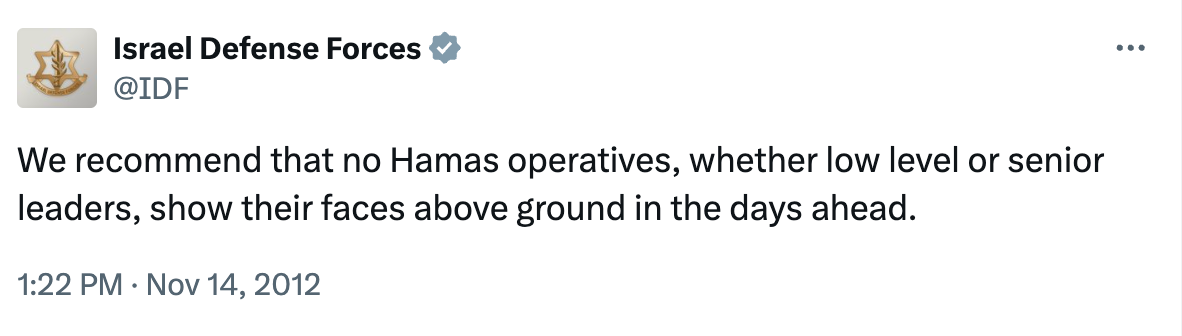
The tweet was followed by an airstrike—and then an hour later, a video of that strike posted with the caption, “In case you missed it.”
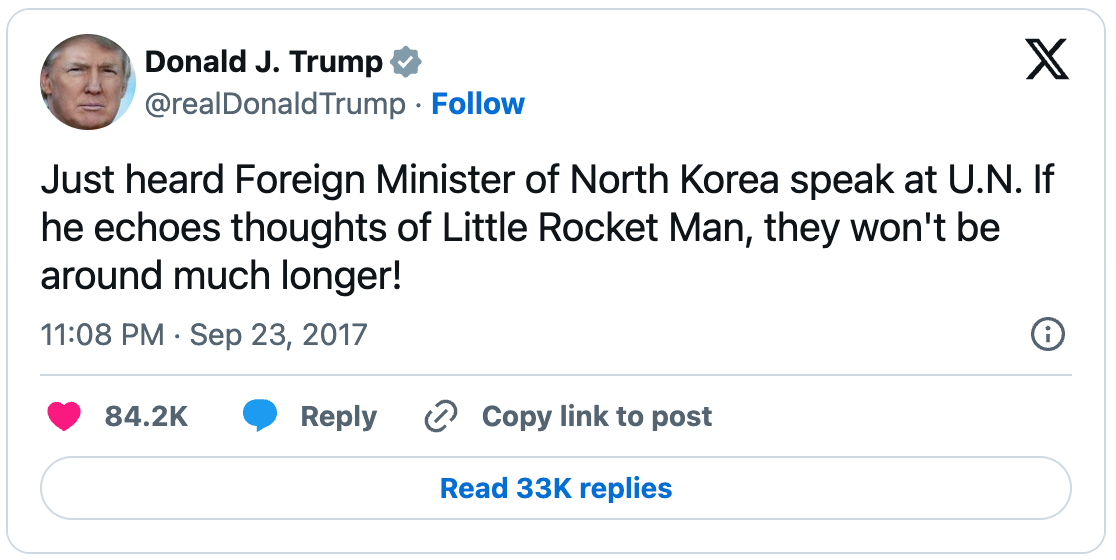
In 2017, Trump tweeted a threat toward North Korea that its leadership took as a declaration of war.
Today, it often feels as though discussions around decisions, tactics, and operations once confined to the Situation Room are being broadcast in real time. According to an analysis by the Wall Street Journal back in March, the president had posted over 90 times about the Iran war, accounting for roughly a quarter of his entire feed. He posts so rapidly and often that Press Secretary Karoline Leavitt has a monitor dedicated solely to tracking his feed in real time. Trump’s posts seem to trigger a scramble behind the scenes, as staff rush to catch up, contextualize, and update everyone from military officials to members of Congress. While there’s a lot of debate around how much transparency the public is owed, we can probably all agree that key decision-makers and those serving in the military need to be read in pretty early on to ensure our world order isn’t hinged on the whims of a man and his smartphone.
When the same tools used for awareness and accountability are also in the hands of the people directing military action, they can’t be wielded carelessly. Governments live-tweeting about war is engrossing, at best, and a major security risk, at worst. We can’t deny that these messages carry life-or-death consequences. On the other side of every air strike is a family, a home, a world destroyed.
Social media isn’t going anywhere, but treating war like “content” is a deeply unserious approach to the most serious matter there is. Decisions about whether we go to war or escalate it further should not be first announced—ironically— in a post on “Truth” Social.
The result is a public left unsure of what’s real, what matters, and what comes next. Yes, we may have gained access, but in doing so, we’ve lost structure, accountability, and, in some ways, the gravity these moments demand. We scramble to react, to be present in the ‘chat,’ but when interacting with the new updates it’s important to ask: are you adding substance or to the spectacle? Contextualizing is of equal or more importance to intellectualizing. There is always a need for dialogue, but not at the cost of responsibility.
The initial reaction is to scramble to respond, to ensure you acknowledge the moment, but words with no action ring hollow. Strongly worded posts have replaced substantive action. For Democratic leaders, it’s of course important to create a solid crisis comms plan and use discernment in responding. By the time you decide to message in opposition, you should be able to explain both your perspective and steps you will take to move forward – even if that action appears small to you.
We also need to stop normalizing this new reality we live in. At any other point in our history, if a president threatened to wipe out an entire civilization, it would have been a huge deal. Meanwhile, it’s been just ten days since Trump posted that horrific message on TruthSocial and we’ve already moved on. Part of being the opposition party is making sure the awful things this administration says and does remain in the public’s memory.
War used to arrive at a podium, with the world holding its breath. Now, we hold our breath waiting for the next announcement to show up on our feed, just like anything else we scroll past. And that’s exactly what they are hoping for.
Please take our money…
We’ve actually heard this before, and you’d say this too if you finally found an ethical list-growth platform that helped you turn $1 into $2 like clockwork. Join over 900 groups like Everytown, Amnesty International, and Mercy Corps that have found a better way to nail their fundraising goals. Learn more >

COURIER’s newly-launched Epstein investigation project
For too long, the Epstein Class has dealt in wealth, power, and politics to avoid accountability and deny victims & survivors their due justice. The public deserves the truth, but the Trump Administration is failing its legal obligation to deliver it.
That’s why we’re expanding our coverage to follow the money and investigate the power players in and outside the government. With a new database by Thorian AI, we have unprecedented access and ability to navigate more than 1.2M files and we’re sharing access—and what we’re finding—with you.
Subscribe to The Cover-Up and get one concise, easy-to-read email a week that cuts through the noise with the headlines you need and the breakdowns you want.
By staying plugged in and leveraging our reporting to make your own calls-to-action louder, together, we can turn information into justice.
That’s it for FWIW this week. This email was sent to 25,733 readers. If you enjoy reading this newsletter each week, would you mind sharing it on X/Twitter, Threads, or Bluesky? Have a tip, idea, or feedback? Reply directly to this email.
Support COURIER’s Journalism
With newsrooms in eleven states, COURIER is one of the fastest-growing, values-driven local news networks in the country.
We need support from folks like you who believe in our mission and support our unique journalism model. Thank you.

Such a good read!
Thank you for the article, Chanda. I feel this nation is definitely tired of the political climate in America. Money should be spent on the American people instead of all that junk advertising. Taxes are too high. Homeowner and car insurance is indeed along with healthcare insurance, seems like one big Ponzi scheme. Our state governments do their level best to cut out high costs of groceries. I live in a farming community, where 3 known suicides have been committed by farmers because of guaranteed money from government was allegedly stolen by the former secretary of Homeland Security, and her own alleged boyfriend. This government is trillions dollars in debt. No cabinet allegedly paid by the American people and these taxpayers have indeed put the money in their pockets and laugh at the American people who have suffered their through these hard times. If you like good journalists and columnists please subscribe to FWIW.