


SPONSORED BY STACKADAPT
Hi everyone! I’m Alison Rice—many people call me Ali. I’m a campaigner, partnerships builder and organizer with a background in multi-issue advocacy and paid media. I run Design It For Us, a new(ish) organization that leverages youth grassroots power and policy chops to disrupt Big Tech’s status quo. I come to your inbox with experience at The Hub Project, Accountable Tech and EMILY’s List’s IE, WOMEN VOTE!, among other gigs.
Like many readers of this newsletter, my work would not be possible without connective media products–full stop. Social media is our most critical organizing tool, and online platforms are our trusty vehicles for reaching key audiences. But we need to be real with ourselves: the honeymoon phase of digital and new media ended years ago. Expanding surveillance and increasing corporate consolidation of platform ownership have exacerbated a vast power imbalance that digital practitioners, strategists and users should take seriously.
Hold that thought as you read this week’s spending…
Digital ad spending, by the numbers:
FWIW, U.S. political advertisers spent about $14.8 million on Facebook and Instagram ads last week. Here were the top ten spenders nationwide:
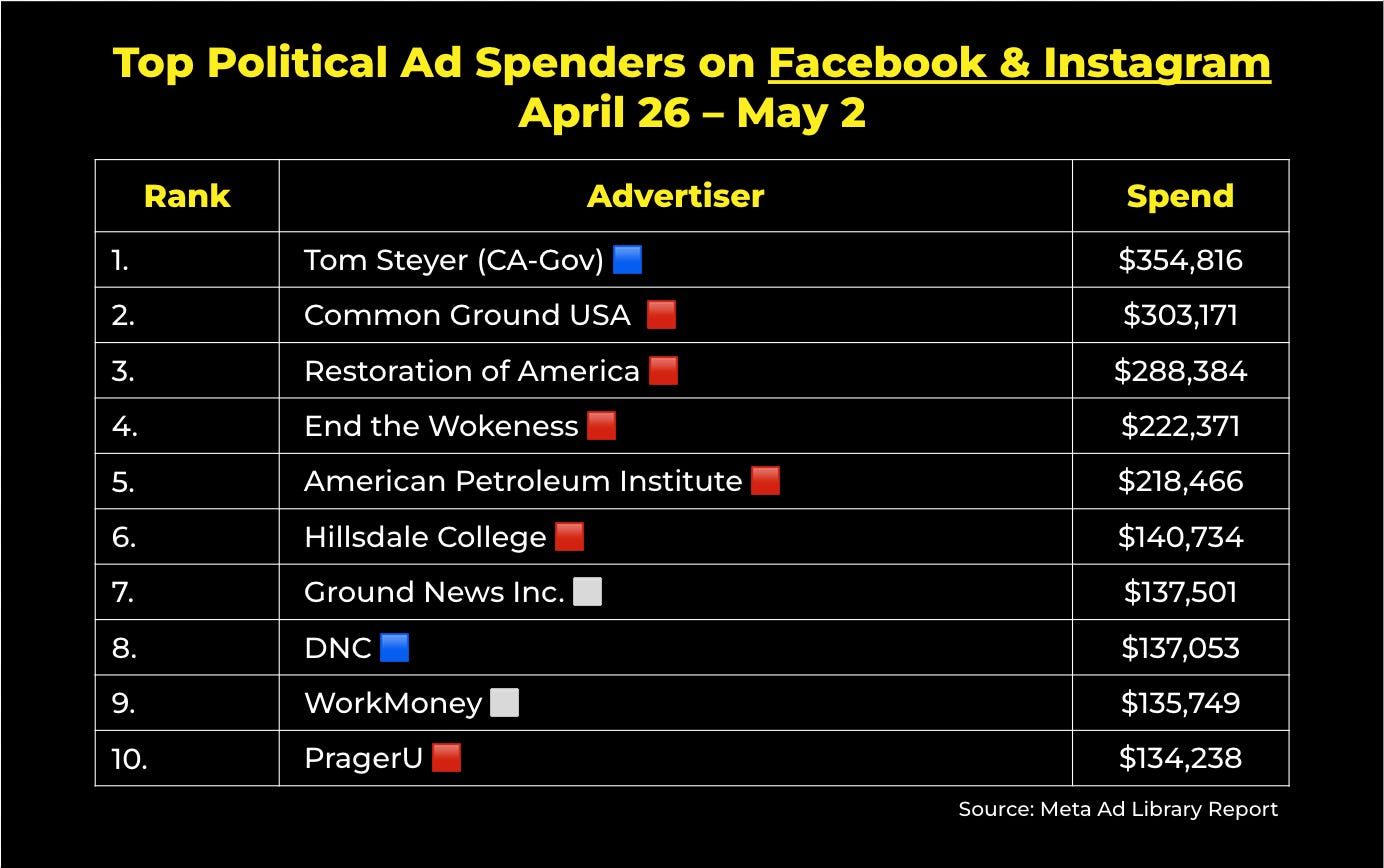
The conservative advocacy group Restoration of America dropped ~$288,000 this past week on Facebook and Instagram ads targeting key states like Georgia, Michigan, Arizona, and Pennsylvania that feature “explainer” videos that address things like how the word “diversity” has been hijacked by the Left and how there’s no such thing as “your truth.”
Meanwhile, political advertisers spent nearly $11.8 million on Google and YouTube ads last week. These were the top ten spenders nationwide:
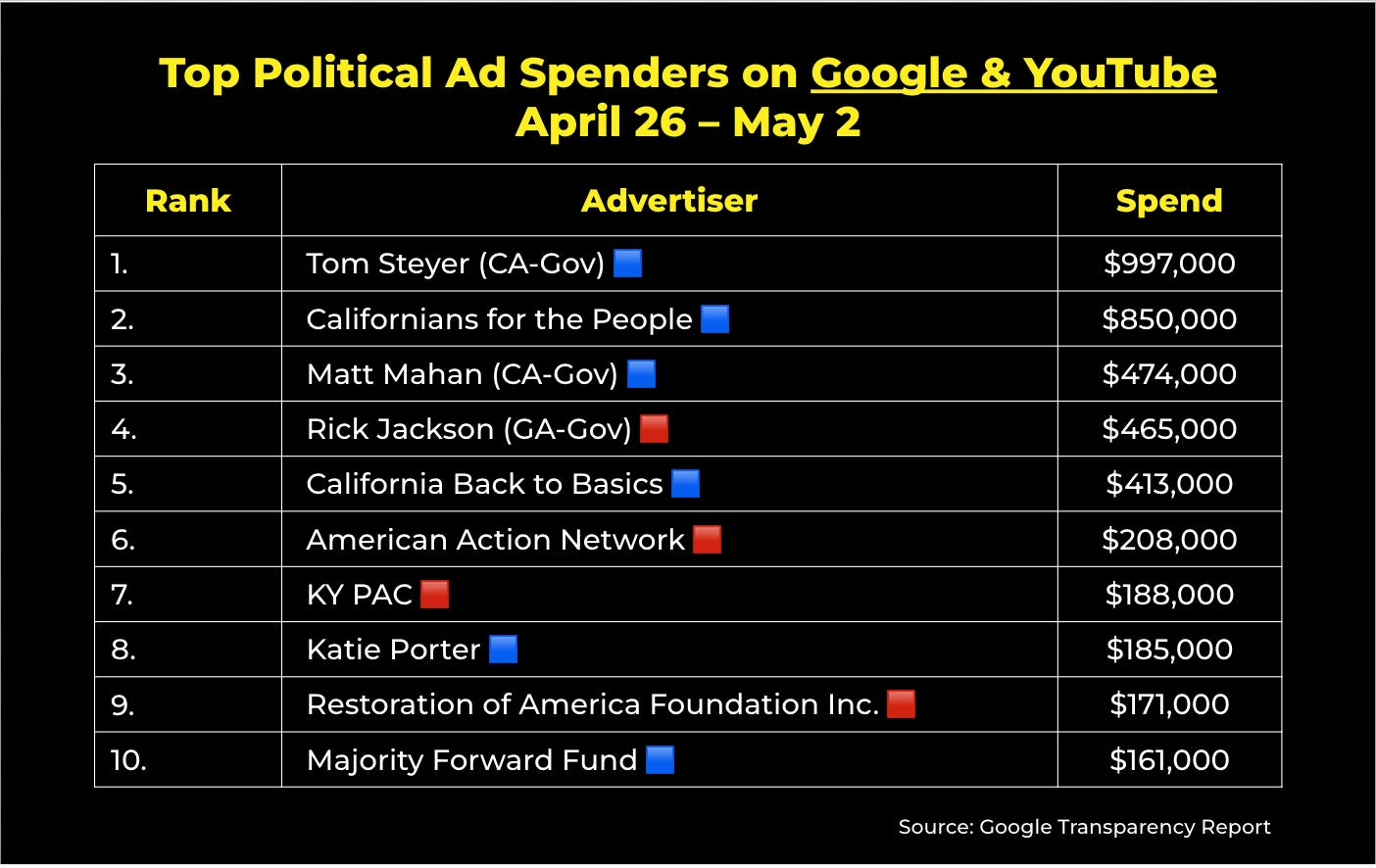
The California governor’s race, which has its jungle primary on June 2nd, is heating up on Google & YouTube, accounting for 6 of the top 10 spots. Tom Steyer leads the group with a whopping nearly $1 million spend, but is closely followed by anti-Steyer PAC Californians for the People and their $850,000 spend last week.
On X (formerly Twitter), political advertisers in the U.S. have spent around $1.8 million on ads in 2025. According to X’s political ad disclosure, here are the top spenders year to date:
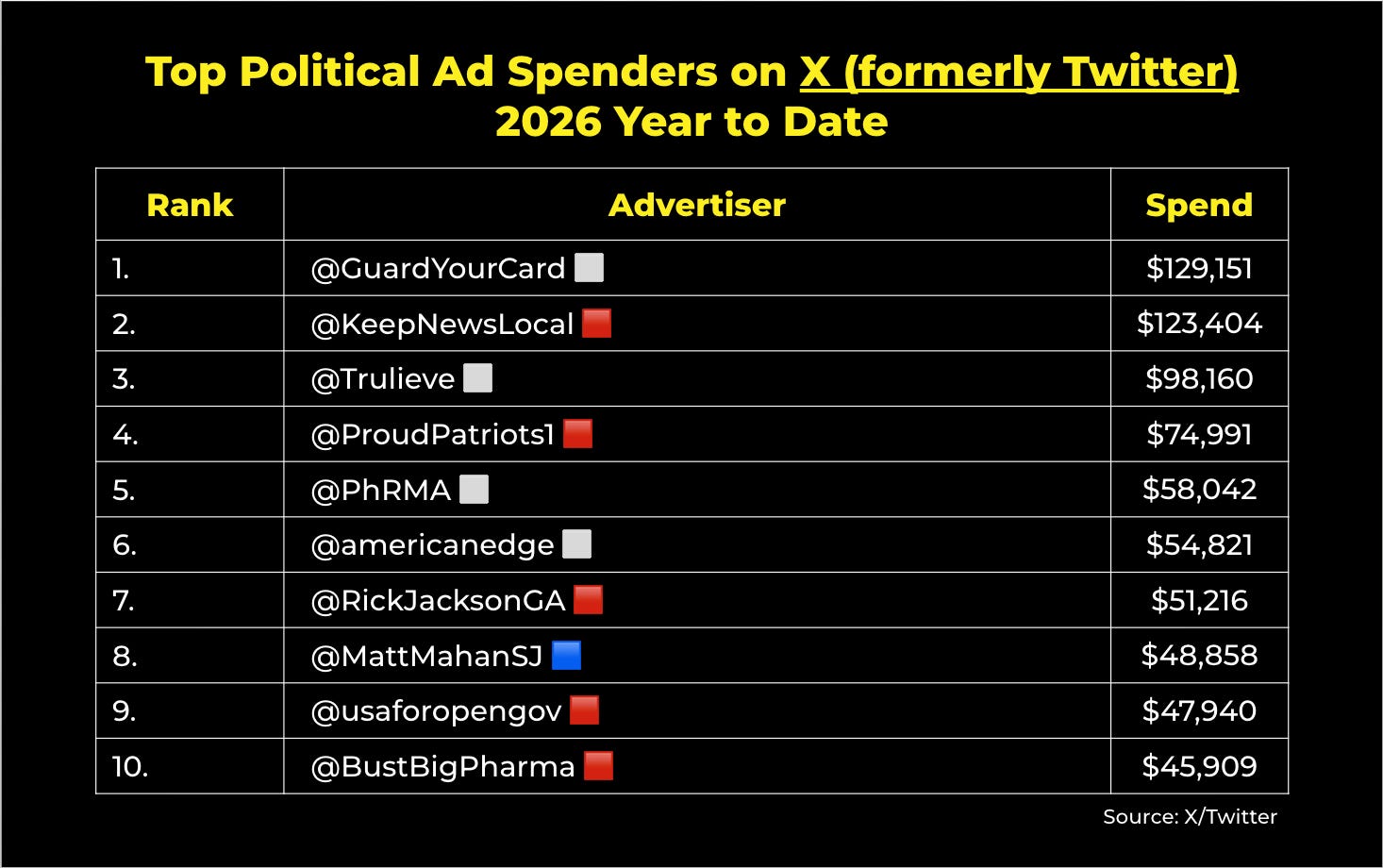
It appears that the only new purchases of X/Twitter political ads in the last 6 weeks (so not accounting for older ads that are still running) have come from this random AI building consultant service called Politech AI.
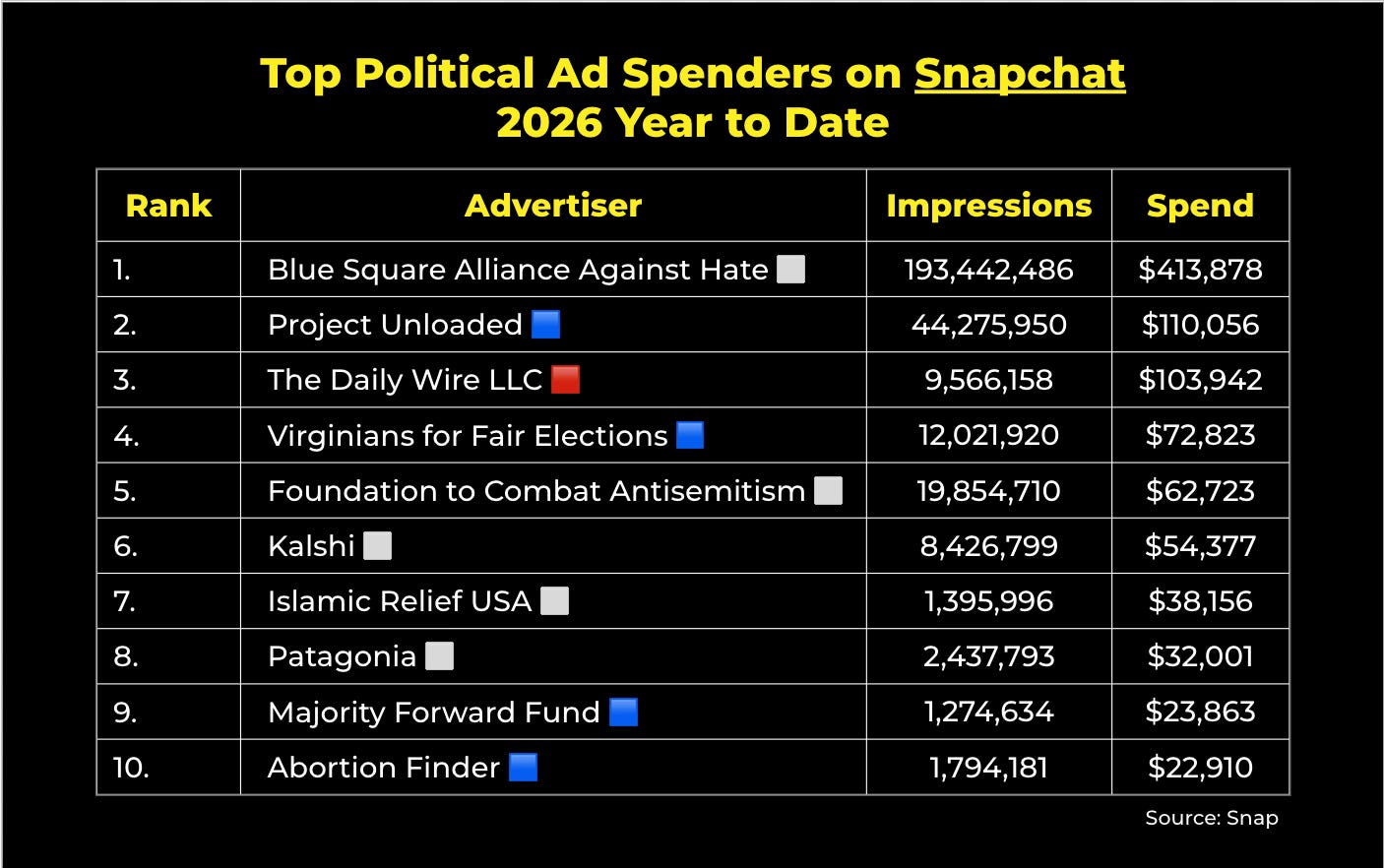
…and lastly, on Snapchat, political advertisers in the U.S. have spent around $1.1 million on ads in 2025. Here are the top spenders year to date:
The next growth channel in political advertising isn’t paid social or online video…
CTV is reshaping how political campaigns reach voters—combining the scale of TV with the precision of digital. Extend reach beyond saturated channels and connect with the right audiences faster. Learn more >

Using digital platforms, from someone who wants to hold them accountable
It’s no secret that tech and the internet have completely transformed our information ecosystems. The “Facebook Election” of 2008 changed the nature of campaigning and social media gave us moments like “We did it, Joe” in COVID-era America. But considering all things viral-Von Dutch-brat-coconut tree, online engagement now relies almost solely on quick touchpoints like likes and retweets, and far less on the 1:1 exchanges that actually drive real-world action, like in 2008. We’re more connected than ever before, but attention alone has become the dominant—and often only—currency that matters.
Social media is not going away, nor should it, but we can’t feign innocence about how it works. Big Tech companies make deliberate choices that shape our spheres of influence as much as a trending song does. Platforms optimize for eyeballs that lead to revenue, reducing the reach of posts that contain external links and throttling accounts to encourage ad buying. Strategists have had to adjust to those policies and creators have been forced to adapt to shadow banning. The lack of accountability structures has enabled tech companies to make decisions solely in their own interest, building the infrastructure we use every day on their terms, while users shoulder the downstream effects.
Employees have raised alarms about some of the worst of these choices. Former Facebook product manager Frances Haugen was the first major social media whistleblower to disclose internal documents to Congress and the SEC in 2021, exposing, among other issues, a consistent pattern of mental health harm that Facebook executives knew about and doubled down on. Another former Meta employee-turned-whistleblower, Arturo Béjar, detailed the absence of reporting mechanisms for harassment—concerns that were ignored or outright rejected by senior leadership.
Rather than responding to clear patterns of harm across their platforms, the largest and richest companies are leaning in. In a landmark case led by New Mexico Attorney General Raúl Torrez, a jury in late March found Meta liable for violating the state’s Unfair Practices Act, fining the company $375 million. Rather than comply, Meta plans to appeal the ruling and has threatened to remove access to its platform for users in New Mexico entirely.
Their response is presumably less about the fine—though among the largest in civil action outcomes against the $214.96B company—and more about the prospect of having less control over user data through targeted advertising and surveillance-driven product design. Compliance would prohibit the use of minors’ data to personalize recommendations and require a product redesign that prioritizes integrity over engagement.
Digital practitioners often rely on the same currencies as companies like Meta, TikTok and Snap. We use demographic data to target audiences, curate experiences, and craft messages based on what testing shows is most compelling for each group. These institutional engagement tactics rely on a thriving attention economy, which treats human focus as a scarce commodity and a carrot-and-stick of our democratic infrastructure.
We should recognize that the attention economy is a lever of control for media companies as much as it is for political operators, and that’s by design. Without capturing attention, we lose—yet capturing it drives up platform revenue and reinforces data surveillance. And when only a handful of companies maintain control over a large majority of our information ecosystem, there’s no incentive to change what’s already working for them. Right now, they are the only winners.
That means it’s on us to reframe our approach to using online platforms. These companies have proven to be unaccountable and will not self-regulate. Until there are product-level accountability measures and pro-competition requirements, we carry the burden of helping shape more democratized, just, safe and private online spaces.
Digital practitioners are uniquely positioned to help disrupt Big Tech while still organizing users who depend on their channels to see our messages.
Pay creators instead of Facebook ads. As Social Currant’s Ashwath Narayanan explained in a recent issue of FWIW, users often develop parasocial relationships with creators, resulting in high levels of earned trust and credibility that no ad can replicate. With trust in national news organizations hitting record lows, investing in these influential messengers allows us to meaningfully reach audiences without contributing to Meta’s bottom line.
Diversify the tools you use for online engagement. Proactively invest in alternative online spaces that are not predicated on data exploitation to deliver revenue. Design It For Us recently launched a campaign called the Innovator Circle to support human-centered competitors that challenge Big Tech’s dominance. It centers the notion that safety, privacy, and human well-being are not tradeoffs; they’re good business. Its inaugural members include Blacksky, Newsreel, Sparkable, The Nudge and Tribela, which are just a few among hundreds of new platforms that are bucking the status quo of Big Tech’s business model. Consider building an audience on their platforms—not only do they align with better values, you might also find that they produce stronger engagement outcomes and yield a better ROI than traditional channels.
Take better care of data—yours and your audiences’. The largest social platforms need our data to operationalize their business models, often partnering with agencies and organizations that weaponize that information. They use information about us to push targeted advertising and recommend content that incentivizes us to spend more time on their platforms, increasing the likelihood that we see ads and convert.
Avoid leveraging transactional mechanisms, like list buying and selling, that treat humans as products to wheel and deal and increase risks of scams or unwanted third-party exposure. Instead, meet people where they are through organic partnerships and creator collaboration.
Emphasize transparency, use privacy-preserving defaults—including opt-ins (not opt-outs)—and consider collecting very minimal data through any social mobilization tools. Make sure you are overly transparent about what you are tracking and what it will be used for.
We won’t win by trying to restore our information economy to what it once was or by investing all of our resources into chasing the highs of simple virality. Tech companies are laser-focused on controlling the attention economy and our relationship with them is only one-sided if we fall in line with how they do business. The long game here is to reclaim some control over what platforms value: our online relationships, our trust in information sources, and our data. When we do that, the ball is back in our court.
If any of this resonated with you, feel free to reach out to me at alison@designitforus.org! I’d be glad to scheme together.
The next growth channel in political advertising isn’t paid social or online video…
CTV is reshaping how political campaigns reach voters—combining the scale of TV with the precision of digital. Extend reach beyond saturated channels and connect with the right audiences faster. Learn more >

Join COURIER and 3.14 Action on June 11 for Facts vs. Fiction: The Fight for Science in American Democracy.
Misinformation isn’t just noise. It’s shaping policy decisions that impact healthcare costs, public health, and everyone’s lives. This live conversation will examine what’s at stake when facts are ignored and what changes when experts lead with evidence. From lowering costs to protecting access to care, we will break down how science-driven leadership delivers real results and why scientific integrity is essential to democracy.
Hear directly from:
Senator John Hickenlooper, Former Governor of Colorado
Dr. Vin Gupta, Physician + Medical Analyst
Representative Emily Gregory, Florida House of Representatives (HD-87)
Dr. Paul A. Offit, Director, Vaccine Education Center, Children’s Hospital of Philadelphia
Shaughnessy Naughton, 314 Action President
Stay tuned for more speaker announcements, and don’t miss this conversation. RSVP today!
That’s it for FWIW this week. This email was sent to 25,814 readers. If you enjoy reading this newsletter each week, would you mind sharing it on X/Twitter, Threads, or Bluesky? Have a tip, idea, or feedback? Reply directly to this email.
