


Hi! It’s me again–Gabriella Zutrau, Digital Strategy Advisor to campaigns and organizations, and part-time dogfluencer. Whether you know me as “Zohran’s social media chatbot architect,” or “the diarrhea parasite girl” really depends on which of my previous FWIW issues you’ve read. My agency, Weird LLC, helps leftists and progressives reach more people online, build trust with their audiences, and mobilize supporters to action. But it’s also totally possible you know me from my work pretending to be a dog on the internet all day on my Edna the Runt accounts, which I use as a lab to experiment with new tools and tactics before trying them with my clients.
In today’s issue, we’re talking about what worked online during the midterms, how social media best practices have changed in the year since Zohran Mamdani’s win, and what we can expect as we head towards 2028.
More on that below, but first…
Digital ad spending, by the numbers:
It was a long cycle full of twists and turns, and we tracked digital spending all the way through. So today, we’ll be taking a longer view of the cycle and digging into some of the broader trends that we saw on the way to Election Day.
FWIW, U.S. political advertisers spent around $344 million on Facebook and Instagram ads from August 1 through Election Day. Here were the top ten spenders nationwide:
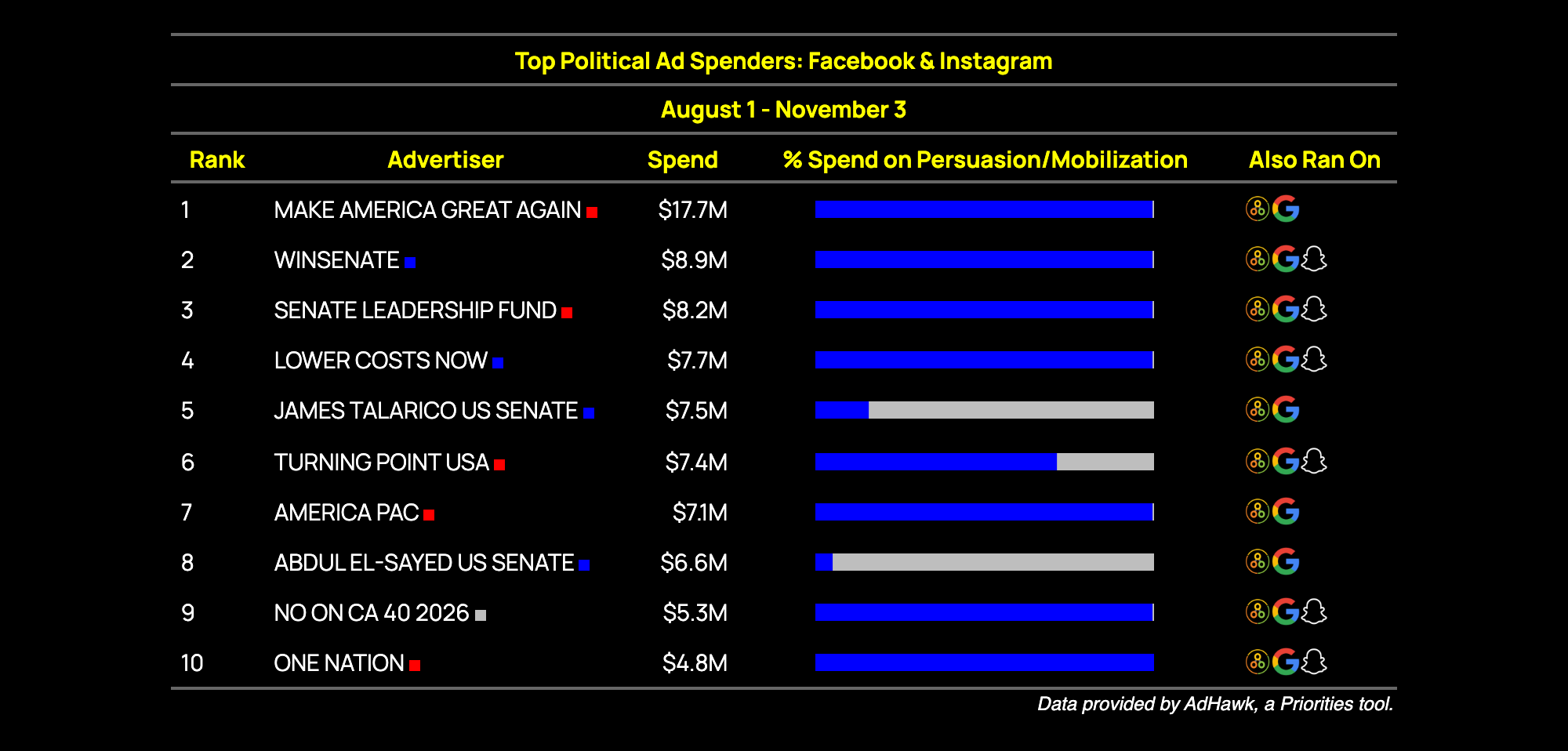
It’s telling that an effort to defeat a ballot initiative landing in the top ten doesn’t surprise us anymore, even when the fight is as big as Prop 40.
Prop 40 had unique dynamics: Governor Gavin Newsom opposed it, Big Tech spent almost as much as Elon did this entire cycle to shut it down, and other propositions muddied the waters. Despite its prominence, Prop 40 was just one example of a broader shift we’ve seen in paid media towards ballot initiative spending.
In the last three months of the 2024 cycle, ballot initiatives accounted for 4.6% of all digital spending, just over $50 million. Over the same period in 2026, that figure almost doubled to $94 million, accounting for 7.2% of all digital spending.
We’ve seen spending increase down-ballot into local races, as well. Stay tuned for more coverage on how paid digital has become a larger part of candidate budgets, even in races as far down the ballot as sheriff and school board.
Meanwhile, political advertisers spent around $779 million on Google and YouTube ads from August 1 through Election Day. These were the top ten spenders nationwide:
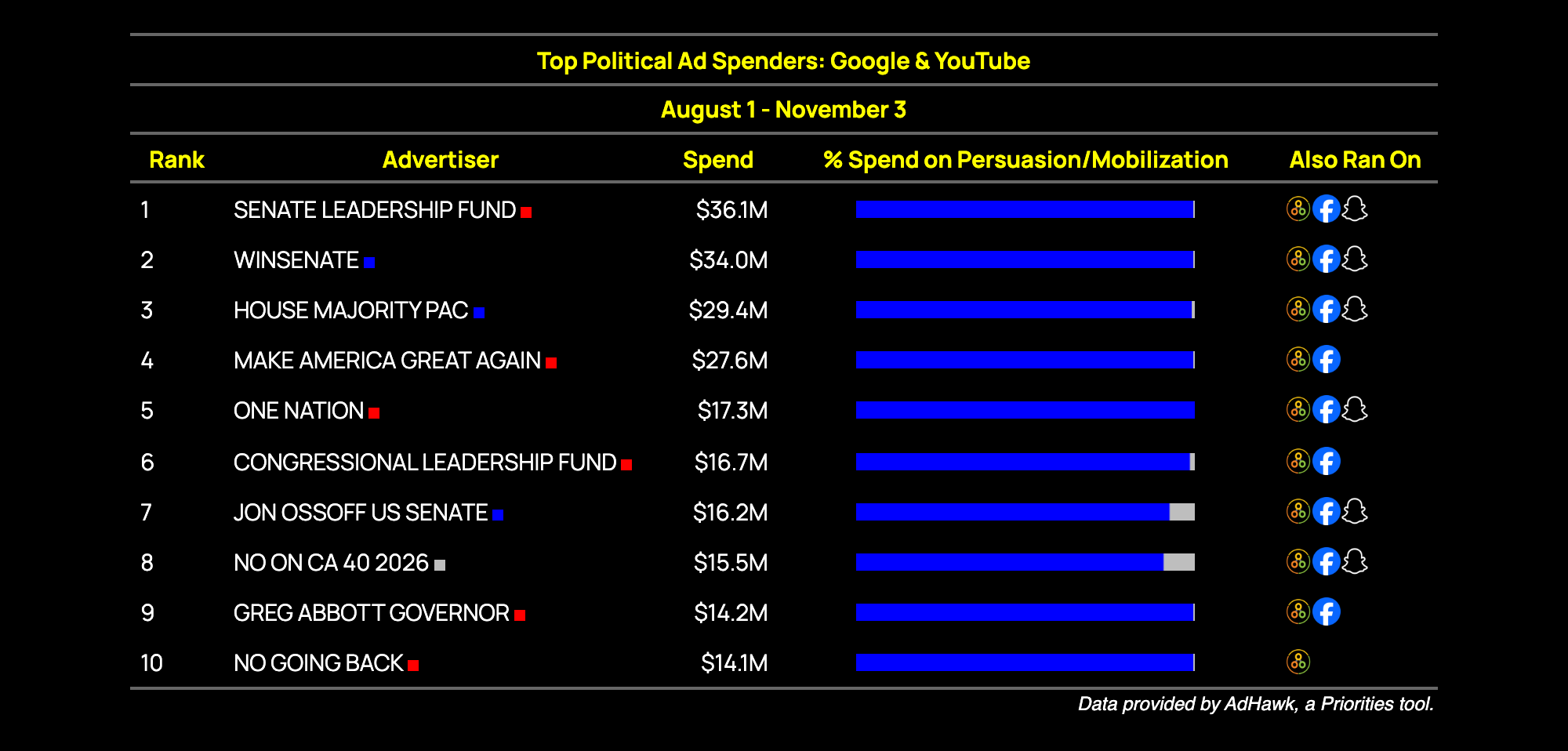
It’s no secret that the GOP transferred tens of millions of dollars out of what were previously considered competitive states, like Georgia and North Carolina, to defend emerging Senate battlegrounds in South Carolina, Mississippi, and Kansas. What you may not be aware of is just how quickly that flip-flop happened:
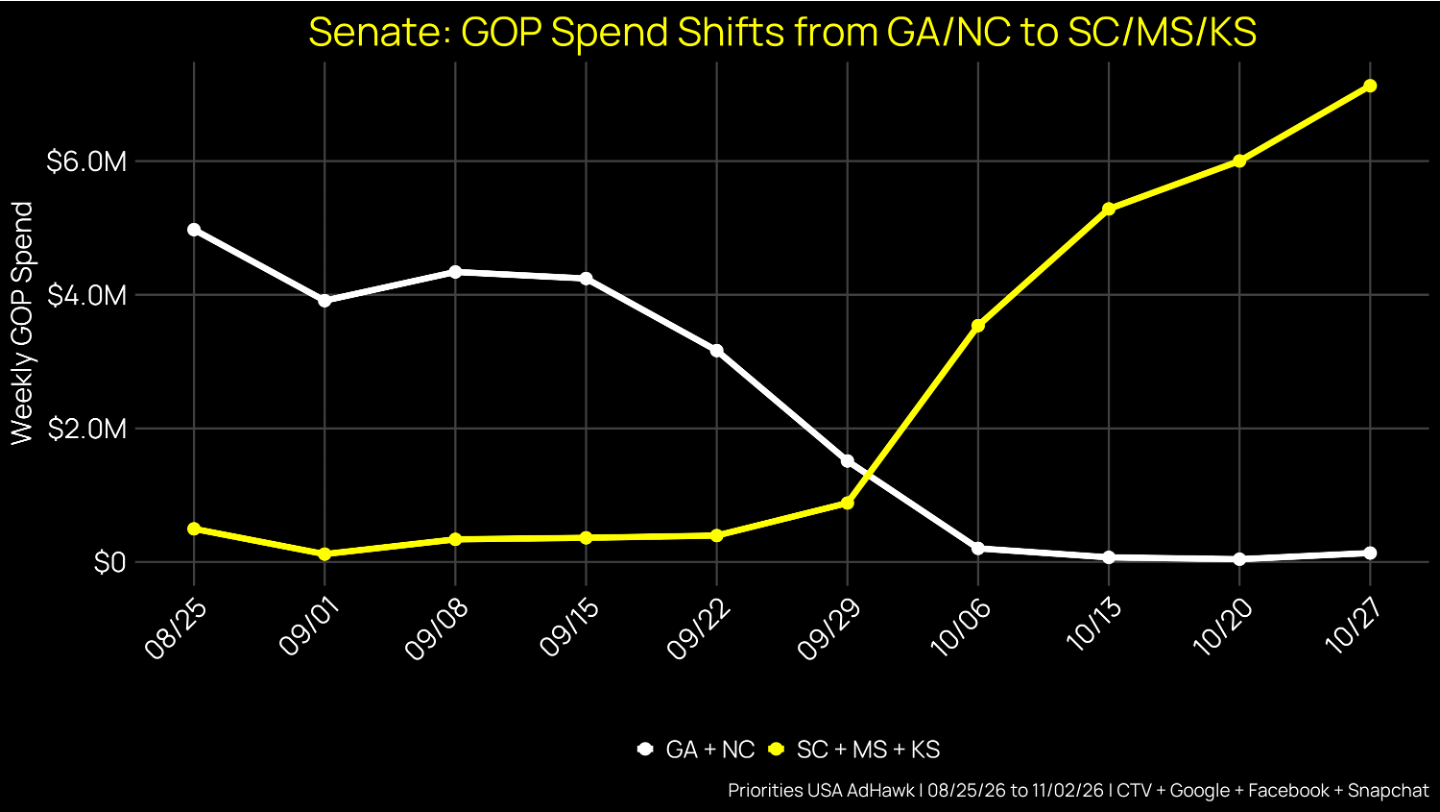
It took very little time to move from polling worries to internal panic to substantial spending transfers. By October, the GOP’s biggest outside spenders were all but silent in what were once thought to be two of the cycle’s most competitive races.
On CTV platforms, U.S. political advertisers spent an estimated $1.4 billion from August 1 through Election Day. Here were the top ten spenders nationwide:
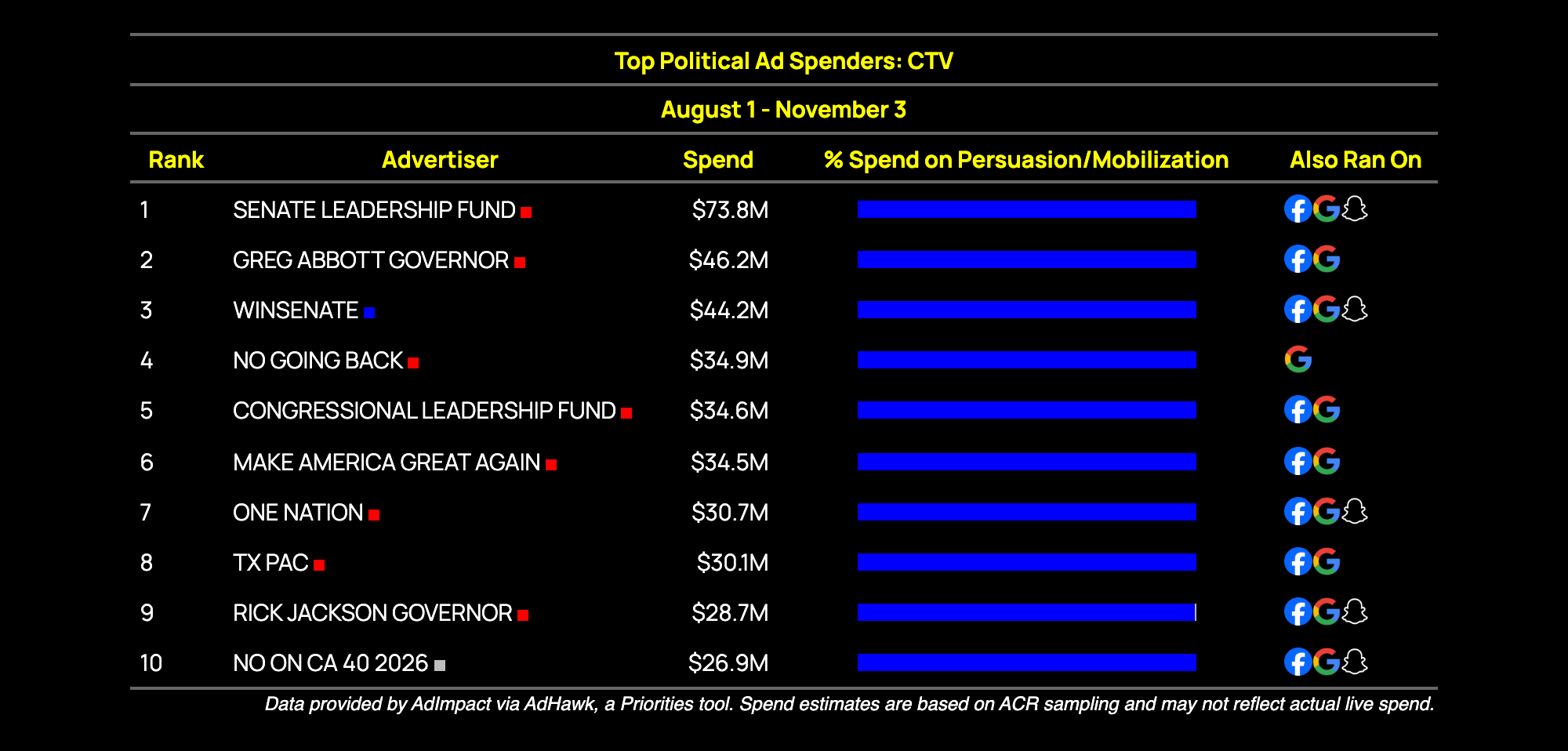
It might be trite to say everything’s bigger in Texas, but we can’t help that it’s the truth. In the last three months, Republicans spent more than $310 million in the Lone Star state on digital alone: $175 million on the Senate race, $39 million on House races, $71 million on the governor’s race, and $31 million everywhere else.
Despite the huge gap between Senate spending and every other contest, incumbent Governor Greg Abbott was the largest spender on digital. He outspent MAGA Inc., the second-largest spender, $61 million to $48 million. Seven of the top ten spenders focused on the Senate race; the only exceptions were Abbott, his opponent (now Governor-elect Gina Hinojosa), and House Majority PAC (D).
We’re sure plenty of folks are happy to put this cycle’s ads behind them, but we’d be remiss if we didn’t highlight the top spending Google spot in the Texas Senate race, run by—you guessed it—MAGA Inc.
…And lastly, on Snapchat, U.S. political advertisers spent an estimated $12 million from August 1 through Election Day. See the top ten spenders nationwide below:
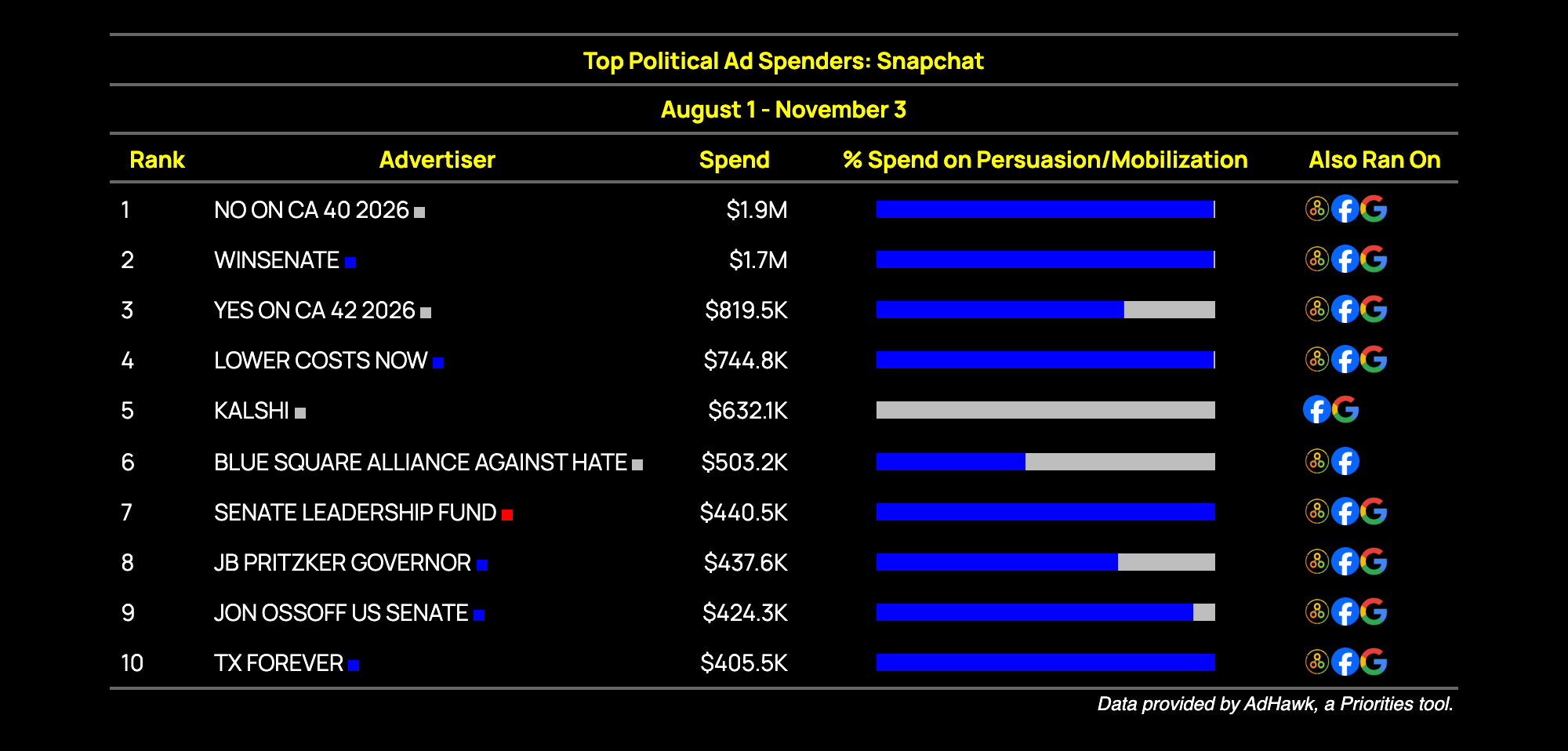
Snapchat is an underutilized platform, as we’ve mentioned before (according to Priorities’ recent polling, 65% of voters ages 18-24 use Snapchat at least weekly) and that case has never been stronger. Similar to other digital platforms, Republicans hit a new peak on their share of voice on Snapchat.
While Republicans haven’t made the platform a substantially larger part of their overall messaging strategy, Democratic pullback has left the platform increasingly vulnerable to a consistent Republican budget. Democrats spent less on Snapchat in 2026 than they did in the last midterm, and as a result accounted for only 54% of spending on the platform, down from 94% in 2022.
Republicans, meanwhile, increased their share from 0.7% in 2022 to 10% in 2026. While this swing isn’t anywhere near as large as the parity they’ve established on other digital platforms, it’s telling that the GOP have maintained their presence on Snapchat while Democrats have done the opposite.
Trustmaxxing and FOMO Machines: How does social media work a year after Zohran’s win?
On November 4th, I woke up to this text from my ex-boyfriend.

So it’s pretty safe to say I won the midterms.
But it’s a stretch to say that I was “ahead of the curve” on a candidate who already had over a million Instagram followers a year ago. What prompted his text was a conversation we’d had in mid-2025 about who could run for president in 2028. I made my case for AOC, as I’m liable to do. I also told him that I thought Talarico could win his senate race, and that even if he didn’t, he’d no doubt run for president one day because he was an undeniable generational talent. My ex hadn’t heard of him.
But Talarico has more than talent. Like Mamdani and so many campaigns that blew us away this year, his team treated social media as a long-term brand play, investing seriously in organic content long before campaigns would’ve in the past. That runway gave them room to experiment and build durable trust and name recognition over time.
So, what did taking social media seriously look like this cycle?
There’s the obvious: in 2026, campaigns held themselves to a much higher standard when it came to the quality of their content because they understood that most Americans get news from social media.
(While this is not a deep dive on social content and editing best practices, if you’re looking for actionable tips in that arena, follow my digital strategy Instagram @extremelyonlinefriend, subscribe to my email list, or follow me on LinkedIn.)
We all saw the content that went viral. Then there were all the tactics behind those viral moments.
Social Chatbots
2026 was a big year for automating the drudge work of answering DMs and funneling social followers onto owned lists. After I published how we used ManyChat to cheaply send over 144,000 automated messages and drive more than 45,000 clicks on the Mamdani campaign, I spent this year advising dozens of campaigns and organizations and training thousands of people around the world on social chatbots.
ManyChat was a common thread across the campaigns of James Talarico, Abdul El-Sayed, Angie Nixon, Melat Kiros, Ayanna Pressley, Claire Valdez, and Nithya Raman, to name a few. We also saw adoption of chat automation tools like Amplify.ai’s Oak and Meta’s new crude-but-functional native DM bot. Every reply is a small act of showing up, turning anonymous followers into relationships you own.
Paid Clipping
This election cycle also marked a turning point for a tactic we finally started borrowing from the far right: paid clipping.
“Clipping” is simply the act of cutting shorter segments from longer video footage to highlight a particular zingy moment in a stream or other longform content. It’s a common approach to content—one that helped James Talarico’s accounts blow up quickly.
But paid clipping is the act of paying per view for the distribution of clips and custom content through non-owned channels, like meme pages and shitposting Twitter accounts. Popularized by unequivocally bad people like Clavicular, it was a tactic that progressives and left-leaning entities steered clear of for years, much to our detriment. I was glad to see our side finally take big swings with it.
According to Ari Salzberg, founder of Politiclip, campaigns and organizations shelled out on clipping campaigns. Across Politiclip’s client roster, which included the likes of Abdul El-Sayed, Gina Hinojosa, and Nithya Raman, their paid clipping content averaged a formidable 7.2% engagement rate (anything above 4% is impressive).
Creator Engagement
Creators spend years earning their audiences’ trust. Engage them well, and they’ll extend some of that trust to you.
As a content creator myself, and as a vendor who builds creator engagement programs for clients, this year felt like the first time the progressive creator ecosystem was actually treated like an ecosystem. We’re still nowhere near the scale at which the right engages its creators and new media, but 2026 was a vast improvement over 2024.
Engaging creators well means making the relationship valuable to them, not extractive. A few ways to do that:
Pay them. Sponsored content buys some editorial control.
Give them exclusive access to opportunities like face time with your candidate.
Provide resources, like filming sets, or (as the DNC did for its 700-member creator group chat), a library of fresh ready-to-share clips of compelling candidate moments or oppo.
Some teams went further, with alternative models and hybrid-style programs. Emilia Rowland, while leading creator engagement for the Mamdani campaign and now his administration, truly set a new precedent for engaging creators as professional media makers and trusted messengers.
In Alaska, Shayne Nuesca, Digital Director at Alaska’s 907 Initiative, ran a Dan Sullivan accountability campaign that put creators on retainer while giving them creative control over most of their content.
MoveOn’s Evelyn Wilroy and Jordan Uhl ran creator houses in Michigan and Texas, which helped creators build a social fabric among themselves and gave them opportunities to meet candidates and collaborate on content.
The FOMO machine
Each of these tactics builds trust and recognition on its own, but the campaigns that won big put them to work inside a bigger loop, something I call the FOMO Machine.
The FOMO Machine is the process by which we plan moments optimized for content capture, capture the footage live, turn it into a slow drip of scheduled content that creates a fear of missing out (FOMO), and then invite our audiences to participate in the next event or moment. Each time around, the crowd gets bigger and the party gets harder to skip.
I watched this work up close on the Mamdani campaign: every IRL event was bigger than the last, and each one produced the addictive visuals and inspiring moments that pulled even more people to the next one. With the rise of AI slop, social media users need proof of real effort and real life in their feeds.
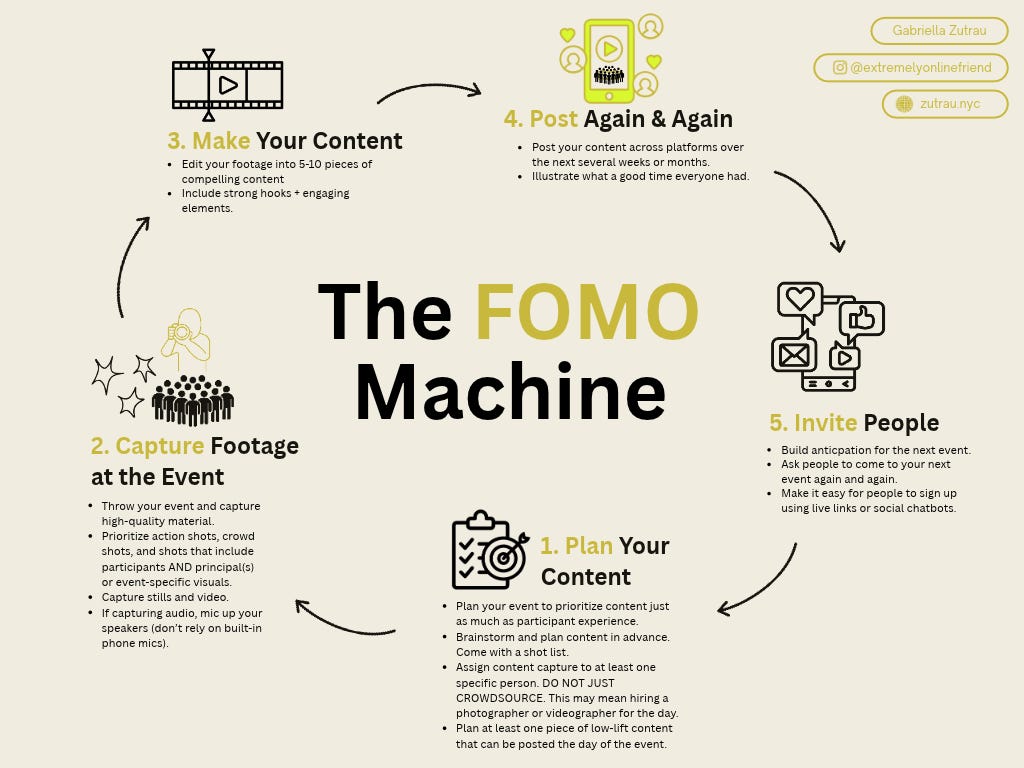
This is how you erase the line between online and IRL. We see it in the content-heavy way Mamdani is governing, and in the way our organizations are hiring—the Working Families Party is gearing up to invest in more original content creation for social and digital in 2027, as are many other political organizations I’ve spoken with.
Natalie Scavuzzo is the Executive Director of DigiDems, the program that trains up digital staffers and deploys them to competitive congressional races across the country. From her unique vantage point, the appetite among congressional campaigns to invest in organic social media is “unprecedented” and will only continue to grow.
Trustmax or Die
The old consultant playbook says “raise as much money as possible because money buys ads, and ads win elections,” but this past year showed that there’s one thing more important than the funds you raise: the trust you build.
Every election cycle, we watch billions get burned on advertising, buying a kind of rented attention that disappears when the money’s gone. Republicans and their allies deeply outspent us in nearly every key race this year, and they still had their asses handed to them. We outspent the GOP in 2024, and we lost badly. And let’s have a moment of silence for the tens of millions spent on pro-Cuomo ads in the NYC mayoral last year.
As we look ahead to 2028, it’s time to question the conventional wisdom that says to throw money at October ad blitzes instead of investing early in the tactics that build trust. Trust is a currency that accrues over time by showing up in people’s lives again and again with conviction and consistency.
What would campaigning look like if we prioritized building trust above all else? Candidates who fail to build trust over time may disqualify themselves from candidacy in the social media age. And that’s a good thing.
That’s it for FWIW this week. This email was sent to 25,790 readers. If you enjoy reading this newsletter each week, would you mind sharing it on X/Twitter, Threads, or Bluesky? Have a tip, idea, or feedback? Reply directly to this email.

Gabriella is right that trust builds early, and that goes for voice too. At Lotas Productions we’re already casting regional talent for 2028, because a voice voters recognize as their own can’t be rushed in October.