

This newsletter is brought to you by the donor acquisition approach that helps you turn $1 into $2.
Hi all — I’m Stasha Rhodes, Executive Director of United for Democracy. We are a national coalition of 160+ organizations — spanning labor, reproductive rights, climate, education, civil rights, and economic justice — working to build a political system that works for everyday people, not the wealthy and well-connected. The Supreme Court’s 2026 term just ended. The consequences for working families are real and immediate. This is the same Court that was built — deliberately, over decades — by dark money and concentrated wealth to deliver for the powerful. And this term, it delivered.
This is not a MAGA problem. It is a structural one. And it demands a structural response.
More on that below, but first…
Digital ad spending, by the numbers:
FWIW, U.S. political advertisers spent around $1.65 million on Facebook and Instagram ads last week. Here were the top ten spenders nationwide:
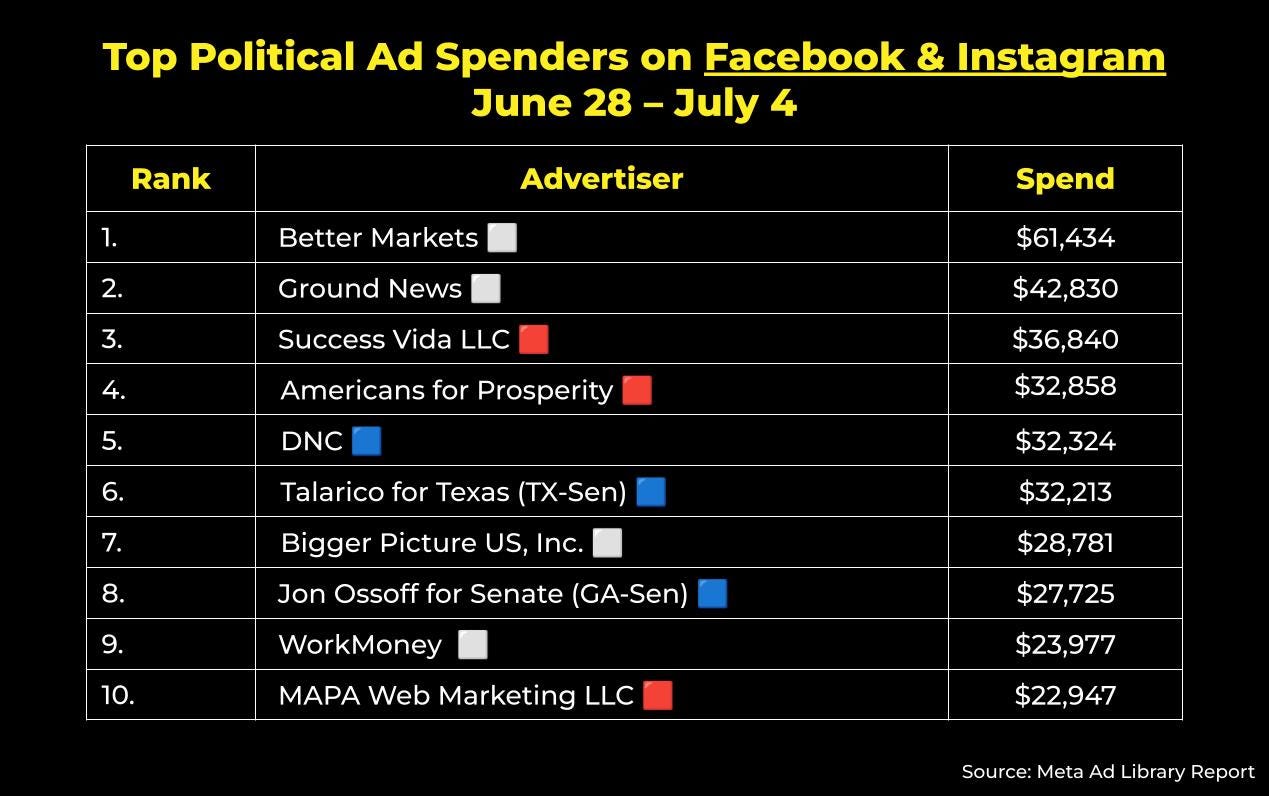
Meta political spending plummeted faster than expectations for The Great American State Fair. At just 10% of the weekly totals we’ve reported recently, it appears much of the political world knew that audiences were ready to tune out ahead of the long weekend — well that and a lull in the July primary calendar. That didn’t stop a few seemingly innocuous LLCs from throwing their weight around though.
Success Vida LLC wouldn’t interpret the heat wave canceling DC’s Independence Day parade or the storm delaying Trump’s primetime remarks as biblical messages. No, its ads urge viewers to purchase a pro-Trump hat as “a testament to God’s divine will — worn out loud for the whole world to see.” Meanwhile, MAPA Web Marketing LLC is targeting senior Americans, encouraging them to take advantage of recent court rulings by applying for concealed carry permits. Here’s to 250, America.
Moving over to Google and YouTube, political advertisers spent around $9 million on ads last week. These were the top ten spenders nationwide:
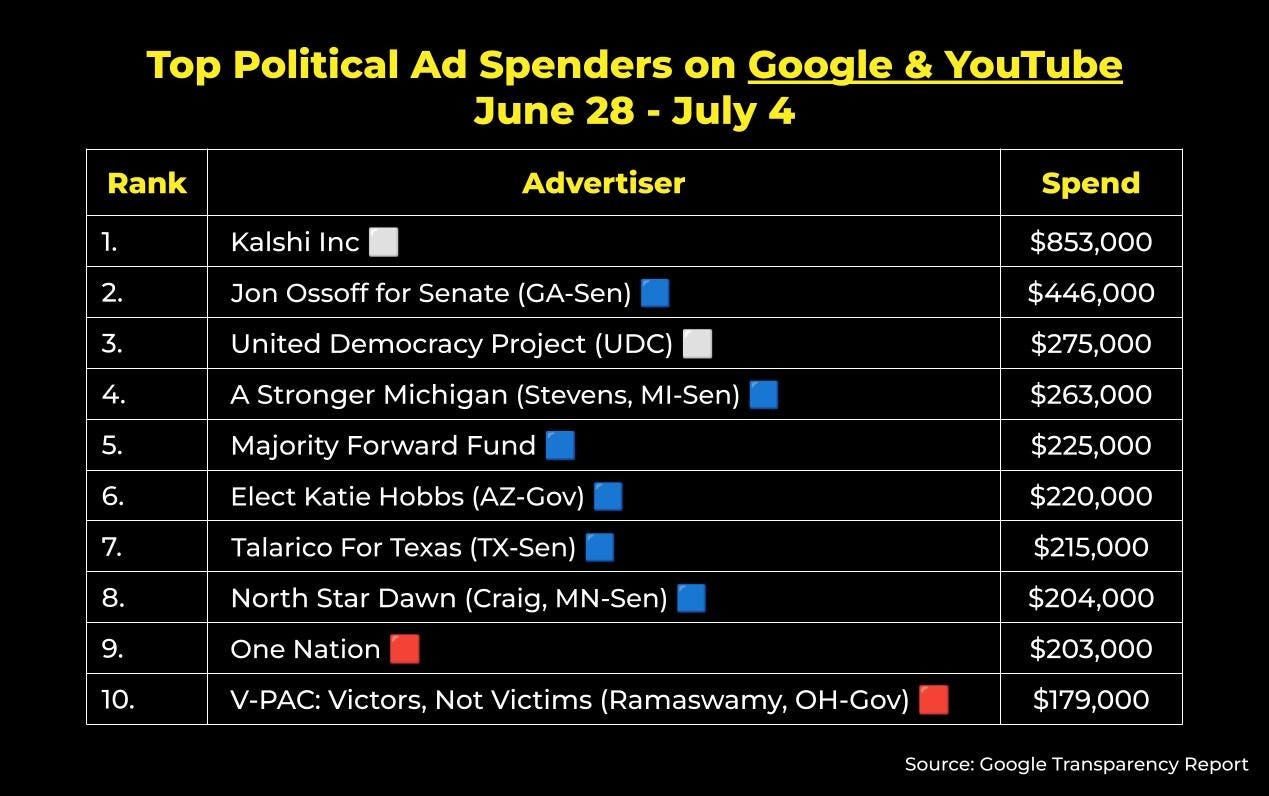
While the primary season cools off for the next few weeks, Michigan and Minnesota’s Senate races are heating up ahead of their August primaries, offering a glimpse into what lies on the other side of Midwest-nice. In Michigan, Stevens kept her ads pretty positive in the days before McMorrow dropped out; but, two states over, North Star Dawn was running both pro-Craig and anti-Flanagan ads. The Minnesota Super PAC drew scrutiny last month after Flanagan alleged they used an AI deepfake of her in their advertising.
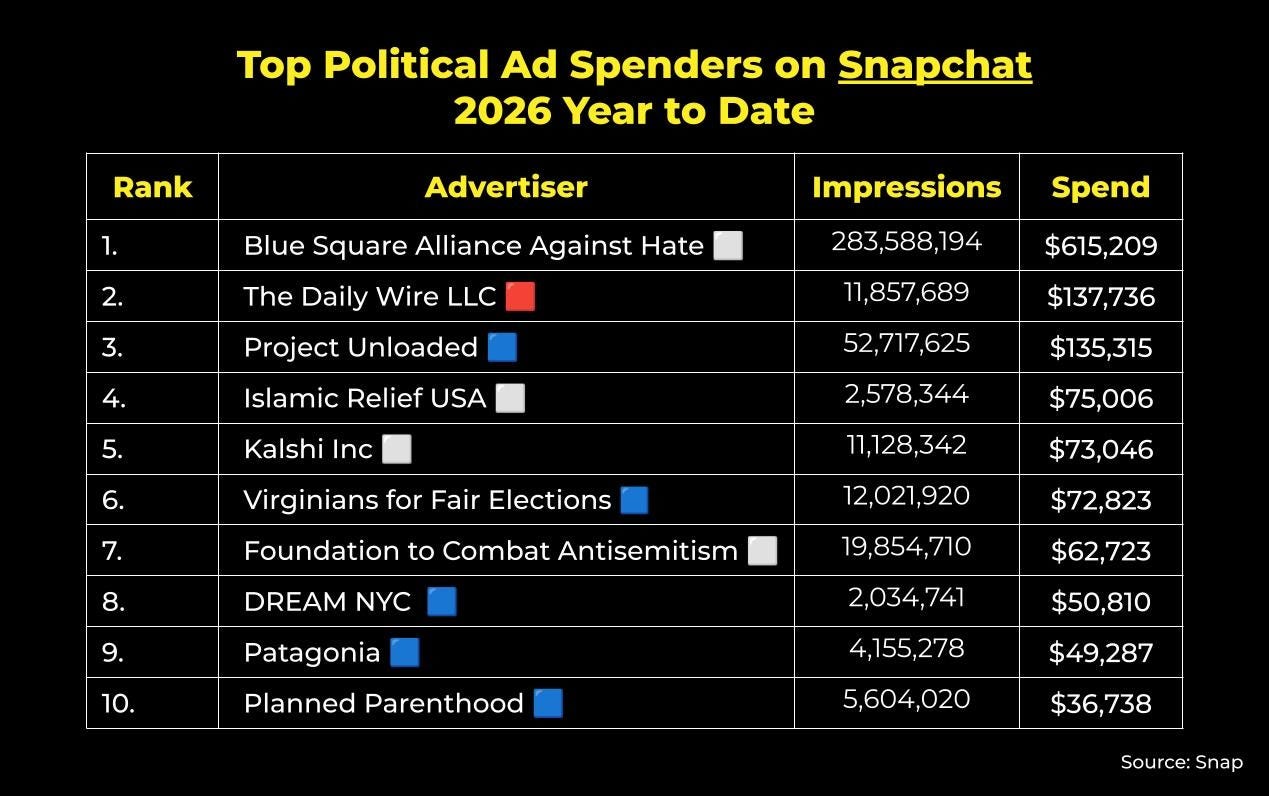
Over on Snapchat political advertisers in the U.S. have spent just over $2.9 million in 2026:
Please take our money…
We’ve actually heard this before, and you’d say this too if you finally found an ethical list-growth platform that helped you turn $1 into $2 like clockwork. Join over 900 groups like Everytown, Amnesty International, and Mercy Corps that have found a better way to nail their fundraising goals. Learn more >

SCOTUS Rewrote the Rules of the Game. Here’s How We Galvanize Working People to Stop Paying the Price.
“Power, not reason, is the new currency of this Court’s decision making.”
— Justice Thurgood Marshall, dissenting in Payne v. Tennessee (1991)
Grocery prices are crushing families. Wages haven’t kept up. Drug companies keep raising prices while Congress looks the other way. No matter who gets elected, the system never seems to change in working people’s favor.
There is a reason for that. And the Roberts Court just spent nine months cementing it.
Yes, Trump won major victories this term. The Court handed him sweeping new power, weakened voting protections, and limited the independence of agencies designed to protect ordinary people from corporate abuse. But if we make this story only about Trump, we make a serious mistake. We allow the people and institutions that spent decades reshaping our system to escape accountability.
Long before Trump entered politics, a determined movement of wealthy donors, corporate interests, and ideological operatives understood something many Americans did not: the Supreme Court is not simply a referee standing above the political fray. It is one of the institutions that determines the rules under which our economy, our democracy, and our society operate.
The Court shapes whether working people can organize for better wages, whether corporations can be held accountable when they harm consumers or employees, whether voters have meaningful power, whether communities can protect their air and water, and whether fundamental rights are protected.
And while much of the country focused elsewhere, the right’s judicial machine methodically moved to capture it. They understood that courts write the rules of the game and if you control the rules, you can shape the outcomes — even when you lose elections.
They funded law schools, built legal pipelines, and spent forty years patiently installing judges who would deliver for them. They played the long game — and they won.
What we are witnessing today is a crisis, but not an unexpected one. It is the harvest of decades of patient investment. The Roberts Court is not a reaction to Trump. Trump is a beneficiary of a movement that spent decades building the conditions for this moment.
Look at what this term actually delivered. And look at who paid the price.
The Court expanded presidential power over independent regulators —the agencies that investigate corporate abuses, protect consumers, and enforce workplace and environmental safeguards. They are often the only counterwright to powerful corporations with virtually unlimited resources.
The Court gutted the Voting Rights Act in Callais, and within weeks, a wave of Southern states moved to redraw maps and erase Black political representation. The communities most likely to demand higher wages, better schools, and accountable government were stripped of leverage across an entire region.
The Court also continued its decades-long expansion of protections for money in politics, allowing wealthy interests to wield enormous influence over the candidates and policies that shape taxes, labor rules, healthcare, and economic opportunity.
And it issued a dangerous ruling targeting transgender athletes, not to resolve a meaningful question of equal treatment, but to deliver a culture-war victory to the movement that built its majority.
These rulings are not isolated events. Together, they reflect a consistent philosophy: limit the power of workers and communities to challenge concentrated wealth, weaken the government’s ability to act as a check on corporate power, and strengthen the influence of the interests that spent decades shaping the judiciary. Every one of these decisions affects whether families get a fair shake in a system that increasingly feels tilted against them. Each one raises the same fundamental question: who has the power to shape the rules that govern our lives?
The answer, too often, has been the people with the most resources to influence the system.
The Supreme Court is not separate from the broken political system working people experience every day. It is one of the engines driving it.
That was not an accident. It was the result of a long-term strategy.
Now it is time to build a movement of our own — to build institutions that serve the American people, strengthen democratic accountability, and give working people lasting power.
That work begins with how we communicate about the Court. If we want people to see what’s at stake, we have to stop treating Supreme Court decisions as isolated legal stories and start explaining them as the choices that shape power in their everyday lives.
First, dig deeper than the headline.
Chief Justice Roberts understands how to shape public attention. While the country focused on the birthright citizenship ruling, the Court quietly issued other decisions that further weakened campaign finance laws and expanded presidential control over independent regulators—rulings that may have an even greater impact on who holds power in our democracy. Organizers can’t just react to the loudest case. We have to explain the decisions that quietly rewrite the rules of the game.
Second, connect every decision to everyday life.
Most people will never read a Supreme Court opinion, nor should they have to. What they understand is whether groceries cost more, whether their drinking water is safe, whether a dangerous product can be recalled, and whether their vote counts. When the Court expands presidential control over independent agencies, it is not just changing the structure of government. It’s changing who stands between ordinary people and powerful corporations when something goes wrong. Our job is to tell that story—to show how decisions that sound technical can have very real consequences for working families. When we make these decisions about kitchen tables instead of courtrooms, people begin to see why they matter.
Finally, give people somewhere to put their outrage.
The Supreme Court has no switchboard to flood and no bill to vote against, but that does not mean people are powerless. Congress can respond through legislation, oversight, and structural reform. After the Court’s decision in Callais, we launched an online petition urging Congress to act, and more than 80,000 people signed it in less than 24 hours. That response reinforced an important lesson: people stay engaged when they are given something meaningful to do.
Awareness without action leads to frustration. Action is what builds movements. Rebuilding the courts is not a niche issue or afterthought. It determines whether every other fight — for better wages, affordable healthcare, housing, workplace power, and the right to vote — can actually be won. You cannot build a fair economy inside an unfair system. You cannot win when the rules have been written against you.
Our task is not simply to win the next election. It is to build institutions that ensure working people have power long after any one election is over.
The question is not whether we can rebuild. The question is whether we are finally ready to begin.
“As a democracy, the people are supposed to be the rulers. The people are supposed to be leading in terms of the policies and the way in which our government operates. And so, the more that people are engaged with our institutions the better.”
— Justice Ketanji Brown Jackson, ESSENCE Festival, July 2025
Please take our money…
We’ve actually heard this before, and you’d say this too if you finally found an ethical list-growth platform that helped you turn $1 into $2 like clockwork. Join over 900 groups like Everytown, Amnesty International, and Mercy Corps that have found a better way to nail their fundraising goals. Learn more >
That’s it for FWIW this week. This email was sent to 25,805 readers. If you enjoy reading this newsletter each week, would you mind sharing it on X/Twitter, Threads, or Bluesky? Have a tip, idea, or feedback? Reply directly to this email.
Thats because democracy as we know it is to a high degree a illusion. Not because its bad idea or people cant decide for themselves but because:
- total connectivity
- its silent weaponisation
I explore these themes here (its not only political manifesto, its theses of my research) https://substack.com/home/post/p-206503491
Hope you will find it intresting