


This newsletter is brought to you by the donor acquisition approach that helps you turn $1 into $2.
Hey kids! I’m Josh Millman, a media and marketing executive who has somehow survived more than two decades planning and buying advertising, including as COO of Plowshare and an executive at Publicis Media. I’ve worked on campaigns for everything from cell phone plans to efforts that helped millions of Americans quit smoking. I’ve also helped organizations including St. Jude Children’s Research Hospital, Wounded Warrior Project, NMDP and Best Friends Animal Society secure billions of dollars’ worth of donated media through public service campaigns.
When I’m not thinking about media, I’m usually wasting entirely too much time on fantasy sports or eating something with enough sugar to make Wilford Brimley spin in his grave. By the time you finish reading this, my wife and daughters will have called me “bro” and mocked my outfit about 4,000 times.
I’m here to say a few words, drop a pop culture reference or two and give you the inside scoop on the impact an industry I’ve managed to make a career out of for more than half my life is about to have on the midterm elections.
More on that below, but first…
Digital ad spending, by the numbers:
FWIW, U.S. political advertisers spent around 12.6 million on Facebook and Instagram ads last week. Here were the top ten spenders nationwide:
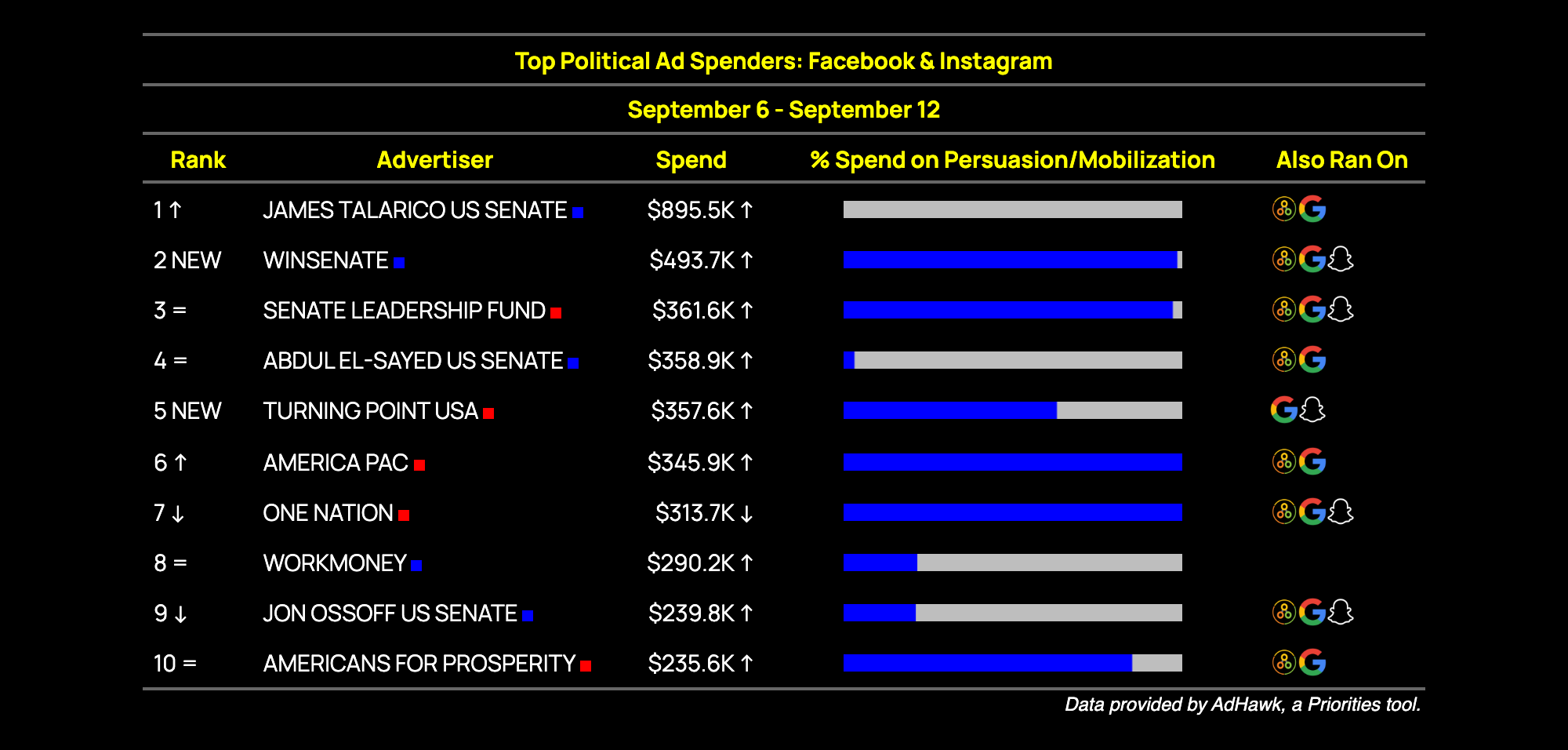
It’s no surprise that the post-Labor Day landscape is dominated by Senate spending. If we read the tea leaves on the GOP PAC side, we can get a closer look at how the party is dividing up the battleground.
Among the top GOP PACs on digital this week: Senate Leadership Fund, MAGA Inc., One Nation, No Going Back, NRSC, and America PAC.
New Hampshire and Ohio each saw five of the six live, missing only MAGA Inc.
Only one race had a single spender: Nebraska, where the NRSC opened up with $60k in a tightening race.
MAGA Inc. was live exclusively in Texas, while Trump’s new entity, No Going Back, was up in Georgia, Michigan, New Hampshire, North Carolina, and Ohio (probably to keep some distance from the Trump brand-name association).
Meanwhile, political advertisers spent around $28.7 million on Google and YouTube ads last week. These were the top ten spenders nationwide:
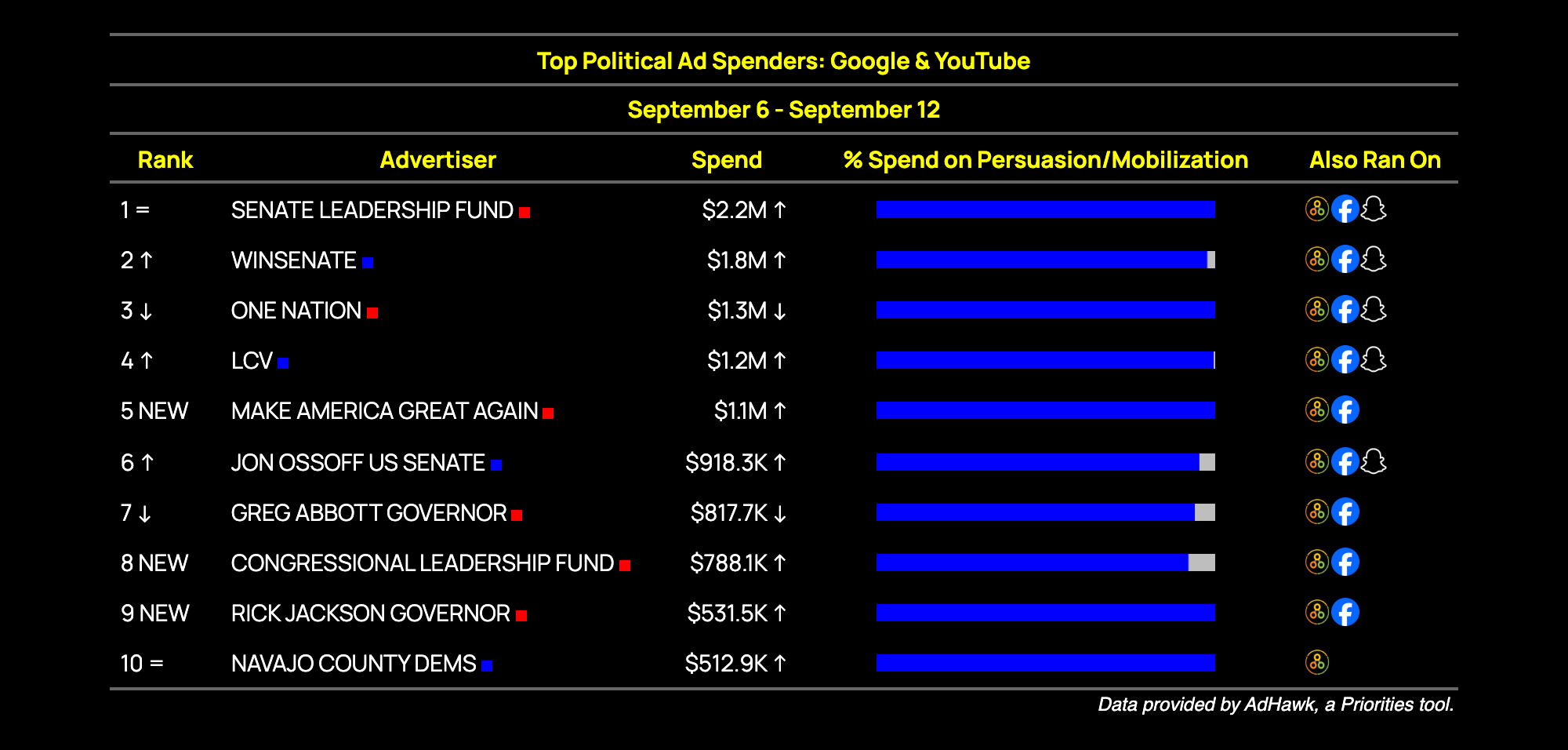
Two new entities in the top ten this week are worth flagging: the Congressional Leadership Fund across House races and Rick Jackson in the Georgia gubernatorial.
CLF was live in 15 districts nationwide with some notable spikes. They tripled spending over last week in CO-08, nearly doubled it in AZ-06 and IA-01, and also opened in eight districts with a minimum digital investment of $85k each. Topping the list were PA-10 ($160k), MI-07 ($140k), and WA-03 ($125k).
Rick Jackson was by far the largest spender in Georgia’s gubernatorial, dropping more than $2.2 million across all platforms. Former Atlanta mayor Keisha Lance Bottoms trailed with only $50k overall, tilting the balance sharply toward Republicans, $2.2 million to… well, $70k (KLB’s $50k + $20k from allies).
On CTV platforms, U.S. political advertisers spent an estimated $66.7 million last week. Here were the top ten spenders nationwide:
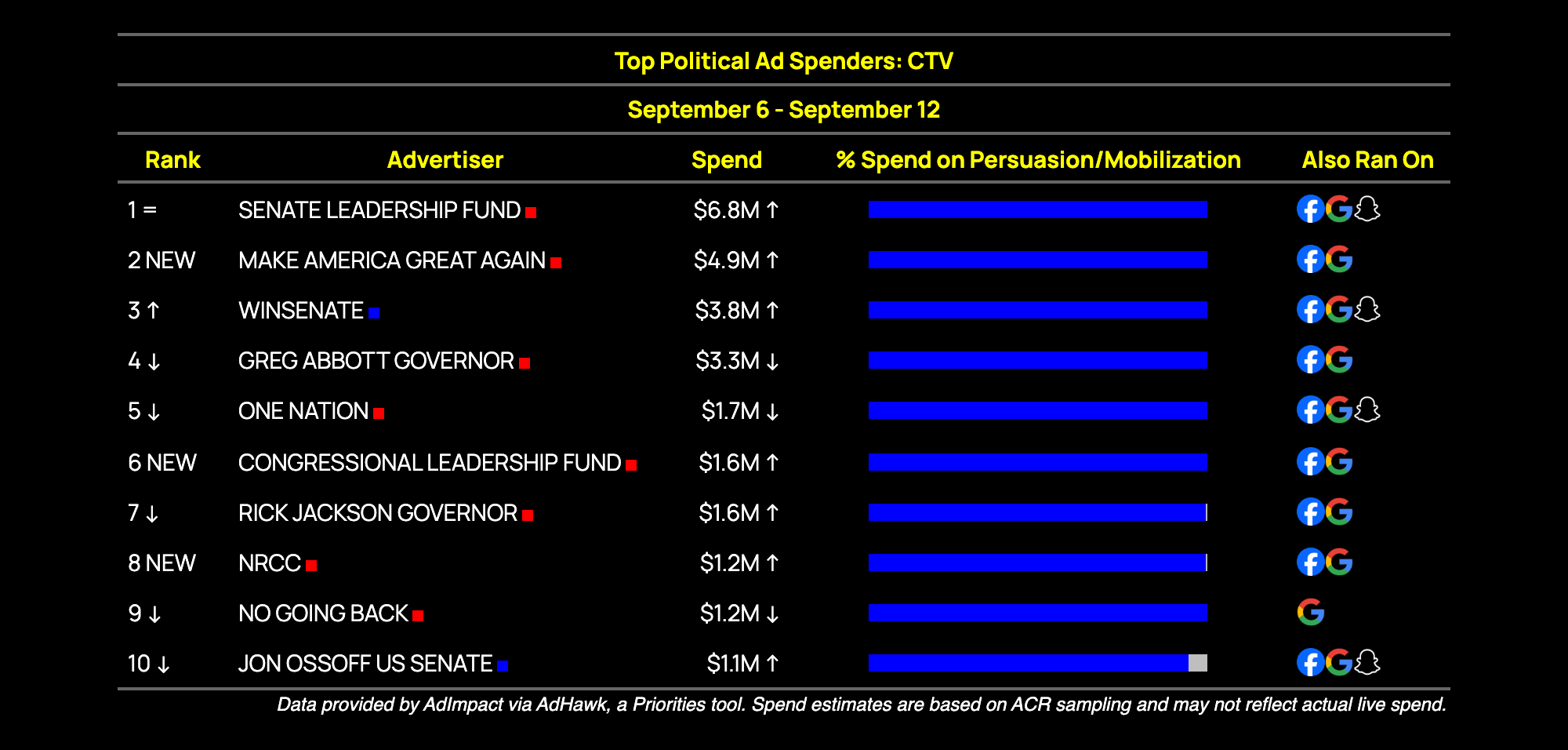
MAGA Inc.’s war chest is starting to deplete in earnest across the battleground—or at least in one battleground in particular.
The group has crammed nearly $8 million into Texas’s Senate race since the beginning of September, with $7 million of that landing in the last week alone, spread across two creatives running fairly standard economic contrast messaging.
…and lastly, on Snapchat, here’s YTD data for the top 10 spenders:
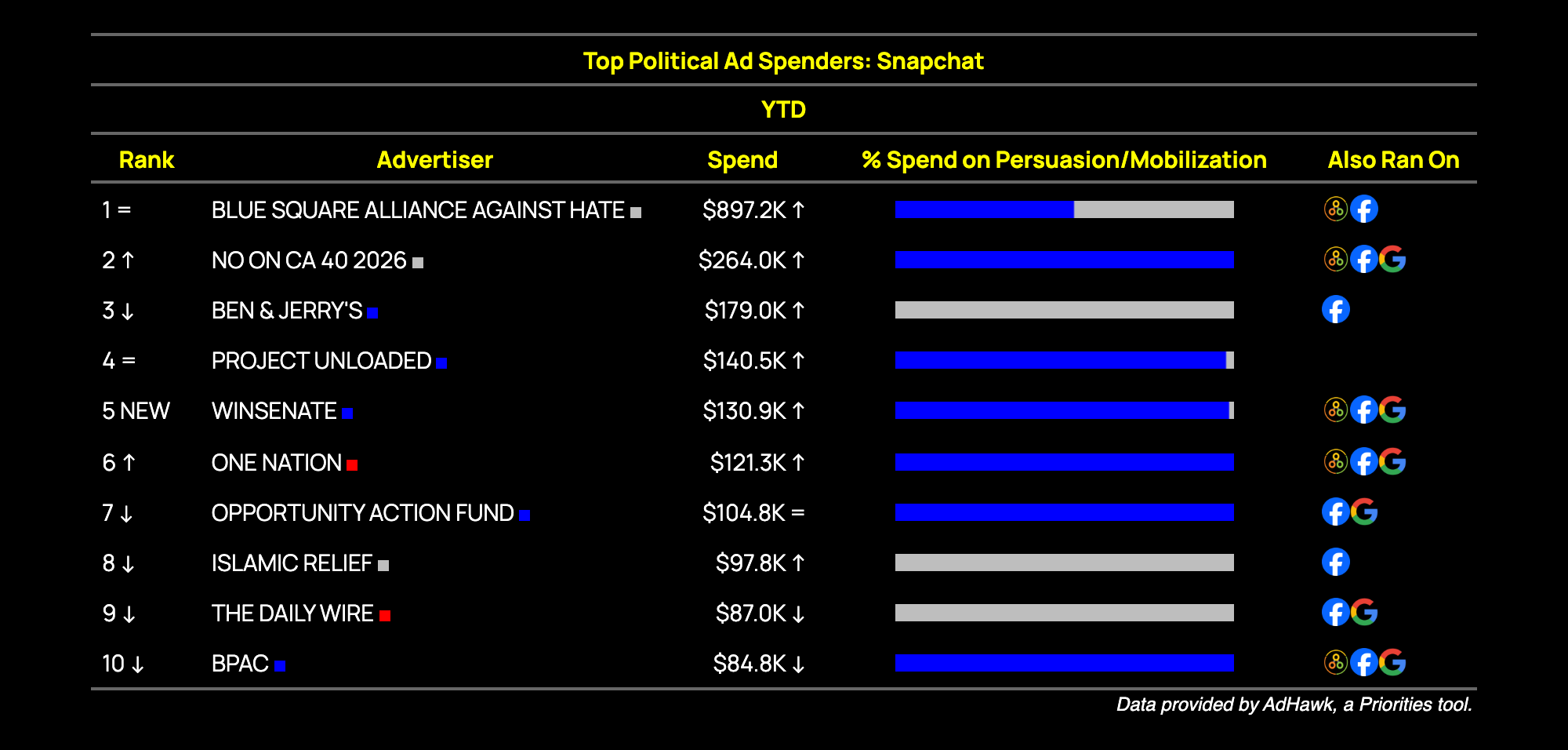
No on CA 40 2026 is really hitting Snapchat hard; they’re the only spender on the platform to break $100k weekly. On the GOP side, Senate Leadership Fund and One Nation spent a combined $51k, making them the third-highest spenders in the week when tallied together.
Please take our money…
We’ve actually heard this before, and you’d say this too if you finally found an ethical list-growth platform that helped you turn $1 into $2 like clockwork. Join over 900 groups like Everytown, Amnesty International, and Mercy Corps that have found a better way to nail their fundraising goals. Learn more >

The Political Ad Industry Approves This Message
Congratulations everyone! We just survived the summer of diarrhea lettuce with the FDA overseen by a guy who once had a brain worm. Now, welcome to the fall of political earworms and diarrhea of your screens.
It’s election season!
Over the next several weeks, nearly every screen you own will be bombarded with political advertising: your phone, TV, Youtube, streaming services, social media, websites, apps. Radio and podcasts will get in on the fun too.
Add the yard signs, mailers and increasingly unhinged text messages from candidates who will pursue you with the persistence of a past booty call who cannot take a hint, and politicians will soon be harder to avoid than your extended family’s political opinions at Thanksgiving.
I’ve spent more than two decades in media planning and buying, including more than a decade as an executive, so I can tell you this isn’t an accident. It’s the point.
Political campaigns are trying to flood the zone. At its most basic level, advertising creates awareness and frequency: Here’s the candidate. Here’s what the candidate stands for. Here’s the candidate again. And again. And again.
But modern political advertising is considerably more sophisticated than name recognition. Campaigns are also testing which issues actually motivate voters, particularly people who might be persuadable or need a little extra motivation to turn out.
And nothing motivates quite like fear.
Fear that someone is coming for your money. Your job. Your health care. Your rights. Your neighborhood. Your children. Democracy itself. Pick an issue and someone has probably produced a 30-second ad explaining why you are 60 days away from losing it forever.
The 2024 presidential election offered a particularly revealing example.
Donald Trump’s campaign spent heavily on ads attacking Kamala Harris over her previous support for providing medically necessary gender-affirming care to transgender federal prisoners. One memorable ad concluded: “Kamala is for they/them. President Trump is for you.”
According to post-election reporting on testing conducted by Future Forward, Harris’ leading super PAC, one related Trump ad moved voter preference 2.7 percentage points toward Trump among people who viewed it. Other research found no statistically significant change in voting intention from exposure to anti-trans ads, so precisely how much the campaign moved votes remains debatable.
From a media perspective, however, the lesson is straightforward: When testing suggests a message is breaking through, you throw more money behind it like Jordan Belfort tossing fun coupons and lobsters at the feds.
After all, why spend precious airtime building bridges when fear can be easier to manufacture, particularly around a small population many Americans may rarely encounter in their everyday lives? Of course, having a tiny share of the population dominate a wildly disproportionate amount of the political conversation is hardly a new phenomenon.
From there, the machine goes to work.
Television is only the part you can easily see. Behind it sits an extraordinarily sophisticated data ecosystem. Campaigns and political organizations can combine voter files, consumer information, behavioral signals and modeled audiences to determine not merely what messages to run, but who should see them.
That’s where the media planners, buyers, ad exchanges and demand-side platforms, or DSPs, enter the picture. In the simplest possible terms, enormous amounts of political money are matched with enormous amounts of data to put an advertisement on the right screen at the right time.
The goal might be awareness. It might be a website visit, a donation, or a volunteer signup. Ultimately, it might be getting you to vote.
And there is an extraordinary amount of money available to do it.
AdImpact currently projects $11.6 billion in political advertising during the 2026 election cycle, which would make it the most expensive cycle on record. Broadcast television alone is projected to receive $5.6 billion, while connected television is expected to account for another $2.7 billion.
Without a presidential race, much of that money becomes intensely concentrated around congressional, gubernatorial, state and local contests. AdImpact projects a record $3.7 billion for down-ballot and state legislative races.
That concentration has consequences beyond annoying the living hell out of you in between quarters of a football game.
Political campaigns operate on immovable deadlines. Election Day is Election Day, despite the fact that the continued existence of free and fair elections has somehow become something Americans now regularly find themselves arguing about.
Candidates also receive certain protections in broadcast advertising. During the 60 days preceding a general election, for example, legally qualified candidates are entitled to a station’s lowest unit charge for comparable advertising time.
As political spending accelerates, available local inventory gets tighter. And when billions of dollars pour into a finite advertising marketplace over a relatively short period of time, the effects extend well beyond the candidates whose faces are suddenly everywhere.
I’ve seen those consequences firsthand while managing advertising for nonprofit organizations. Many nonprofits supplement their paid campaigns with public service announcements that television and radio stations air using donated inventory. According to internal data I’ve relied on in managing those campaigns, I’ve seen available PSA airings decline by nearly double-digit percentages from one quarter to the next during election cycles.
It makes perfect economic sense. When someone arrives with a Scrooge McDuck vault to purchase airtime, the free stuff becomes considerably less attractive.
Unfortunately, that can leave nonprofits fighting for awareness immediately before one of the most important charitable giving periods of the year. We’ve had to develop contingency plans, move messages into digital channels and prepare organizations for the possibility that their campaigns simply won’t receive the exposure they would during a normal year.
Small businesses can get squeezed, too. A local business trying to generate awareness heading into the holiday season suddenly finds itself competing for finite inventory with political organizations carrying enormous budgets and an expiration date.
The political advertising ecosystem isn’t disappearing anytime soon. There is too much money involved, too much technology available and too much evidence that advertising can influence what people know, feel and do.
So what can you do about it?
Do your homework before the machine does it for you.
That advice applies to voters, but it may matter even more for those of us who understand how the machine works.
For all of us operating within the broader political marketing ecosystem, every impression, audience segment, frequency cap and optimization ultimately lands in front of an actual person. The technology has become extraordinarily good at finding the right voter, at the right moment, with the message most likely to move them. That makes the work more effective. It also makes the choices behind that work more consequential.
Those of us who understand that process also have an opportunity beyond our professional roles. We can encourage the people around us to visit campaign websites and understand what candidates say they support. We can point them toward credible reporting about their records and claims. We can encourage them to seek out viewpoints that challenge their own rather than allowing a social media algorithm to construct an increasingly comfortable echo chamber around them.
And we can remind them to pay attention to the races farther down the ballot. State legislators, county officials, mayors, councils and school boards make decisions that can affect taxes, schools, roads, development and everyday life far more directly than their comparatively tiny share of political coverage would suggest.
Media literacy becomes a lot more useful when it leaves the media industry. And an informed electorate is a dangerous thing, at least if you’re in the business of trying to manipulate one.
The ads are coming. You can’t stop them or escape them. Somewhere, an exhausted 26-year-old media planner is staring dead-eyed at a frequency report, wondering if there are any chicken Caesar wraps left in Conference Room B from the vendor lunch-and-learn while simultaneously figuring out how to make sure you see even more of them.
And that is worth remembering for everyone who works in this business. We have a responsibility to think about how we do this work, but our influence does not have to end when we close our laptops.
If we’re serious about government of, by and for the people, those of us who understand how the system works have an opportunity to do more than just operate it. We can help the people around us understand it, question it and make informed decisions before the machine does it for them.
Please take our money…
We’ve actually heard this before, and you’d say this too if you finally found an ethical list-growth platform that helped you turn $1 into $2 like clockwork. Join over 900 groups like Everytown, Amnesty International, and Mercy Corps that have found a better way to nail their fundraising goals. Learn more >
That’s it for FWIW this week. This email was sent to 25,872 readers. If you enjoy reading this newsletter each week, would you mind sharing it on X/Twitter, Threads, or Bluesky? Have a tip, idea, or feedback? Reply directly to this email.
