



Hi! I’m Danielle Butterfield, Executive Director of Priorities USA. I got my start working on digital ads back in 2011 on the Obama campaign and joined the Priorities team in 2017 to help Democrats make better investments online. Today, I want to talk to you about breaking through to less engaged voters online.
There’s a major disconnect in modern political communication: most political strategists like me, my team, and my friends live in a high-information bubble and we incorrectly assume voters follow headlines the way we do.
They don’t.
The good news? We can authentically reach them online, and my team has done the work to find them.
More on that below, but first…
Digital ad spending, by the numbers:
FWIW, U.S. political advertisers spent around $10.3 million on Facebook and Instagram ads last week. Here were the top ten spenders nationwide:
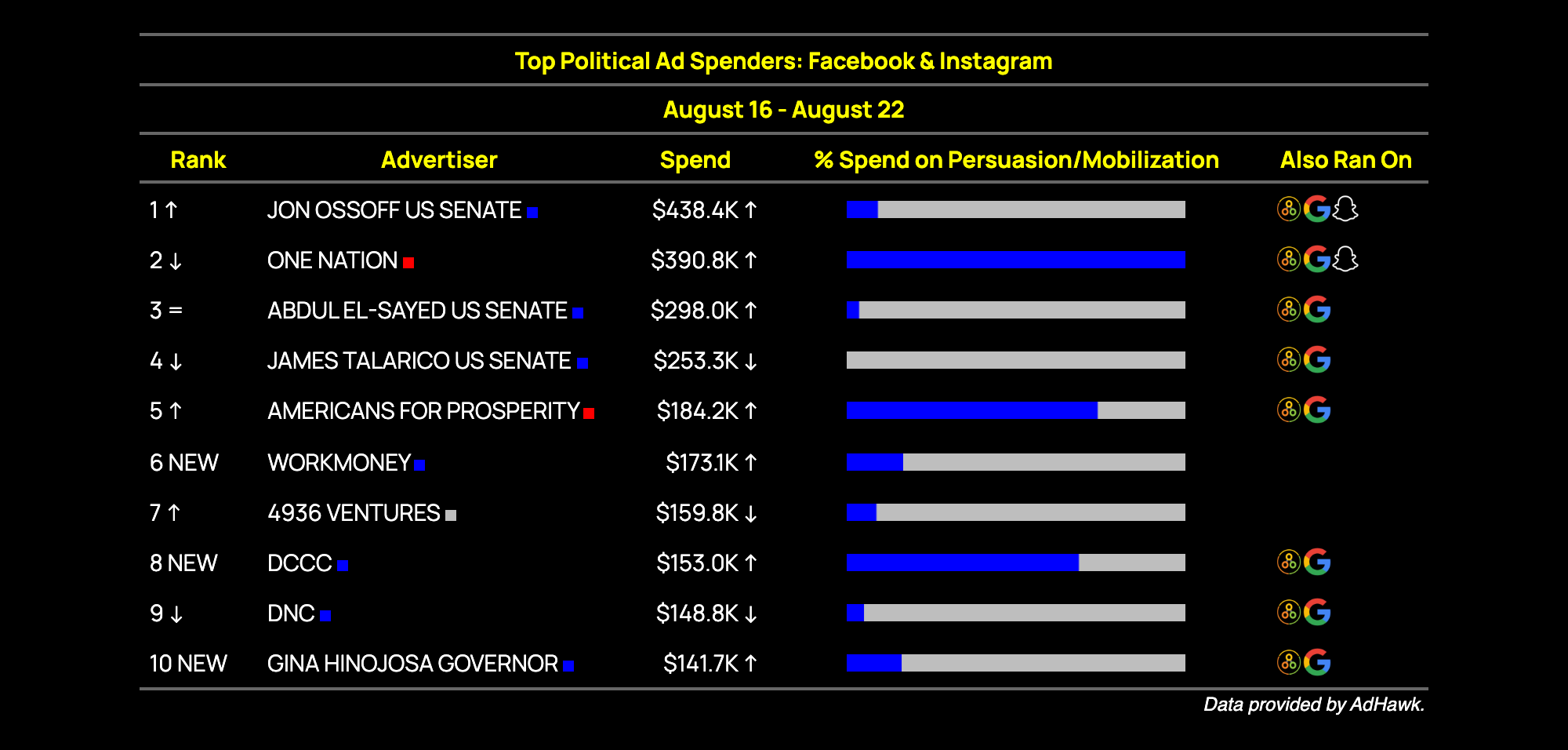
While Senator Ossoff’s fundraising machine tops the spending charts, PACs owned the persuasion and mobilization lanes on Meta platforms.
One Nation is all in on Senate battlegrounds. Georgia is of particular interest; the group was first-on-the-air with major GOP post-primary spending this month at more than $9.1m and counting.
The other major persuasion PACs in the top ten were Americans for Prosperity and American Bridge, with a much more diverse set of hits — the former up and down the ballot, the latter in Senate and House battlegrounds.
Meanwhile, political advertisers spent around $21.5 million on Google and YouTube ads last week. These were the top ten spenders nationwide:
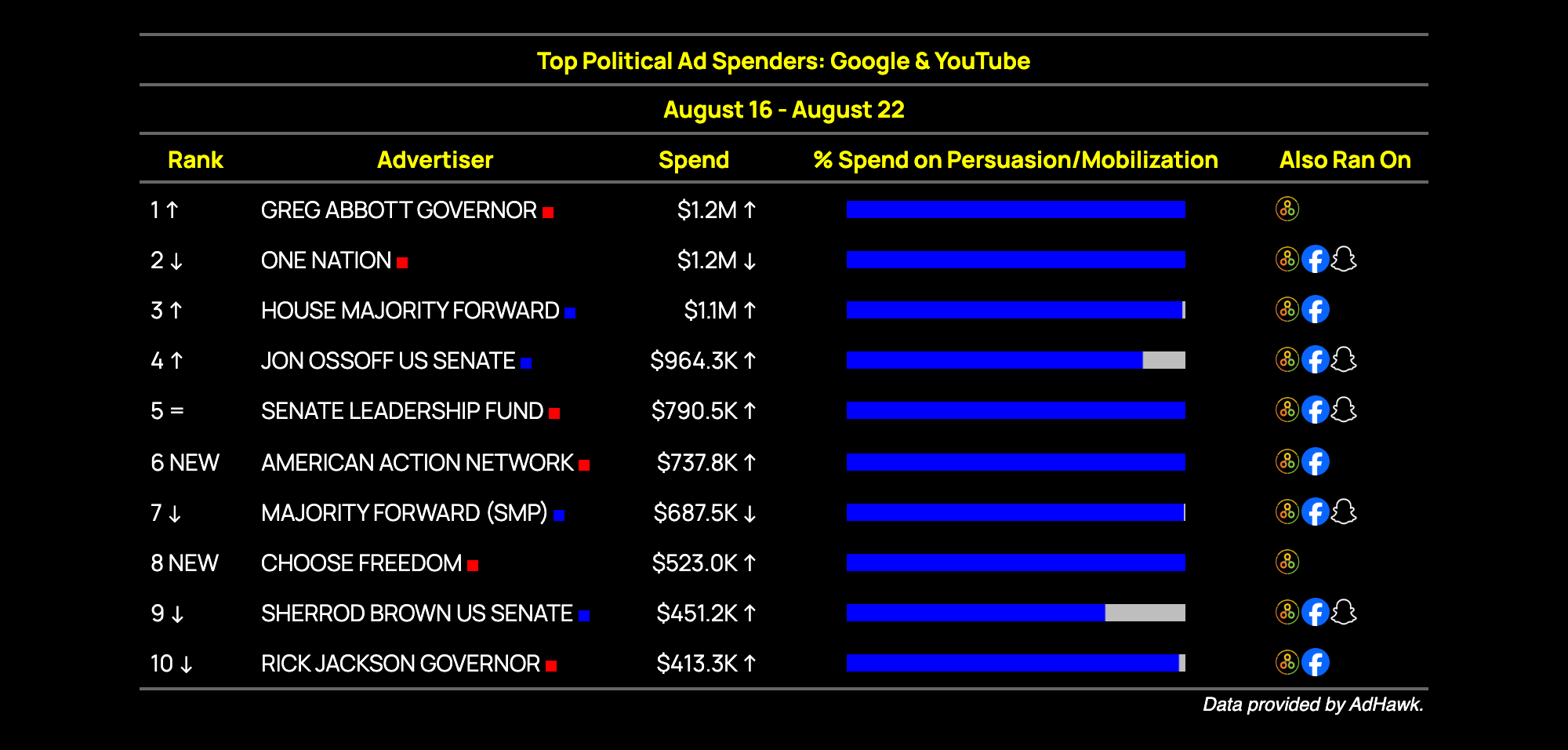
The Senate was (mainly) the name of the game this week, with a few House and gubernatorial races cracking the top tier as well. Choose Freedom is the newcomer to watch. Its biggest investment was in Ohio’s Senate race, but the PAC spent even more overall across ~20 House battlegrounds. What are they spending this money on, you ask? Praising Republicans for their votes to ban stock trading. They’ve dropped $14.8 million so far—and they’ve only been up for two weeks.
On CTV platforms, U.S. political advertisers spent an estimated $45.5 million last week. Here were the top ten spenders nationwide:
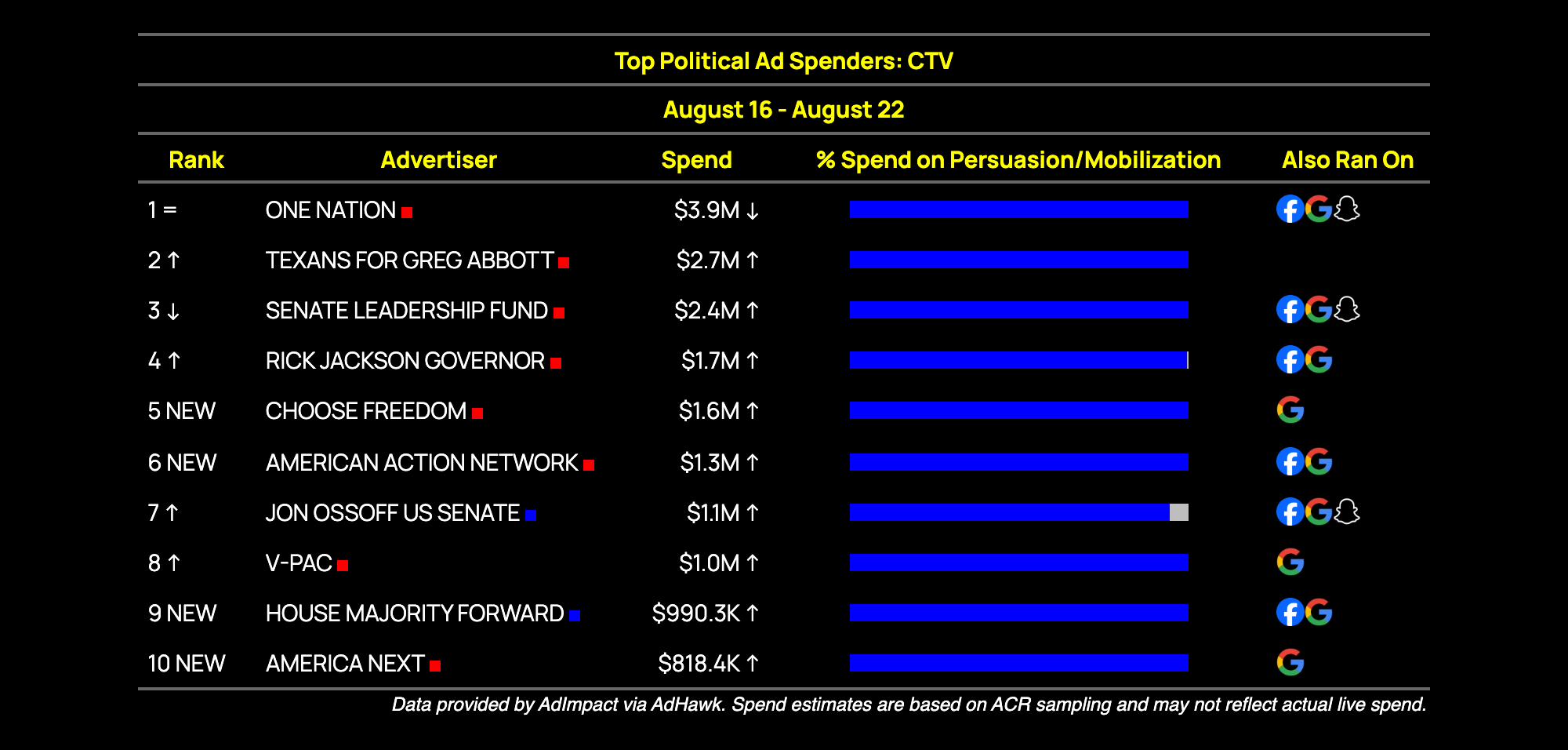
It was mostly the usual suspects at the top of the list, but one in particular caught our attention: America Next. We’ve seen them before: in Missouri in 2024 and in West Virginia and Nevada in 2022. So far this cycle they’ve landed in Michigan’s gubernatorial race. It’s not completely clear, but they may be the same America Next which has existed since 2015, founded by former Louisiana governor Bobby Jindal (remember him?).
…and lastly, on Snapchat, here’s YTD data for the top 10 spenders:
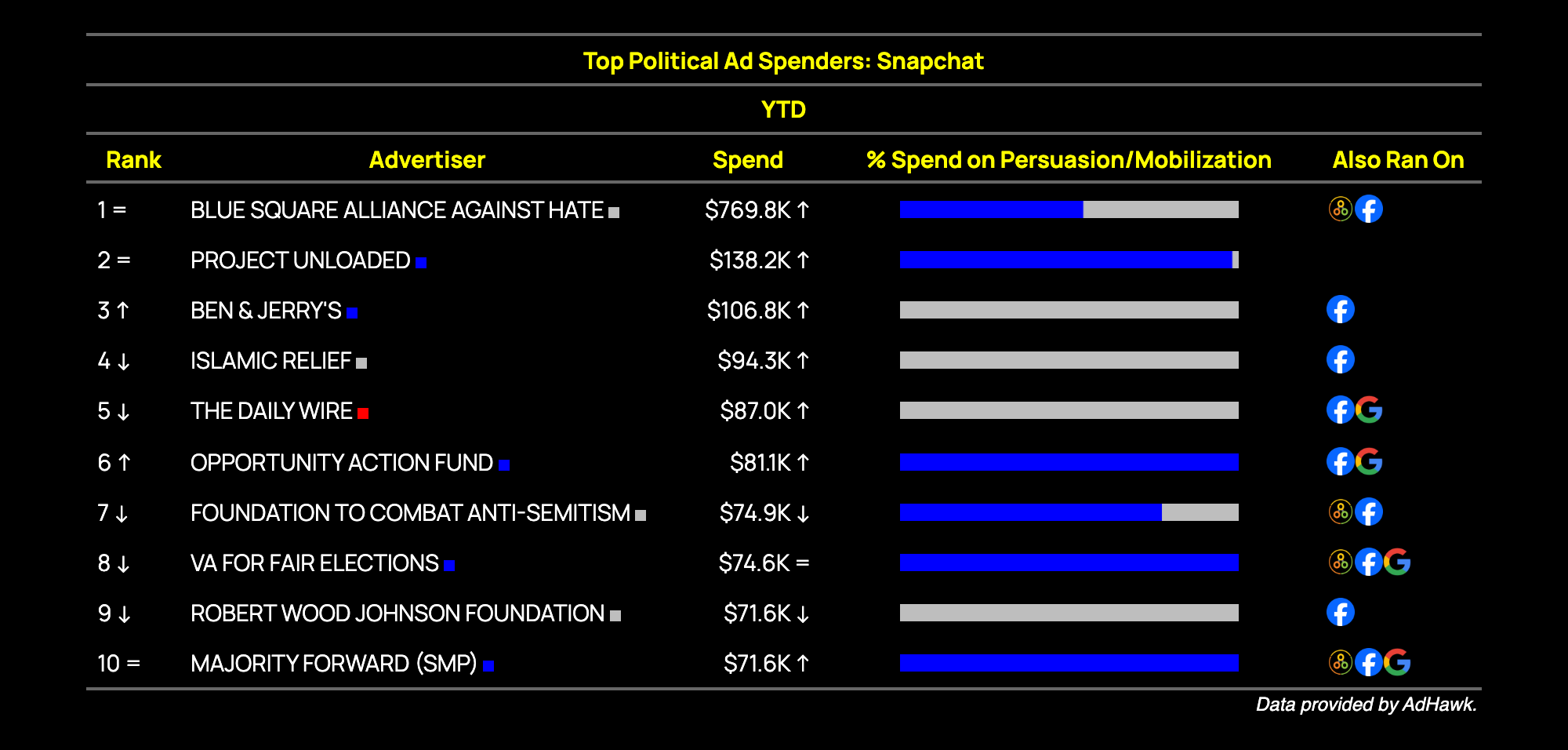
Our most interesting piece of intel here is a launch on the traditionally Democratic platform by the Republican Senate Leadership Fund. While spending hasn’t been dramatic so far, the move could be an early sign that Republicans are testing a youth-focused persuasion lane in Maine’s Senate battleground.
The new silent majority? Voters who don't seek out news.
Let’s talk about “Swing Voters”
The classic image of the “swing” voter that many operatives still hold — actively following the news, genuinely undecided, torn between the two parties — is increasingly rare. In our recent polling, just 3% of registered voters fit that description (and in reality, it’s likely an even smaller share of the electorate).
Let’s dive into how news consumption actually plays out amongst voters, from our own research:
46% are active news seekers. They skew older, more educated, and more invested in politics. When they consume political news, they’re doing it intentionally.
54% are passive consumers or avoid news altogether. They are less politically invested and mostly encounter political news by stumbling across it. 12% actively avoid news, a group especially concentrated among parent-aged women.
However, that 54% of voters aren’t “low-information.” They’re online. A lot. They spend hours scrolling every day. The difference is that they just skip, mute, or scroll past anything that looks and feels like traditional politics or news.
That 54% is most valuable to us because they’re less likely to be hardened partisans, more likely to hold mixed or conflicted political views, and are ripe to be swayed by new information.
So where does their attention go?
Video. Streaming platforms and YouTube dominate their screen time.
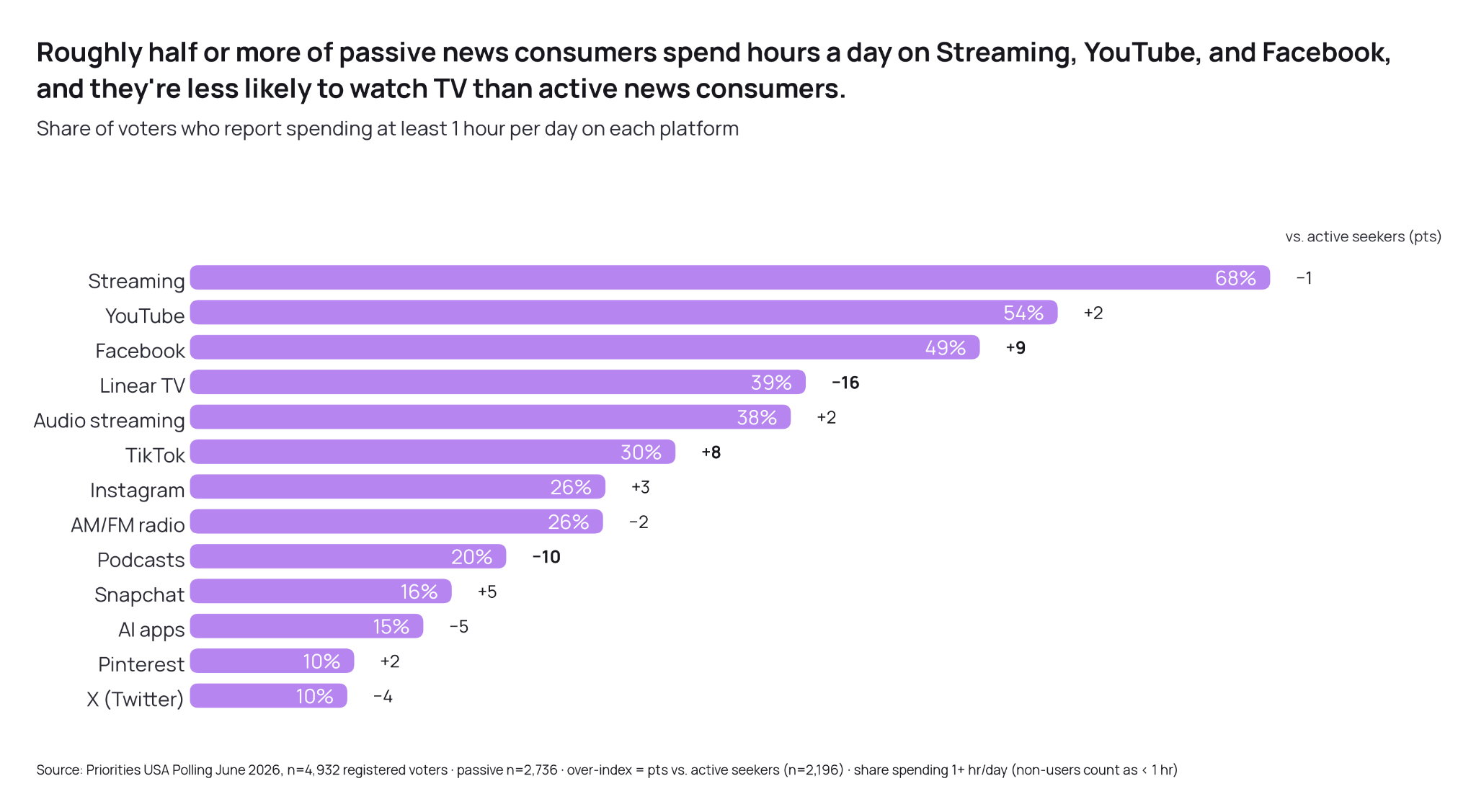
Democrats have always tried to reach these voters by throwing money at traditional political channels. If we want to succeed, we have to rethink where the money is going in the first place. Meeting voters where they are means prioritizing video-first, non-political environments, and delivering content that fits naturally into the feeds they already enjoy watching.
The Digital Divide: Commentators vs. Pop Culture
One of the most illuminating views we’ve gotten into this audience came from our study of hundreds of adults’ YouTube watch histories. The contrast was pretty stark. While active news seekers head to YouTube for political commentary like The Daily Show or MeidasTouch, passive news consumers occupy an entirely different corner of the internet. They’re entertainment-first: tuning in for music, pop culture, and lifestyle content.
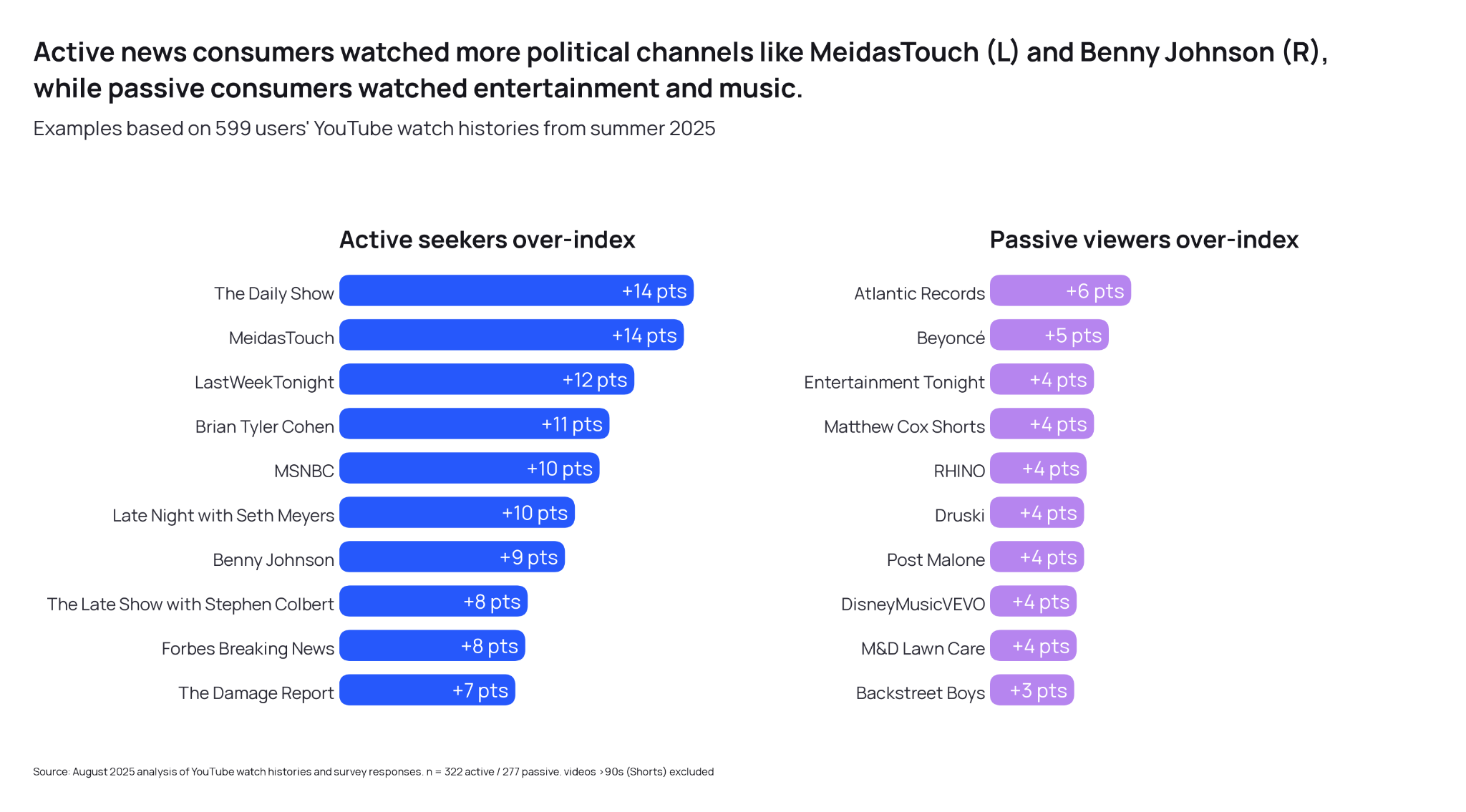
So when they do get news, where does it come from?
The short answer? The algorithm decides.
Our research shows that passive news consumers generally open apps to relax, be entertained, or learn something useful. They avoid content that appears negative or stressful. Political news reaches them through algorithmic recommendations, shared clips, or non-political creators. This doesn’t mean they aren’t coming across politics — it’s just much more passive and less explicit.
Unsurprisingly, these voters over-index on short-form platforms:
TikTok: 47% of less engaged voters used it in the past week, compared to 39% of active news seekers.
Snapchat: 31% of less engaged voters used it in the past week, compared to 24% of active news seekers.
In other words, political content isn’t necessarily absent from their feeds; it just blends in with what they’re already consuming. That’s the opportunity.
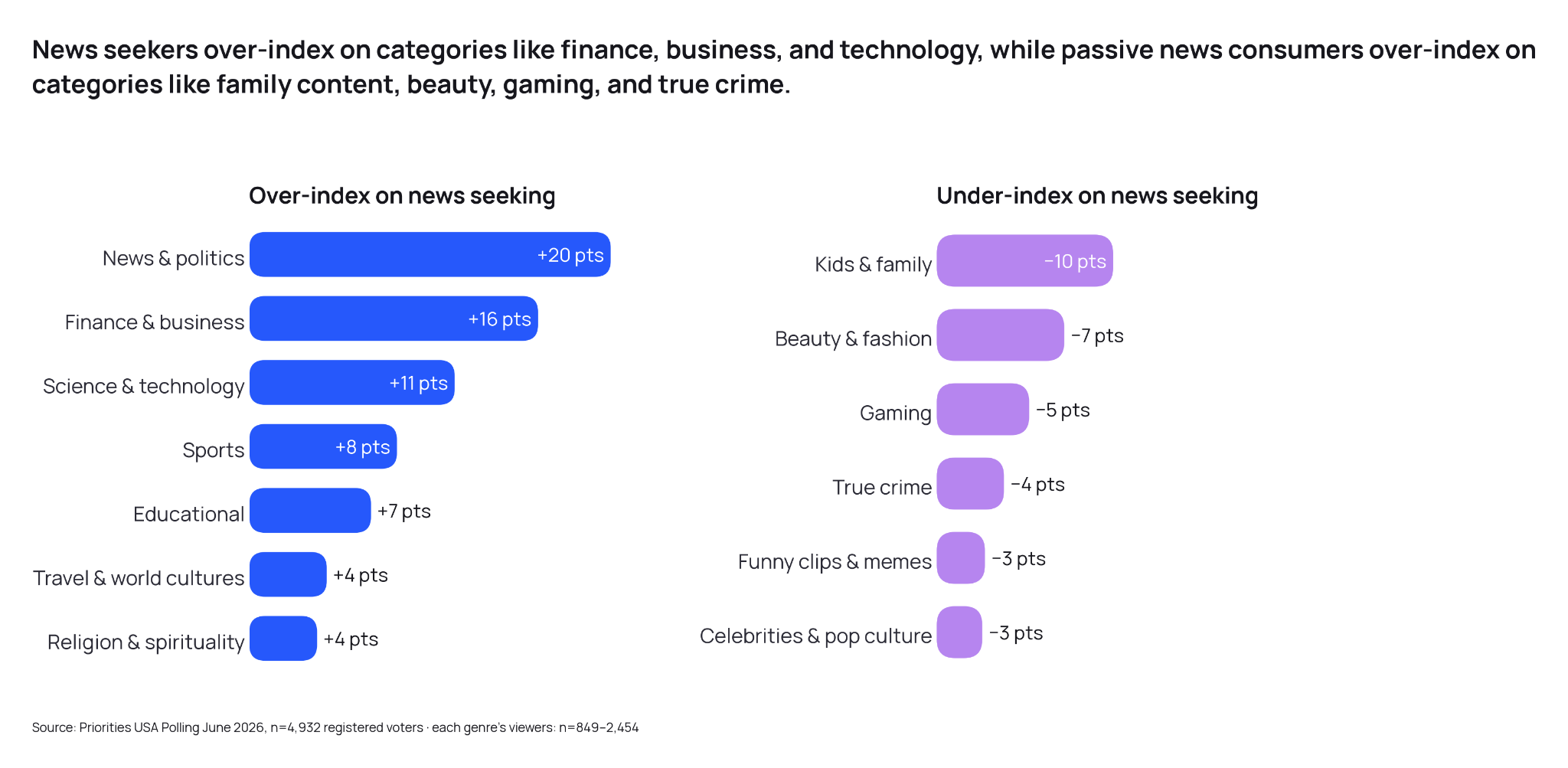
Trying to break through to the 54%
My team has been testing a simple hypothesis: Content that blends in moves passive news consumers better than content that’s overtly political.
In Ohio, we set out to reach young men on YouTube in popular and not traditionally political content-niches: sports, gaming, and fitness. Then we built ads to fit those niches.
Picture this running ahead of a video game clip on YouTube:
At first glance, you might not even realize it’s political — very different from a traditional political ad that would disrupt your feed.
The ads linked Ohio Sen. Jon Husted to rising energy costs and the FirstEnergy scandal. The results were promising. Reaching young men in their content niches led to a more than 5% increase in disapproval of Sen. Husted and drove substantial engagement, including a 224% increase in Google searches for Husted/FirstEnergy.
Why this matters now
Our Ohio test and the other small bets we’ve taken throughout 2026 aren’t just about the midterms. They’re helping us understand how Democrats need to communicate when voters are tuning out.
The old playbook assumed that whatever tested best would break through. But in today’s world of streaming, multiple screens, and shorter attention spans, the best-tested message doesn’t mean much if people scroll right past it. That’s why we’re doing everything we can to understand what voters are consuming — and how — so that our messages can be more contextually relevant.
We try our best to break out of our own bubble and step inside voters’ shoes. Our political world lives on Substack and Bluesky, just like our competitors exist on Truth Social, but most voters don’t. We kept hearing about how 2024 was the “podcast election,” but most of the people listening to those shows are already news junkies!
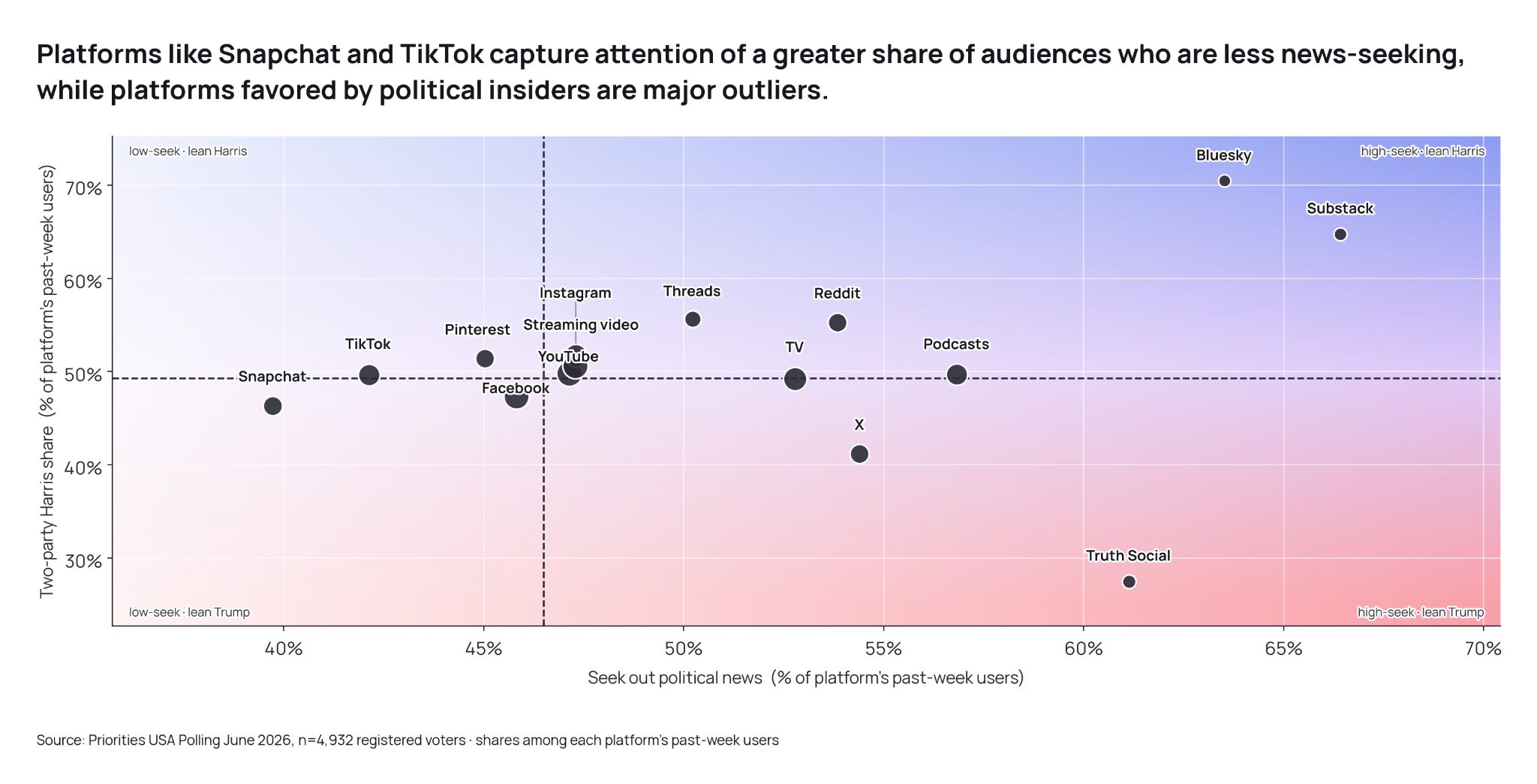
If we don’t build strategies for the 54% of people who tune out the news, we are walking away from the voters who decide elections.
They won’t come looking for us. We have to fit into their world.
That’s it for FWIW this week. This email was sent to 25,875 readers. If you enjoy reading this newsletter each week, would you mind sharing it on X/Twitter, Threads, or Bluesky? Have a tip, idea, or feedback? Reply directly to this email.


I can't believe the Democratic Party is hust now waking up to this. Must come from all that bubble living, like you say. That speaks to something Wilson was saying. The Republicans built a political machine that is a wonder to behold. Both for its breadth and depth. Sure, their substance may be pretty rotten, and it is, but they have simply been outplaying the Democrats for years. And have the results to prove it. So I applaud the work you are doing. It is way overdue. I live by the old maxim (which I'm kinda making up on the spot):
If you keep using the same methods as you always have, and you're losing ground, then you're going to keep losing ground.
That is something every Democratic player/operator/member needs to hear and understand. We're losing because we've been playing a substandard game, among other reasons. Democrats got lazy and arrogant and they're paying for it. So is the rest of the country. This doesn't relieve Republican Rank & File for the moral failure of their voting. But it does show the problems start at home. I blame Clinton and Obama. They both made some fundamental errors. Which we now see playing out across the country. We're late to the game, but at least we've started.