


This newsletter is brought to you by the donor acquisition approach that helps you turn $1 into $2.

Hi, I’m Amb. (ret.) Nina Hachigian, CEO of Alliance for Local Leaders International (ALLIES), a new organization connecting mayors around the world so they can learn from each other and share best practices as democracies backslide. Previously, I served as the first U.S. Special Representative for City and State Diplomacy under the Biden Administration and as the second U.S. Ambassador to the Association of Southeast Asian Nations under the Obama Administration.
Mayors are on my mind constantly these days—specifically, how they’re stepping up at a moment when democracy is under strain. Their leadership, creativity, and commitment to protecting their residents show what democracy looks like at its most local level. There’s a lot the rest of us can learn from them as we navigate this uncertain moment.
More on that below, but first…
Digital ad spending, by the numbers:
FWIW, U.S. political advertisers spent around $11.3 million on Facebook and Instagram ads last week. Here were the top ten spenders nationwide:
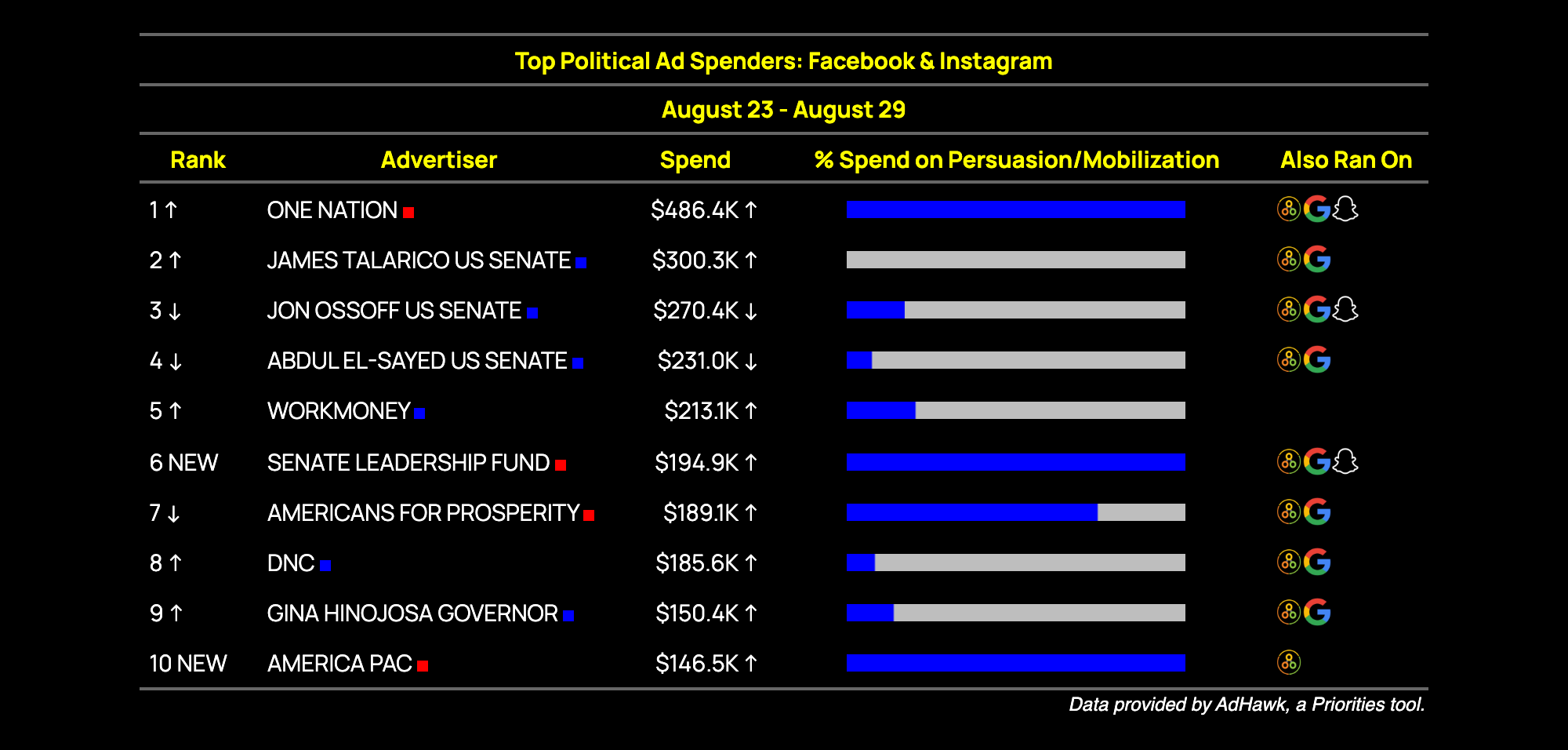
Our “Spender of the Week” is America PAC, Elon Musk’s mega-entity. Musk only recently announced plans to spend big this cycle, and it’s already begun. The PAC has spent $250k on Meta so far, largely focused on broad mobilization efforts and criticizing Mayor Zohran Mamdani.
Meanwhile, political advertisers spent around $24.5 million on Google and YouTube ads last week. These were the top ten spenders nationwide:
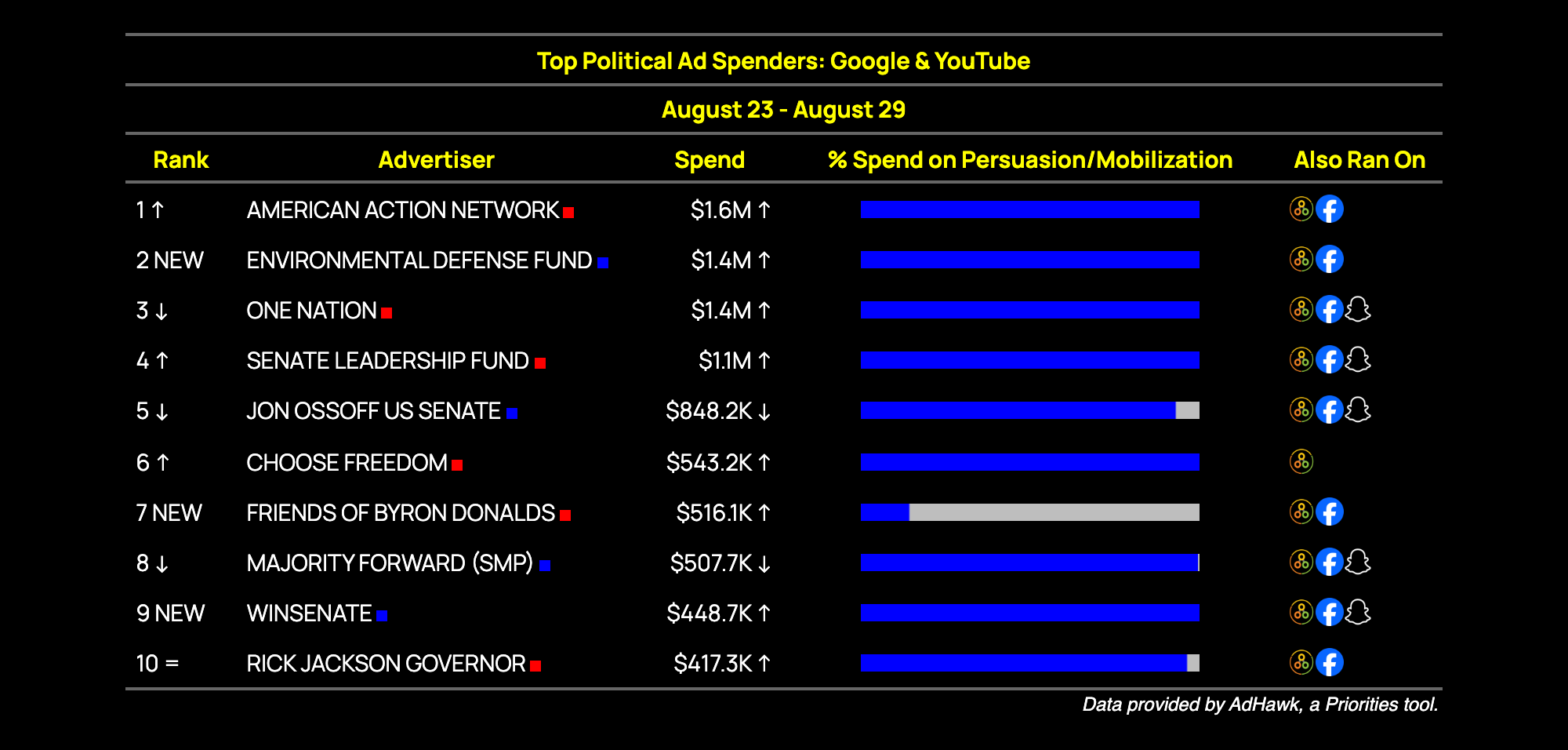
The Environmental Defense Fund catapulted into the top ten here with last week’s investments. Their Google spend has been remarkably focused, with every dollar going against Sen. Jon Husted (R-OH). Interestingly, their Facebook approach has been quite different and predominantly centered on educating voters about the Arizona Corporation Commission.
On CTV platforms, U.S. political advertisers spent an estimated $50.6 million last week. Here were the top ten spenders nationwide:
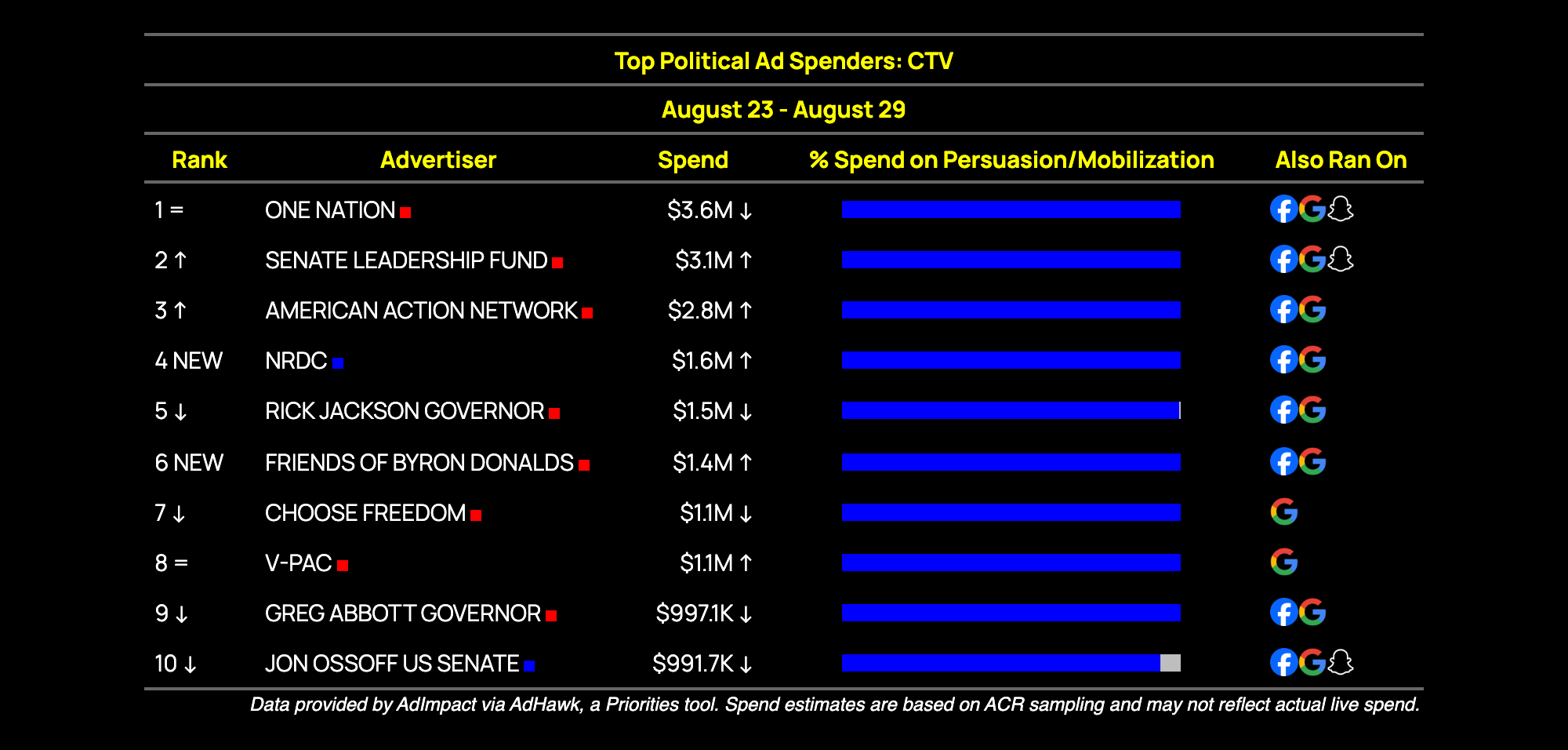
One Nation continues to pour serious money into the Georgia Senate race, even if the spending has slightly tapered off. The GOP PAC spent $1.19m on CTV in Georgia, targeting Sen. Jon Ossoff. The only state where they spent more was Ohio ($1.3m).
Other major One Nation targets last week? Iowa ($470k), New Hampshire ($260k), Maine ($220k), and Alaska ($140k).
Notably absent: Texas, Michigan, and North Carolina. That doesn’t mean Republicans have stopped spending in those states however. The latter two have been propped up by our second highest spender, the Senate Leadership Fund ($1.1m in North Carolina and $860k in Michigan).
…and lastly, on Snapchat, here’s YTD data for the top 10 spenders:
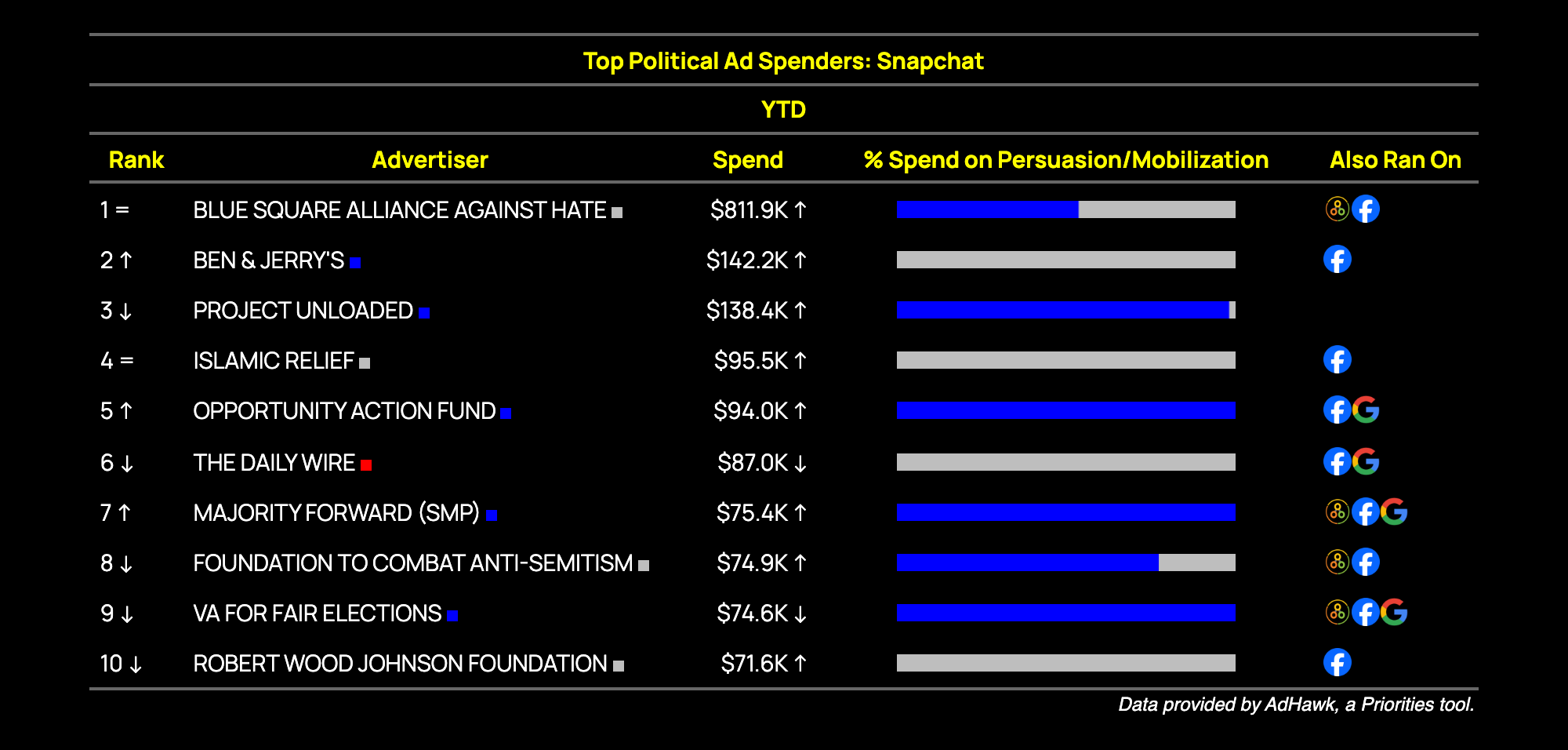
Last week, we highlighted the Senate Leadership Fund (SLF), the GOP counterpart to Democratic group Senate Majority PAC (SMP).
SMP has always been active on Snapchat: they’re the sixth highest spender of all time on the platform, with more than $1m spent since the start of 2021.
This cycle is no different, as SMP is the eighth highest spender since the start of the year at $80k spent. SLF, in comparison, has only spent $9k.
Please take our money…
We’ve actually heard this before, and you’d say this too if you finally found an ethical list-growth platform that helped you turn $1 into $2 like clockwork. Join over 900 groups like Everytown, Amnesty International, and Mercy Corps that have found a better way to nail their fundraising goals. Learn more >

The Mayors’ Guide to Communications
Every election cycle, campaigns and politicians in both parties spend enormous amounts of money trying to answer the same question: How do you sound authentic? How do you get people to believe you in a media environment designed to make belief—and persuasion—nearly impossible?
Mayors have some answers. National political discourse tends to overlook them, but that’s a mistake. They experiment with communications tactics elected officials at every level of government could learn from.
Trust is paramount. Americans trust their mayors far more than their governors, senators, or president, at a rate of about 70%, more than 30 points higher than federal officials. Some of that gap is sheer proximity. People run into their mayor at Little League or the grocery store. They’re members of the same community. As Chattanooga Mayor Tim Kelly puts it, mayors have to “eat their own cooking.”
But increasingly, trust is also being built and defended online, through digital communication tactics many national figures still haven’t fully embraced.
As someone who runs the Alliance for Local Leaders International (ALLIES), an organization that works with mayors around the world, I see this up close. Many of them are fighting to keep their residents’ trust through very difficult circumstances. And under real pressure, they’ve come to understand what actually lands online.
For politicians trying to rebuild credibility with disengaged voters, there are some lessons worth paying attention to.
Speak like a person, not a politician.
When federal immigration operations turned violent in Minneapolis earlier this year, Mayor Jacob Frey didn’t reach for the usual carefully crafted language. He bluntly told federal agents to get out of his city. The remark drew criticism and international attention precisely because it was quotable and so direct. It sounded like something he would say, unlike the sanitized statements most national figures issue after a crisis.
Frey followed it with something more calculated: a preliminary assessment putting the economic cost of the federal operation at over $200 million in a single month. The combination worked because it paired emotion with something concrete. One statement was raw and memorable. The other gave people a number they could remember and repeat.
Don’t wait for the media to tell your story. Tell it yourself, all the time.
When President Trump described Portland as “war-ravaged,” Mayor Keith Wilson didn’t issue a rebuttal through a spokesperson and hope a few reporters decided it was worth covering. He posted ordinary, idyllic photos of the city with the hashtag #WarRavagedPortland and asked residents to do the same. It spread fast enough that a federal judge later cited its prevalence in a ruling, noting the “war-ravaged” claim seemed unmoored from the facts. It worked because the mayor wasn’t the only one telling the story. There were thousands of residents posting evidence in their own voices.
On the other side of the world, Sofia, Bulgaria’s Mayor Vasil Terziev consistently takes a version of the same approach. He repeats the same simple, factual claims across every platform his residents use—TikTok, Instagram, print, radio—tailoring them to each audience. He’s also taken to publicly predicting, often correctly, what lies the national government is about to say about him. By getting ahead of the attack, he drains some of their power before they land. Terziev treats message discipline and offense as the weapon it should be for any elected leader.
During the height of the COVID pandemic, Los Angeles Mayor Eric Garcetti held a press conference every day at 5:30 p.m. He led with the numbers—deaths that day, hospital beds available, ventilators free—then walked through testing, stay-at-home orders, masks, vaccine sites, senior meal deliveries, and more. And he always took questions from journalists. Angelenos scheduled their evenings around it.
Mayors Wilson, Terziev, and Garcetti were dealing with very different situations, but they understood the same basic principle: Don’t leave a vacuum for someone else to fill.
Show up constantly, even when nothing’s on fire.
Not every mayor is fighting off a hostile national government or managing a pandemic. And the strategy may look different when you’re not. Most of the time, the challenge is much more mundane: How do you convince people you’re actually doing the job?
San Francisco Mayor Daniel Lurie took office pledging to turn around a city widely seen as declining, and his approach has been fairly simple. He posts short, often unpolished videos touring a project, stopping into a local restaurant, or walking through a neighborhood. His tone is warm and upbeat rather than combative—closer to a small-business owner’s Instagram than a politician’s press shop.
It’s paid off. Mayor Lurie has drawn well over 200,000 Instagram followers without spending a dime on ads in a little over a year. At the same time, his approval rating has held in the low-to-mid 70s, among the highest of any recent San Francisco mayor at this point in a term.
It sounds simple, but a leader showing up on- and off-camera, unscripted, sometimes unpolished, day after day, week after week, builds a familiarity and sense of trust with residents that a biannual town hall can never match. That can and should be replicated everywhere.
Invest in new and creative ways of communicating.
In a saturated, fragmented media environment, reaching constituents is no longer just about press releases and traditional coverage. Leaders need to think creatively about where people actually get their information—and build communications channels they actually control. That means investing in new media: working with content creators and showing up on podcasts, YouTube, and TikTok, wherever people actually get their news.
New York City Mayor Zohran Mamdani offers a masterclass here. He’s consistently invested in new media and even created a dedicated New Media Director role focused on engaging creators, podcasters, and YouTube shows. The lesson extends well beyond any one mayor: new media should be a core part of public engagement, not an afterthought.
Seattle Mayor Katie Wilson made a similar bet during her 2025 campaign. While her opponent, then-incumbent Bruce Harrell, mostly stuck to traditional media, Wilson leaned into short-form video and interviews with local content creators to reach younger voters. Her clearest hit was a two-minute video of her walking down the street with an $8 slice of pizza, arguing that Seattle’s housing costs were quietly inflating everything else. It wasn’t polished and that was the point. The policy argument was something anyone who’d recently paid for lunch could understand. The video pulled nearly 100,000 views on Instagram and over 50,000 on TikTok.
None of this requires a giant budget, either. Istanbul offers a more dramatic example of why diversified infrastructure matters. After Mayor Ekrem İmamoğlu was arrested by Turkish authorities and his X account—with more than 10 million followers—was blocked, his team turned to Instagram and TikTok to keep communicating with the public.
They even experimented with AI-generated videos that let his voice and likeness continue appearing in conversations about city events while he was detained. It’s a controversial tactic, for good reason, given the destructive potential of deepfakes, but it illustrates a broader point. Politicians must utilize all the levers of communication to get messages to the public. If you rely on one platform, one outlet, or one channel, you’re vulnerable to losing your audience overnight.
To be clear, none of this is about mayors being better people than senators or presidents. It’s about incentives. Local leaders answer to the same residents every day, often in person. That forces a level of directness that national politics has largely engineered out of itself. Mayors also have a built-in advantage: the progress they make in their cities happens in real time, in ways residents can see and touch.
But the tools they’re using—plain language, community-sourced testimony, repetition across platforms, owning your channels, radical transparency—aren’t unique to city hall. These are not “local government” tactics. They’re just good comms strategies.
As national campaigns spend heavily trying to manufacture authenticity, mayors, out of necessity, are demonstrating what it actually looks like—often while facing direct attacks from the governments above them. If national leaders want to reach people who’ve stopped listening out of apathy or distrust, the mayors’ playbook is right there.
Democracy, after all, is built from the ground up.
Please take our money…
We’ve actually heard this before, and you’d say this too if you finally found an ethical list-growth platform that helped you turn $1 into $2 like clockwork. Join over 900 groups like Everytown, Amnesty International, and Mercy Corps that have found a better way to nail their fundraising goals. Learn more >
That’s it for FWIW this week. This email was sent to 25,874 readers. If you enjoy reading this newsletter each week, would you mind sharing it on X/Twitter, Threads, or Bluesky? Have a tip, idea, or feedback? Reply directly to this email.

Thank you for the article, I thought or believed that Senators must report what money they have received from investments.