


This newsletter is brought to you by Action Network Boost, a new set of features built for the most advanced digital programs.

Hi y’all! I’m Dillon St. Bernard, the Digital Director of Team DSB, a Gen Z-led communications agency helping organizations and campaigns engage young, multicultural folks online.
I’ve led the digital team for the largest network of young activists, a coalition of 500+ climate organizations, and insurgent congressional campaigns. My days are currently spent advising campaigns and advocacy groups on how to turn views into real-world engagement.
Political campaigns and organizations are pushing out more content than ever, but it’s not going as smoothly as they imagined.
More on that below, but first…
Digital ad spending, by the numbers:
FWIW, U.S. political advertisers spent around $16 million on Facebook and Instagram ads last week. Here were the top ten spenders nationwide:
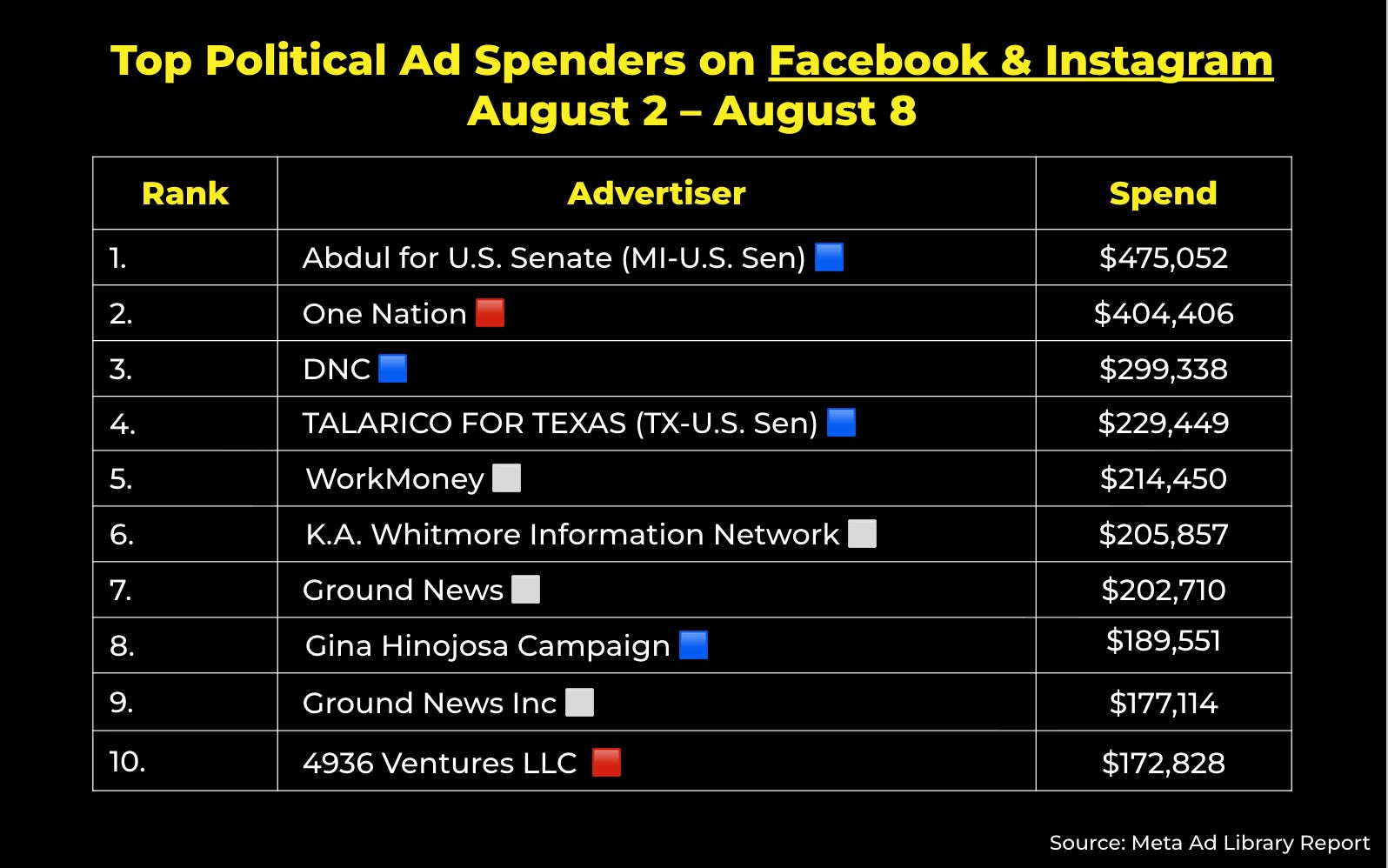
Abdul El-Sayed takes the top spot this week as Michigan’s Democratic Senate nominee gears up to take on Mike Rogers in November. Next door, in Wisconsin, Francesca Hong lost the Democratic primary for governor to David Crowley on Tuesday night, the first DSA defeat after a string of progressive wins in New York, Colorado, and Michigan.
Gina Hinojosa, Democratic nominee for governor of Texas, appears on the charts as her race with Greg Abbott heats up. A recent poll shows the two in a dead heat, putting the national spotlight on a race that could produce one of the biggest political upsets in Texas history.
Meanwhile, political advertisers spent around $17.3 million on Google and YouTube ads last week. These were the top ten spenders nationwide:
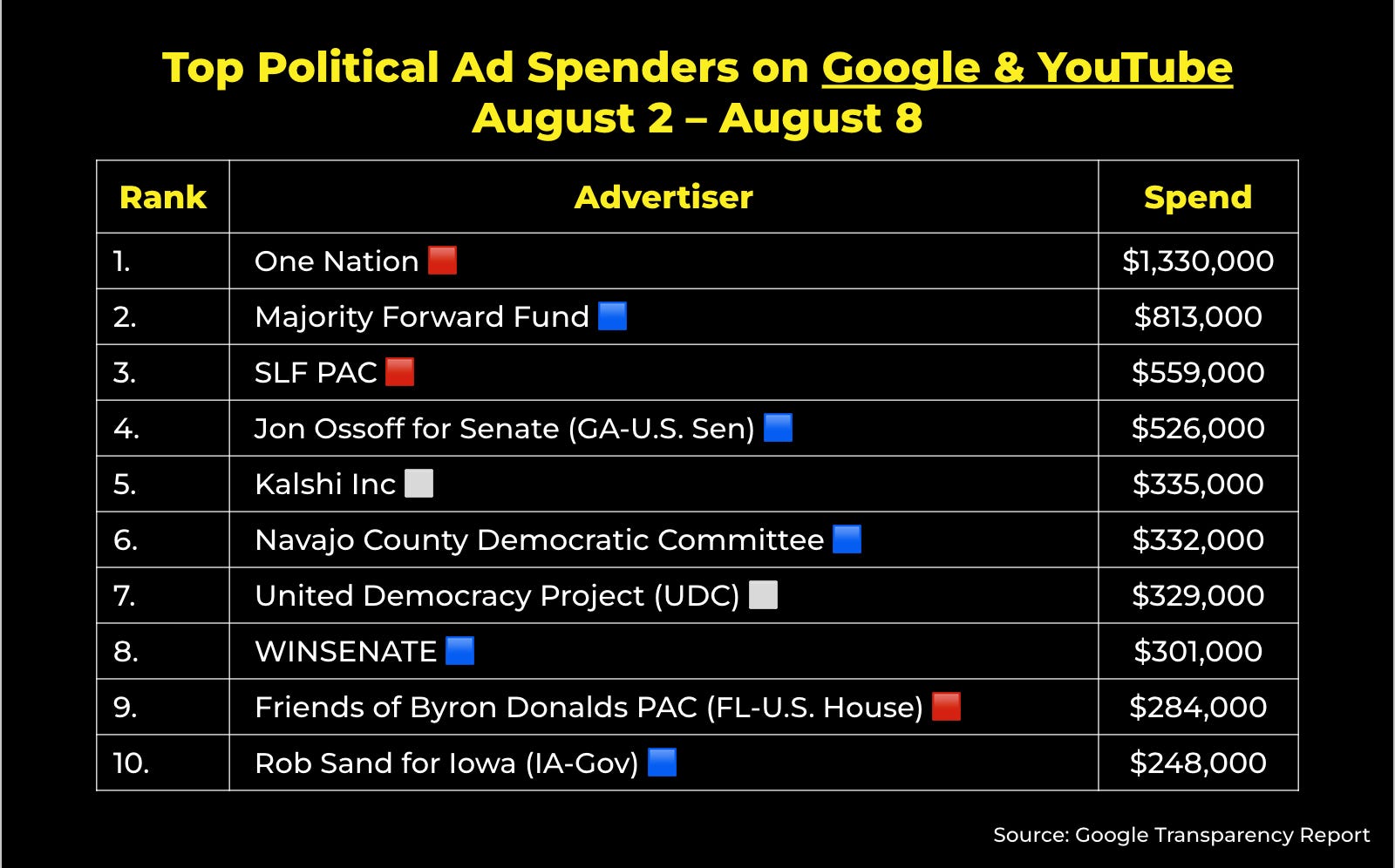
In Maine, Majority Forward Fund is going after Susan Collins, claiming she “is trying to keep it so senators can get rich playing the stock market.” FactCheck.org reviewed the ad and found the attack gets a little ahead of itself: it’s true that Collins does not support a full ban, but she has previously backed some restrictions on congressional stock trading.
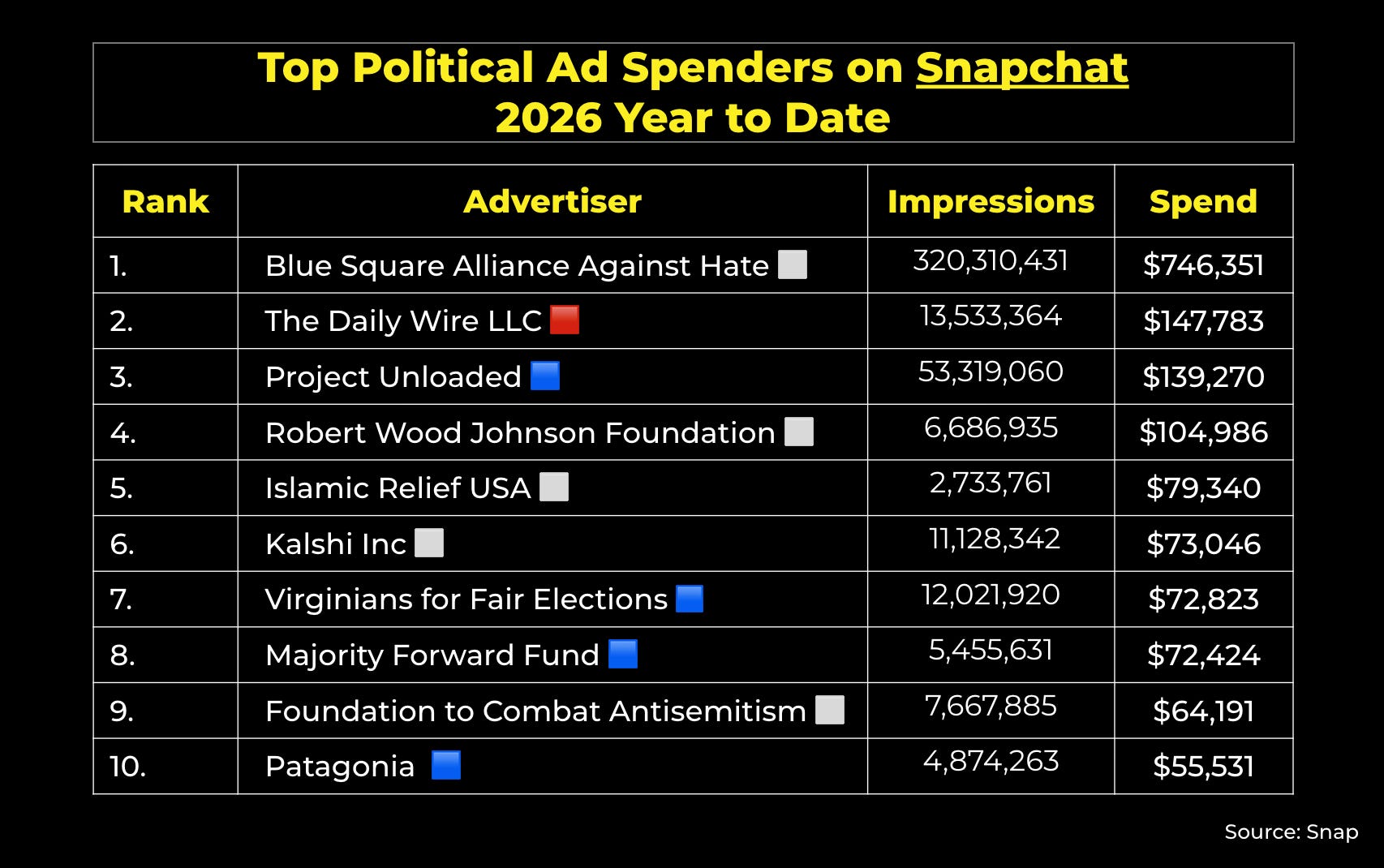
…and lastly, on Snapchat, there was a glitch this week, so we don’t have the total YTD, but here’s the data for the top 10 spenders:
New features to Boost your digital program
Introducing Action Network Boost, a new add-on package built to take sophisticated digital programs to the next level. AI-informed reporting insights, new tools for cross-team collaboration, deliverability expertise, priority support, and much, much more. Learn more & get 10% off Boost here >

The Internet Knows You’re Faking It
We can’t afford to ignore this lesson.
We’ve spent years analyzing the shifting media landscape and diagnosing what went wrong in past elections. The postmortem has been performed by everyone, including those of us who live and breathe digital comms and the several politicos whose complicity helped spur us into this mess.
One of the biggest takeaways has been a mandate for comms teams to expand the tactics they use to reach people: more appearances on new media, more coordination with creators, more direct-to-camera videos. More, more, more.
Campaigns and organizations are increasingly producing daily content across every possible platform, complete with a meticulous content calendar, an underfunded communications budget, and a dream.
Here’s the problem: being fluent in the tactics without first establishing your values is why so much content continues to underperform, even when it looks technically “good” on paper.
Too many people are putting out communications without knowing what they actually want to communicate, so the content they publish is devoid of any principles or conviction. AI may have nothing to do with it, but it’s slop all the same.
The result is an inauthentic online presence that feels hollow. As elections get closer and trust in legacy institutions and systems continues to erode, principles and conviction are what truly resonate with audiences and make (or break) their trust.
You can borrow tactics. You can’t rent trust.
The principle that communications should be polished within an inch of their lives does not translate well to today’s digital-first universe.
A walk-and-talk video scripted word for word won’t resonate. Neither will a content creator who isn’t allowed to make your campaign’s talking points their own. You can borrow the formats and tactics that work, but you can’t rent the trust that made them work in the first place.
It’s why a “Get ready with me while we talk about corporate greed” video from a lifelong U.S. Senator would have the internet cringing. People would see through it right away. It’s the “right” tactic, but the wrong messenger.
Voters are crying out for authenticity, driven by clear and consistent values. They want disciplined messengers who speak to what keeps them up at night and who sometimes go off script (rightfully leading to rising blood pressure among comms professionals). They want nuanced conversations and a chance to have their questions answered. They want to see the folks vying for their trust be undeniably human. They don’t want us to just meet them where they are. They want their distrust of the establishment and abandonment by those in power addressed head-on.
This is especially true for the audiences I specialize in engaging: Gen Z and people of color who have continued to navigate a broken civic landscape. When people aren’t engaged as voters, fingers are pointed at them. Disengagement gets framed solely as a cultural problem or a lack of motivation rather than as a systemic failure. Instead of addressing the concerns of folks who have been systematically excluded, structural change is traded in for ad hominem attacks, leaving us with more of the same.
If we want to communicate online effectively and build relationships that extend offline in 2026 and beyond, we have to give people the authenticity they demand. That only works if we say what we mean and mean what we say.
A five-part playbook (to use as you create content).
I know well that there are best practices for engaging audiences, such as strong video hooks, automations, and creators. But, most importantly, I’ve found it critical to set up a container for digital comms team I lead to execute those tactics effectively:
Plan content with precision.
I design my content in thirds. 33% is proactive (to introduce the candidate or organization and what they stand for); 33% is reactive (to position the candidate or organization as a trusted voice in the cultural conversations and rapid response moments people are paying attention to); the final 33% is the equivalent of an “About You” section (to communicate the grit, vision, professional know-how, and lived experiences that make the candidate or organization worth trusting).
Overplan, so you’re ready for “organic” moments.
My team’s three top-performing pieces of content for a recent Congressional race were shot by our traveling videographer: our candidate with a voter in front of an early-voting site, at the beach, and at a town hall. These moments were only possible because of our “always-on” content approach, where we capture everything, including unplanned behind-the-scenes and “between-the-scenes” moments. That means prioritizing the limited time our team has with a candidate or principal, and doing it enough times that they grow comfortable enough to forget they’re on camera.
Pass the mic to others to talk about you.
Many candidates and organizations do one thing really well: talk about how great they are. For politicians who aren’t exactly known for their humility, it’s especially important to leave space for everyday people to share why they’ve joined or support your work. It’s even more important to foster an environment where those people jump at the opportunity to do so. People want to see themselves in your content. Literally.
Bring new people in.
The barrier to entry is often too high for folks to find and join us. I usually create a “Start Here” section on our partners’ platforms that answers the questions their audience is already asking: Who are you, really? What are you fighting for? What can I do *right now* to join your movement? If your only points of engagement are newsletter signups, donations, and an ask for their vote, your audience will drop off and you won’t get another chance to engage them.
Speak to everyone, one person at a time.
Every piece of content should answer your audience’s central question: “Why should I care?” Providing value is about creating content your audience actually wants to engage with. It should inform, entertain, or inspire. It should be thumb-stopping. It should give your audience a reason to care. And most importantly: it should feel like you’re speaking directly to another person on the other side of the phone. This illusion of one-to-one engagement is the magic of digital communications. And that magic is driven by specificity, which creates authenticity.
Let’s remember what’s at stake.
Doing digital communications in 2026 is a game of whack-a-mole. The tactics and platforms will continue to shift. What works today may not work six months from now.
But the values we create our content with can outlast any single election cycle or algorithm change… only if those values are a true reflection of what we believe. Audiences are better at reading through messaging than we give them credit for. They’re savvy enough to see through the platitudes and political games.
As conversations about the horse race of the midterms and 2028 intensify, the work that will shape election outcomes begins with communicating clear, consistent values that speak to the wants and needs of the people we hope to engage. We can only build trust when we invite our people in. Because ultimately, we’re not fighting for better engagement. We’re fighting to move people and progress forward.
New features to Boost your digital program
Introducing Action Network Boost, a new add-on package built to take sophisticated digital programs to the next level. AI-informed reporting insights, new tools for cross-team collaboration, deliverability expertise, priority support, and much, much more. Learn more & get 10% off Boost here >
That’s it for FWIW this week. This email was sent to 25,907 readers. If you enjoy reading this newsletter each week, would you mind sharing it on X/Twitter, Threads, or Bluesky? Have a tip, idea, or feedback? Reply directly to this email.

I said what I said! FWIW, thanks for allowing me to turn these ramblings into something tactical for the space! ❤️🔥
If anybody wants to chat more or exchange lessons learned, I love cold messages! You can send me a note via LinkedIn (or anywhere you find me).