


Hi, y’all! I’m Dillon St. Bernard, founder of Team DSB, a creative agency helping organizations and campaigns engage young, multicultural folks online. Our team has led content for political candidates and nonprofits who are defining this political moment, including Angie Nixon, the largest network of youth activists, and leading climate organizations.
As the 2026 election reaches its grand finale, I’ve been advising communicators on what will yield the best results in the final weeks before the midterms.
I’ll tell you exactly what I’ve been telling folks, but first…
A note from Lisa Graves, author of COURIER’s Grave Injustice
Next Tuesday, October 20, COURIER is hosting a must-watch event in partnership with Americans United: "Weaponizing Faith: Christian Nationalism at the Supreme Court."
I'm thrilled to moderate what I'm sure will be an illuminating, infuriating, and inspiring conversation about the forces behind the weaponization of the Roberts Court and key federal agencies, like the Pentagon under Pete Hegseth. Our panelists — Rachel Lazer, Mike Podhorzer, and Stasha Rhodes — have deep expertise in exposing and countering these extremists.
All Americans have the freedom to worship or not, but no American has the right to impose their religious agenda on the rest of us through the force of law. Regressive billionaires are fueling efforts to control who we can be, who we can love, and how we care for our bodies and families. Together, we can and must take a stand.
Please join us by registering here.

Digital ad spending, by the numbers:
FWIW, U.S. political advertisers spent around $28 million on Facebook and Instagram ads last week. Here were the top ten spenders nationwide:
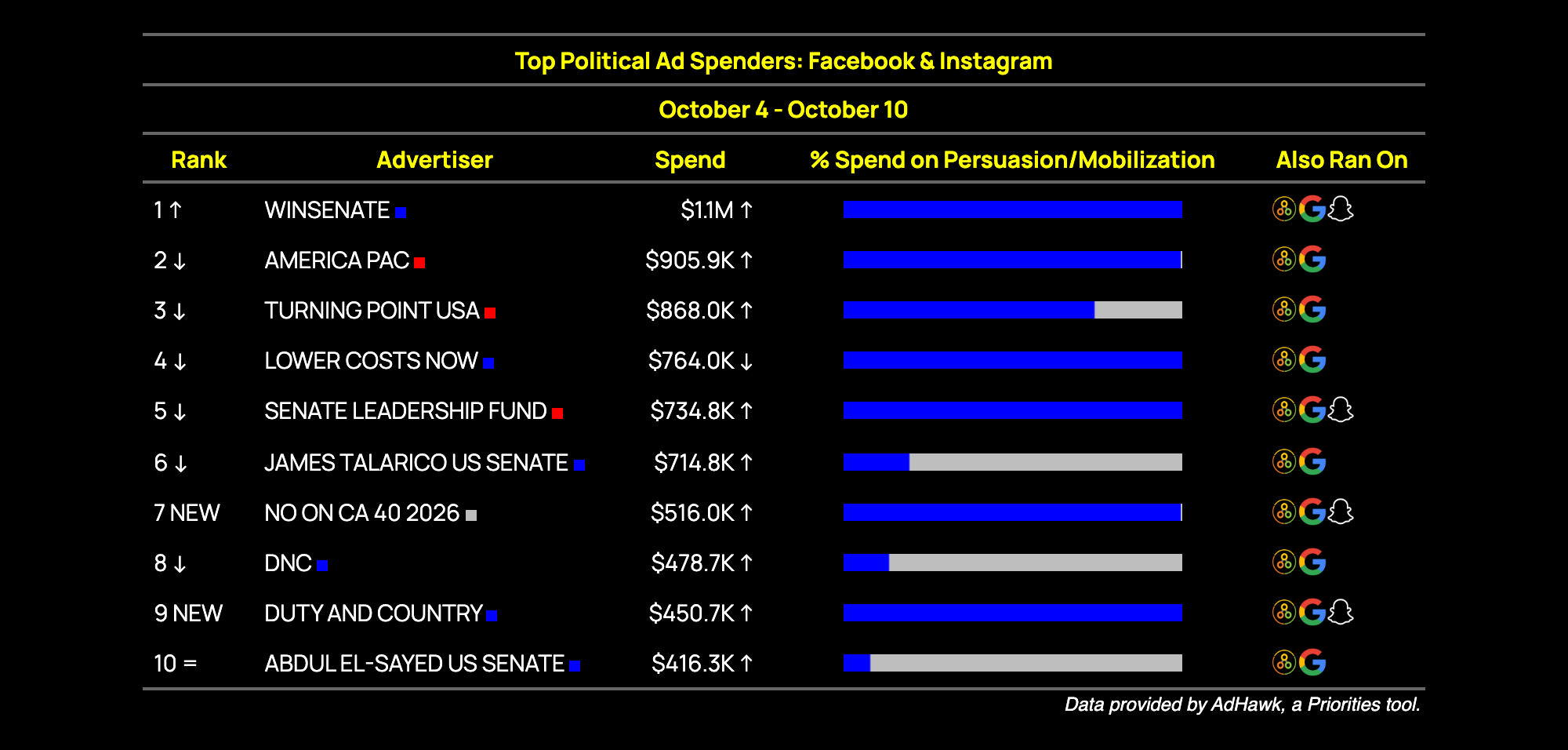
Future Forward is back online for the first time since the 2024 election. They’re running as Lower Costs Now, an entity that has already announced $9 million in paid ads across six Senate races. The group is live in Texas, Georgia, Ohio, Michigan, Iowa, and Kansas with a broad mix of creative from polished traditional spots and news clips to creator content.
Meanwhile, political advertisers spent around $72 million on Google and YouTube ads last week. These were the top ten spenders nationwide:
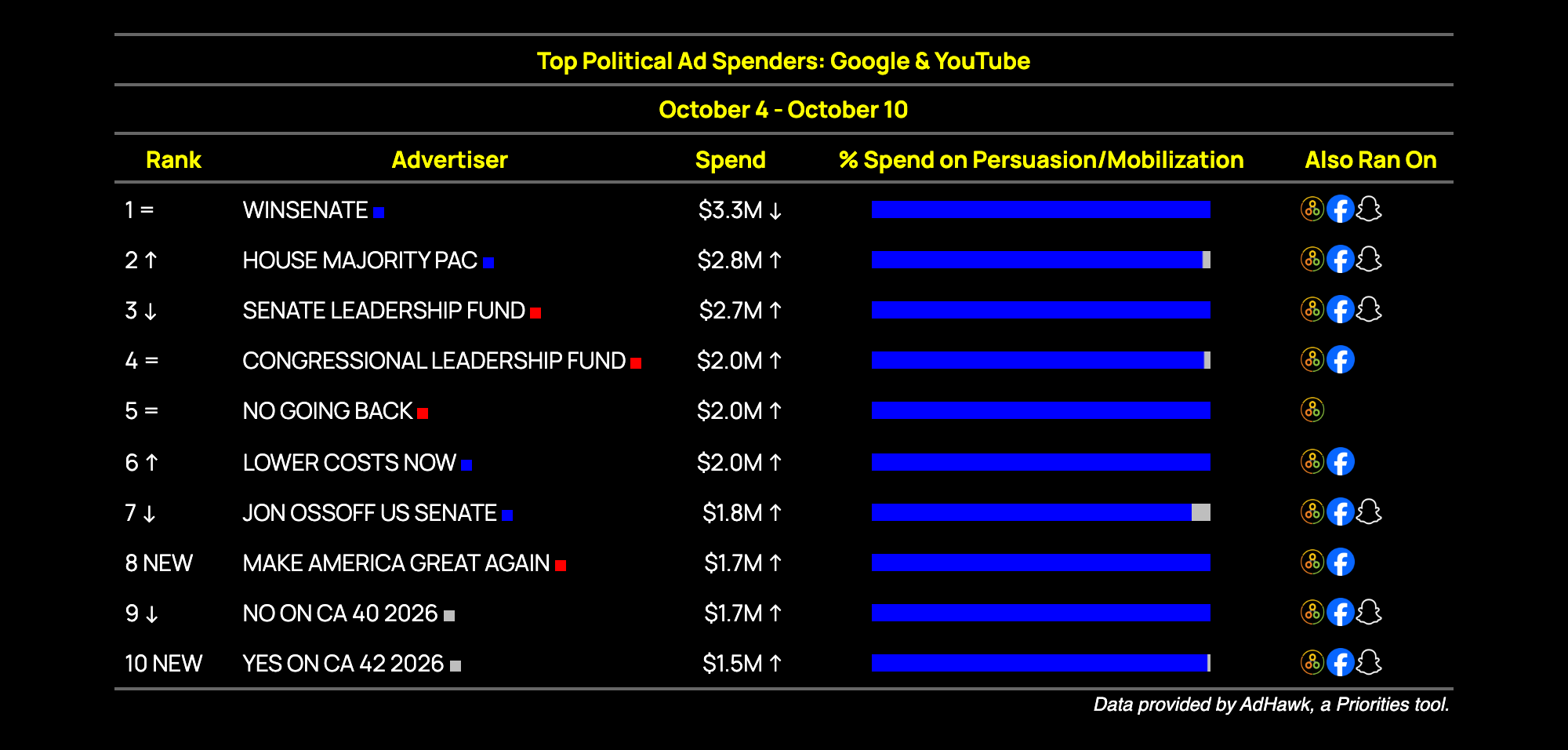
As the GOP “privately” concedes that it’s given up on the House majority, attention has shifted to the Senate, and in particular to playing defense in an attempt to hold the upper chamber. No state illustrates that better than Kansas, where Democrat Adam Hamilton nearly tripled his second-quarter fundraising.
On the paid side, non-candidate spending eclipsed candidate spending for the first time last week. Outside spenders poured $1.7 million into the state, with Senate Leadership Fund and Main Street Fund leading the defensive effort. On offense, Lower Costs Now (Future Forward) was the biggest spender, while Senate Majority PAC’s WinSenate launched spots at the tail end of the week.
The creative is mostly familiar territory: immigration, trans attacks, socialism, and diesel/Iran. But some groups are going more local with Kansas-specific messaging: a dueling war over child predation, a return to the Epstein files, and a healthcare spot which contrasts the two candidates.
We may have spoken too soon about Democrats’ other new pickup targets. American Bridge has put money into Florida’s Senate race and even gone online in Mississippi and South Carolina. Democratic megadonor Steve Pajcic is also planning a seven figure ad blitz.
On CTV platforms, U.S. political advertisers spent an estimated $123 million last week. Here were the top ten spenders nationwide:
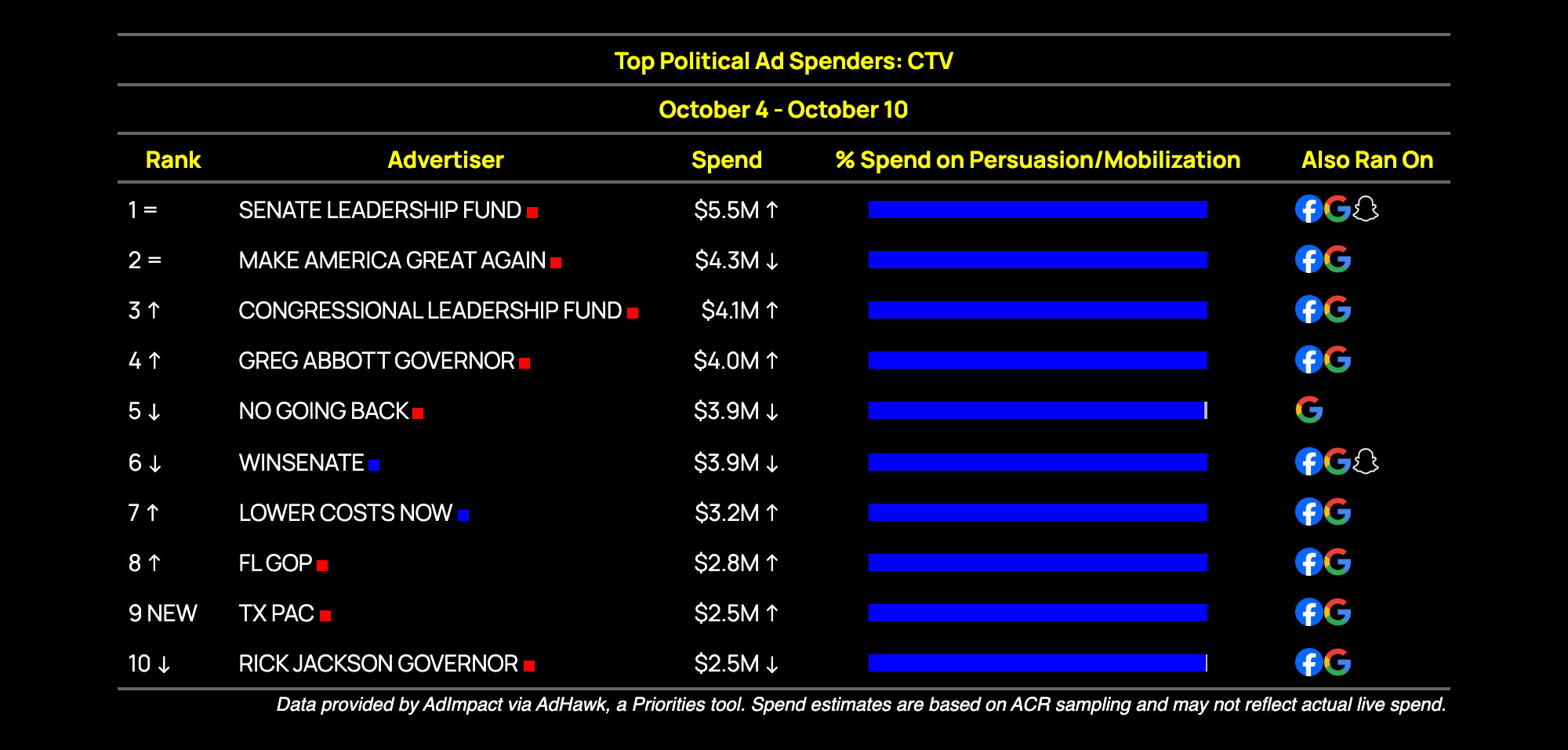
As the GOP grows increasingly worried about their base, they’re reaching for a familiar playbook: anti-choice messaging. Women Speak Out PAC is running ads across multiple states, often in multiple races, including Ohio, Georgia, Iowa, and South Carolina. They’ve spent over $420k so far, with more to come.
This is the first wave of anti-abortion spending we’ve seen from outside groups since 2024 and it’s a completely different tenor from Musk’s October surprise, which sought to muddy the waters around Trump’s abortion stance. It’s also a risky strategy—without careful targeting, Women Speak Out’s ads could end up alienating swing voters rather than turning out the base.
…and lastly, on Snapchat, here’s YTD data for the top 10 spenders:
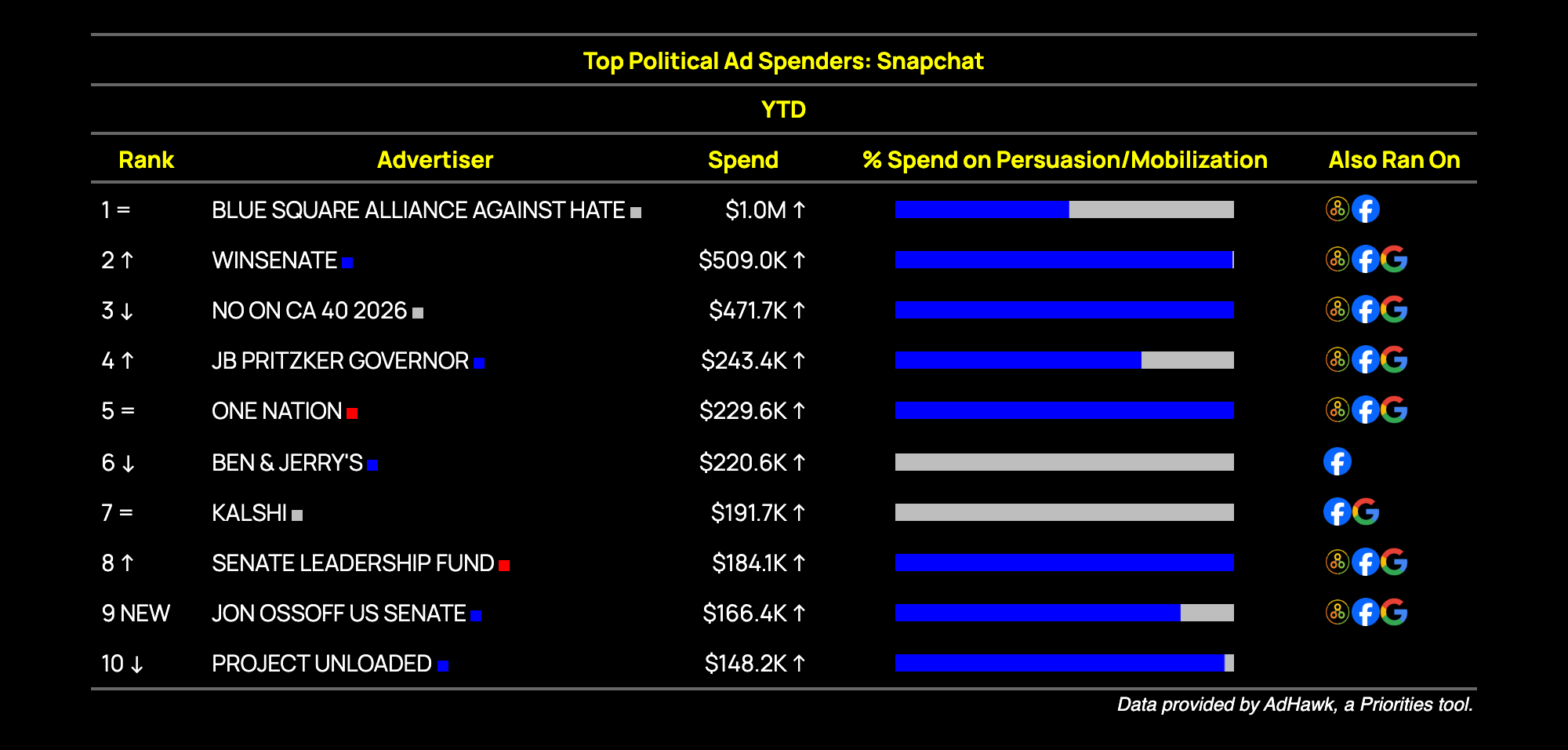
Mary Peltola has made her Snapchat debut with a moderating spot that highlights her NRA rating. On a platform dominated by young voters, it’s not immediately clear how this tactic will play, though her buyer did provide an undisclosed list for the targeting.
The other new Snapchat spender worth watching is Texas Forever, which has already dropped $30k on the platform across ten placements, all against Ken Paxton.
The Home Stretch Playbook
With less than three weeks to go until Election Day, the temptation is to panic-post with more volume. More graphics. More emails. More of whatever we were already doing.
This home stretch is the time to sharpen what’s already working, get it in front of people who haven’t seen it yet, and lock in the voters who haven’t been paying attention. They’re out there in bigger numbers than we’d like to admit, and they will decide this election. A lot of these voters are scrolling past election content in defiance of business as usual, and their frustration is understandable.
Voters don’t owe us their attention. But it’s our job to earn it, and we’ve got to move fast. This requires clarity, consistency, and the right messengers.
In a FWIW article earlier this year, “The Internet Knows You’re Faking It,” I made the case that you can borrow tactics, but you can’t rent trust.
Assuming you’ve been building that trust muscle all cycle, now’s the time to be both loud and strategic. These final weeks are all about showing up in more places, collaborating with more voices, and delivering the same core message every time.
Five moves for the final stretch
This is the framework I use for everything: create the content, amplify it through people your audience already trusts, and mobilize those people toward the next step. Here are five ways to put that into practice:
Invite folks to your kitchen table, one voter at a time: Voters are feeling the economic strain, and at this point, every candidate is talking about “the economy,” however abstract. It’s time to get more granular and more emotional by building specific messaging tracks around your plan and your vision. Your message should address voters’ frustration and offer a vision of what can be. This is also the point in the cycle when communicators feel like they’re repeating themselves and try to get cute with their language. Resist the urge by remaining clear and consistent across every imaginable medium.
Invite your audience in, through the front door: The audiences we’re trying to reach deserve an easy way to learn what we’re about. Consider a “Start Here” hub that doubles as a guide to boost voter confidence. Voters are overwhelmingly encountering misinformation and disinformation. The hub should answer three questions: Who are you? What are you fighting for? What can you do right now? Include key voting information and dates. Pin it on socials and give it prominent placement on your website. Make it easy for voters to be informed.
Recycle your best content: As communicators, we are often too precious about the stories we tell. Now’s the time to put the work you’ve done over the past several months in front of new audiences. Revisit your best-performing content. Pull your greatest hits. Upload them as-is or with a twist. If it did well before, it will likely do well again and reach a portion of your target audience who have never seen it.
Run content sprints: You no longer have the luxury of time, so consider the moments where you can capture something immediate and human. This content should answer what folks are asking most: Are you who you say you are? Do you understand what’s at stake? Will you fight? Mix in reaction videos to cultural moments already happening, behind-the-scenes footage, and on-the-street conversations. These final weeks are about credibility, sure. But we can’t forget that credibility goes hand in hand with relatability. Show off your personality!
Focus on distribution: We seem to have gotten the memo that focusing on content is critical. That’s great, but there’s a new reality: elections in 2026 and beyond will be won or lost by how well we amplify our content across every corner of the internet. Instead of our accounts being the broadcast tower, we’ve got to think in terms of hubs and satellites. The hub is your official page. The satellites are trusted people in orbit: supporters, volunteers, creators, and local celebrities. They post from their own pages, to their own people, in their own voices. Look for amplifiers who expand your reach, validators who lend credibility, and connectors who tap into communities and culture you can’t reach on your own.
Make people believe
We’ve spent this entire cycle experimenting and seemingly making more political content than ever.
The campaigns and movements that win in these closing weeks will do more than produce content. They’ll make people believe in a vision that goes beyond themselves and beyond any single election cycle. Voters are eager to mobilize around belonging, purpose, hope, and possibility. Let’s give them what they want.
As communicators, our focus should be on creating content that resonates, amplifying it through people your audience trusts, and mobilizing voters with clear and useful information.
Transformative change requires nothing less.

Get the full receipts every Monday in The Cover-Up
COURIER's Contradictions Tracker puts officials' Epstein testimony next to the files, with every entry linked to its primary source. Updated weekly in The Cover-Up.
That’s it for FWIW this week. This email was sent to 25,830 readers. If you enjoy reading this newsletter each week, would you mind sharing it on X/Twitter, Threads, or Bluesky? Have a tip, idea, or feedback? Reply directly to this email.
