



Hi everyone! We’re the digital team at America’s Voice, a national immigration advocacy organization that uses research, communications, and digital organizing to build public support for immigration reform.
In our last piece for FWIW, we talked about why some of the best messengers on immigration aren’t necessarily immigration experts. They’re the people we already know and trust: our neighbors, teachers, pastors, parents, and creators who have spent years building communities online.
But there’s another part of that conversation we’ve been thinking about a lot lately: the stories we’re asking those messengers to tell.
More on that below, but first…
Digital ad spending, by the numbers:
FWIW, U.S. political advertisers spent around $40 million on Facebook and Instagram ads last week. Here were the top ten spenders nationwide:
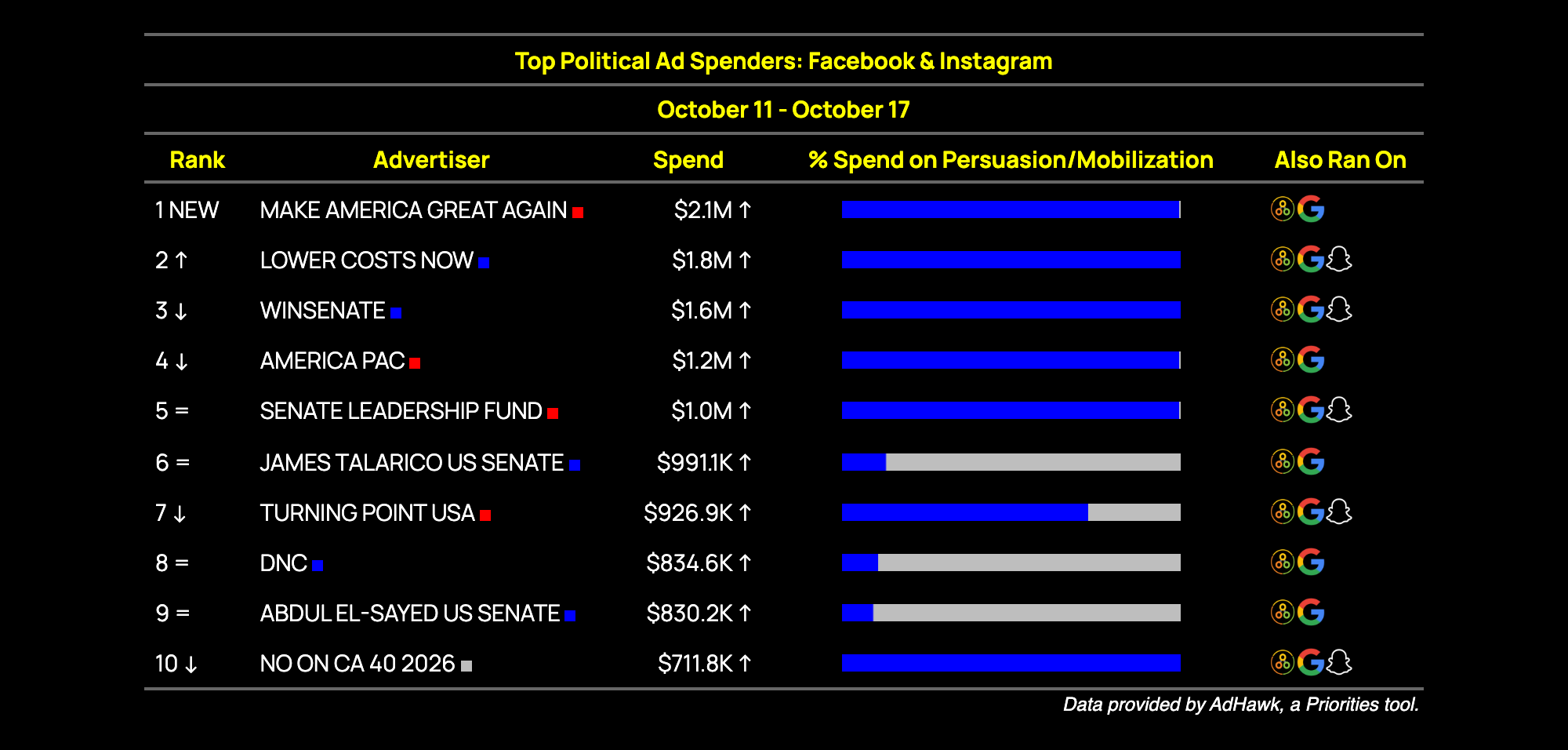
Trump is up with a new entity and in case, like us, you can’t keep track of them all, let’s review what his active PACs were up to last week:
No Going Back ($3.1 million): Active in 29 Senate and House races, it’s basically MAGA in states where the name might trigger backlash. While the House spots are negatives on self-enrichment and corruption, the Senate ads lean into contrast: taxes, health insurance, and “unemployment city”.
Common Sense Voters Coalition ($4.3 million): The new entity! So far, it’s all generic, fear-motivated mobilization spots. The name and page don’t exactly scream MAGA, but the Meta disclaimer gives it away as MAGA-funded.
Make America Great Again ($1.8 million): In Texas, apparently there’s no need to shy away from the MAGA brand. 98% of its spending went to a spot titled ‘Weird,’ though we’re still seeing some money behind the older tax contrast spots.
Safety and Affordability PAC ($400k): Primarily active in the House, this entity is spending broadly on targeted negative content.
Meanwhile, political advertisers spent around $88 million on Google and YouTube ads last week. These were the top ten spenders nationwide:
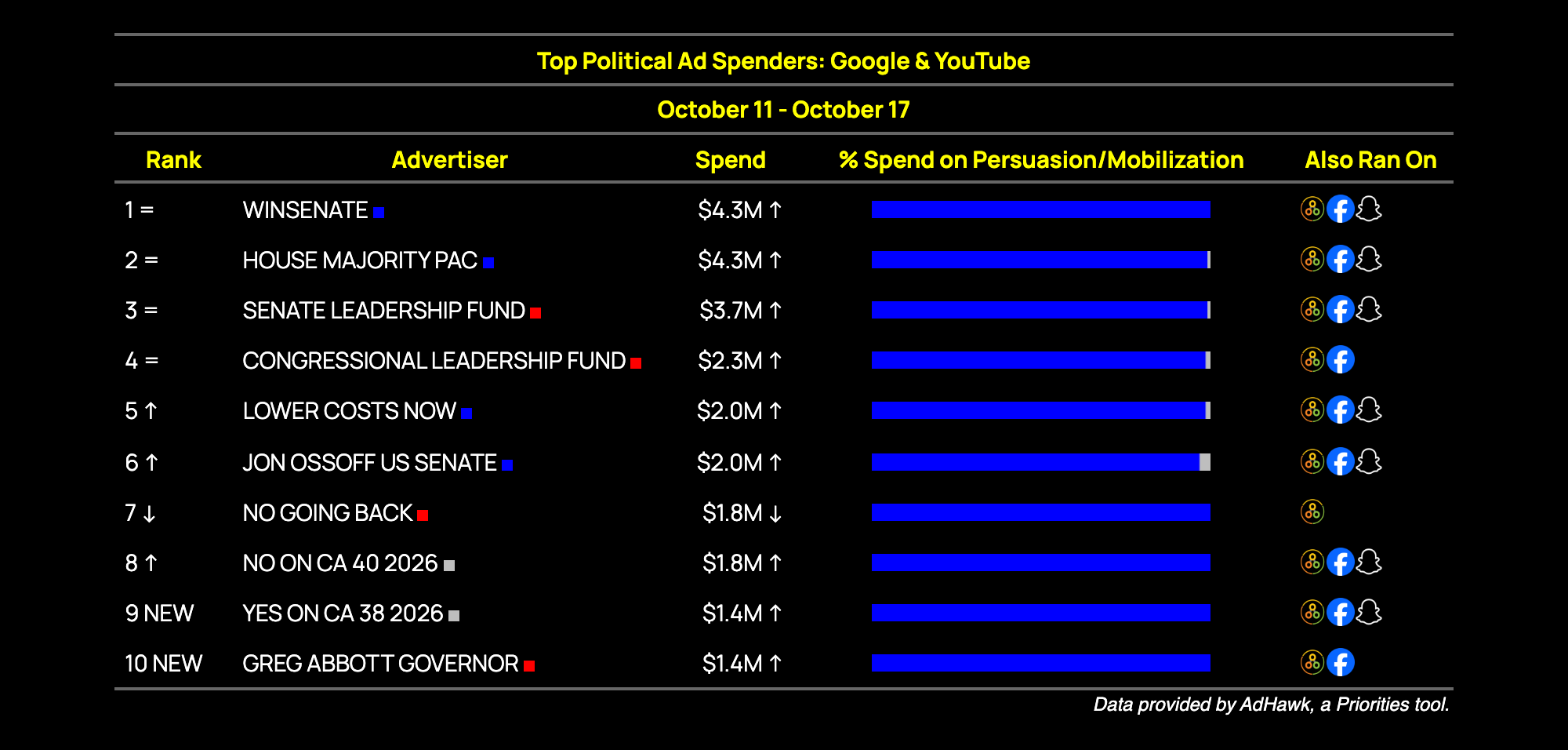
Ballot initiatives have become a real weapon in the political arena on everything from reproductive rights to redistricting. Appropriately, spending behind them has ballooned over the last few cycles, particularly on digital. We tracked $49 million in 2022, $64 million in 2024, and we’re already at $51 million this cycle. With two weeks to go, we expect 2026 will push well past 2024. A few key initiatives to get you oriented:
In California:
The wealth tax (Prop 40): Tech billionaires, pushing a no vote, dumped $1.8 million last week into fighting higher taxes for themselves. The yes side has just $16k behind it, including this digital spot.
Another tax thing (Prop 42): This prop would ban taxes on retirement and savings accounts. Much like Prop 40, there’s a lot of educational messaging out there. 42 sits just outside of the top ten here, but had $4 million across all digital platforms last week.
Not in California:
More tax things (Washington 645): This would repeal the state income tax, a popular issue in ballot fights across the country. Weekly spending broke $1 million, mostly on spots like this one.
Finally, not taxes—courts! (Montana 132): This one is about whether to allow explicitly partisan judges.
On CTV platforms, U.S. political advertisers spent an estimated $146 million last week. Here were the top ten spenders nationwide:
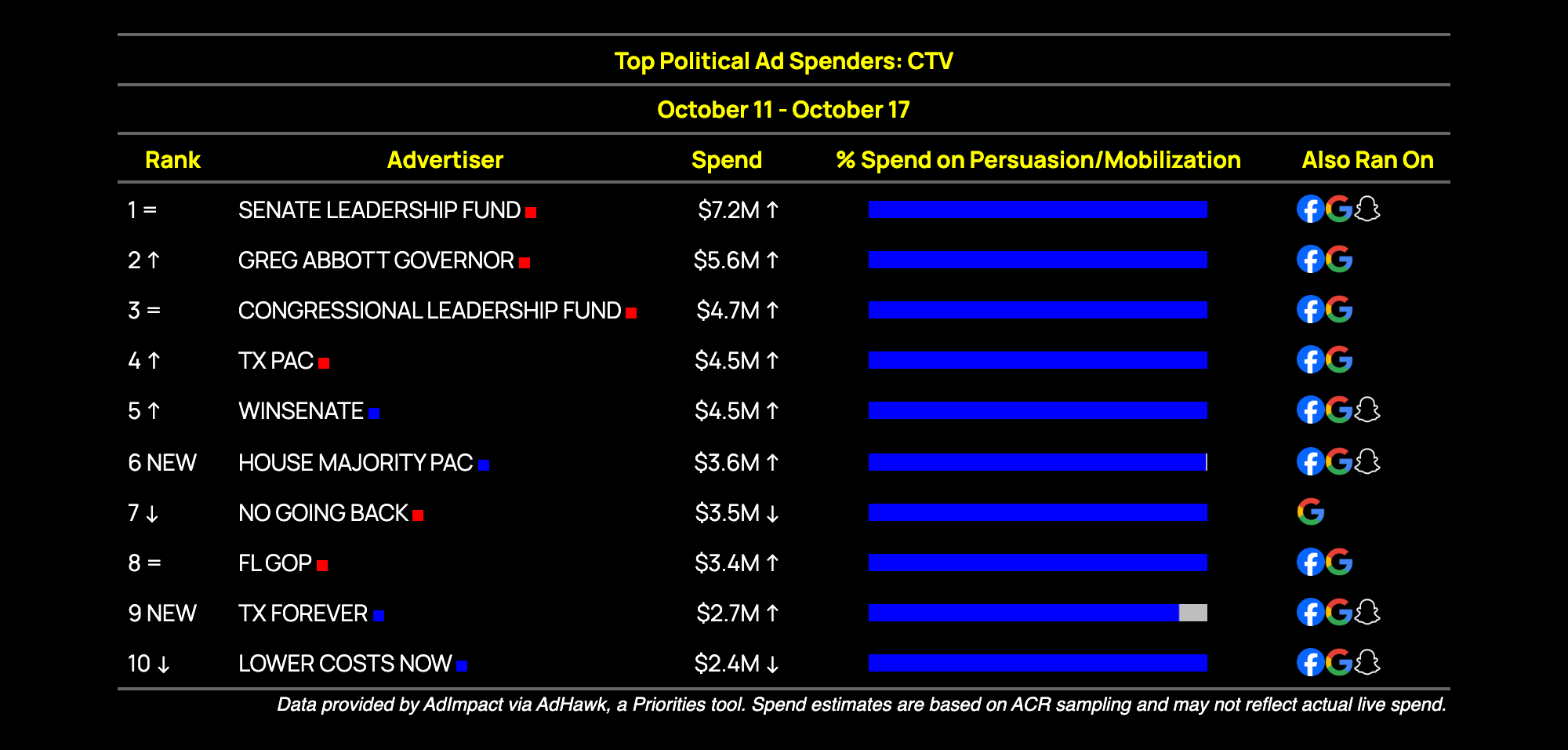
Messaging in Texas is all over the place, so here’s your latest debrief on the Senate race:
Run of the mill anti-trans ads from Texas PAC
A defense of Ken Paxton, touting his work as AG
A callout of Paxton’s AI-generated videos of James Talarico
A Spanish-language spot highlighting Paxton’s role in the Uvalde shootings
From Lower Costs Now: a pro-Talarico spot and two covering Paxton’s animal abuse and corruption
A Spanish-language exposé of the Hoffman-Paxton plea deal
Overall, the GOP spent $28 million while Democrats were up with $14.4 million. And we’re sure to see plenty more come through before this thing is over.
…and lastly, on Snapchat, here’s YTD data for the top ten spenders:
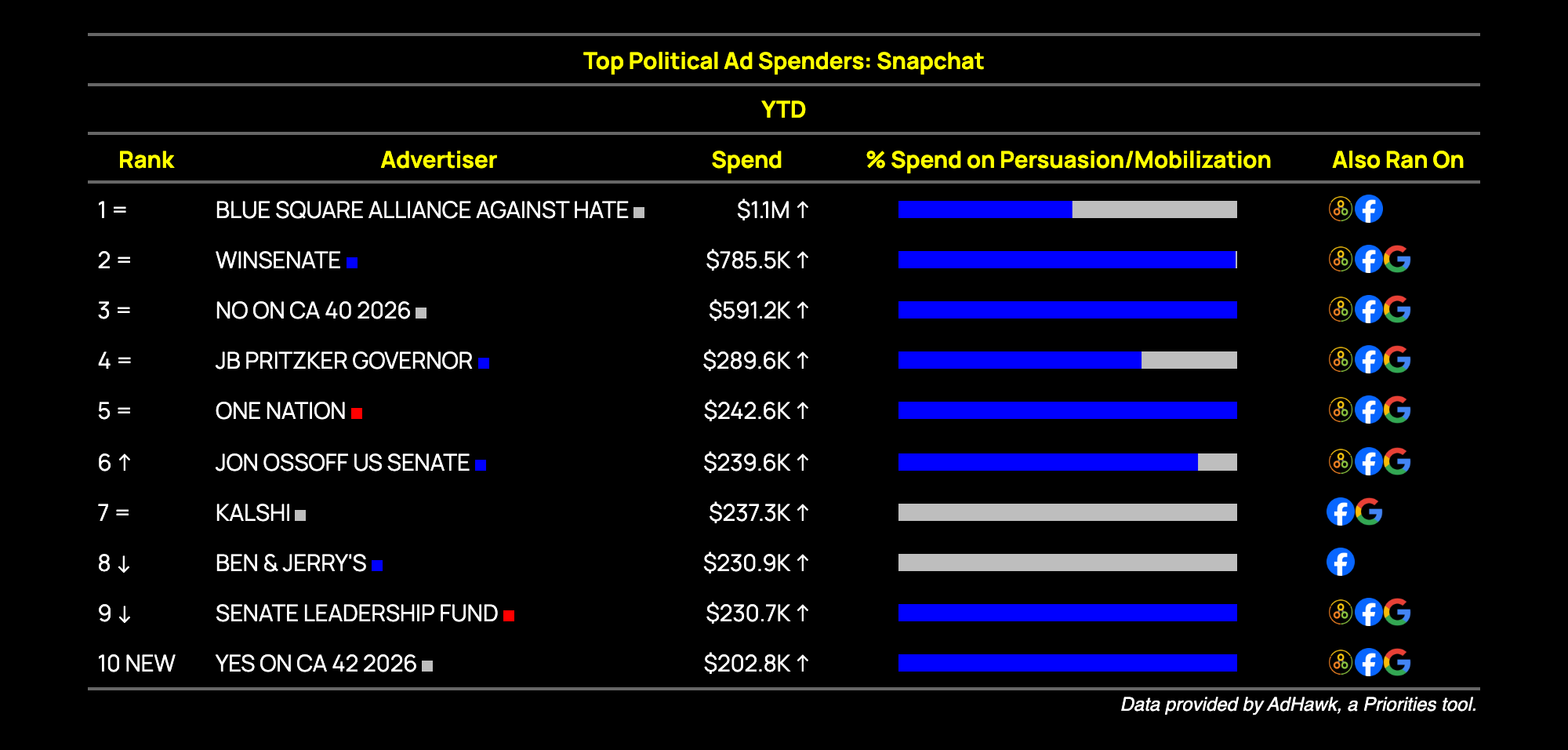
Unsurprisingly, WinSenate (an affiliate of Democratic group Senate Majority PAC) was the biggest spender on the platform this week, at $150k. Almost half of that went behind this anti-Husted spot in Ohio.
In second and third place were Jon Ossoff and Bruce Blakeman, who spent $72k and $61k, respectively. Blakeman is still pushing his anti-Hochul saxophone spot, for anyone keeping track.
The Cruelty is the Point
Over the past year, our team has spent countless hours tracking immigration enforcement and abuses of power across the country. We’ve worked with creators and partners to find new ways to bring the human consequences of mass deportation into people’s social media feeds.
And if there’s one thing that has become increasingly clear, it’s this: The violence and cruelty we’re witnessing isn’t a side effect of the Trump administration’s immigration agenda. It’s the point.
We’re talking about parents being detained after dropping their kids off at school. Longtime neighbors taken from their communities. Children growing up afraid that their parents might not be there when they get home. Kids as young as 2 years old facing immigration judges alone.
These aren’t abstract policy debates. They’re people’s lives.
And the more we tell these stories, the harder it becomes to pretend that what’s happening is just business as usual.
The People Behind the Headlines
One of the biggest challenges we face as immigration communicators is that enforcement is often discussed in numbers: billions of dollars in enforcement spending, thousands of arrests, dozens of detention facilities expanding across the country. Those numbers matter, of course. They tell us the scale of what’s happening. But they don’t tell us what it feels like.
A statistic can’t capture the fear that spreads through a community when immigration agents show up in the neighborhood. It can’t capture the uncertainty of not knowing where a loved one is being held or when they’ll be released. And it can’t capture a family’s scramble to pay rent, buy groceries, and explain to their children why someone they love isn’t coming home.
Consider the case of a Haitian father in San Diego who was detained by immigration authorities shortly after dropping his toddler off at a Head Start program. What should have been an ordinary morning for a father and his child instead became another example of how immigration enforcement is upending lives in communities across the country.
That’s what gets lost when immigration enforcement is discussed only in terms of arrests and deportation targets. We’re talking about people whose lives change in an instant and about families who have no idea what tomorrow will bring.
For our digital team, stories like these have become central to how we communicate the consequences of mass deportation. Because when people see a parent, a neighbor, or a child instead of an immigration statistic, the conversation changes.
Children Are Paying The Price
Perhaps nowhere is the cruelty more apparent than in what’s happening to children.
According to The Marshall Project, ICE detained more than 500 children ages three and younger between January 2025 and March 2026. We’re talking about babies and toddlers – children who are still learning to talk and who need consistency, stability, and the comfort of their parents.
But behind that number are stories that are even harder to comprehend.
At the detention center in Dilley, Texas, families have reported children experiencing severe emotional distress. A two-year-old boy named Kaleth was reportedly suffering from a fever and refusing to eat the food provided at the facility. When his mother, Joani, asked staff for help, she was allegedly told that his symptoms were all “mental.” According to Rep. Joaquin Castro (D-TX), Kaleth wasn’t receiving adequate medical attention, even as his mother pleaded for assistance.
And he was far from the only child suffering inside the facility. Families have reported severe emotional distress among children, including a 13-year-old who was reportedly placed in isolation after attempting suicide.
These are children whose days should be filled with learning, playing, and spending time with their families. Instead, they’re experiencing fear, isolation, and conditions that child development experts have long warned can cause lasting psychological harm. And for many children – not just immigrant children – that fear doesn’t end when they leave detention. It follows them into their homes, classrooms, and everyday lives.
That’s why we’ve been particularly focused on elevating children’s stories at America’s Voice. Through our work with creators, educators, and children’s advocates, we’re trying to make sure these experiences don’t disappear into the daily flood of immigration headlines.
Why These Stories Are Breaking Through
One thing we’ve learned from working with more than a hundred creators is that people respond to stories that feel close to their own lives.
A video about a complicated immigration court ruling might reach people who already follow immigration news. But a video about a family being separated? That can reach someone who has never paid much attention to immigration policy at all.
And that distinction matters.
Our team works with creators from all kinds of backgrounds, including faith leaders, veterans, teachers, and lifestyle creators. Many don’t consider themselves immigration advocates. That’s part of what makes their voices so powerful. They often recognize something that connects directly to their own values.
A teacher sees the impact on students. A parent thinks about their own children. A faith leader sees a community member who needs support.
That’s how an issue that’s often framed as political becomes personal.
Of course, telling these stories responsibly matters, too. We have to verify the facts, provide context, and make sure we’re not reducing someone’s trauma to a viral moment.
Part of our work is helping creators access credible reporting, research, and firsthand accounts so they can tell these stories accurately and in their own voices.
And importantly, the goal isn’t simply to make people feel sad or angry. It’s to help them understand that the consequences of mass deportation aren’t happening somewhere far away, to people who have nothing to do with their lives. They’re happening all around us – in neighborhoods, schools, workplaces, and communities across the country.
And it is about people taking action to make it all stop.
The Stories We Need to Keep Telling
As we get closer to Election Day, there will be no shortage of conversations about immigration. We’ll hear about border security, enforcement statistics, and political messaging. We’ll hear plenty of arguments about which policies are popular and which talking points are most effective.
But we hope communicators keep coming back to the real people at the center of those conversations – the children in detention, the parents and children grieving their loved ones caught in the dragnet, and the families being separated.
Because there’s a difference between telling people that an immigration policy is cruel and showing them what that cruelty looks like.
We don’t need every creator, communicator, or organization to become an expert in immigration law. We need more people willing to pay attention, listen to those directly affected, and help tell their stories with care and accuracy.
The Trump administration has made cruelty a defining feature of its immigration agenda. Our responsibility is to make sure the people experiencing that cruelty aren’t reduced to numbers, headlines, or political talking points.
The most powerful way to expose what’s happening isn’t always to explain another policy. Sometimes, it’s simply to tell the story of the person whose life that policy has changed.

Get the full receipts every Monday in The Cover-Up
COURIER's Contradictions Tracker puts officials' Epstein testimony next to the files, with every entry linked to its primary source. Updated weekly in The Cover-Up.
That’s it for FWIW this week. This email was sent to 25,830 readers. If you enjoy reading this newsletter each week, would you mind sharing it on X/Twitter, Threads, or Bluesky? Have a tip, idea, or feedback? Reply directly to this email.
