The Case for Amplification In The Fight For Voting Rights
Also inside: primary season is heating up
SPONSORED BY STACKADAPT
Hi Everyone! I’m Esosa Osa, Founder and CEO of Onyx Impact. In this era of propaganda, the Onyx team is fighting the spread of harmful information, investing in independent Black media, and empowering Black communities to create healthier online ecosystems. My work is grounded in my experience as Deputy Executive Director of Fair Fight Action, where I led national efforts around voting policy reform and developed strategies to protect democracy.
All of that to say: I have dedicated my career to preventing a decision like Callais from happening, and I have an unwavering commitment to scaling power to build something greater on the other side of it.
More on that below, but first…
Digital ad spending, by the numbers:
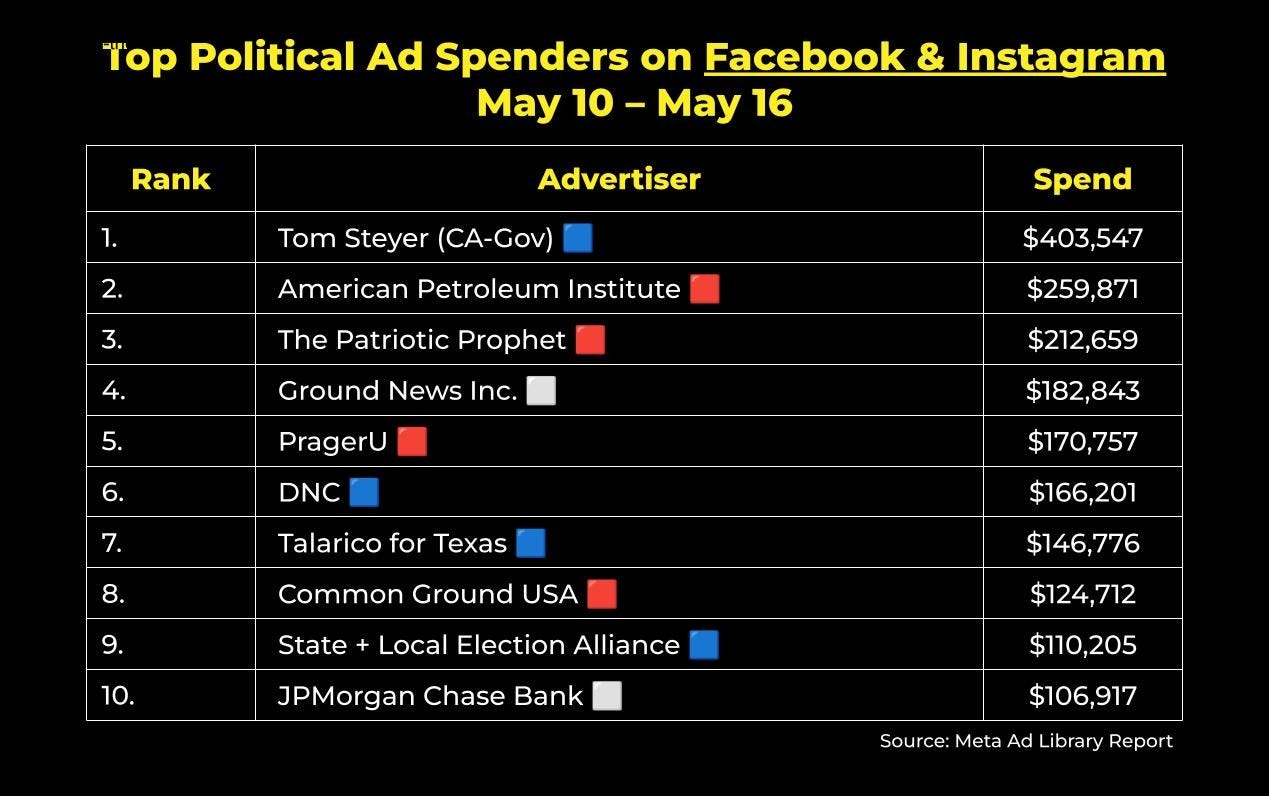
FWIW, U.S. political advertisers spentaround $16.7 million on Facebook and Instagram ads last week. Here were the top ten spenders nationwide:
American Petroleum earned its spot atop the leaderboard with ads urging viewers in Colorado, Georgia, Michigan, Minnesota, New Mexico, North Carolina, Ohio, and Pennsylvania to believe that “economic success starts with oil and natural gas.” Right now, the average price of gas across those states sits around $4.50 per gallon, which is well over a dollar more than what it was in 2024. Sounds like it might be time for American Petroleum to revisit its definition of “economic success.”
A little lower on the chart, but still earning top spender stripes, is James Talarico. The Texas Democrat seems to be riding the high of his taco outing with former President Obama last week. So, that leaves pretty much everyone in the Texas Senate race having a better time than Senator John Cornyn.
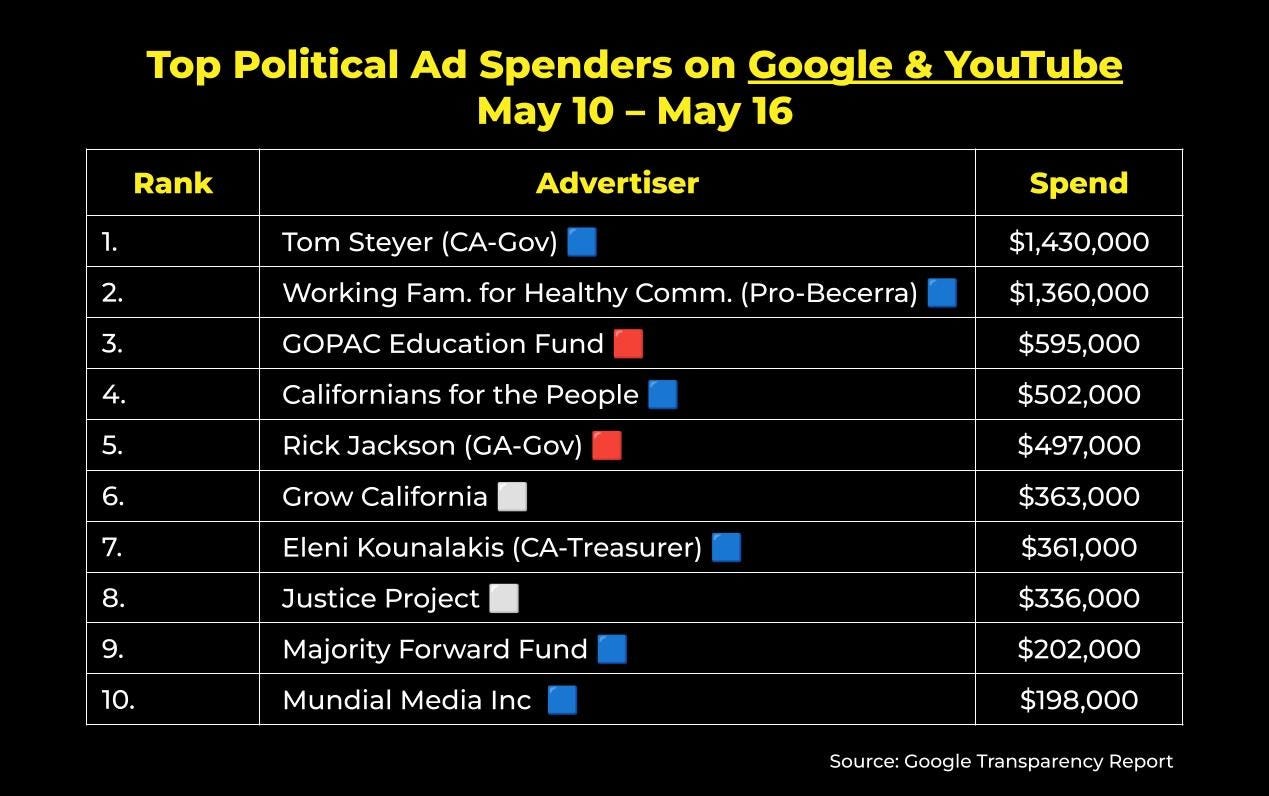
Meanwhile, political advertisers spent around $17.1 million on Google and YouTube ads last week. These were the top ten spenders nationwide:
This past week gave Super Tuesday’s weird little midterm cousin energy, with voters in six states heading to the polls —a number we will see again on June 2. But a look at the top spenders on Google and YouTube might make you think California is the only one with a major election underway. To be fair, not every state has a top-two primary with 62 gubernatorial candidates. But while you may not get a text back, your work presentation may bomb, and your coffee may burn, there’s one thing you can almost certainly count on: Tom Steyer spending more money than everyone else.
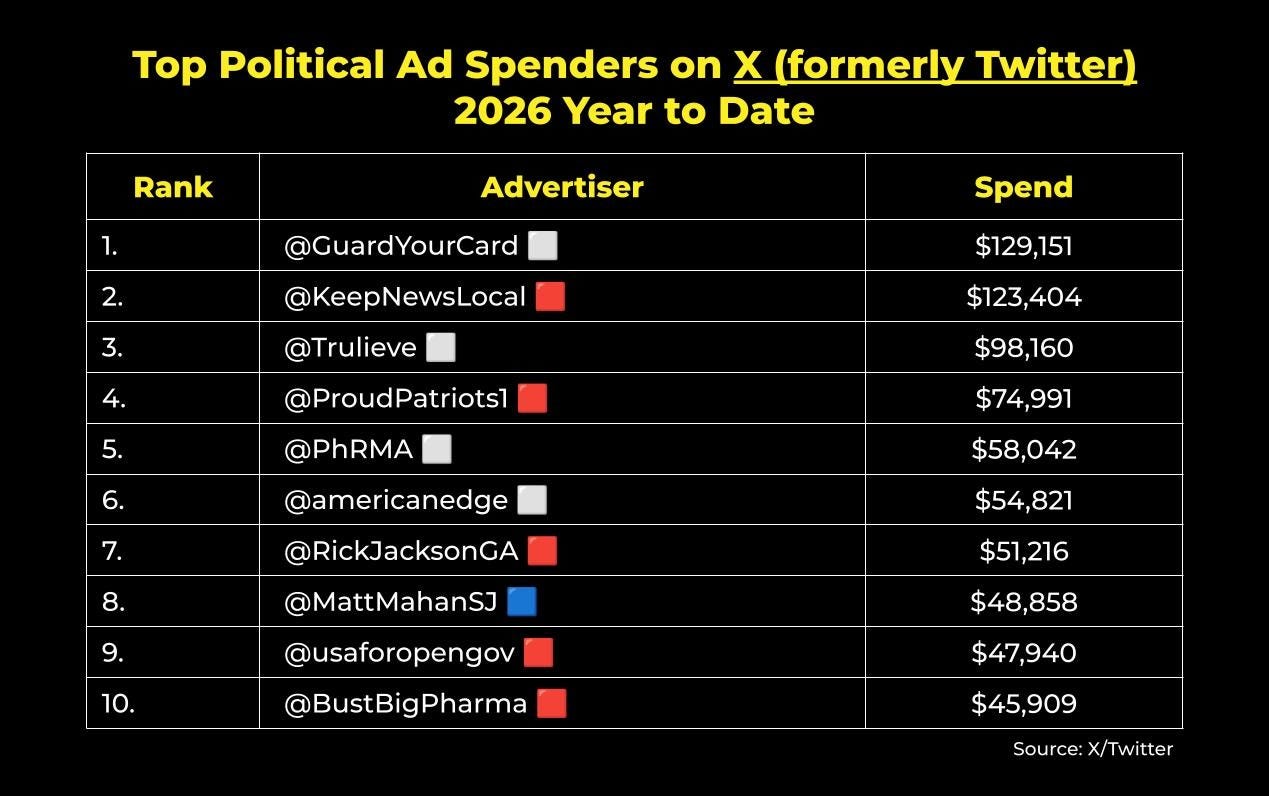
X, formerly Twitter, needs to get its act together on its disclosure information. We are still tabulating political advertisers’ total 2026 platform spend at around $1.8 million. In case you want the evergreen reminder, here are top spenders year to date as of… well, a long time ago:
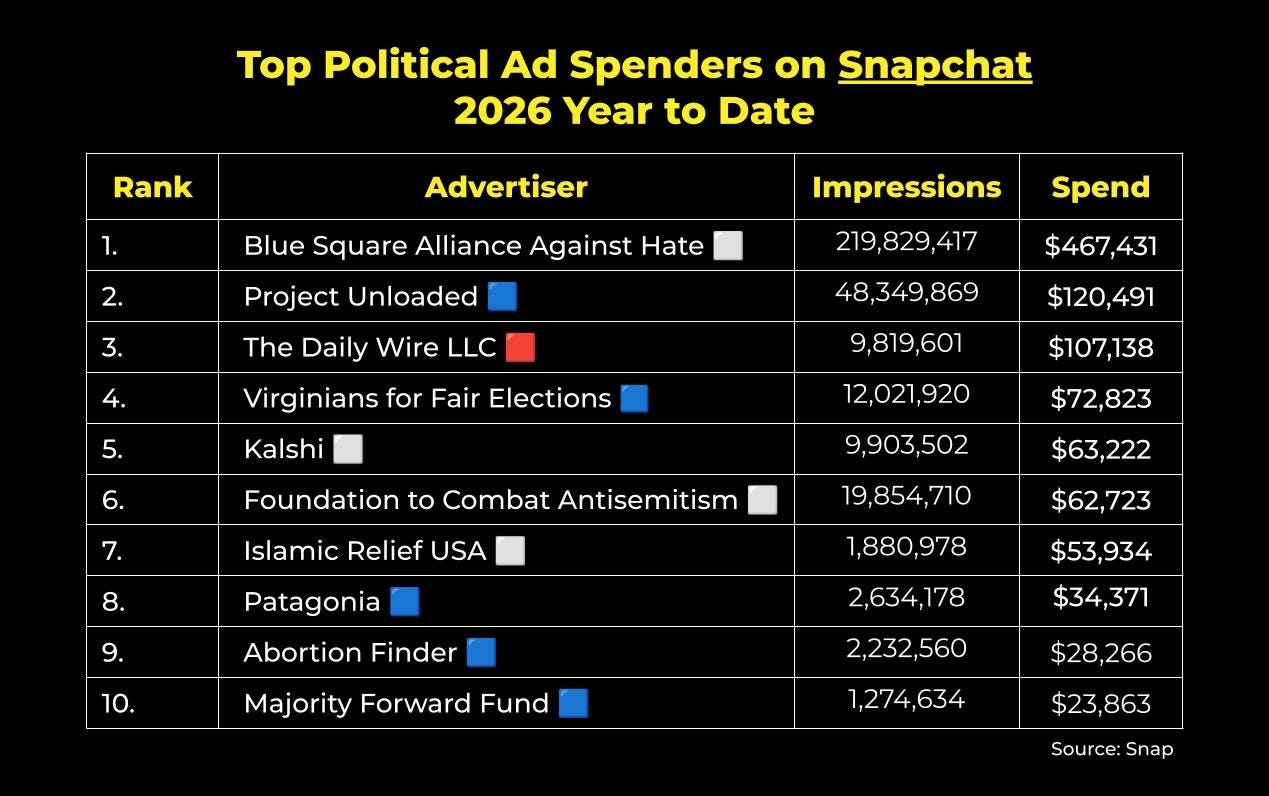
…and lastly, on Snapchat, political advertisers in the U.S. have spent just over $1.3M on ads in 2026. Here are the top spenders year to date:
Your political media mix has a tracking blind spot
In politics, everything comes down to wins and losses—but you need the right tools to know if you’re on track. As CTV captures more ad spend, measurement hasn’t kept up. Learn how to track performance across CTV, video, display, and more to see what’s really driving real-time results. Learn more >
The Case for Amplification In The Fight For Voting Rights
There are two stories colliding in the digital universe right now that we should all be paying attention to.
This past weekend, the New York Times published a buzzy story questioning the expanding—and sometimes murky—role of content creators in political and advocacy campaigns.
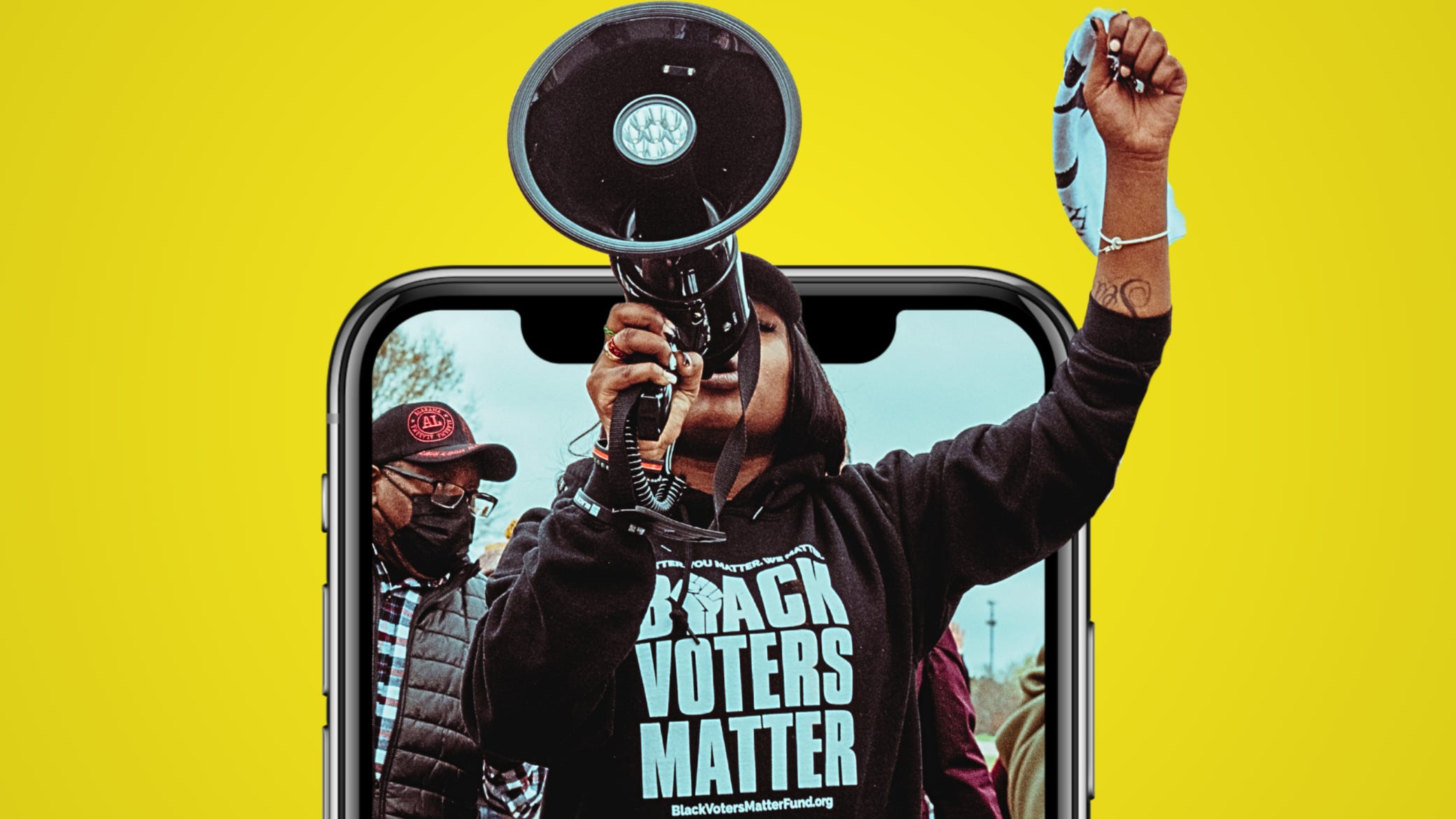
That same day, thousands of people from across the country came to Alabama after the Supreme Court’s Callais decision eviscerated the Voting Rights Act, removing some of the last remaining protections for Black voters in the South. The ruling targeted one of the Civil Rights movement’s most crowning achievements. And organizers responded accordingly.
The All Roads Lead to The South pro-voting rights march and rally came together to reject the wave of former Confederate states moving to erase fair representation and Black political power in the decision’s wake. Alongside those in attendance, 80 satellite events blanketed the country and millions tuned in online.
Now here’s where the two stories come together.
While parts of the Times’ critique of disclosures and the wild-west nature of the sector are valid, it assumes that creators are not leveraging their platforms to help stories break through the noise in one of the most frenetic news environments in our country’s history. In reality, it was the rapid-response creators, organizers on the ground streaming live, and local officials posting in real time who kept the conversation around Callais alive for weeks.
Mainstream media gave the decision cursory coverage. Talking heads on cable news explained the ruling almost exclusively in legal terms. But we all know that cable reaches a fraction of the audience that the right-wing blogosphere does. To win, the Left needs a multipronged approach that must include amplifying narratives from people closest to the ground and, therefore, closest to the harm.
It’s Black creators and their allies who are stepping into the gap left wide open by mainstream media that is feverishly fixated on 1600 Pennsylvania Ave. Creators like Elizabeth Booker Houston, Lynae Vanee, Joshua Doss, and Garrison Hayes produced content that propelled this decision outside of the beltway and onto social media timelines. Black media outlets added their own amplification lift. Roland Martin Unfiltered multicasted the rally live on YouTube, while REVOLT boosted coverage of the event and The Root collaborated with creators to expand reach across platforms.
Each of them, and many others, have authentic relationships with their audiences, along with the lived experience that enables them to provide critical historical context to the ruling’s impact and the meaning of the moment. This weekend showed us that if we want to move the base, we must adopt a surround-sound strategy that not only hooks people through social media but also engages them in a movement.
According to data collected by Defiance Dispatch and verified by Onyx Impact, content related to the Callais decision generated 948.8 million views, 99.1 million engagements, and 79,818 posts. Defiance Dispatch’s social media sweep found that All Roads garnered 82.5 million views with 11 million engagements and 9,637 posts this past weekend alone.
Given the results of this collaboration, one could argue that failing to engage creators or deploy a sophisticated digital strategy is advocacy malpractice. With the VRA, Black creators and Southern organizers are capturing the public’s attention, driving culture, shaping online trends, and moving audiences to action.
We cannot ignore the power creators have to level the playing field for audiences that don’t typically receive mainstream coverage. Black media storytellers reflect their audiences’ experiences and lived memories in their coverage, deepening connection and providing authenticity that is essential to moving information from the corners of the Internet into the mainstream. When combined with grassroots amplification accounts like the Tennessee Holler, Defiance Dispatch, and COURIER, the aftermath of the Callais decision feels fundamentally different from the post-Dobbs news cycle.
Those who assail voting rights, democratic norms, and anti-corruption practices have long understood the power of amplification to influence the barometer of public sentiment. The right has employed and deployed creators and amplification accounts designed to spread their propaganda and control narratives online to great success. Onyx’s research has found that right-wing narratives spread across the internet at rates their opposition fails to match or replicate.
The story is not merely about political strategy or an evil plot to subvert the law. This is about adaptability in the era of propaganda and regulation that has failed to keep up. For some in our country, especially our Southern neighbors, this is about a means of survival.
We’ve written reports in the past about the unprecedented efforts to erase, distort, and suppress Black history, wealth, and data from the public record, alongside the impacts of the currentadministration’s anti-DEI policies on Black federal contractors who make up just 1.2% of all federal contract recipients. Unemployment numbers are holding steady for most of the country, but for Black people, especially Black women, 600,000 of whom lost their jobs in the last year, the rate is much higher than that of their counterparts. The Callais decision proves the pattern we are seeing is very intentional: crush the opposition by going after and weakening its loudest voices.
Mainstream media is right to be concerned about the direction of the industry as a whole. Foundational elements and rules of engagement no longer apply in the same form. Podcast audiences continue to grow, while NPR and radio decline. A majority of Americans do not trust journalists to act in their best interests, according to a recent study released by Pew. And every day we see more and more journalists harassed and attacked, while also experiencing widespread layoffs driven by corporate consolidation.
No doubt, journalists and mainstream media are right to ask questions. They are just focused on the wrong problem.
When wielded for evil, we know social media causes massive harm on so many levels, especially our health. Study after study makes this plain. But we have yet to fully understand its potential for good and how it can amplify and socialize the idea that we the people do have the power to hold our leaders accountable.
Traditional media used to be the primary means for communicating information, but unless they adapt, they will be left behind.
Your political media mix has a tracking blind spot
In politics, everything comes down to wins and losses—but you need the right tools to know if you’re on track. As CTV captures more ad spend, measurement hasn’t kept up. Learn how to track performance across CTV, video, display, and more to see what’s really driving real-time results. Learn more >
That’s it for FWIW this week. This email was sent to 25,819 readers. If you enjoy reading this newsletter each week, would you mind sharing it on X/Twitter, Threads, or Bluesky? Have a tip, idea, or feedback? Reply directly to this email.
Join COURIER and 3.14 Action on June 11 for Facts vs. Fiction: The Fight for Science in American Democracy.
Misinformation isn’t just noise. It’s shaping policy decisions that impact healthcare costs, public health, and everyone’s lives. This live conversation will examine what’s at stake when facts are ignored and what changes when experts lead with evidence. From lowering costs to protecting access to care, we will break down how science-driven leadership delivers real results and why scientific integrity is essential to democracy.
Hear directly from:
Senator John Hickenlooper, Former Governor of Colorado
Dr. Vin Gupta, Physician + Medical Analyst
Representative Emily Gregory, Florida House of Representatives (HD-87)
Dr. Paul A. Offit, Director, Vaccine Education Center, Children’s Hospital of Philadelphia
Shaughnessy Naughton, 314 Action President
Stay tuned for more speaker announcements, and don’t miss this conversation. RSVP today!