

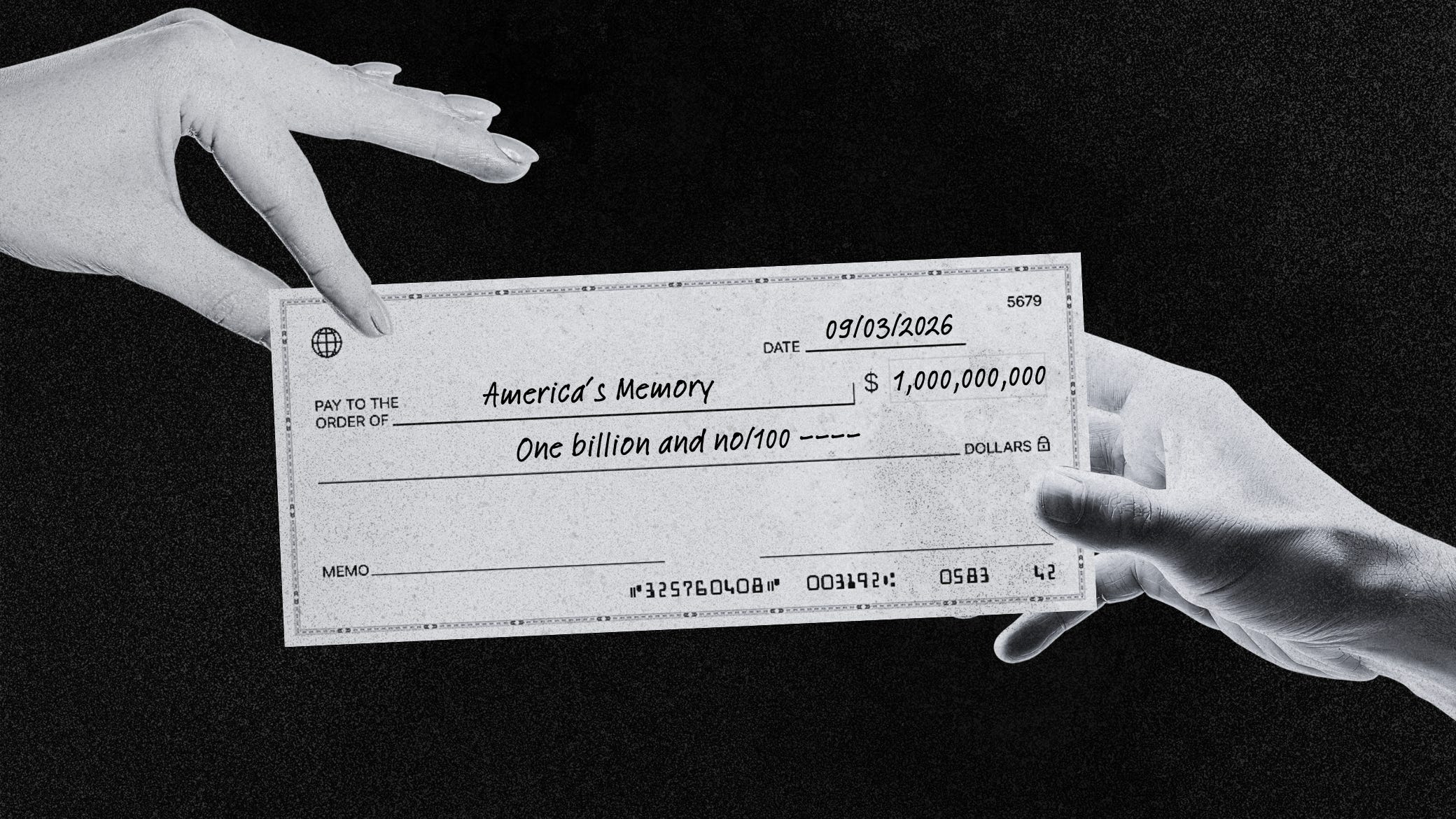
The Billion-Dollar War Over America's Memory
Also inside: The Cover-Up, COURIER's new investigation into the Epstein class

Hi everyone, idris brewster here! I am a Brooklyn artist, technologist and founder of Kinfolk Tech, a non-profit that uses immersive technology, local storytelling, and community-centered design to preserve and share untold stories of place. I have spent the last 10 years working in communities across the country, unearthing the stories that have been erased as part of an effort to reshape and broaden America’s collective memory.
For today’s FWIW, I will be diving into the current battle for control over our history taking place as the United States approaches its 250th anniversary.
More on that below, but first…
Digital ad spending, by the numbers:
FWIW, U.S. political advertisers spent just over $13 million on Facebook and Instagram ads last week. Here were the top ten spenders nationwide:
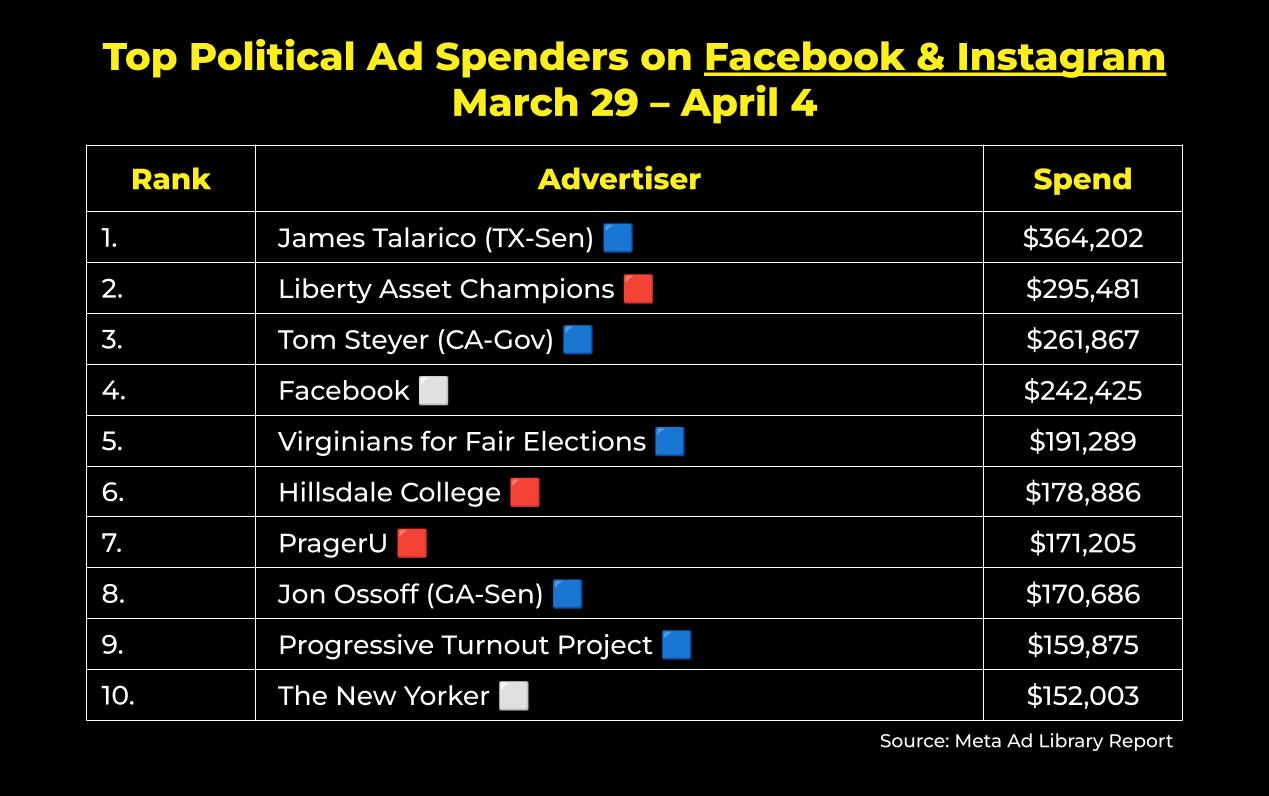
A majority of the ads Jon Ossoff and James Talarico ran last week were centered around meeting their campaigns’ goals for the first FEC quarterly fundraising deadline of the year.
On the other hand, billionaire Tom Steyer, who famously has no financial concerns to speak of, ran the gamut on issue areas, hitting everything from entertainment tax credits, climate justice, and the Iran war to ICE, free school meals, and the tech revolution. He even came out in support of single-payer healthcare, contradicting his own previously held stance on the issue.
Meanwhile, political advertisers spent around $8.2 million on Google and YouTube ads last week. These were the top ten spenders nationwide:
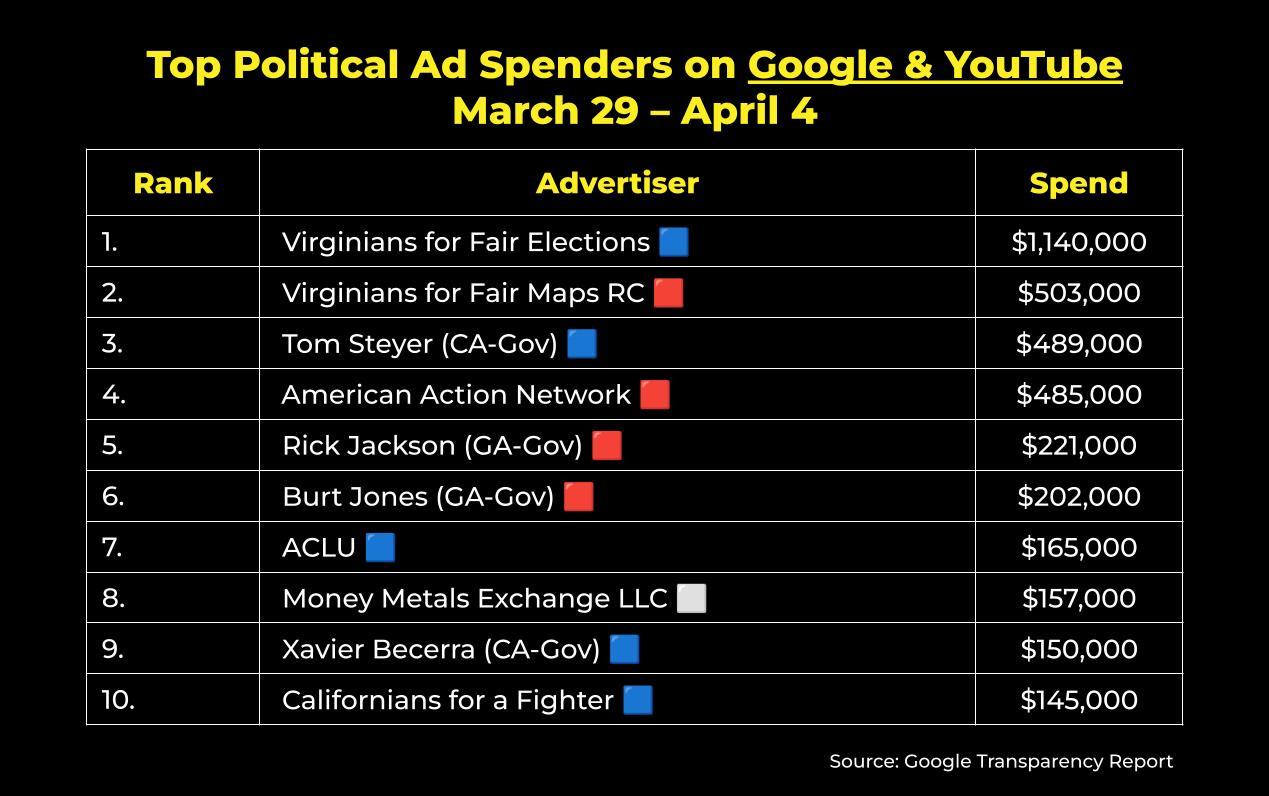
Three states—California, Virginia, and Georgia—dominated 7 of the 10 spots on this list. Nearly $2.6 million were spent on ads in Virginia alone, which makes sense considering the state will vote on its redistricting referendum in less than two weeks.
California saw $1.3 million in investments last week as the battle to replace Governor Gavin Newsom wages on. The top spenders were Steyer, former HHS Secretary Xavier Becerra, and Californians for a Fighter PAC supporting Rep. Eric Swalwell. Swalwell is currently at the center of lots of online conversation around possible misconduct, allegations his team categorically denies.
Georgia’s gubernatorial primary is on May 19 and it’s no surprise Rick Jackson and Burt Jones make up a good chunk of the $947k spent in the state last week. ICYMI, the two of them HATE each other. A lot. Like a lot a lot.
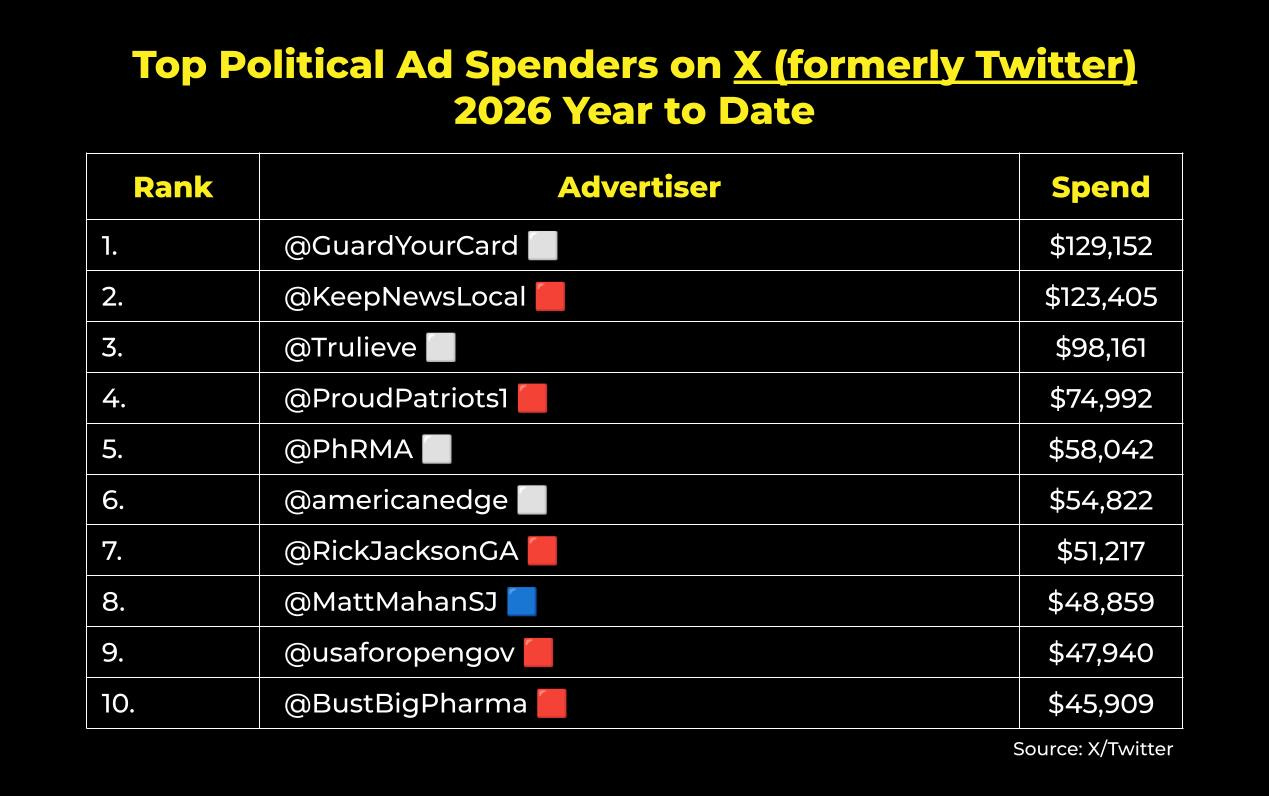
There once again appears to be a glitch in X’s political ad disclosure and the numbers have not been updated, so as of last month, political advertisers in the U.S. had spent just over $1.8 million on ads in 2026. Here were the top spenders year to date:
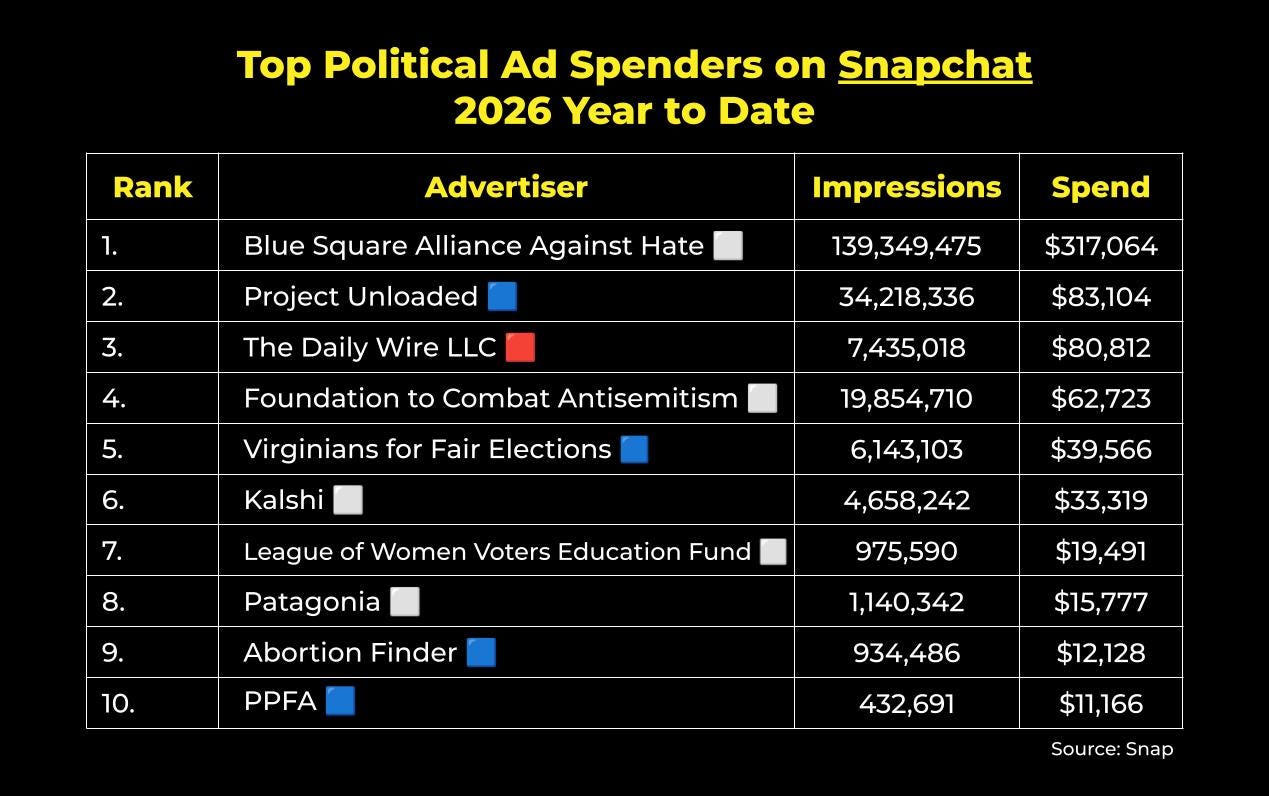
…and lastly, on Snapchat, political advertisers in the U.S. have spent just over $805,000 on ads in 2026. Here are the top spenders year to date:
The Billion-Dollar War Over America’s Memory
There are 48,178 public monuments in the United States. Only 0.5% honor people of color. Three times as many memorialize Confederate leaders as honor Black, Indigenous, or Brown figures.
That imbalance isn’t really surprising, but it also hasn’t been treated as what it actually is: a political project with a centuries-long head start.
Allow me to explain.
When Donald Trump was first elected in 2016, it marked a resurgent obsession with white grievance politics and historical revisionism. The country’s public spaces became battlegrounds over memory itself. Confederate monuments—long-standing symbols of terror—were suddenly defended with renewed ferocity. It became clear not only how contested our history is, but how deeply power depends on controlling it.
The American monument landscape is one of the most effective propaganda machines ever built, and almost no one in progressive politics talks about it that way.
Now, the right understands how to wield the tools of narrative and culture extremely well. Trump 2.0 has put its full force behind the effort to control our collective memory.
On his first day back in office, Trump signed an executive order creating a task force for America’s 250th birthday. It called for the construction of a “National Garden of American Heroes” and directed federal buildings to reflect “traditional, classical architecture.”
It also set a clear tone: “restore Federal sites dedicated to history … to solemn and uplifting public monuments that remind Americans of our extraordinary heritage” and remove content that “inappropriately disparages Americans past or living.”
In other words: Clean up the story. Decide what gets remembered and what doesn’t.
Just last month, the government ordered signage to be taken down from at least 17 national parks, including exhibits about the forced removal of Native Americans from the Grand Canyon and George Washington’s enslavement of people at Independence National Historical Park in Philadelphia.
But this war doesn’t just sit in the physical. It’s digital too.
A separate executive order, “Preventing Woke AI in the Federal Government” requires that AI companies doing business with the federal government ensure their systems are “objective and free from top-down ideological bias.” Translation: Strip any acknowledgment of structural racism, erase diverse representation from AI outputs, and ensure that the systems shaping how Americans learn and communicate reflect a single, white, conservative worldview. An administration whose playbook is steeped in ideological supremacy should not be able to define what objective means for the country.
At the same time, media ecosystems are growing increasingly imbalanced. According to Media Matters president Angelo Carusone, right-leaning content accounts for 82% of the major online programming across podcasts and streaming channels, AKA “narrative dominance.”
This conservative narrative infrastructure, from the Heritage Foundation’s $150 million annual budget, to PragerU’s $70 million operation, to Leonard Leo’s $1.6 billion war chest, is the result of billions of dollars invested over decades to control which version of American history gets told, taught, and remembered. It’s a coordinated, well-funded effort with institutional backing at every level.
So, how do we catch up? (And before you even think it, no, the answer isn’t to build a liberal PragerU.)
Progressive movements need to build long-term infrastructure rather than chasing cycle-to-cycle wins. We need to invest in the kinds of stories that ignite agency within people. What moves the needle to get people engaged in politics in the first place? An ad campaign alone won’t do the trick. We need to start a few layers deeper and speak to people through their hearts and through their values.
When people understand where they come from and can trace the patterns that connect their present to a past they actually recognize, they become harder to manipulate and easier to mobilize. Liberation becomes truly possible when we stop treating art, history, and culture as secondary to “the real work” of advocacy. They are the real work.
And there’s research to support this. The American Historical Association found that people with an active relationship to history are 8 to 13 percentage points more civically engaged. If our stories didn’t matter, Trump and his cronies wouldn’t be spending so much time and effort to erase them.
I have learned this firsthand through building Kinfolk from the ground up over the last 10 years. Inspired by Pokémon Go, we created our own augmented reality (AR) app where people could walk around their city and see history come to life through community-generated digital monuments. Each monument is the product of 3-6 months of deep engagement: building relationships with local leaders, artists, and residents, hosting community workshops, and creating spaces for shared storytelling.
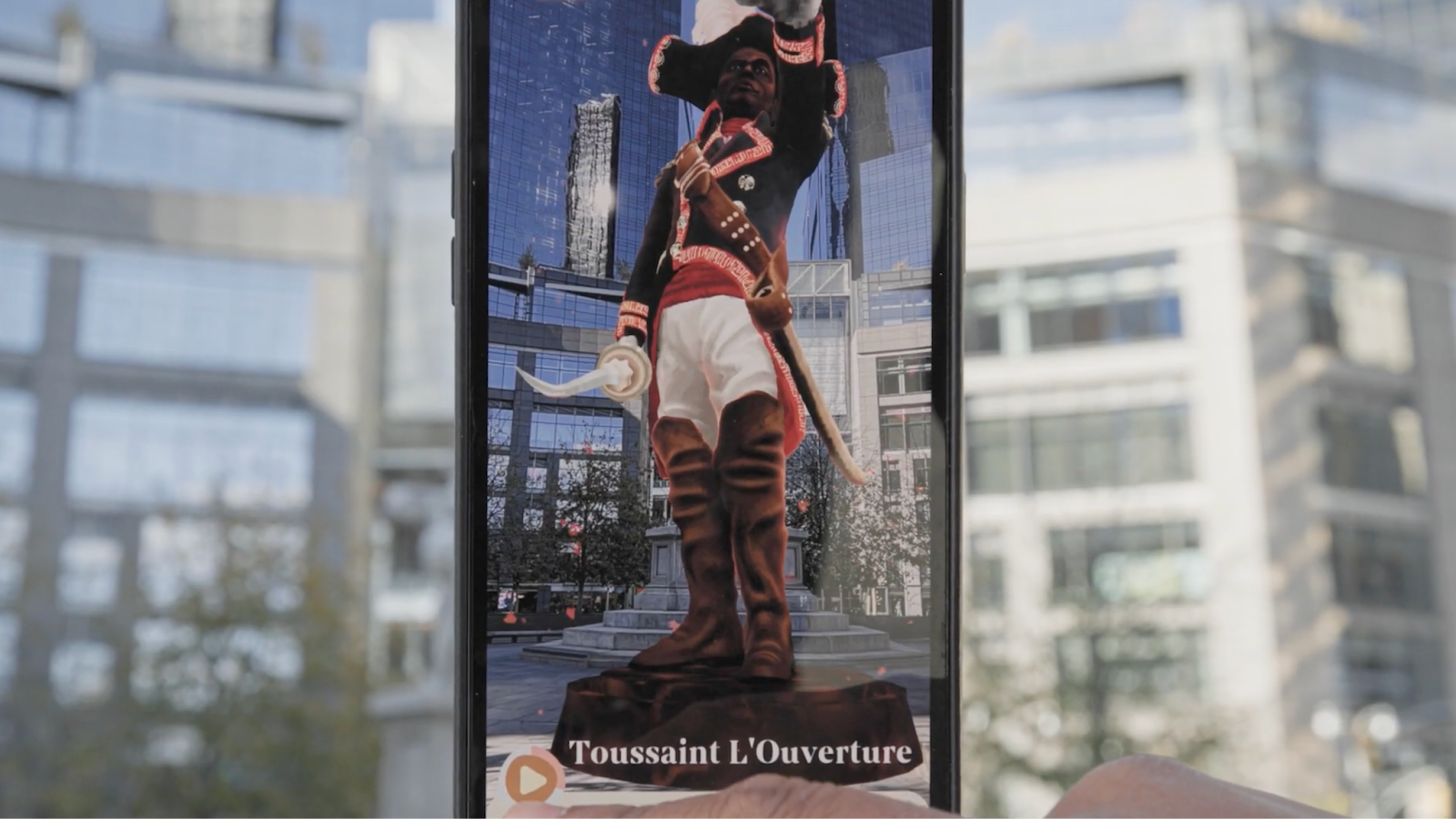
What started in New York City has grown into a platform with over 100 monuments, accessed by people in all 50 states.
Immersive media has the power to shift how people understand the world and each other in ways that other media cannot. Emotionally engaging, immersive storytelling activates key psychological processes, such as empathy, moral reflection, and perspective shifting, increasing the likelihood of actual behavior change.
But at the core of all of this is something far simpler: trust. If your relationship with communities, especially communities of color, begins and ends with election cycles, it’s not a relationship. It’s extraction. And people can see right through that facade.
Authenticity has become a currency, and the further we catapult into the tech bro billionaire AI dreamscape future, its value will only increase. People are craving real in-person experiences that foster connection and a sense of belonging.
Third spaces, the community gathering spots where civic life actually forms, are disappearing across the country, and people are starving for them. A nation without shared physical spaces loses the habits that make democratic life possible.
If progressive leaders want to galvanize support, they need to stop optimizing for surface-level engagement and start showing up in these spaces where trust is already built in: parks, local businesses, cultural centers, community events. That’s where Kinfolk operates. That’s where Mamdani operates. That’s where you should too. While digital engagement is critical for successful movements and organizing, we need to make sure to balance that with as much in-person engagement as possible.
The long game requires investment in cultural and community infrastructure, helping people build collective knowledge and mobilize on their own terms, in both digital and physical spaces. The future isn’t one or the other. If we want to maintain a winning trajectory, we’ll need to truly show up and support people’s agency and humanity no matter where they are.
If any of this resonated with you, you can reach out to me at idris@kinfolktech.org!

COURIER’s newly-launched Epstein investigation project
For too long, the Epstein Class has dealt in wealth, power, and politics to avoid accountability and deny victims & survivors their due justice. The public deserves the truth, but the Trump Administration is failing its legal obligation to deliver it.
That’s why we’re expanding our coverage to follow the money and investigate the power players in and outside the government. With a new database by Thorian AI, we have unprecedented access and ability to navigate more than 1.2M files and we’re sharing access—and what we’re finding—with you.
Subscribe to The Cover-Up and get one concise, easy-to-read email a week that cuts through the noise with the headlines you need and the breakdowns you want.
By staying plugged in and leveraging our reporting to make your own calls-to-action louder, together, we can turn information into justice.
That’s it for FWIW this week. This email was sent to 25,698 readers. If you enjoy reading this newsletter each week, would you mind sharing it on X/Twitter, Threads, or Bluesky? Have a tip, idea, or feedback? Reply directly to this email.
Support COURIER’s Journalism
With newsrooms in eleven states, COURIER is one of the fastest-growing, values-driven local news networks in the country.
We need support from folks like you who believe in our mission and support our unique journalism model. Thank you.
 | A guest post by
|
We are a mixture of many races and nationalities. Other countries might have this mixture yet remain tied together owing to a long shared history with myths and structures dating back 1,000 years (England); others have a unified ethnic or religious background (think of the Koreas); still others have managed to tie their populations by geography or foes. We, uniquely, did have a unifying myth and history especially after WW II. I am 80, grew up in suburbia with a stay-at-home mom, one car, three tv stations, the New Deal supporting otherwise marginalized folks; returned vets glowing with patriotic pride, and the fear of Communist conquest tying us together. Since Reagan, Gingrich, Gulf Wars and now Trump's politics of lower class white grievance devoid of empathy or morality, and financially supported by amorla Tech Bros, we no longer have common myths unifying us. I always thought, and taught as a US History instructor, that we were the "good guys", always trying to atone for national sins such as slavery, and trying to build up fledgling democracies around the world. It's hard to digest that we are not the good guys any longer, but we, thanks to the misguided "ceasefire plan," are no longer the #1 super power aiming to "do good" in the world. Our 250th anniversary will be besmirched by tawdry hucksterism, conman bluster, and a divided and demoralized nation. The candles needn't be lit; the wick is all wet with blood.
I’m finally going to call myself woke! 😎