


This newsletter is brought to you by the donor acquisition approach that helps you turn $1 into $2.

Hi everyone! We are the digital team at America’s Voice, a national immigration advocacy organization that uses research, communications, and digital organizing to build public support for immigration reform. Over the past year, we’ve worked with over a hundred creators – including immigration lawyers, journalists, teachers, veterans, faith leaders and lifestyle creators – to tell immigration stories that reach audiences far beyond the usual political sphere.
That work has fundamentally changed how we think about creator partnerships and digital organizing: The best immigration messengers often aren’t immigration experts. They’re trusted voices who understand how to connect with their communities by talking about immigration as a human experience rather than a political issue.
More on that below, but first…
Digital ad spending, by the numbers:
FWIW, U.S. political advertisers spent around $11.8 million on Facebook and Instagram ads last week. Here were the top ten spenders nationwide:
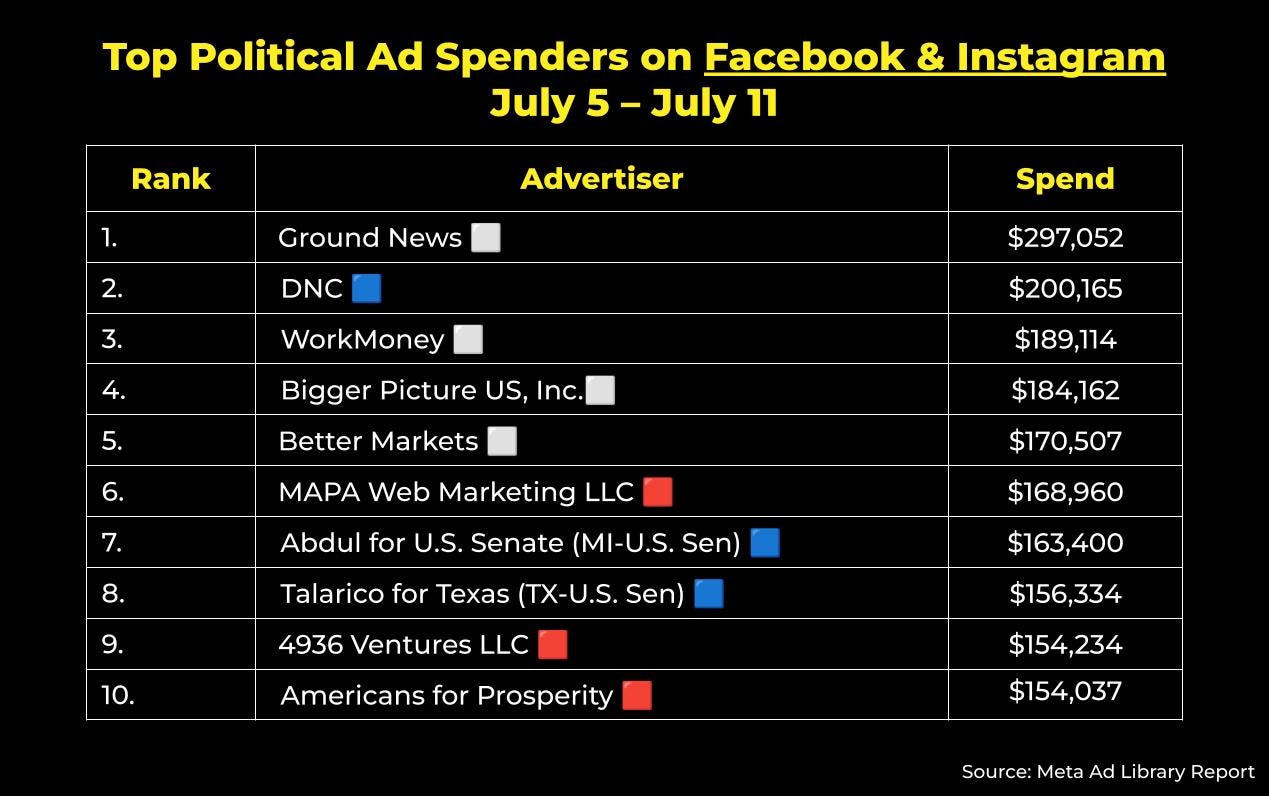
Call us obsessive or call us trend experts, either way we’re not done calling attention to the LLCs that keep popping up among the top spenders — especially now that numbers have normalized post-holiday dip. Last week, we reported that MAPA Web Marketing was coordinating ads encouraging seniors to take advantage of recent court rulings by applying for concealed carry permits. The following week, the group spent more than 7 times as much and was joined by 4936 Ventures LLC, which promoted a very similar CTA. Much of 4936 Ventures’ six-figure spend ran through the Facebook page belonging to a Dale Williams, who has a little over than 300 followers. This past week’s ads celebrate the passage of new legislation from Trump, the America 250 Bill, allowing for online permits valid in all 50 states— but we can’t find a record of such a bill passing (even Firearms News can’t).
Meanwhile, political advertisers spent around $8.3 million on Google and YouTube ads last week. These were the top ten spenders nationwide:
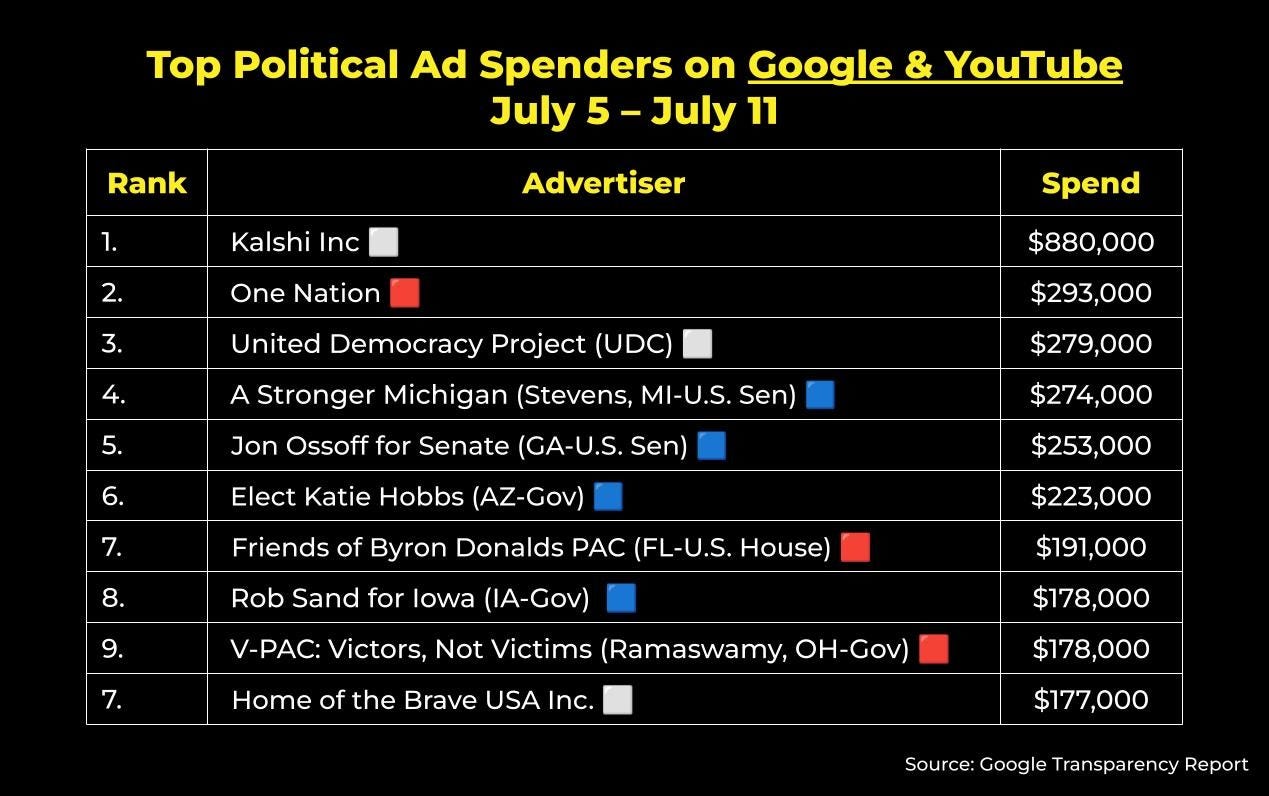
As Kalshi tops the Google & YouTube chart, spending more than 3x times as much as the next biggest advertiser, we’d like to give a quick shout out to Popular Information’s great piece from earlier this month, “How Kalshi Infects the News.” The article details how CNN and CNBC have promoted Kalshi “extensively, frequently vouching for its accuracy” since signing landmark deals with the prediction market, while inconsistently disclosing their financial ties. So you can add that to the list of things to be alarmed about!
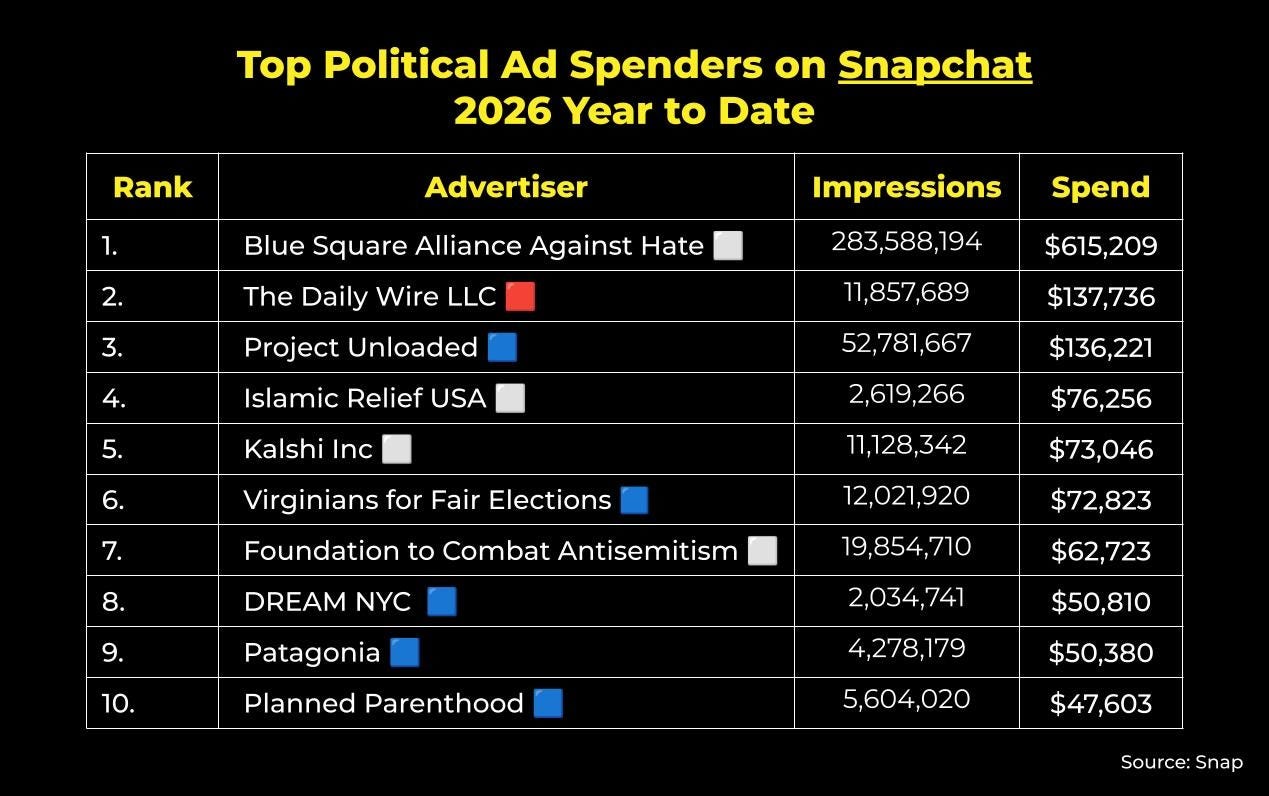
…and lastly, on Snapchat, political advertisers in the U.S. have spent just over $2.95 million on ads in 2026. Here are the top spenders year to date:
Please take our money…
We’ve actually heard this before, and you’d say this too if you finally found an ethical list-growth platform that helped you turn $1 into $2 like clockwork. Join over 900 groups like Everytown, Amnesty International, and Mercy Corps that have found a better way to nail their fundraising goals. Learn more >

The Best Immigration Messengers Often Aren’t Immigration Experts
Prioritizing Values, Not Expertise
People often ask how we’ve been able to grow our creator program at America’s Voice and how we’ve mobilized people online who usually wouldn’t engage with immigration issues. The answer usually surprises them.
We rarely start by talking about recruiting strategies or platform trends. Instead, we talk about the types of creators we’re building close relationships with and the audiences we’re trying to reach.
We talk about a pastor. A soccer fan. An animal welfare activist. A military veteran.
None of them built their audiences by posting about immigration law or breaking down the latest USCIS memo. None of them wake up thinking about asylum policy or the newest instance of unjust detention. And yet, some of the most meaningful conversations about immigration we’ve helped spark online have come from creators who had never posted about it before.
That may sound counterintuitive, especially for advocacy organizations that are instinctively looking to partner with creators already speaking about their issue. Ultimately, our goal isn’t to keep having the same conversations with the same people. It’s to bring new people into the fold.
That’s why we (strongly!) recommend spending less time looking for issue experts and more time looking for values-aligned communicators.
The reality is that immigration is often framed as one of the most fraught and polarizing issues in our country. Most creators aren’t going to become immigration experts overnight, and they shouldn’t have to. Asking them to memorize legal terminology or recite talking points rarely makes for compelling content. More often, it results in their audiences not being able to connect with the issue.
Our job as digital strategists isn’t to turn lifestyle creators into immigration experts. It’s to help them recognize where immigration already intersects with the communities they’ve spent years building. That’s a very different approach.
A parenting creator doesn’t need to explain humanitarian parole; they can talk about family separation. A veteran doesn’t have to talk about court cases; they can talk about service, sacrifice, and the values we cherish as a nation. And a sports creator can tell the story of immigrant athletes who have shaped America’s teams.
One of the clearest examples of this approach was our collaboration with Isabel Klee, an animal welfare creator and author known for fostering some of the hardest-to-place dogs and helping people connect with rescue animals.
On the surface, immigration policy seems like an odd fit for her audience. But the underlying values were already there: compassion, caretaking, and family. Instead of asking Isabel to explain immigration law or recount the day’s headlines, we provided her with reporting, first-hand stories, and examples from animal shelters documenting the growing trend of families facing detention or deportation being forced to surrender beloved pets, leaving shelters to absorb the fallout.

 Tiktok failed to load.
Enable 3rd party cookies or use another browser
The resulting video helped her audience understand the human impact of immigration enforcement through a point of connection they already cared about.
For us, this partnership was a huge lesson: the strongest entry point into an issue isn’t always the issue itself – it’s the values, communities, and experiences it intersects with.
Our Takeaways
If there is one thing we’d encourage other digital teams to think through, it’s this: stop trying to find the perfect messenger or get your talking points repeated word for word. Instead, become a resource. Help creators find the intersection between your issue and the communities they already know how to reach.
Here are a few things to keep in mind:
Recruit for trust, not expertise:
Find creators whose communities trust them, not just creators who already know everything about your issue only.
Lead with values:
Discuss with creators why the issue is important and how it intersects with their own stories and niches.Offer resources, not scripts:
Introduce creators to people affected by the issue and provide them with real-life examples. Then, trust them to tell that story in their own voice.Measure who you’re reaching:
Success is more than just views. For us, it’s reaching people who never would’ve sought out immigration content in the first place.
The challenges facing immigration advocates aren’t going away anytime soon. If anything, they’re becoming more complex. But that also creates an incredible opportunity to rethink who gets to tell these stories and how we reach new audiences.
The internet has fundamentally changed how people build trust. Organizations and legacy media are no longer the only – or even the primary – sources of information for folks. People are increasingly turning to creators, neighbors, pastors, teachers, athletes, and friends.
That means advocacy organizations have to let go of the idea that we need to be the loudest voice in the room or that there’s a silver-bullet fix to our communications problem. Our role is increasingly to humanize the issue and provide the context and the facts for others to tell stories in ways only they can.
If we do that well, we won’t just create better content. We’ll build broader, more resilient movements.
Please take our money…
We’ve actually heard this before, and you’d say this too if you finally found an ethical list-growth platform that helped you turn $1 into $2 like clockwork. Join over 900 groups like Everytown, Amnesty International, and Mercy Corps that have found a better way to nail their fundraising goals. Learn more >
That’s it for FWIW this week. This email was sent to 25,848 readers. If you enjoy reading this newsletter each week, would you mind sharing it on X/Twitter, Threads, or Bluesky? Have a tip, idea, or feedback? Reply directly to this email.
