



It’s me again, Danielle Butterfield, Executive Director and President of Priorities USA. We’re in the final days of the most expensive election in history, and if you live in a state with a hotly contested race, it probably feels like you can’t turn on the TV or pick up your phone without running into a political ad. But not all ads are created equal, and most fall flat. So our team polled more than 5,000 registered voters across House and Senate battlegrounds to figure out what’s actually breaking through.
More on that below, but first…
Digital ad spending, by the numbers:
FWIW, U.S. political advertisers spent around $53 million on Facebook and Instagram ads last week. Here were the top ten spenders nationwide:
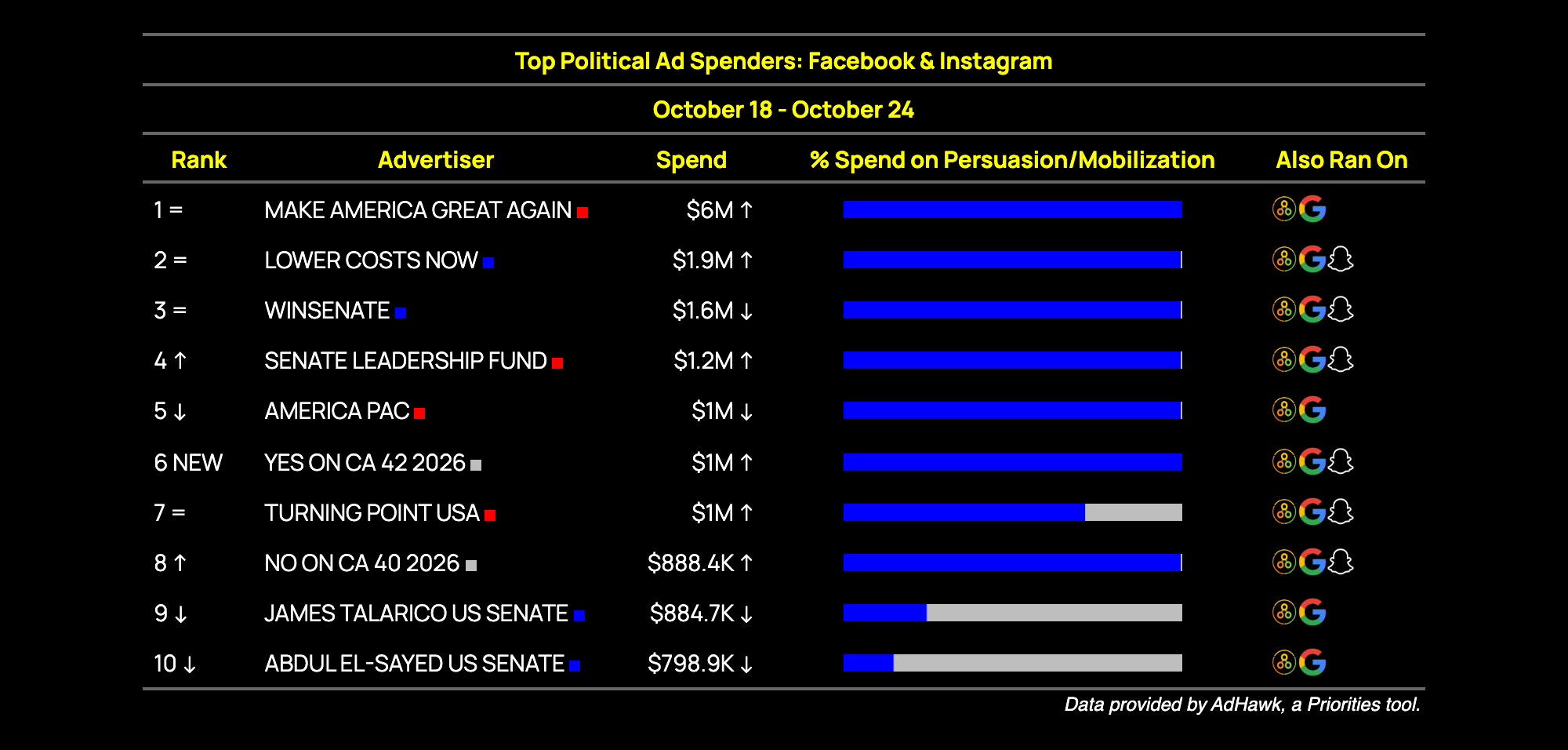
Last week, we talked about the new Trump entity Common Sense Voters Coalition, funded by MAGA Inc. They’re still up – Meta reports $11.5 million behind their generic mobilization spots – but that hasn’t stopped them from launching more mobilization content from their namesake page featuring Trump asking voters direct-to-camera to “pretend I’m on the ballot.” So far, they’ve spent about $380k on Meta with the DTCs and $7.2 million on Google behind a variety of spots.
Meanwhile, political advertisers spent around $116 million on Google and YouTube ads last week. These were the top ten spenders nationwide:
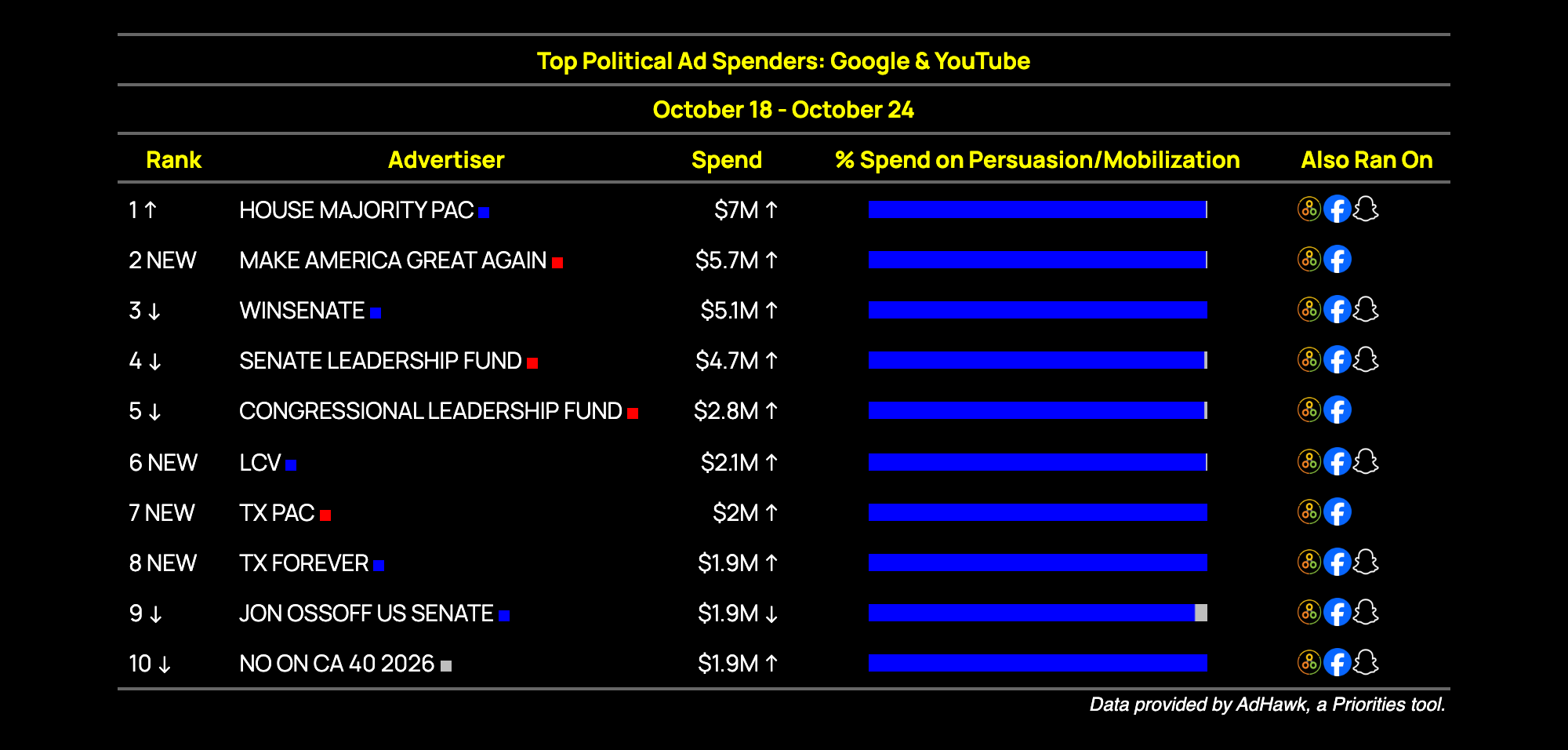
It’s already hard to keep track of the advertisers each cycle, and no group has much incentive to make it easier. Case in point: Texas PAC (R) and Texas Forever (D), both active in the Texas Senate race. Each has spent about $5 million on Google.
Texas Forever has focused almost entirely on the “Epstein-style deal” between Paxton and Adam Hoffman, with some light additions on personal enrichment and affordability.
Texas PAC has pivoted largely to hitting Talarico on crime, with another lane focused on trans attack ads.
On CTV platforms, U.S. political advertisers spent an estimated $191 million last week. Here were the top ten spenders nationwide:
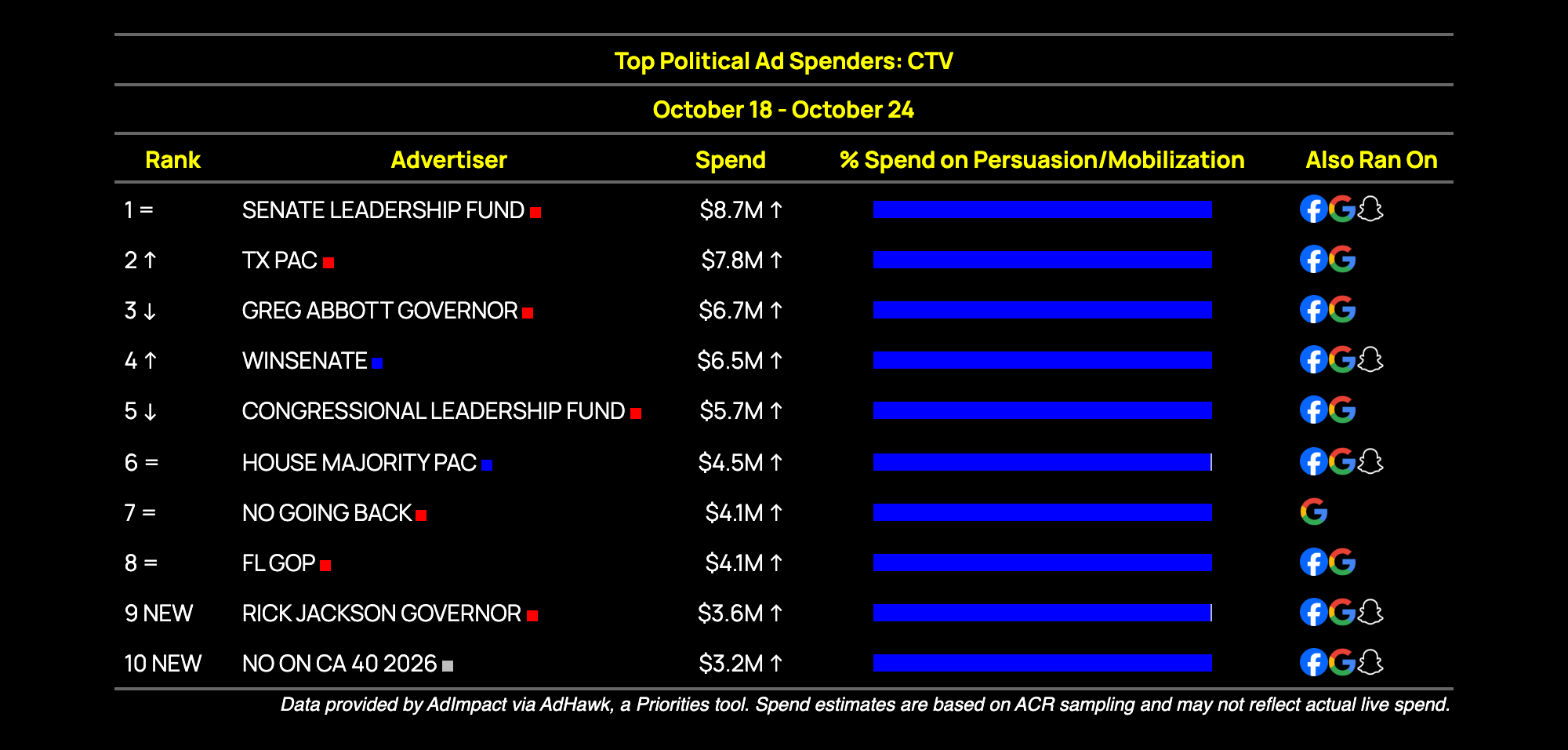
Five weeks ago, we covered the one-sided battle that was the Georgia governor’s race: Jackson was spending eight figures to Lance Bottoms’s five. While the gap has narrowed, the balance is still heavily in the GOP’s favor.
Across all digital platforms, Rick Jackson dropped nearly $11 million in October alone. His opponent, former Atlanta mayor Keisha Lance Bottoms, spent $2.1 million over the same period. They’re trading barbs over data centers, crime, and Trump.
Lance Bottoms has some backup from New Engagement, which is running ads on costs, but at $87k total, we don’t expect to see much more from them in this final week. Despite the cash disparity, the race is tight—maybe Ossoff’s coattails will help carry Lance Bottoms over the finish line.
…and lastly, here’s Snapchat YTD data for the top 10 spenders:
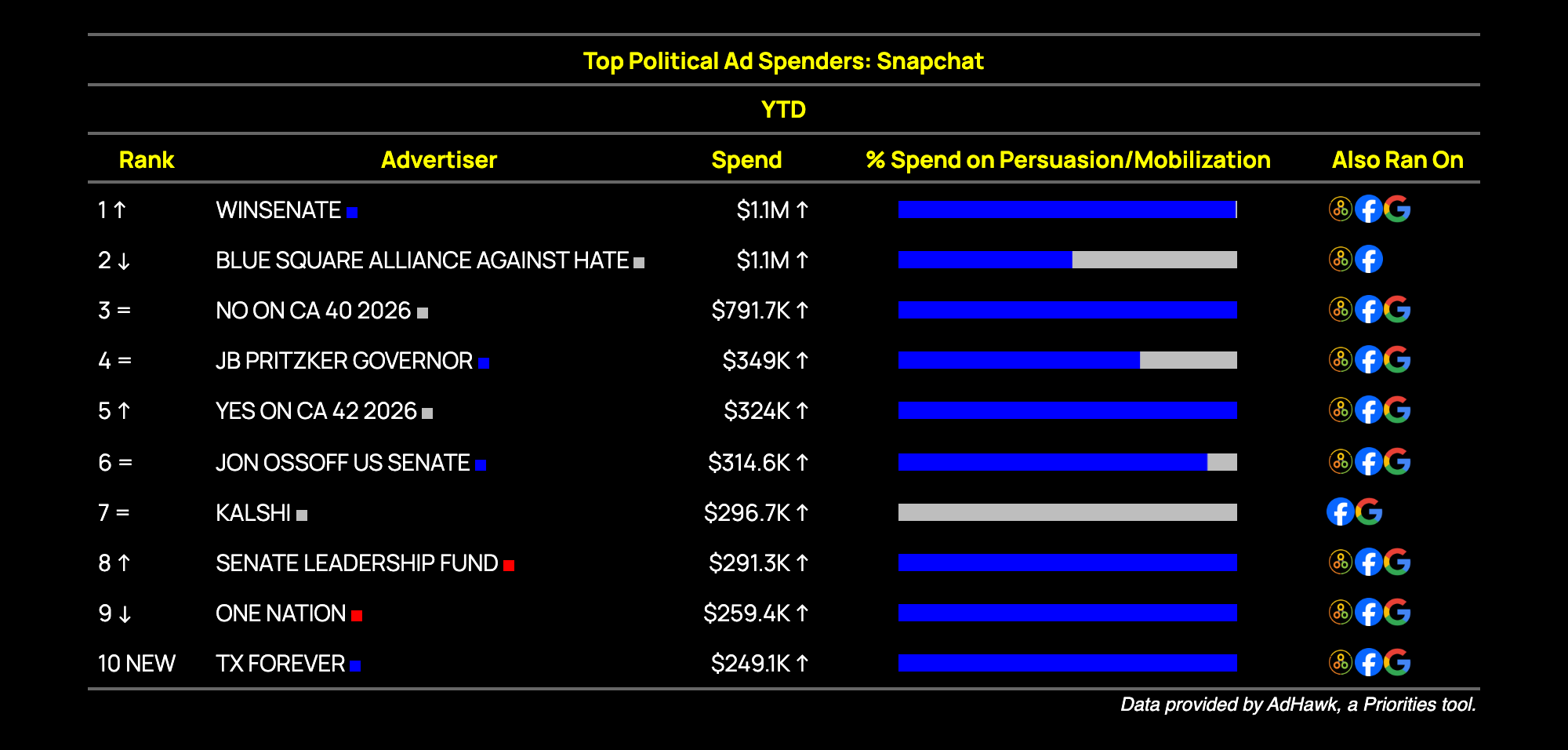
Silver State Accountability is up to some solid meddling in Nevada; they’ve spent $22k on the platform this month. We haven’t seen anything from them outside of Snapchat, but Democrats are already up with response messages.
Protect the vote. Donate to Fair Fight Action.
At Fair Fight Action, we’ve been organizing for years to protect your freedom to vote, defend independent elections, and stop voter suppression in its tracks. We don’t just sound the alarm—we take action. Join the fight. Donate to Fair Fight Action.

The $11 billion dollar question: What actually moves voters?
This election is about costs, and Democrats have stayed on that message all cycle. 55% to 70% of Democratic digital spend each month has gone toward the economy, labor, and health care. Economic messaging has accounted for 30% of the party’s ad spending since August and more than $1 billion since the start of the cycle.
Nationally, the numbers look good. Voters are stressed about the daily cost of living, and they trust Democrats more to handle it. Nearly two-thirds of voters say they’re personally very concerned about the cost of groceries, as well as gas and utilities, where Democrats lead by 13 and 11 points respectively. On health care, their lead sits at 16 points.
But step into high-spend, red-leaning states and that edge shrinks. In Texas, Democrats’ trust advantage is just 6 points on groceries, 5 on gas and utilities, and 3 on health care.
What voters hear, care about, and who they trust
When you ask people to describe what they’ve been hearing about in this election, cost of living blows everything else away. In open-ended responses about recent ads, it was the most mentioned theme across Senate battlegrounds and other competitive states.
“Fuel prices are much higher. Food prices are much higher. Everything is much higher.” - White Man, 79 (IL)
“Housing, rising prices on food and gasoline, healthcare, abortion.” - Black Woman, 35 (TX)
Q. Which party do you trust the MOST to handle these issues?(ALL VOTERS)
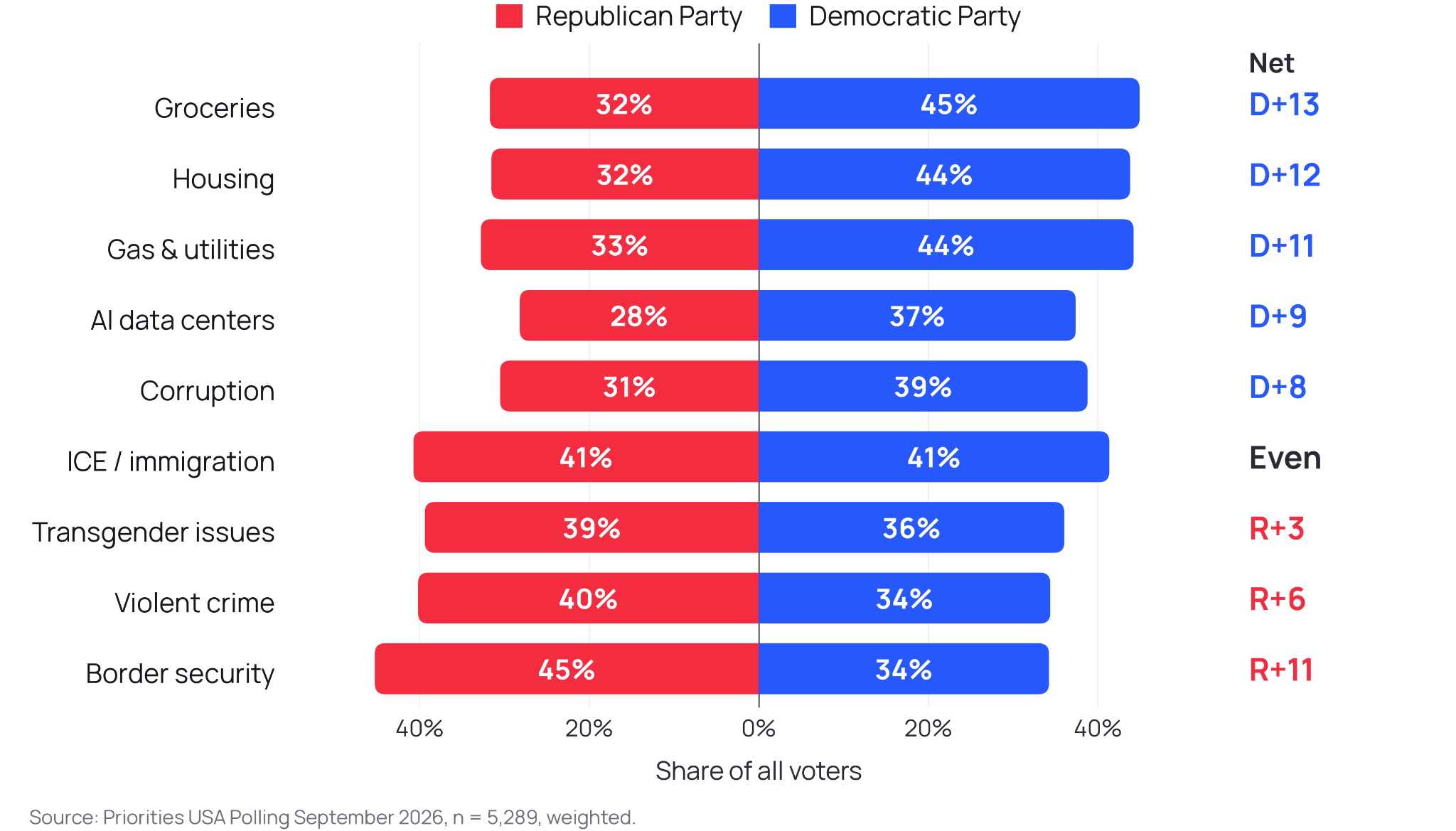
Rent and mortgages are top-tier concerns for undecided voters and those who don’t follow the news closely. Democrats hold a 12-point trust advantage on housing nationally and a few campaigns have picked up on this opening – Sam Forstag put $85k behind an ad about banning corporate homeownership in Montana and Angie Nixon has spent nearly $500k on spots in Florida. More often, housing is folded into a broader cost-of-living spot, like this one from Talarico.
But the further you get from pocketbook issues, the tighter things get. Democrats have single-digit leads on newer fights like AI data centers, where undecided voters are particularly notable: just 25% say they trust one party more than the other.
On ICE and immigration enforcement, voters are split right down the middle, leaving neither party with a clear trust advantage. That makes immigration an obvious place for Republicans to compete, but they’ve mostly sat it out instead.
Republicans have been anything but consistent. They know they can’t win on costs, so they’re trying to change the subject. After a push on veterans’ issues in July, the GOP pivoted back to the tried-and-true: trans issues and crime. Those two, along with the border, ranked in the bottom third of voters’ concerns in our poll. Republicans are spending heavily to put them front and center anyway.
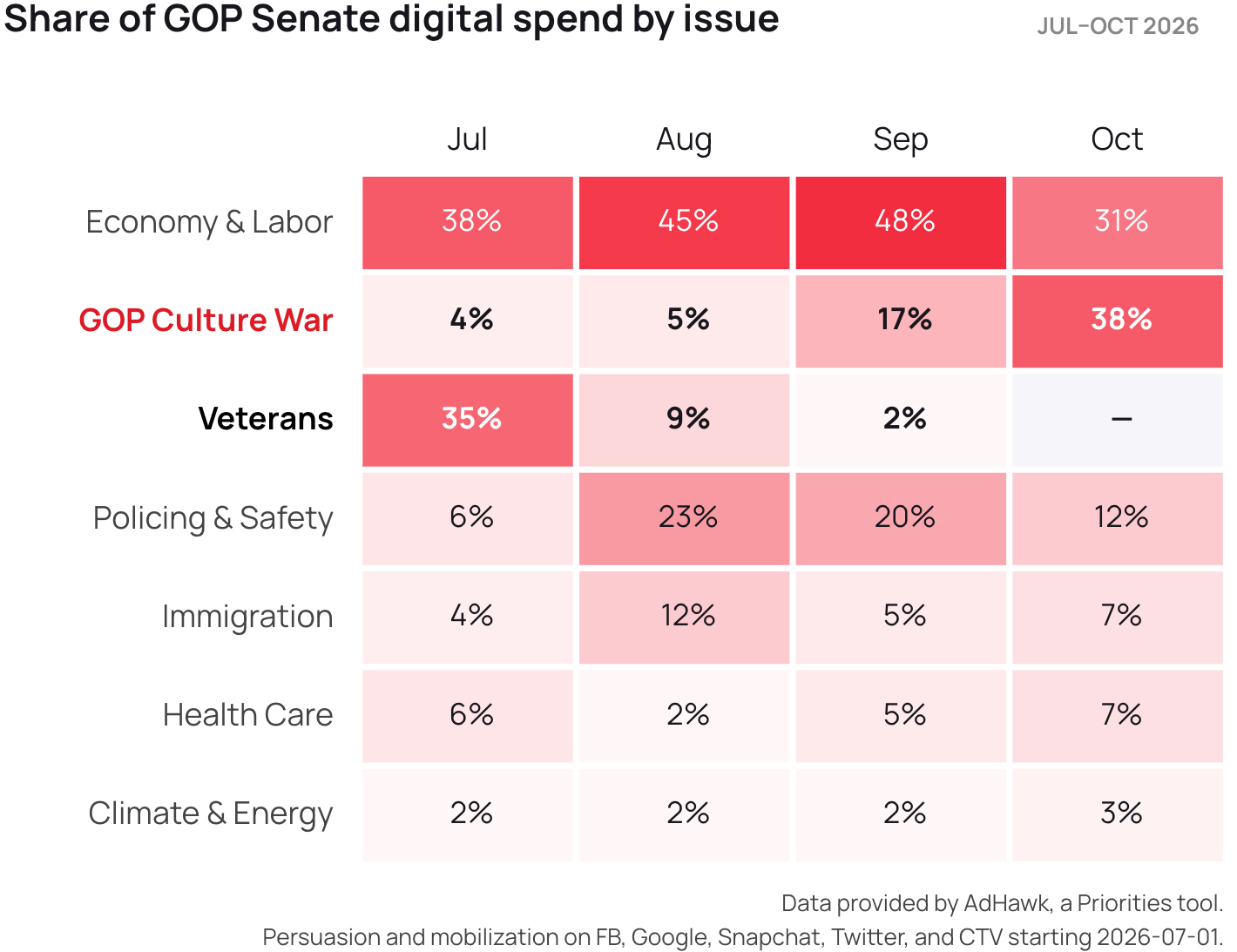
The national numbers only tell part of the story. Let’s take a look at what’s shaping the conversation in three of the highest-spend states.
Texas: Culture Attacks vs. Kitchen-Table Costs
Texas is where Republicans are running their culture-war playbook the hardest and where Democrats’ trust advantage is slimmest.
Governor Greg Abbott is the largest single digital spender on trans issues this entire cycle. 53% of Texas voters say they’ve heard a lot about trans issues recently, the highest share of any Senate battleground we polled. Since August, Ken Paxton and the GOP have spent about $120 million on culture-war ads, including $65 million on anti-trans ads alone.
Anti-trans rhetoric and the border are two issues where Republicans lead in Texas, but they’ve also ramped up spending on crime/policing. When we fielded our poll in mid-September, just 1% of Texas voters recalled “crime” as an election issue, but that was before Republicans started spending significantly on it. They spent only $75k on crime and policing in August, but in September, that number jumped to $38 million. In October so far? $35 million.
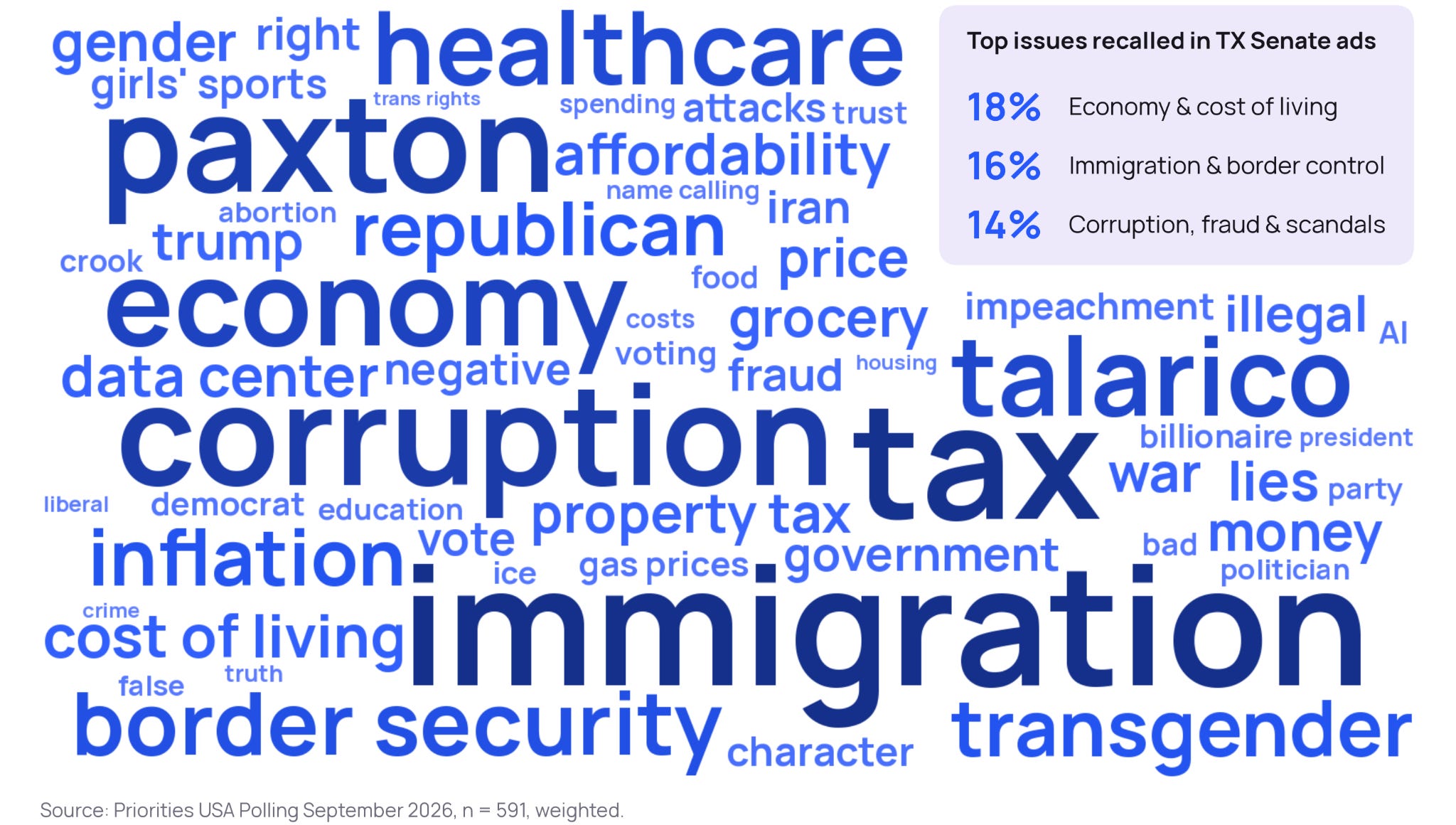
Texas is one of the reddest states, so it’s no surprise that Democrats’ edge on pocketbook issues is pretty small. Still, costs haven’t gone away. The economy remains the top issue Texans recall from Senate ads, especially among Latino voters (24%).
“We can’t afford groceries, health care, rent and gas and corruption.” - Latina Woman, 21 (TX)
Republicans are spending big to make culture-war attacks the conversation. Democrats can’t let them.
Q. What issues have you heard the most about in ads regarding the election for U.S. Senate in Texas? [open text]
Ohio: Corporate Handouts and Utility Bills
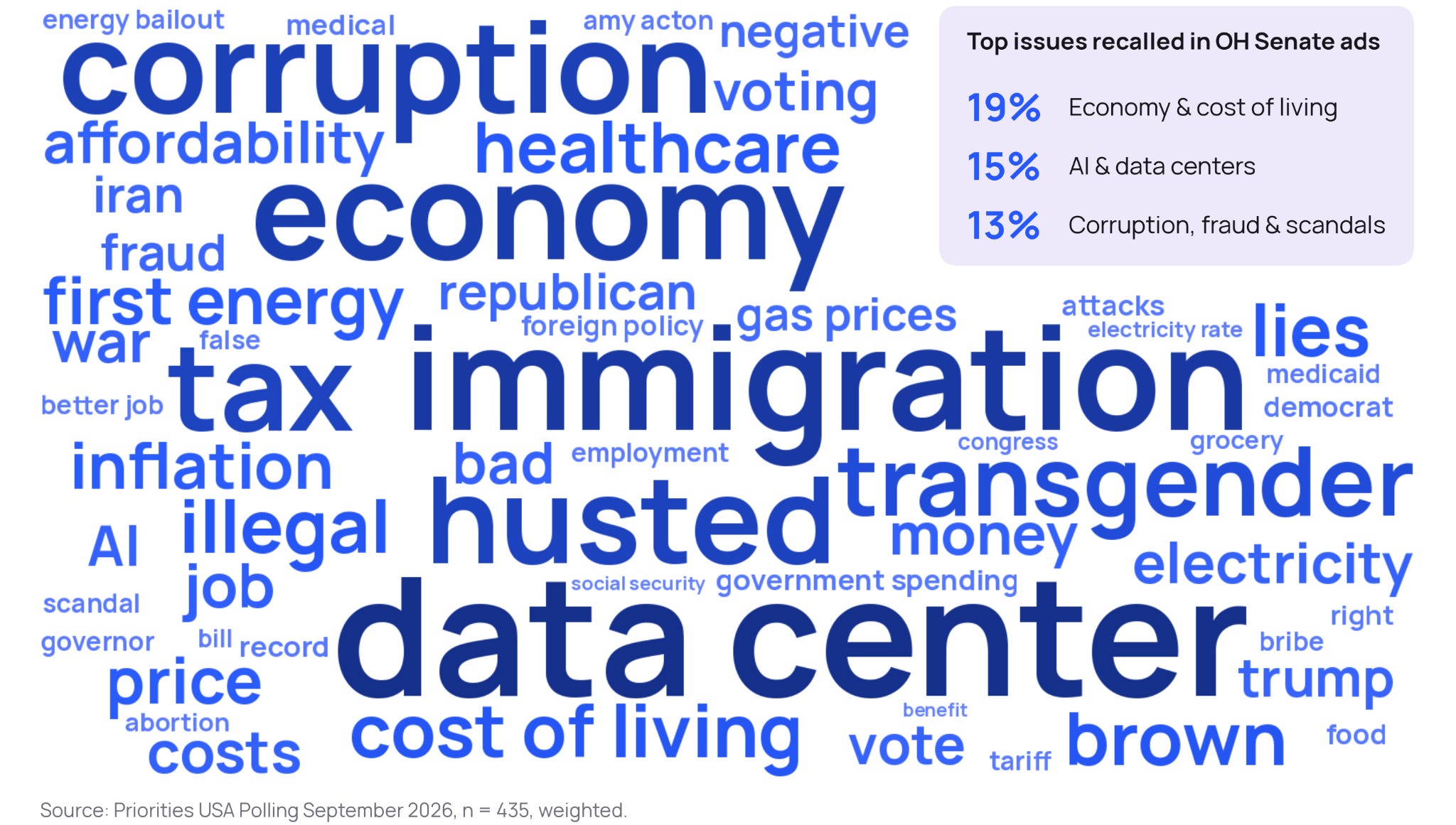
In Ohio, AI data centers have broken through unlike anywhere else in the country. 66% of voters in the state say they’ve heard a lot about data centers recently, compared with 58% nationally. Data centers are also the second-most recalled topic from Senate ads in open-ended responses, more than any other state we polled.
That reflects how Sherrod Brown’s campaign has led on this issue, launching a $1.3 million ad in July and tying data centers to local accountability and utility costs. Voters are connecting the dots on their own: AI tax breaks, the FirstEnergy scandal, and higher electric bills, all tied back to GOP candidate Jon Husted.
“Data centers and AI, AI tax breaks Husted was responsible for.” - White Man, 76 (OH)
“About Husted taking a million dollar bribe from First[Energy] causing Ohioans’ bills to go up.” - White Man, 68 (OH)
It’s working for Democrats – they lead on corruption (+7) and data centers (+8) in Ohio, about 10 points better than their standing on the generic ballot.
Q. What issues have you heard the most about in ads regarding the election for U.S. Senate in Ohio? [open text]
Alaska: Fishing, Corruption, and Who Gets Rich
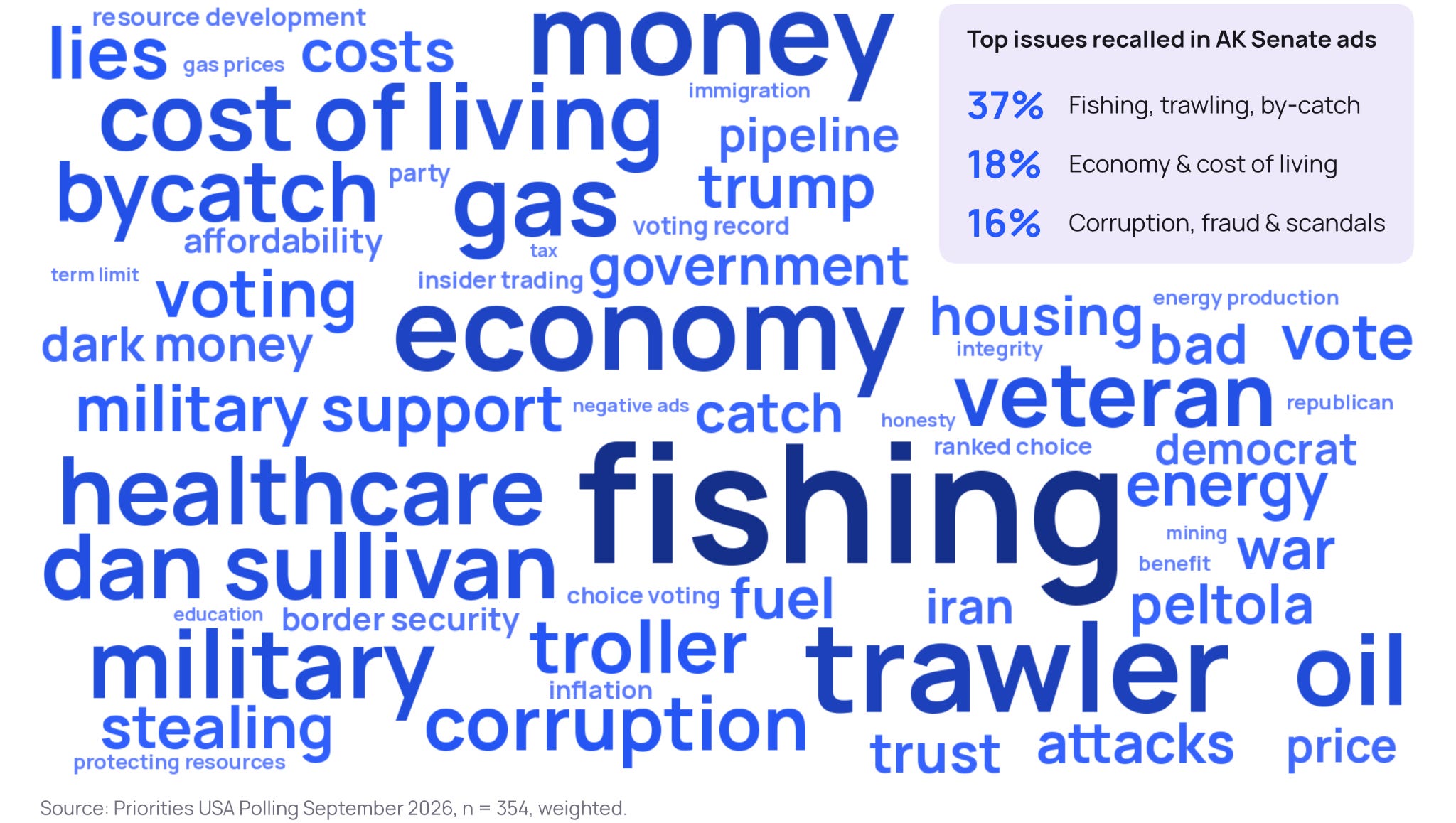
Alaska shows what happens when a race runs on local terms. In nearly every Senate battleground we polled, cost of living is the top issue voters recall from ads. Alaska’s economic debate is centered on the fishing industry at the heart of the state’s economy and culture.
More than a third of Alaskan voters (37%) name fishing, trawling, and bycatch as what they’ve heard most about in Senate ads. That’s twice the share who name broader cost-of-living issues like gas and food prices (18%).
The data backs this up. Since August 2026, campaigns have poured over $72 million into ads with messages heavily focused on fishing and bycatch. Democrats are driving that conversation, devoting 30% of their spend to the issue compared to just 10% from the GOP.
Corruption was mentioned by 16% of voters and they’re connecting the issues on their own: trawler money, stock trading, and an incumbent they describe as getting rich in office.
“Fishing issues and how incumbent Sullivan has become independently wealthy over 12 years.” - White Woman, 57 (AK)
Q. What issues have you heard the most about in ads regarding the election for U.S. Senate in Alaska? [open text]
What we’re watching for on Tuesday
Will localized messaging beat national talking points? In Ohio, watch whether communities near data centers back Democrats calling for regulation. In Alaska, if Peltola over-performs by running on fishing and corruption, other candidates should take note.
Where do undecided voters land? They lean toward Democrats on costs, but trust Republicans on crime and the border. Republicans largely sidelined immigration this cycle and leaned harder into trans issues. After a year of ICE raids, that looks like it could be a play to hold the Latino voters they won in 2024. Immigration ads are now creeping back into the mix in the final weeks.
Who shows up? Our poll found Democrats more motivated to vote than Republicans (66% vs. 51%). That’s a familiar problem for the GOP, which has struggled to turn out its base when Trump isn’t on the ballot. Now Trump is telling voters to act like he is and Republicans are spending heavily on digital mobilization. Will that be enough to close the gap?
What carries into 2028? Health care, housing, and AI are all areas where voters trust Democrats and where the next fights are forming. Whether candidates like Abdul El-Sayed win on universal health care will shape the primary debate, and so will how AI policy and data centers play out.
There are a lot of new issues on the ballot, and even more new candidates – but the key answer we’re looking for is to an age-old question: Is it still the economy, stupid?
Polling from Priorities’ Pre-Election Landscape Poll of 5,289 registered voters in House battleground districts, states with key Senate races (AK, GA, IA, ME, MI, NC, OH, TX), and states with other competitive statewide races (AZ, NM, NV, PA, WI), fielded September 15 to 21, 2026.

Get the full receipts every Monday in The Cover-Up
COURIER's Contradictions Tracker puts officials' Epstein testimony next to the files, with every entry linked to its primary source. Updated weekly in The Cover-Up.
That’s it for FWIW this week. This email was sent to 25,802 readers. If you enjoy reading this newsletter each week, would you mind sharing it on X/Twitter, Threads, or Bluesky? Have a tip, idea, or feedback? Reply directly to this email.

