


This newsletter is brought to you by the donor acquisition approach that helps you turn $1 into $2.
Hi! I’m Danielle Butterfield, Executive Director of Priorities USA and today’s guest author. I got my start working on digital ads back in 2011 on the Obama campaign but joined the Priorities team in 2017, and became our ED in 2021, where I became obsessed with advancing the Left’s digital communication strategy through training, tools, and more creative experimentation.
Today, I want to talk about health care, the issue that got me involved in politics. When my dad was diagnosed with cancer in 2007, he had to spend more time on the phone with insurance companies than fighting the disease itself. The 2008 Democratic primary was unfolding at the same time and I saw how much Democrats across the spectrum wanted to make real policy change - I knew right away I had to get involved.
Right now, the subsidies fight is looming large, with GOP and Dem health care messaging becoming almost indistinguishable. I thought I’d walk through how we got here, and where we go from here.
More on that below, but first…
Digital ad spending, by the numbers:
As part of today’s takeover, we are experimenting with some new paid media data charts (h/t AdHawk, the competitive dashboard the Priorities team built to make this data easier to understand and act on).
FWIW, U.S. political advertisers spent $3.6 million on Facebook and Instagram ads last week. Here were the top ten spenders nationwide:
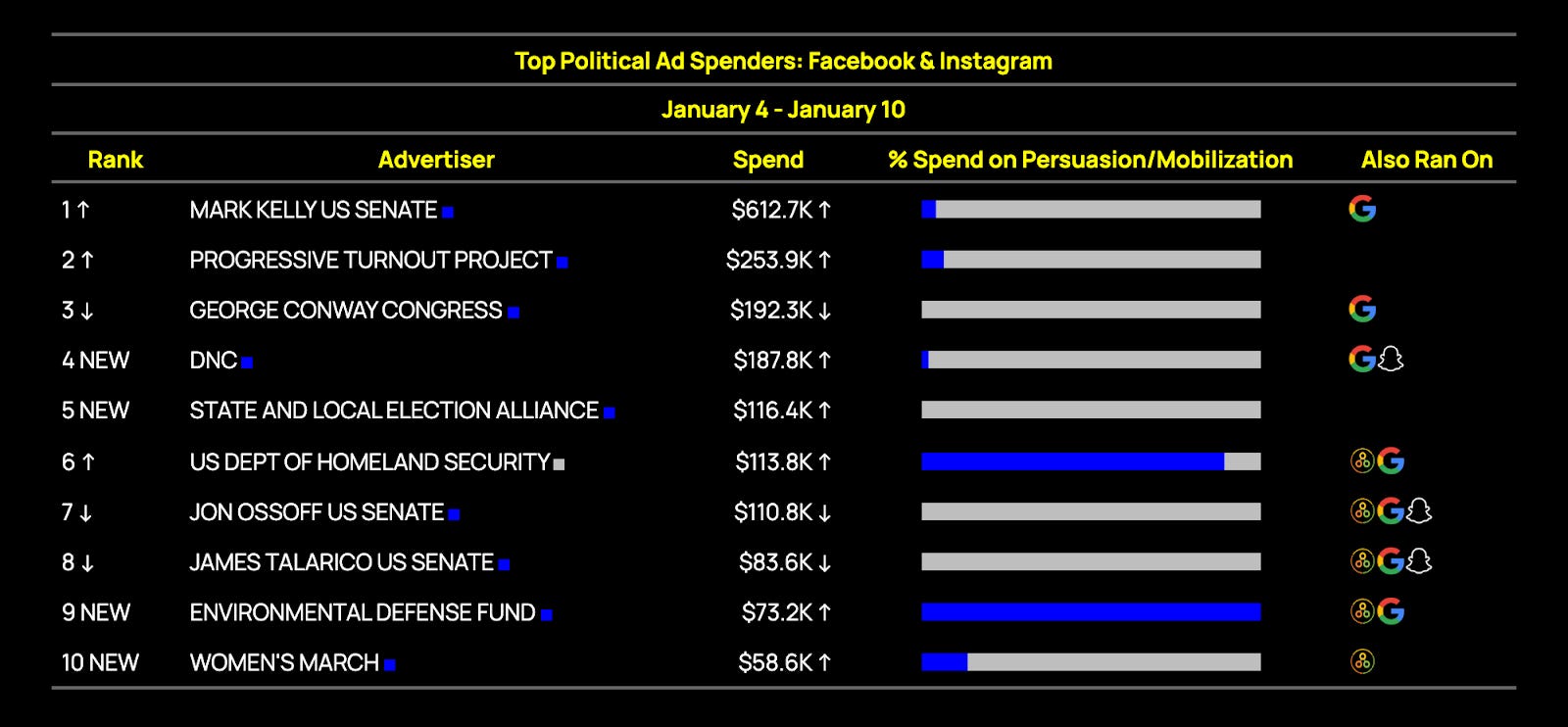
Democrats outspent Republicans significantly on Meta this week, with Senate candidates Ossoff and Talarico remaining in the top 10.
Sen. Mark Kelly leaned into his potential 2028 candidacy, with a more than 5x increase in his fundraising spend over last week. We expect this momentum to continue, especially in the wake of his newly-announced lawsuit against the Department of Defense. But Sen. Kelly isn’t the only 2028 contender who’s fundraising well ahead of a candidacy announcement: check out these spots from former Secretary of Transportation Pete Buttigieg’s Win the Era PAC.
On Google, political advertisers spent $1.3m last week.
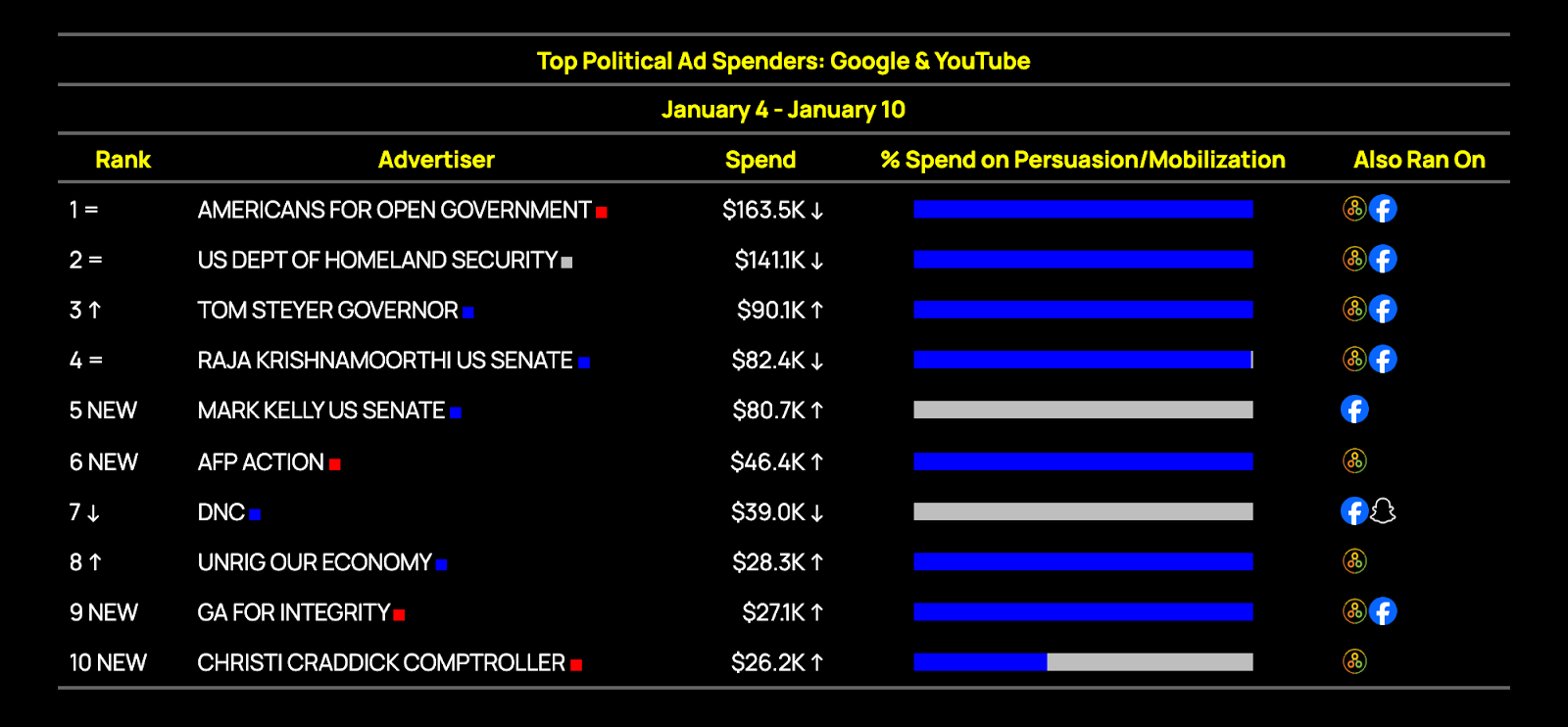
As was predicted in last week’s FWIW, Tom Steyer has ramped up spending across all platforms in the rapidly-heating California governor’s race. Former Rep. Katie Porter and Rep. Eric Swalwell are both up with fundraising spots, but their overall spend is dwarfed: Steyer at $350k overall in the last week, Porter with $3.3k, and Swalwell with $1k.
On X (formerly Twitter), political advertisers have spent $289K this year.
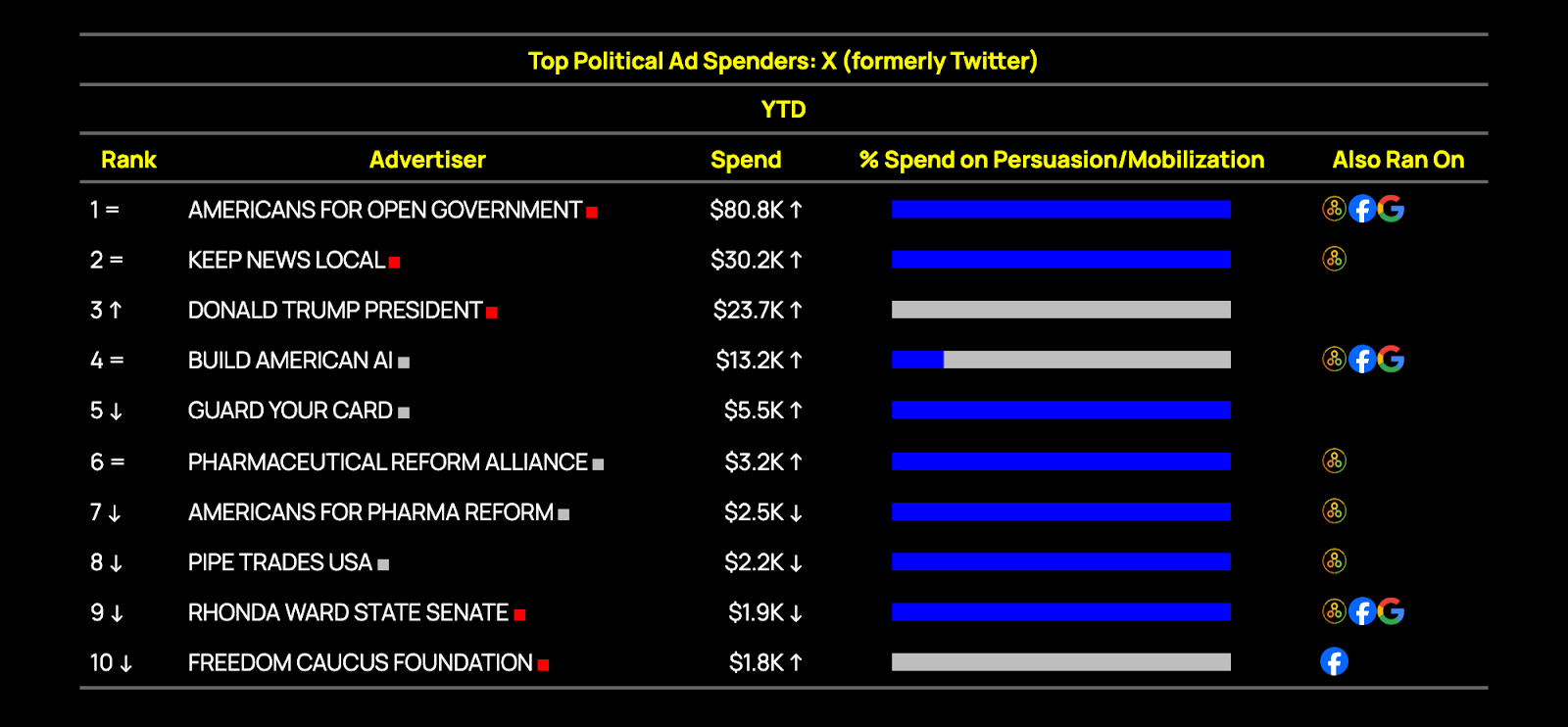
With X’s rightward tilt (understatement), it’s a place where electoral persuasion has gone to die. Instead, it’s become a home for MAGA-focused advocacy. One of the major campaigns reflecting that trend so far this year is Build American AI, a $10m effort advocating for a pro-AI federal regulatory framework. Most of their ads so far have been listbuilding, but there is a hint of subtle persuasive messaging on the horizon. With that much cash to spend, we might just see a first-party targeting pivot.
What if you could raise more in 2026?
Groups like Common Cause, Earthjustice, and Amnesty International are setting themselves up to crush it in 2026 with Civic Shout, and you can too.

And this week, courtesy of AdImpact, we added CTV to the mix. Across streaming platforms, political advertisers spent $4.4m. AdImpact’s spend is estimated based on a limited sample of sets across the country.
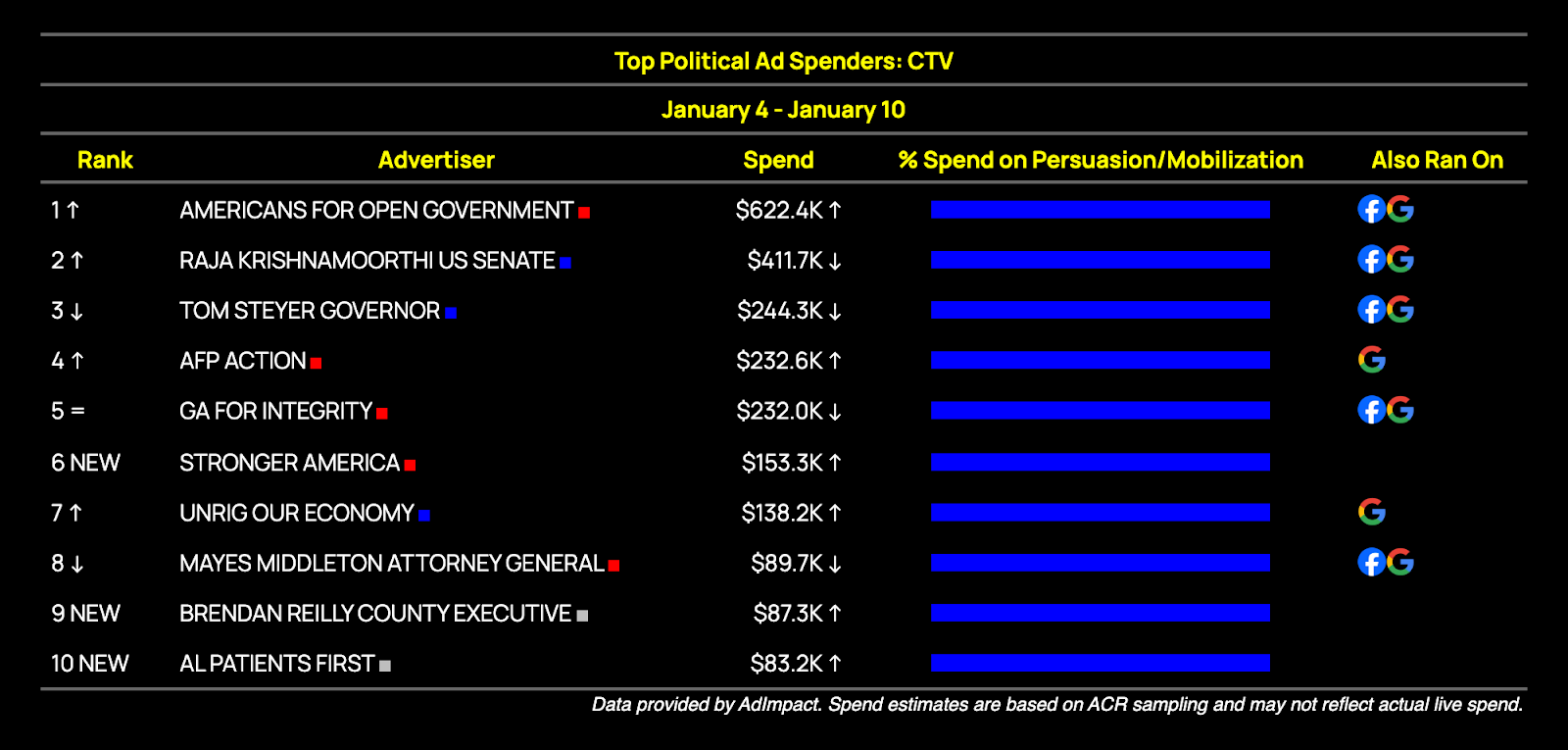
While it might seem like Americans for Open Government is a new player, keen eyes might have spotted that they’re a DBA of the American Prosperity Alliance, a cash-rich group with ties to former Speaker Kevin McCarthy. Either way, they’ve spent a lot since their first ads hit the digital space on Nov. 6th of last year ($2.2m across all platforms). Their messaging has been framing Trump’s refusal to extend Obamacare subsidies as a positive that will bring down health care costs. How, you ask? They’re saying Trump will ask insurance executives to voluntarily lower premiums.
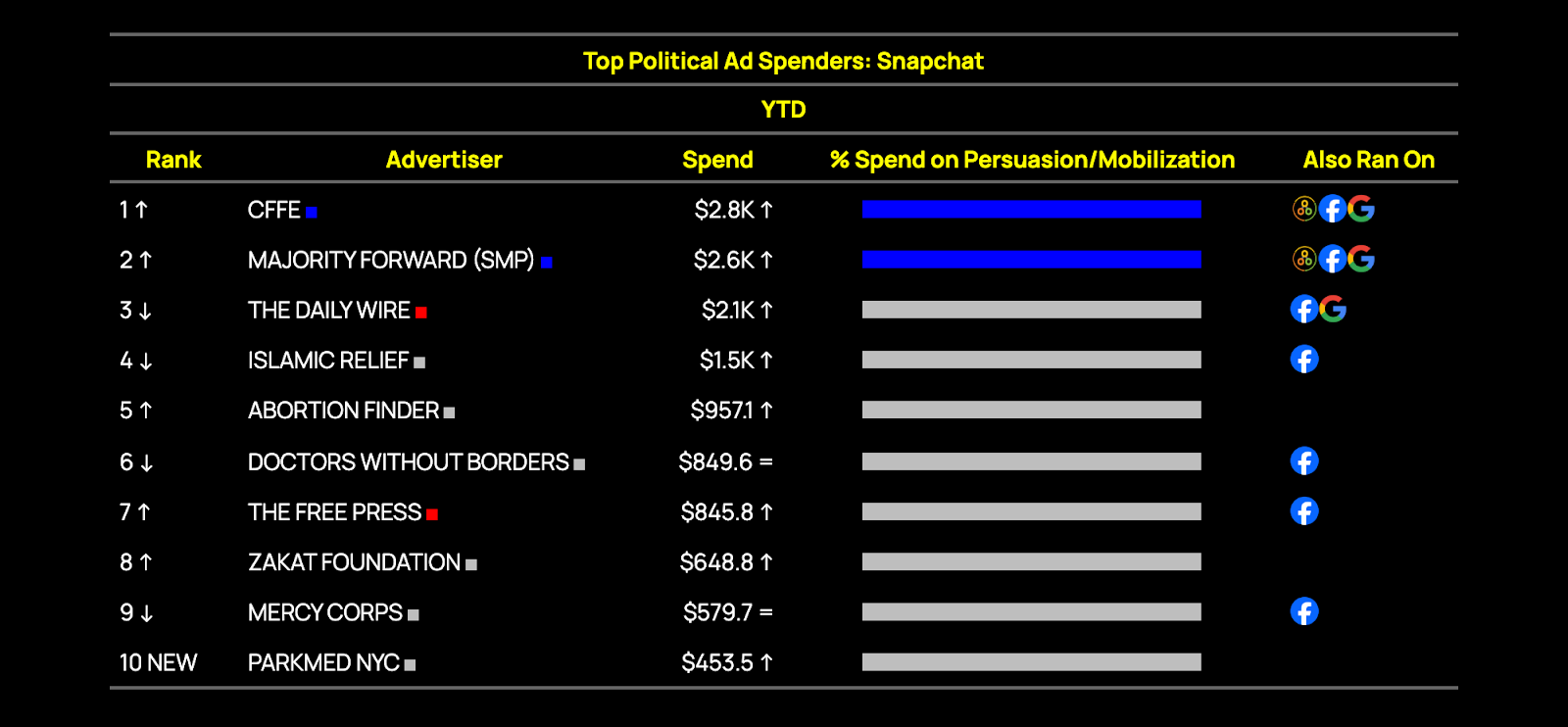
Finally, on Snapchat, political spenders have placed $22k in ads so far this year.
The Campaign for a Family Friendly Economy has been busy across platforms this year, spending $131k on spots featuring street interview-style clips of people impacted by the lapse in Medicaid subsidies. Some mention Gov. Cooper’s actions on Medicaid expansion and others directly call out sitting Senator Ted Budd (R-NC).
Republicans are changing their tune on health care, but why?
One truth of political messaging: when health care is an issue, Democrats run ads and Republicans run away (hello 2018 blue wave!). But Republicans know that needs to change. Since ending health care subsidies, they’ve fallen back to their go-to tactic when facing a major liability: muddying the waters. Republicans have never been afraid to lie to voters or create chaos by changing their tune on longstanding issues. We saw it in 2024 when the Elon-funded RBG PAC pivoted on abortion in the final days of the election.
Now Republicans are looking to do the same thing with health care. And if we don’t stop them, we risk a universe where it sounds like both parties are fighting for cheap health care. A problem for voters because - again - they’re lyin’.
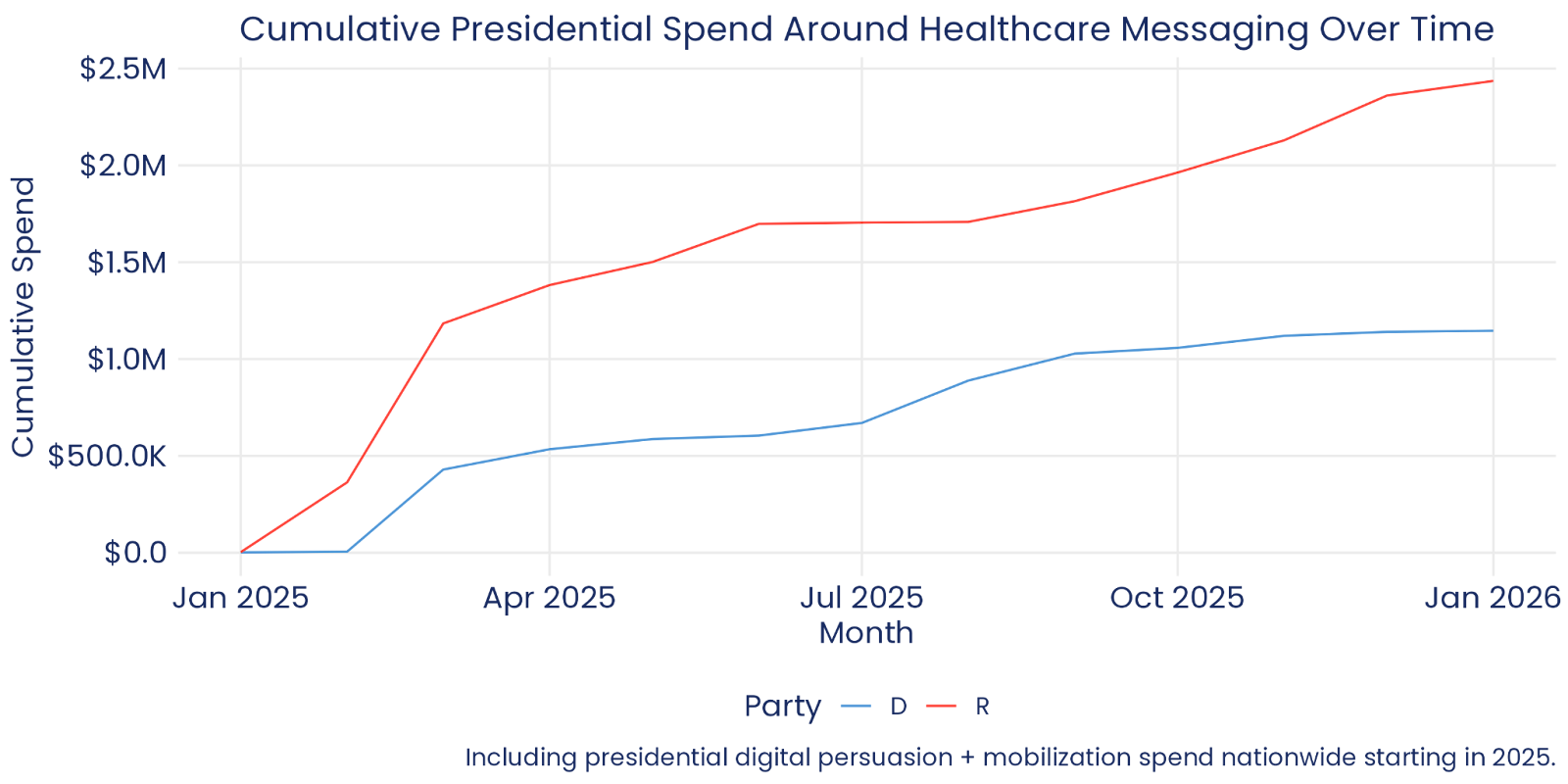
Today, health care is the second most expensive issue in GOP paid media, with Trump and top allies taking the lead. We’ve seen this movie before. In 2024, anti-trans attacks went from fringe messaging to a national focus once Trump leaned in. We should expect more of the same here.
Ending the subsidies has changed everything
During the shutdown, groups like Majority Forward and Unrig Our Economy invested in making health care a liability for Republicans. In North Carolina, for example, the messaging focused on affordability, premiums, and the direct cost burden on families. It wasn’t vague. It was specific. And it worked. Polling immediately following the shutdown showed that Trump’s approval on handling health care dropped 9 points in a single month… among Republicans.
Then Republicans ended the subsidies. Premiums went up. Voters are (rightfully) pissed. And suddenly, the GOP’s putting out new health care messages.
Starting in January, Republican groups began changing their language in ways that should feel very familiar to anyone who watched Democratic health care ads in 2024. Suddenly they’re talking about taking on insurance companies, lowering costs, protecting tax credits, and making health care more affordable. In some cases, the language is eerily similar to what we ran last cycle.
If you can believe it, they’ve even started running on restoring the subsidies.
That is not an accident. Republicans are responding to general interest and voter pressure. They’ve seen the polling and the search trends. Health care is expensive, and people are paying attention.
Republicans know they’ve been exposed, and instead of defending the cuts, they’re trying to reposition themselves as the solution.
Once again, they have done this before. Like with RBG PAC, it worked because it didn’t need to be true—it just needed to create doubt. We cannot assume voters will automatically trust us on our “best” issues or that long-held opinions will never change. I often think Republicans have more confidence in the power of persuasion than we do.
We have the tools, now we need to take action
When health care is salient, Democrats traditionally have had the advantage. More voters already think we’ll handle it better, and we’re good at talking about it because we talk about it all the time. But if we don’t actually keep a steady drumbeat, talking to as many people as possible, then we will lose that advantage. We need to be meeting voters where they are today and every day until we take back Congress and the White House.
And that’s not just on paid media channels. Creators actually want to talk about health care – we need to stay engaged with them and make sure the content is clear about who made the cost spike—and who is fighting to fix it. PACs are tapping compelling messengers, and this message works in a lot of contexts: economic anxiety, family security, basic competence, values. Health care is also an effective fundraising tactic.
When you put health care at the center, people respond. And health care is interwoven into so many other critical issues facing voters today - there’s not a false choice between talking about the horrors of today’s ICE raids and the active choice Republicans made to cut health care - AOC showed us how to thread that needle.
Our voters—and their stories—may be our most valuable asset. Cost. Coverage. Fear. Relief. Anger. Gratitude. It’s all there, and those stories cut through. The point isn’t just that health care motivates voters. The point is that health care is one of the few issues where Democrats can win both on substance and trust, but only if we keep the contrast sharp.
The bottom line
Republicans are moving on health care because they have to. They cut subsidies, costs went up, and now they’re trying to shift the blame by borrowing Democratic language. If they succeed, we will lose one of our biggest midterm advantages.
We have to stop it and make them pay the price, because Americans already are.
So the job is simple, but not easy: don’t let Republicans sound like the party fighting for affordable health care. Make the contrast undeniable. Keep the story clear. Use their own words against them. And keep health care a Democratic issue—where it belongs.
And when we do win, we need to then use that power to do what really matters: bring down costs for every American.
What if you could raise more in 2026?
Groups like Common Cause, Earthjustice, and Amnesty International are setting themselves up to crush it in 2026 with Civic Shout, and you can too.
That’s it for FWIW this week. This email was sent to 25,255 readers. If you enjoy reading this newsletter each week, would you mind sharing it on X/Twitter, Threads, or Bluesky? Have a tip, idea, or feedback? Reply directly to this email.
Support COURIER’s Journalism
Democracy dies behind a paywall, so our journalism is and will always be free to our readers.
But to be able to make that commitment, we need support from folks like you who believe in our mission and support our unique model.

Spot on Danielle. Priorities USA and Lotas are looking forward to telling the truth.