



Hi there, me again, Danielle Butterfield, Executive Director and President of Priorities USA. I’m back this week because this past Sunday, I was watching football when an ad for the Texas Senate race came on (ok let’s be real, I was watching the NY Liberty game, but another TV at the bar was playing football). Alas, I live in Brooklyn—I can’t vote in Texas. And neither can most of the people around the country who saw that ad. Texas PAC ran it nationally anyway. That, plus a few other signals have me thinking Republicans are more scared than they’d like us to believe.
More on that in a moment, but first…
Digital ad spending, by the numbers:
FWIW, U.S. political advertisers spent around $22.2 million on Facebook and Instagram ads last week. Here were the top ten spenders nationwide:
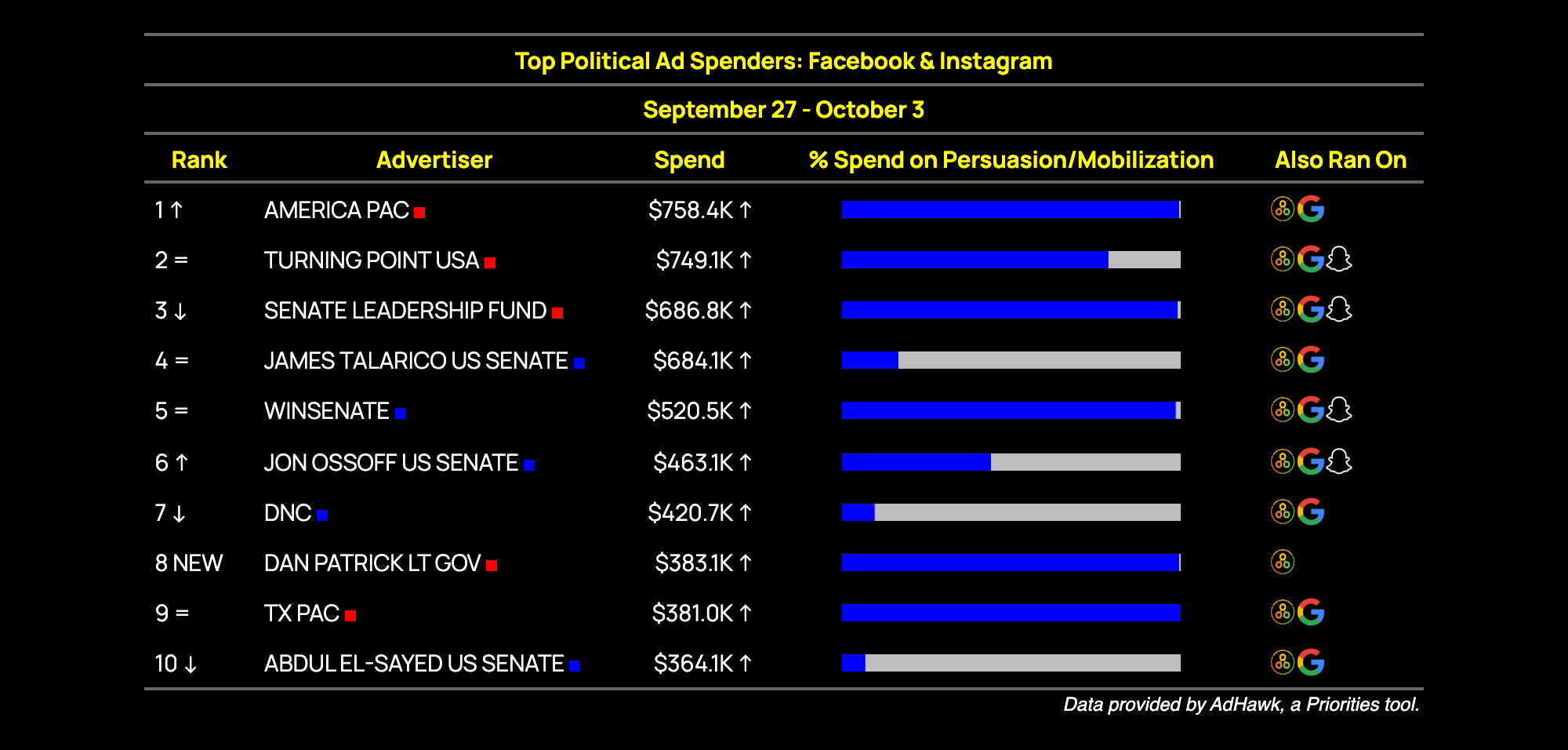
It’s not often we see a lieutenant governor’s campaign crack the top ten, let alone one focused so heavily on persuasion and mobilization content. For folks who haven’t been following LG races this cycle, incumbent Republican Dan Patrick is running for a third term against Democratic State Rep. Vikki Goodwin. LG Patrick is the only major advertiser live in the race—and his panic isn’t unwarranted, as recent polls have flip-flopped in a contest that’s likely to be decided by the strength of Texas’s Senate and gubernatorial coattails.
Patrick’s digital operation is pretty sophisticated for a lower-ballot statewide race: he’s up on CTV and Facebook with a wide range of creative on crime, data centers, and property taxes, to name a few. Goodwin is live on Facebook too, but mostly with fundraising spots. Let’s hope she pivots that money into a strong ground game, because there’s not much time to make up the digital gap.
Meanwhile, political advertisers spent around $57.3 million on Google and YouTube ads last week. These were the top ten spenders nationwide:
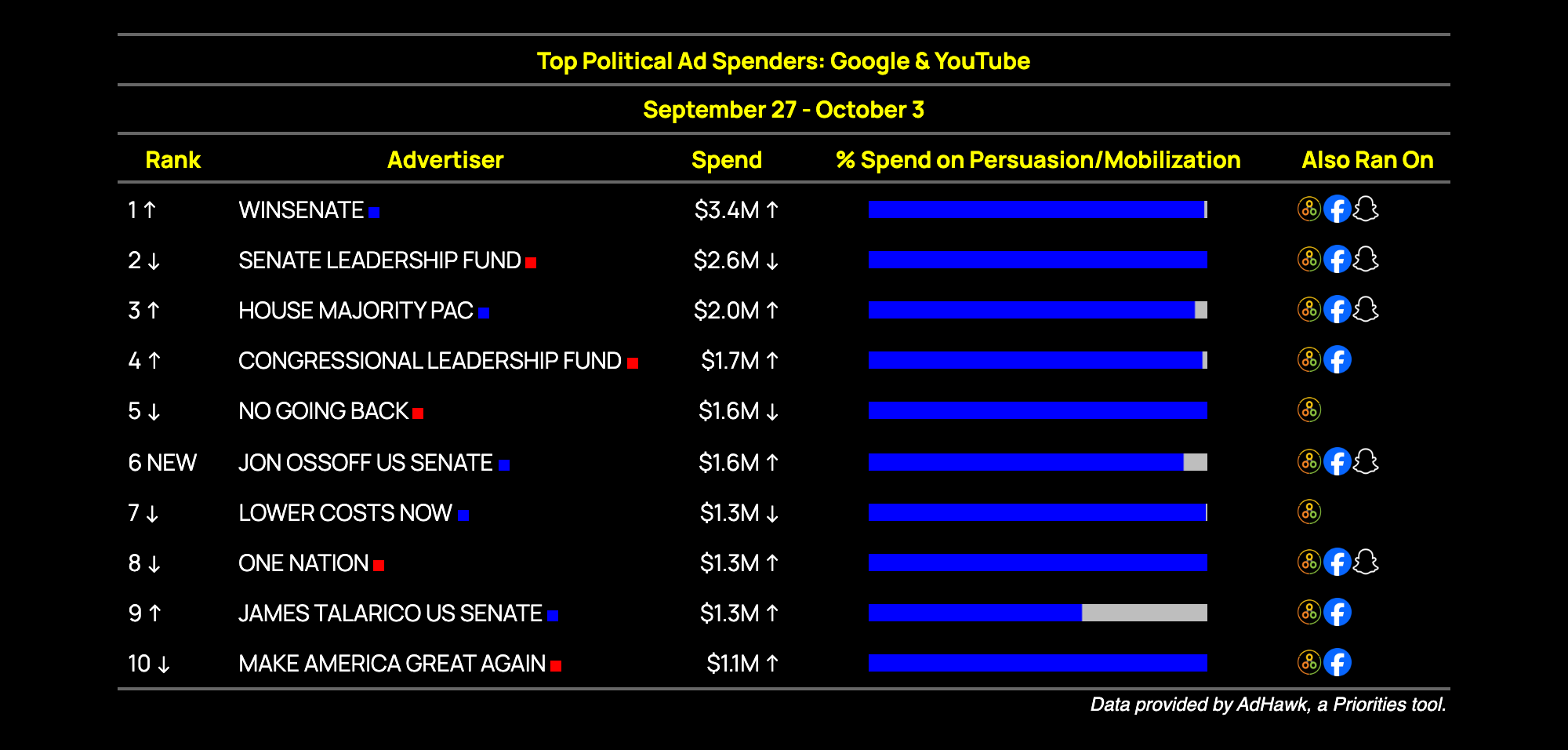
In a cycle where Republicans have spent boatloads of money claiming Democrats put children at risk, Sen. Jon Ossoff (D-GA) is showing off his digital savvy again with this spot cutting that attack off at the legs. That doesn’t mean he’s ignoring the bread-and-butter: messages on drug prices, the cost of groceries, and Social Security also dominated the Peach State’s airwaves last week.
Though the press has been bleak, Republicans haven’t totally given up on the seat. Senate Leadership Fund is still running with their creative which calls Ossoff a… makeup hog? No Going Back and One Nation stuck to the traditional lane, blaming Ossoff for a higher cost of living. Despite those efforts, Democrats outspent Republicans on digital last week, $8.3 million to $3.8 million.
On CTV platforms, U.S. political advertisers spent an estimated $106.6 million last week. Here were the top ten spenders nationwide:
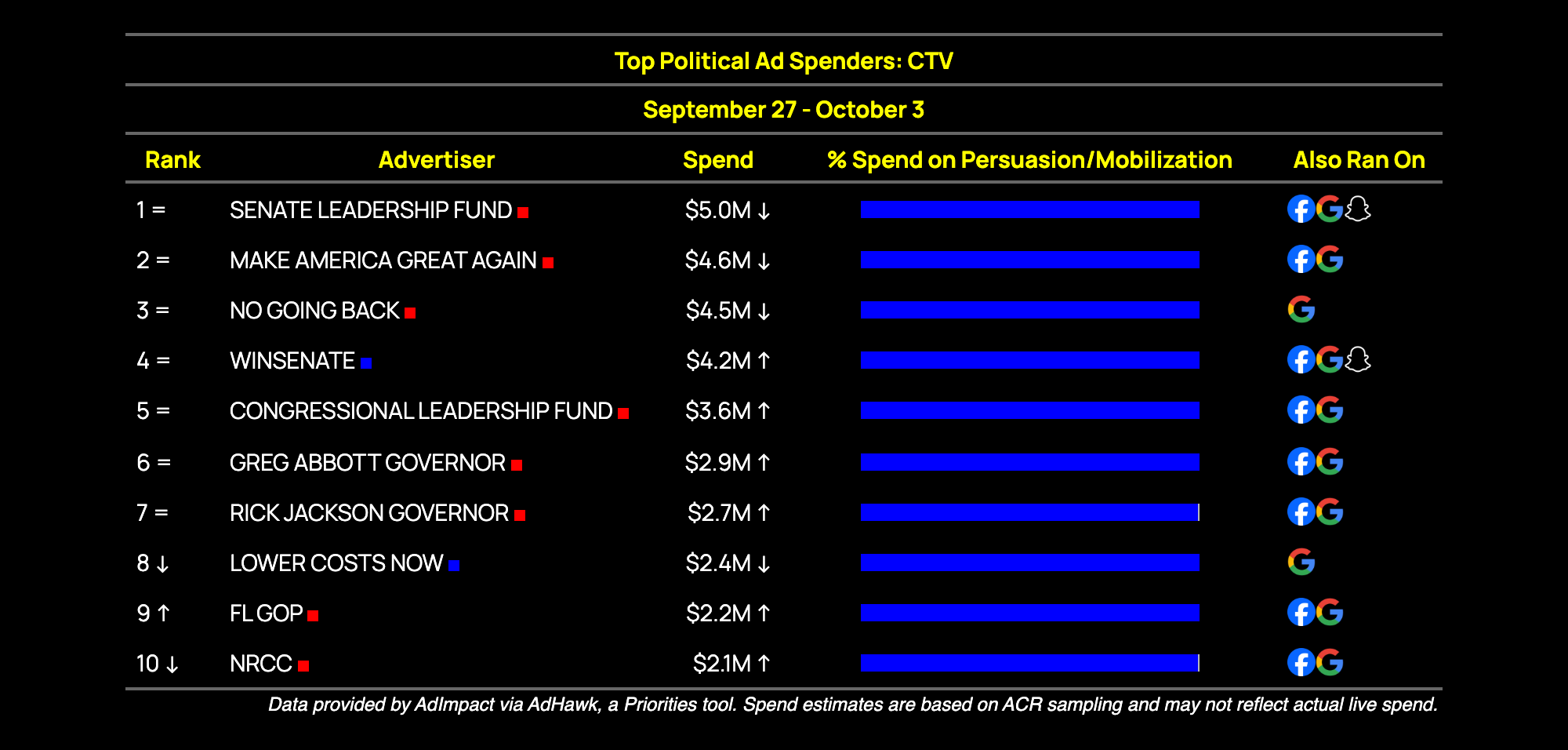
The Florida Republican Party spent a second straight week near the bottom of the CTV charts, which officially makes it of interest. They’re spending across a number of statewide races on ads that are very distinctly Floridian:
In the governor’s race, claiming that Democrat David Jolly will institute a hurricane tax.
In the CFO’s race (yes, Florida’s Treasurer is called the CFO), saying that Democratic nominee Annette Taddeo would raise taxes.
And in the AG’s race, running a fairly standard “we lowered crime rates” spot.
There aren’t many bright spots for Democrats in a state where Republican registered voters outnumber them by 1.5 million. But we’ll take what we can get: a recent poll put Jolly “within striking distance” of the governor’s mansion, Sen. Ruben Gallego (D-AZ) said he hopes to campaign with Democratic Senate nominee Angie Nixon, and Sen. Bernie Sanders (I-VT) sent her campaign $250k.
But for every good piece of news, there’s a bad one. Another poll showed Republicans with substantial leads in both races, no Democratic outside spenders have gone up on the air, and none have announced plans to do so in the last four weeks. It seems like Jolly and Nixon are on their own at the top of the ballot in the Sunshine State, for now.
…and lastly, on Snapchat, here’s YTD data for the top 10 spenders:
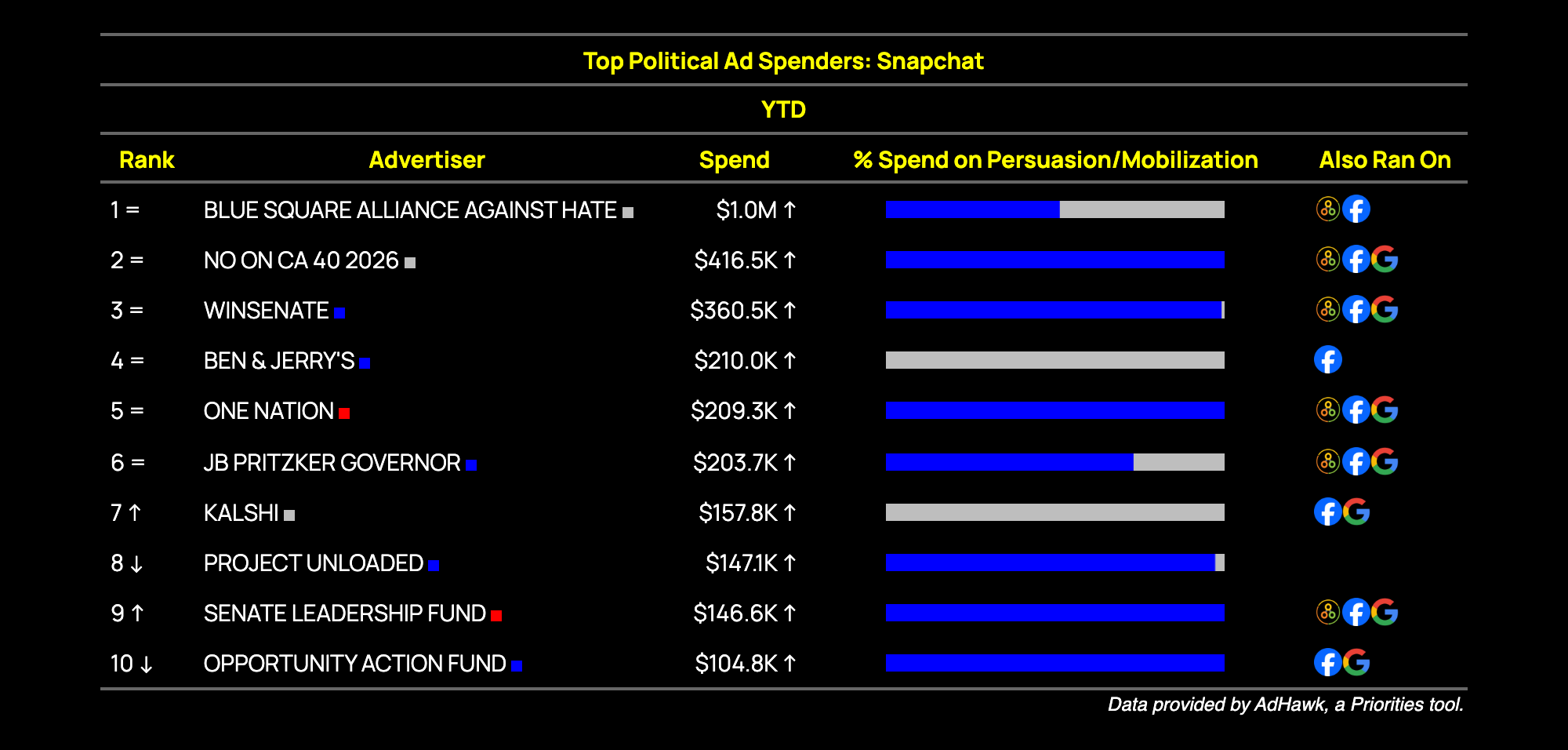
Snapchat spending continues to climb, week-over-week. Last week, $640k flowed onto the platform, the size of a medium-scale Senate CTV buy. Much of that came, as usual, from Democrats: Senate Majority PAC-aligned WinSenate was the top spender at $106k, followed by Sen. Jon Ossoff in second place at $64k. Both ramped up considerably from the previous week, when they spent $67k and $12k respectively.

What’s really happening at the Supreme Court?
Join COURIER and Americans United on October 20 for Weaponizing Faith: Christian Nationalism at the Supreme Court. Featuring Rachel Laser, Stasha M. Rhodes, Michael Podhorzer, and moderator Lisa Graves, this panel uncovers how political allies are reshaping our legal system and what we must do to reclaim it.
Attend in person at The Milton Theatre in D.C. or watch the live stream online. RSVP today!
And Now Back to That Football Ad
Texas PAC isn’t the only one buying airtime during football. Since September, the Trump administration has spent at least $11 million in taxpayer money on campaign-style ads, including some that aired during NFL games. One is a shortened version of a 2024 Trump campaign ad with a new tag at the end, “Paid for by the U.S. government.” Spoiler: that means you.
It all fits with what we’ve been seeing in our competitive data for months. Republicans are trying to buy their way out of an impending electoral catastrophe, and the polling helps explain why. Democrats are 9 points ahead on the generic congressional ballot in this week’s polling averages. For context, the party leading on that question has gained seats in each of the last seven midterms. Trump’s approval sits at 37%, tied for the lowest pre-midterm rating in half a century. When George W. Bush hit that same mark in 2006, Republicans lost both the House and Senate.
In September, the two parties spent roughly $1.3 billion on ads, with Democrats spending $520.7 million and Republicans $770.9 million. Put another way, that’s about $1.50 in GOP spending for every Democratic dollar.
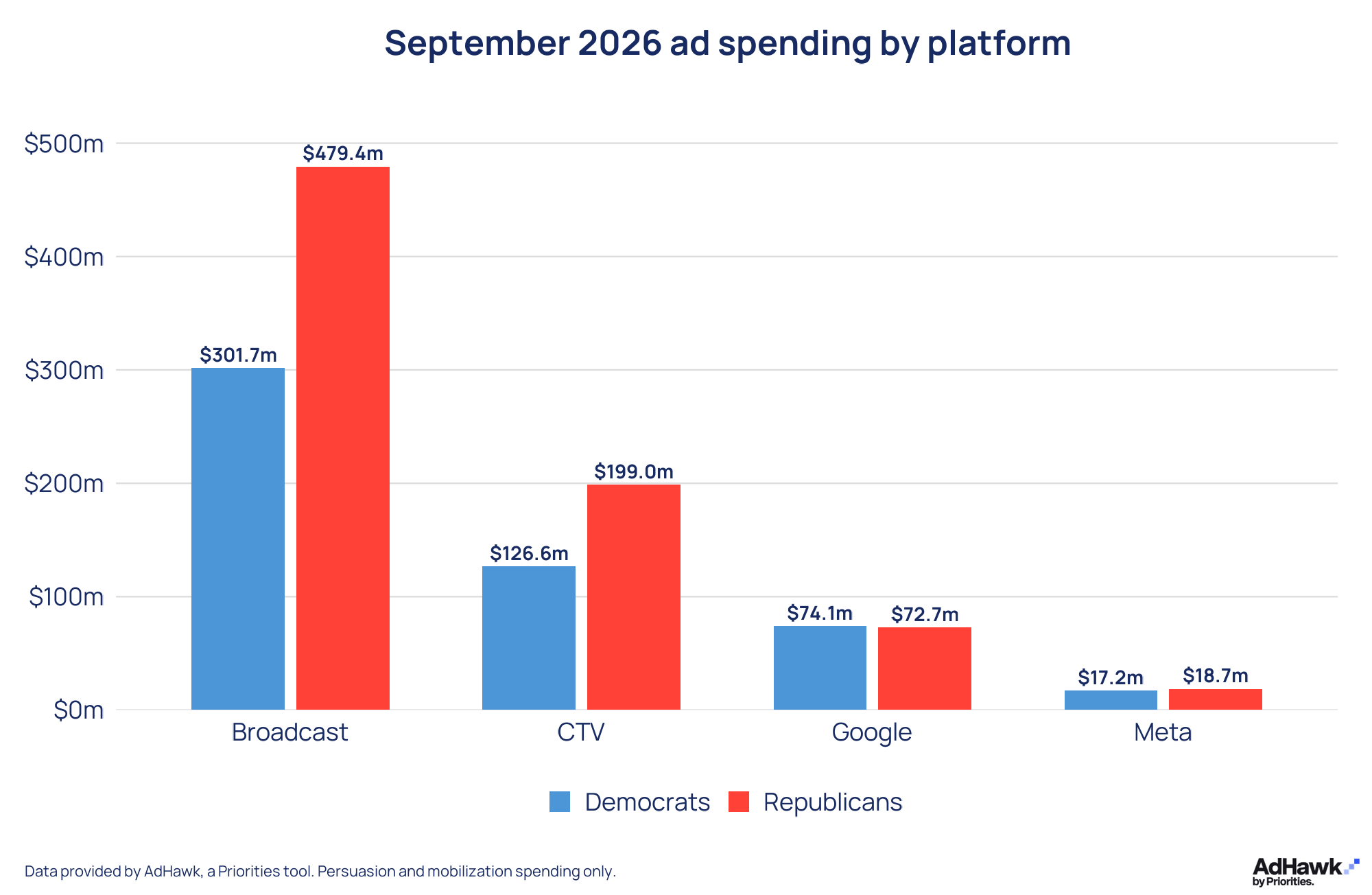
The gap is widest on TV screens, both broadcast and streaming TV (CTV). Outside of CTV, digital is basically a tie.
Republicans Doubled Down
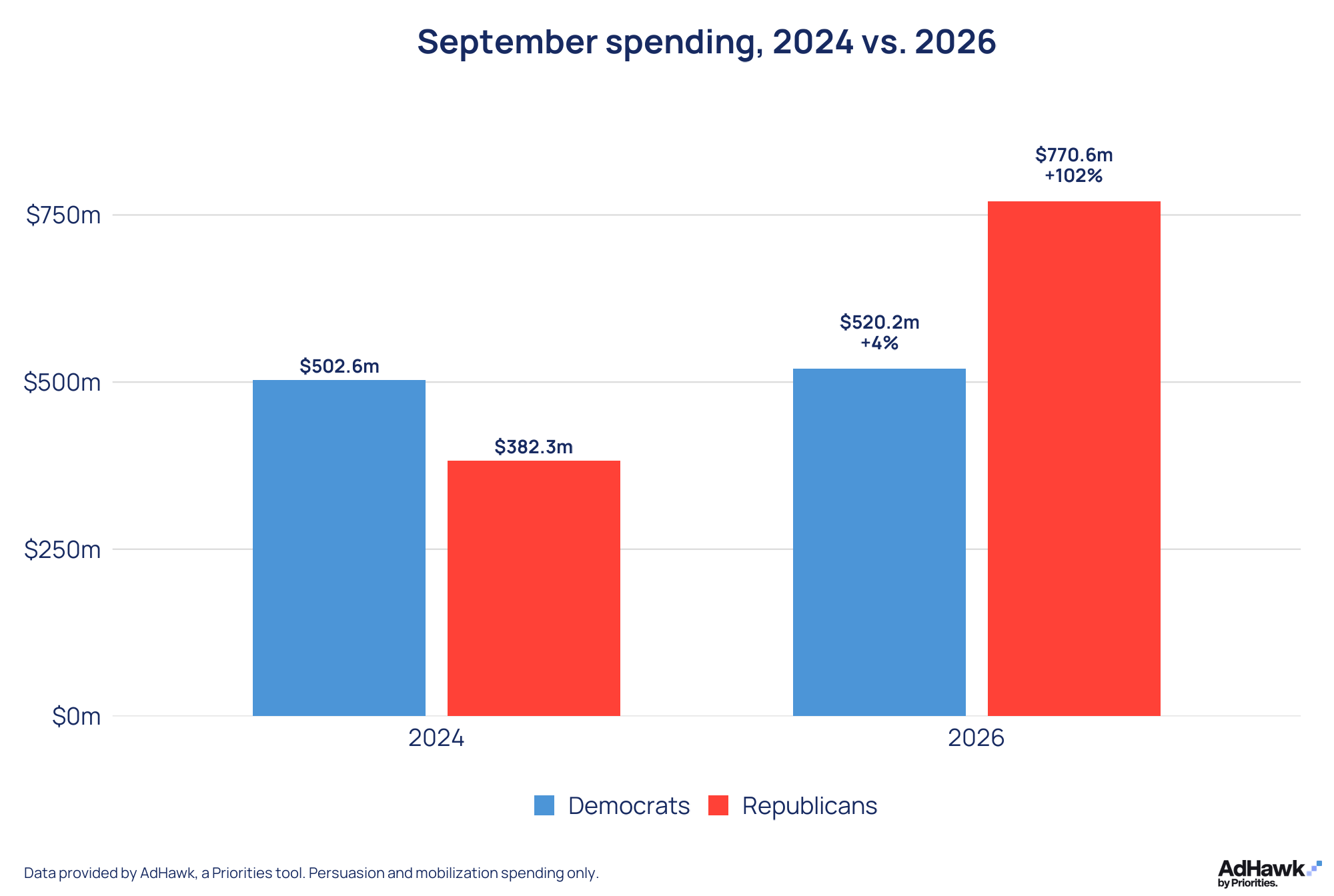
To see how unusual this is, compare it to September 2024. I’ve pulled presidential spending from the 2024 figures to keep the comparison fair.
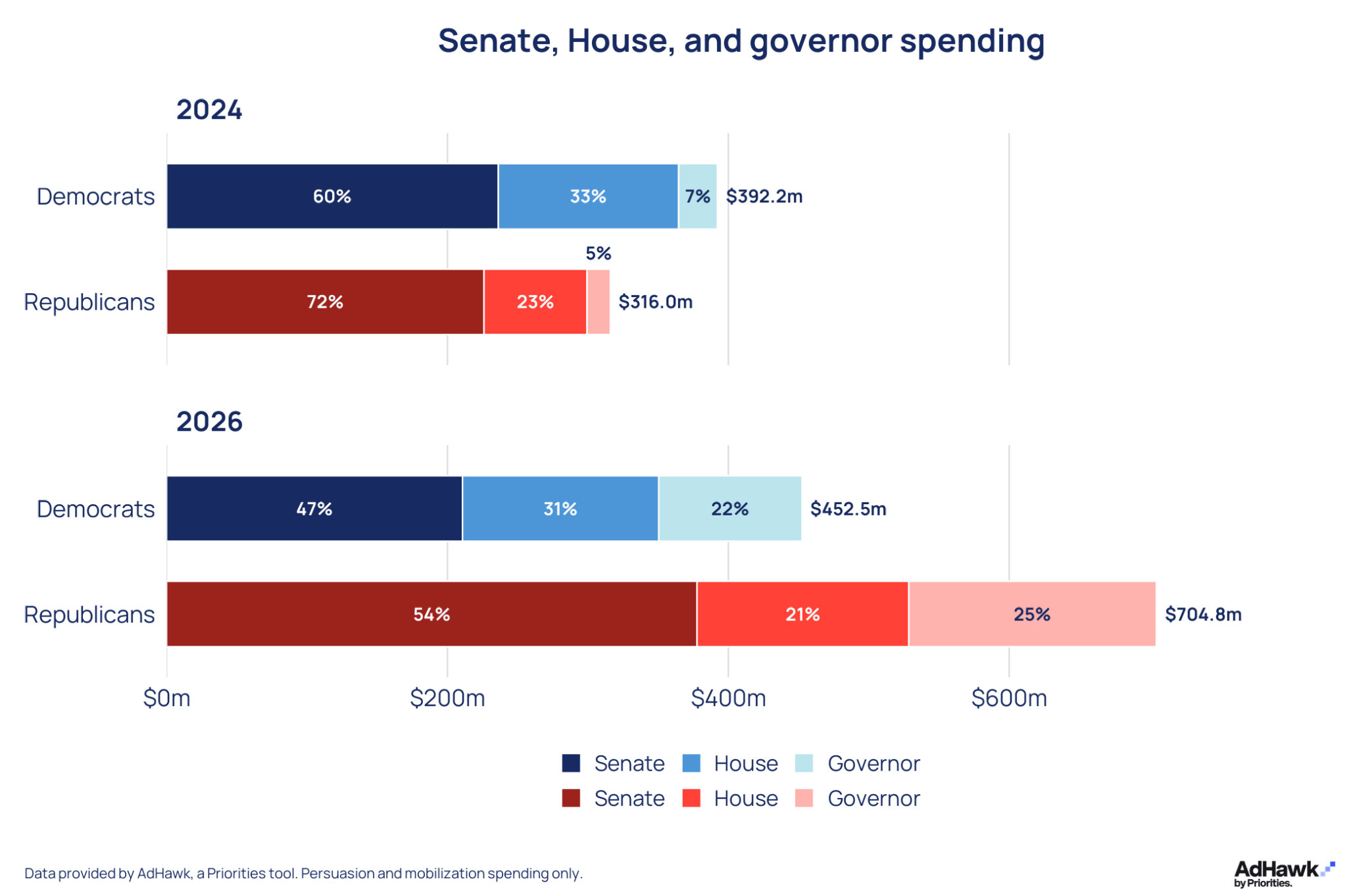
Both parties are spending more than they were two years ago. Democrats are up just 3.5%, but Republicans more than doubled their investments. For every new dollar Democrats added, Republicans added about $22, and no, that’s not a typo.
A lot of that new money went into governor’s races, fewer of which were on the ballot in 2024. Republicans’ five largest gubernatorial buys this September totaled about $118 million.
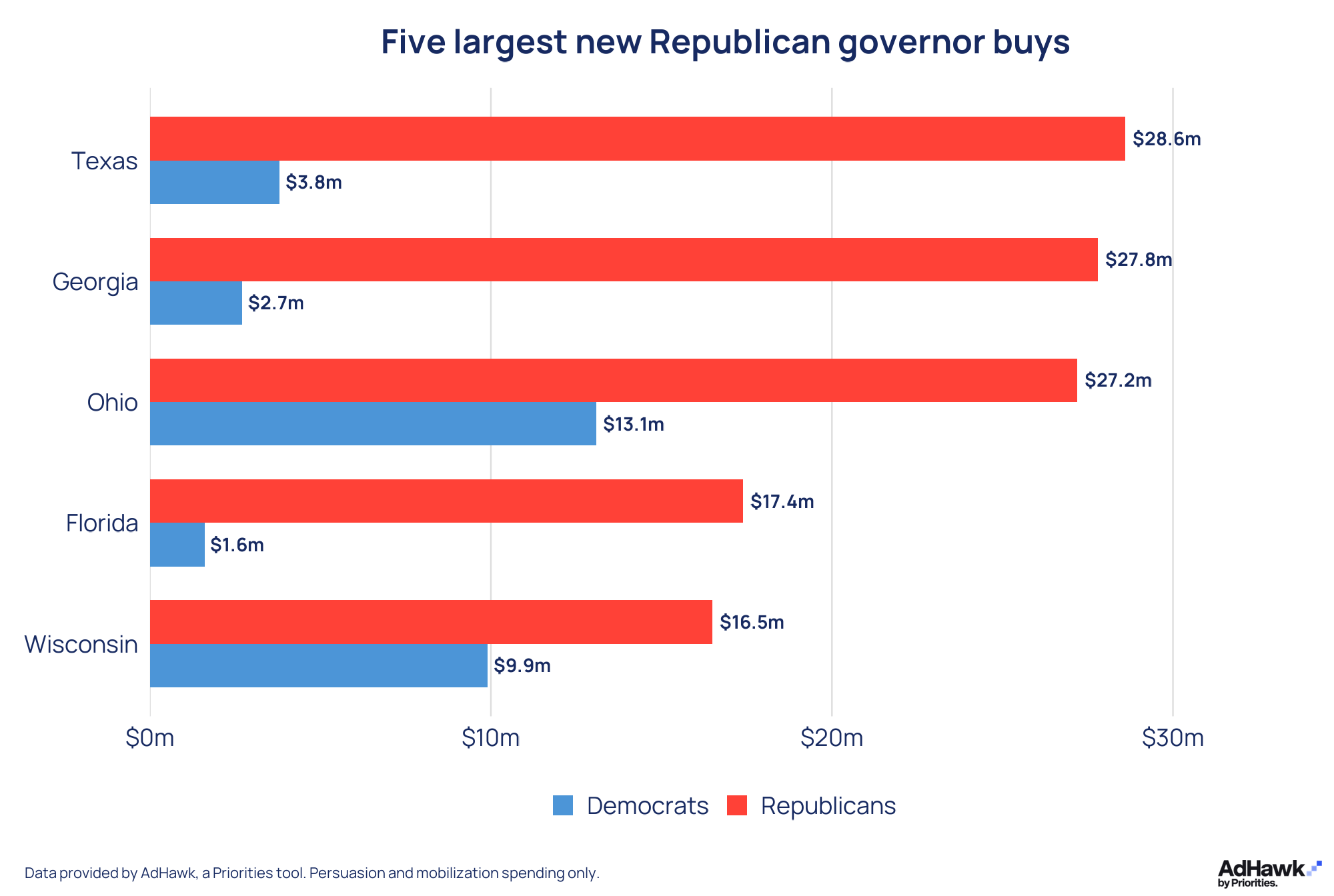
Ohio and Wisconsin show just how much the GOP has ramped up at the gubernatorial level. Republicans are spending more than twice as much as Democrats in Ohio and about two-thirds more in Wisconsin. Tom Tiffany’s campaign alone spent $10.1 million, bankrolled almost entirely by three billionaires.
The House shows the same pattern. Across the 124 districts on the DCCC’s target list, Republican ad dollars grew at about 8x the Democratic rate. Republicans now lead in total spending in those districts ($146.3M vs. $136.0M). In the 19 Republican seats Democrats are working to flip, Republicans have ramped up their ad buys by 154%. In other words, they’re putting a lot more money into defending those seats.
Everything’s Bigger in Texas
The Senate map has moved fast. The Cook Political Report has shifted six Senate races toward Democrats since June, and a majority that once looked like a long shot is now within reach.
Republicans haven’t lost a statewide race in Texas in three decades. In September 2024, they spent $13.8 million on the Texas Senate race. This September, they spent $108.4 million, a 687% increase. Texas PAC, Senate Leadership Fund, the main Republican Senate super PAC, accounts for $65.2 million of it.
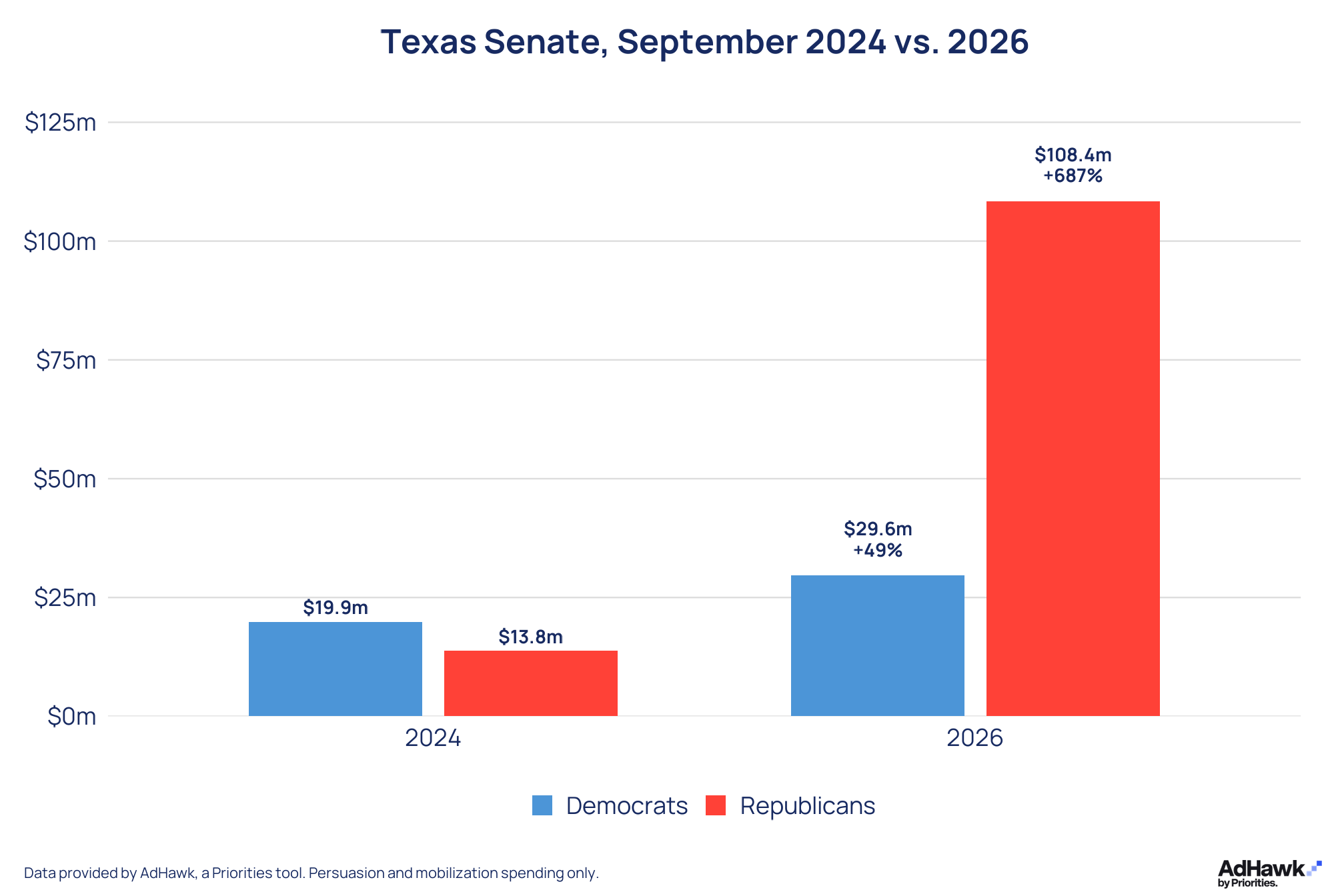
The governor’s race is a different story. Gina Hinojosa has spent $3.8 million, compared to Greg Abbott’s $28.3 million.
Altogether, Texas voters saw $137 million in Republican ads in September. Two years ago, Trump carried Texas by 14 points and Ted Cruz by 9. You don’t spend that kind of money on a race you feel good about.
And that pattern holds across red states. In Florida, Republicans outspent Democrats about 11 to 1 in the governor’s race ($17.4M vs. 1.6M). They also poured $7.6 million into a Senate race where Democrats spent almost nothing. Kansas governor ($5.0M vs. $0.6M) and Nebraska Senate ($5.4M vs. $1.9M) followed suit.
Senate Leadership Fund is following the same playbook. After putting more than $30 million into North Carolina, the group paused its spending there in the final weeks and moved seven figures into Kansas, a state Trump won by 16 points in 2024.
How Democrats Are Responding
In plenty of races, Democrats are the ones setting the pace. In September, they outspent Republicans in the Arizona governor’s race ($9.0M vs. $3.2M), the Georgia Senate race ($21.7M vs. $16.3M), and NH-01 ($4.3M vs. $1.5M), along with governor’s races in Oregon and New York.
They’re also going on offense in places Republicans once considered safe. They more than doubled their spending in NJ-07 and IA-01, two seats Republicans currently hold. Democratic spending in the Texas Senate race grew 49%, led by $23.2 million from James Talarico’s campaign.
Super PACs and party committees still do much of the heavy lifting. In the Senate, Dem-aligned WinSenate is outgunned by Senate Leadership Fund ($70.8M vs. $107.3M). In the House, Dem-aligned House Majority PAC and the DCCC combined for $49.8 million, against the GOP’s $78 million from the CLF (House Republicans’ super PAC) and the NRCC. In governor’s races, Democratic money is coming more from candidates and in-state groups.
Democrats are also leaning harder into digital, which now accounts for 44% of their Senate buys, up from 36% in 2024.
Running Through the Tape
With less than four weeks to go, Republicans aren’t slowing down. Money can only do so much to close a gap in the polls, though. In September 2024, Democrats outspent Republicans about two to one in the presidential election ($310.5M vs. $156.4M) and still came up short. At this point, we are unlikely to outspend Republicans in many of these races, so how we finish comes down to what we say with the dollars we have.
In a September poll, Priorities asked battleground registered voters which issues they’re personally concerned about, which they’ve been hearing a lot about lately, and which party they trust to handle each.
Cost of living—whether defined as gas prices and utilities or groceries and day-to-day expenses—is the clear leader. Nearly two in three voters select each as something they personally are very concerned about (64%). And 67%-69% say they’ve been hearing A LOT about them lately. In a poll that runs D+6 on the generic ballot, Democrats hold a net trust advantage of 12 to 13 points.
Some of the issues Republicans have heavily advertised—trans issues, violent crime, and border security—are areas where they hold a trust advantage. But far fewer voters say they’re very concerned about them.
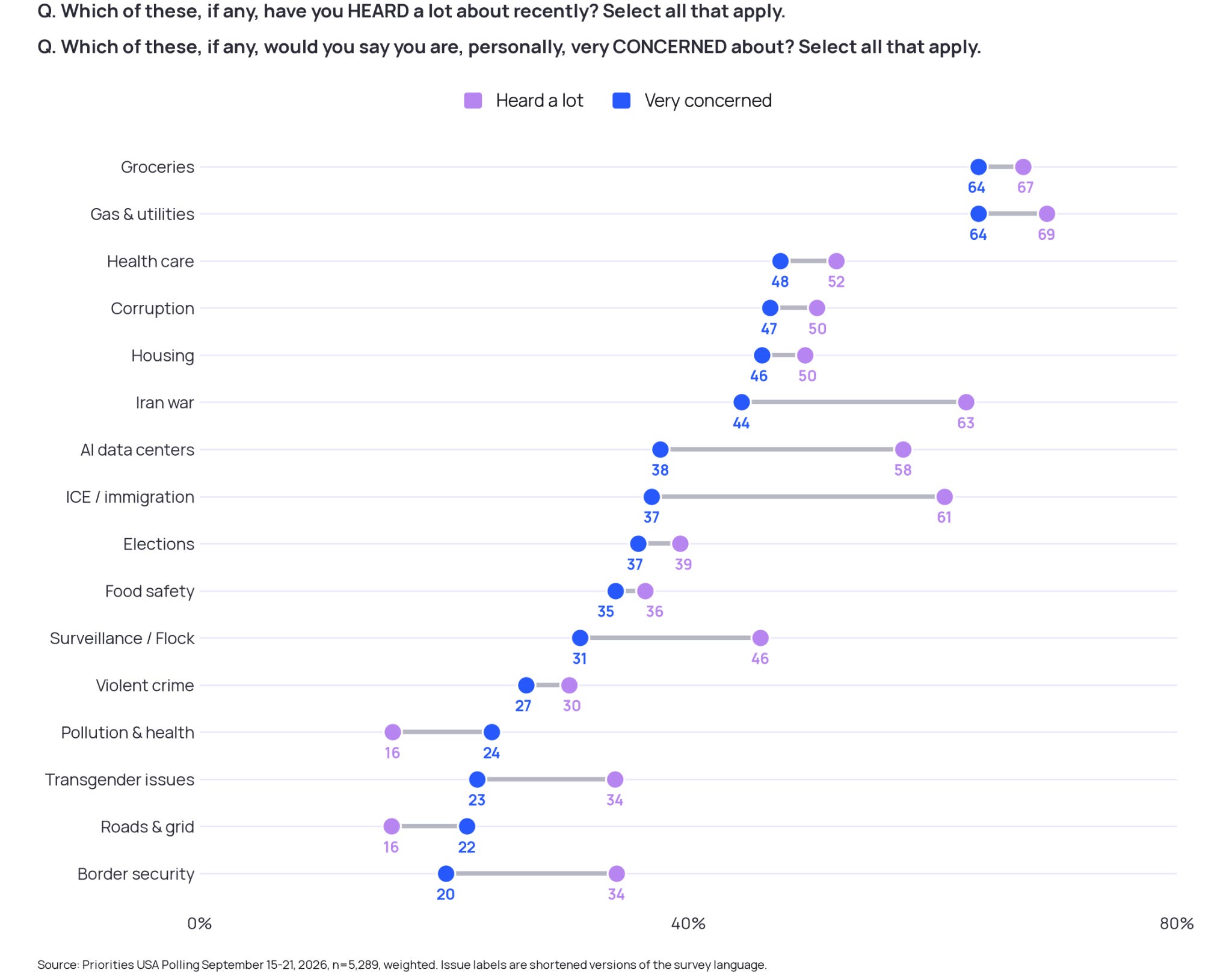
All that said, net trust only tells us so much. It’s largely driven by voters who already have firm opinions. Undecided voters in the same poll (either undecided on a generic ballot or a named battleground senate match-up) were very concerned about many of the same issues: groceries and day-to-day expenses (63%), gas, electricity and utilities (60%), housing (49%), and health care (46%). But, importantly, on all four issues, 27–30% said they were not sure which party they trust more.
Republicans may be running like they’re scared, but among less engaged voters, plenty of minds are still far from made up.
So the next time a Texas Senate ad interrupts your Sunday football (or basketball!), take it as a good sign. Republicans are betting they can spend their way out of this. On November 3, we’ll find out if that’s true.
Data from AdHawk by Priorities, covering September 2026 persuasion and mobilization spending, with September 2024 as the comparison month. TV includes broadcast and cable. Digital includes CTV, Google, Facebook, and Snapchat. All comparisons list Democrats first, then Republicans. Ratios are Dem:GOP, so 1:1.5 means Republicans spent $1.50 for every $1 Democrats spent.
This piece uses two totals. “All spending” covers every race on the ballot. “Contested races” covers races where both parties spent at least $1 million in September, and is the basis for the 2024 vs. 2026 comparisons.
Polling from Warbler Media Intelligence’s September Landscape Poll of 5,289 registered voters in key House and Senate geographies, fielded September 15 to 21, 2026.

Get the full receipts every Monday in The Cover-Up
COURIER's Contradictions Tracker puts officials' Epstein testimony next to the files, with every entry linked to its primary source. Updated weekly in The Cover-Up.
That’s it for FWIW this week. This email was sent to 25,824 readers. If you enjoy reading this newsletter each week, would you mind sharing it on X/Twitter, Threads, or Bluesky? Have a tip, idea, or feedback? Reply directly to this email.

