



Hi everyone! We’re Sofia Garduno Araujo and Bethanie Olivan, NextGen America’s digital organizing team. NextGen is dedicated to educating and empowering young people to organize, vote, and lead on the issues that matter most to them.
Sofia brings a decade of experience — from field organizing and immigration advocacy to leading NextGen’s digital voter contact efforts and distributed volunteer team for the last six years. Bethanie has nine years of experience in distributed organizing, spanning presidential campaigns and state parties, and has managed NextGen’s text program and volunteers for the last five.
For today’s FWIW, we’re talking about our Pulse Check project: a peer-to-peer (P2P) text campaign focused on identifying the issues currently affecting young people the most. Building on our 2025 work, we expanded outreach in Arizona, Georgia, Iowa, Michigan, North Carolina, New Mexico, Nevada, and Pennsylvania, where our volunteers have contacted over 1 million people ages 18-29. We’re thrilled to share what we’ve learned.
More on that below, but first…
Digital ad spending, by the numbers:
FWIW, U.S. political advertisers spent around $15 million on Facebook and Instagram ads last week. Here were the top ten spenders nationwide:
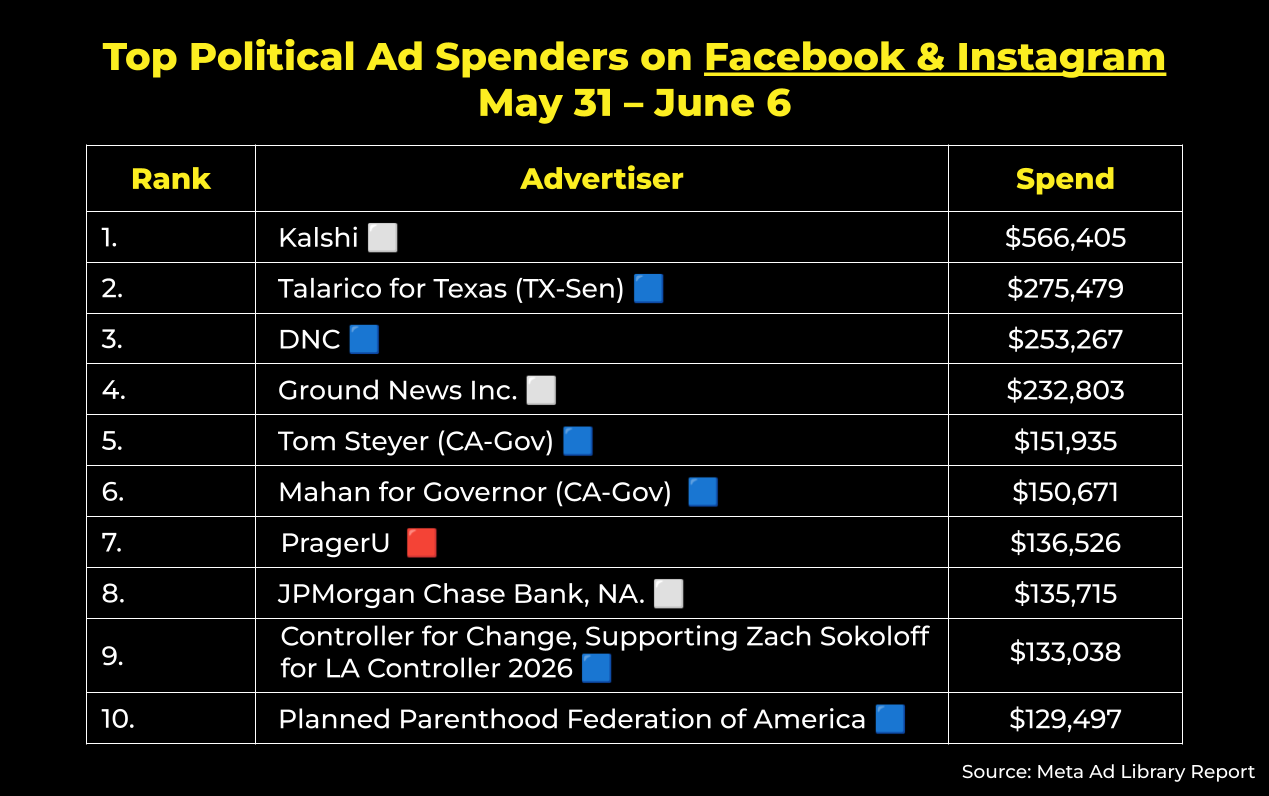
Move over, Nate Silver and The New York Times’ Election Needle — Kalshi has devised a new way of messing with mind, body, and soul this cycle. After holding steady near the top of Snapchat’s spending charts this year, the prediction market came out swinging last week (or at least relative to the waning California spend) with a series of Meta ads, largely promoting their new American Power Index. The new feature tracks the current distribution of political power between Democrats and Republicans and who it thinks ‘will hold them next.’
Political advertisers spent around $13.9 million on Google and YouTube ads last week. These were the top ten spenders nationwide:
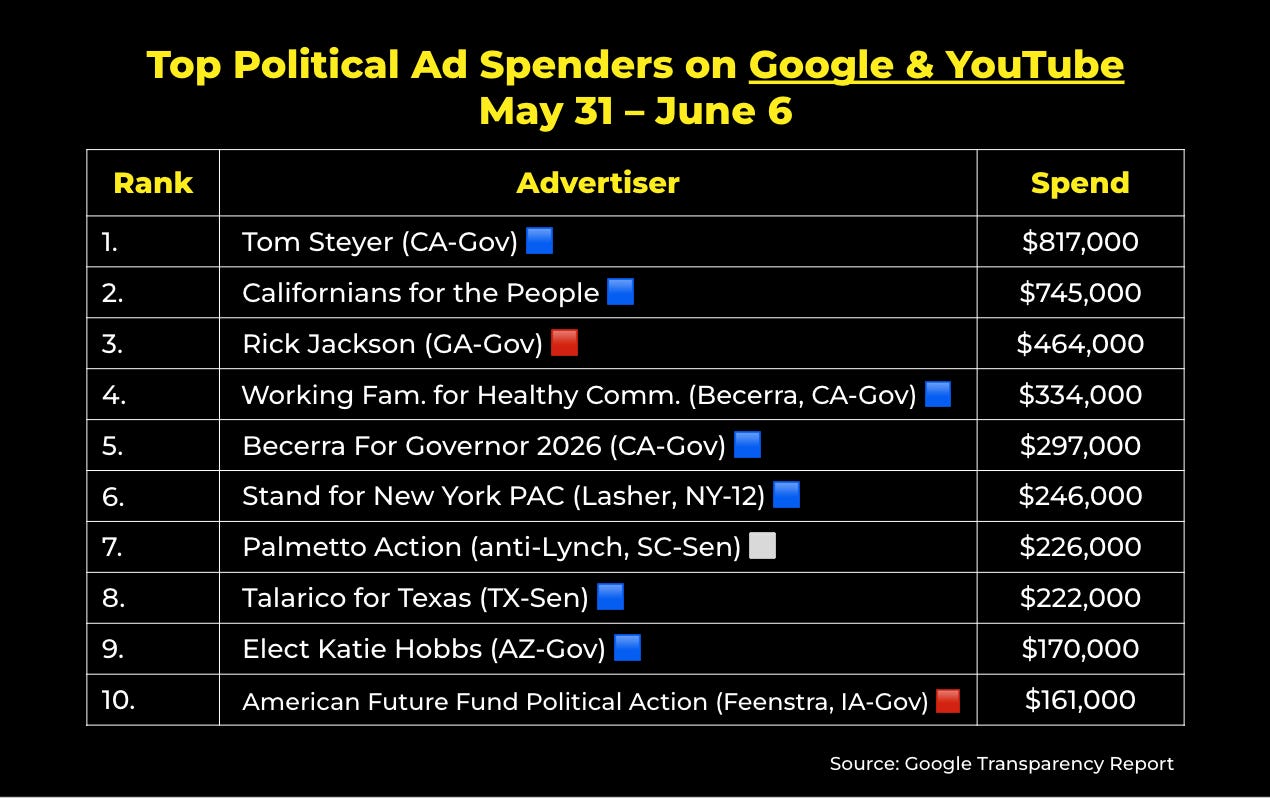
On Tuesday, Senator Lindsey Graham secured the Republican nomination as he pursues a fifth term in Congress’ upper chamber. His primary victory — 57.6% of the vote to Mark Lynch’s 28.3% — was perhaps aided by super PAC Palmetto Action’s 41 Google & Youtube ads last week. Gotta love a good intra-GOP fight at the top of the charts.
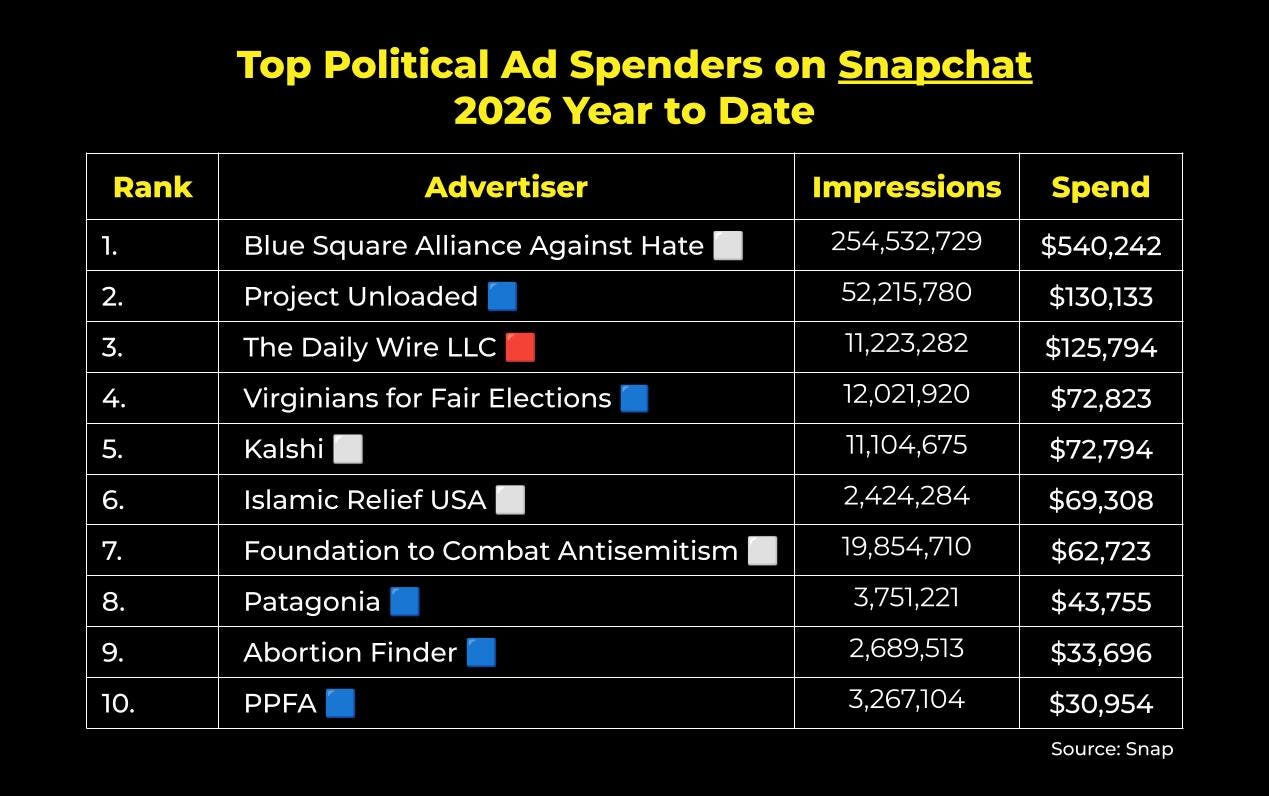
Skipping X (formerly Twitter) once again, but over on Snapchat, political advertisers in the U.S. have spent just over $2.5M in 2026:
Organizing young people via text still works…you’re just doing it wrong
After the 2024 election, it became clear young people did not feel represented by either major party. Rather than voting for a candidate they didn’t like or feel inspired by, many chose to opt out entirely and stay home.
Combined with the fact that a majority of young people identify as politically independent, we realized traditional voter contact methods — transactional asks at the eleventh hour — can no longer be the norm. Young people aren’t swayed by empty promises. They need to see results and a real commitment to fighting for the issues they care about.
After attending many research debriefs (s/o Analyst Institute!) and analyzing our own 2024 data, we identified the root cause of their frustration: they feel like no one is actually listening to them. This led us to build a deep canvassing call program into Michigan, North Carolina, and Pennsylvania to understand how to better advocate for them and rebuild trust.
We started by asking young people to tell us what was impacting them most from a set list of issues and were completely blown away by how much people were willing to share with us over the phone. Our contact rate remained very high throughout the call campaign (averaging 9%, with some days getting as high as 14%), and we collected hundreds of meaningful stories.
Encouraged by those results, we set out to see about scaling through texting. We tried out some smaller text campaigns in those same states, adding Virginia to the mix, and were fascinated by how consistent the results were with the calls. With two successful campaigns under our belt, we set out to make this the flagship effort of the first half of 2026.
Going into this, we were often told that texting was no longer an effective way to reach young people. Calling? Forget about it. P2P’s reputation has taken a hit, mainly due to fundraising spam. Campaigns have spent the last few years overwhelming people with fundraising texts and wondering why their response rates are so low. Young people are sick of receiving asks for money as they watch the economy work only for billionaires and their tax dollars fund yet another war.
The Pulse Check campaign proved that it’s not the tactic — it’s how you use it.
We asked open-ended questions like “What issue is affecting your life the most right now?” to allow recipients to take the reins and have more agency in the conversation.
Across all campaigns, we averaged a 5.8% response rate, with some getting as high as 6.9%, higher than our initial test campaigns in 2025 and a remarkable response rate by any industry standard.
We knew the economy would be a big topic for folks, so rather than a single economy-focused response, we divided the topic into four categories — Rent/Housing Market, Jobs/Wages, Inflation/Groceries, and a general Economy bucket — to try to pinpoint the specific pressures causing the most distress.
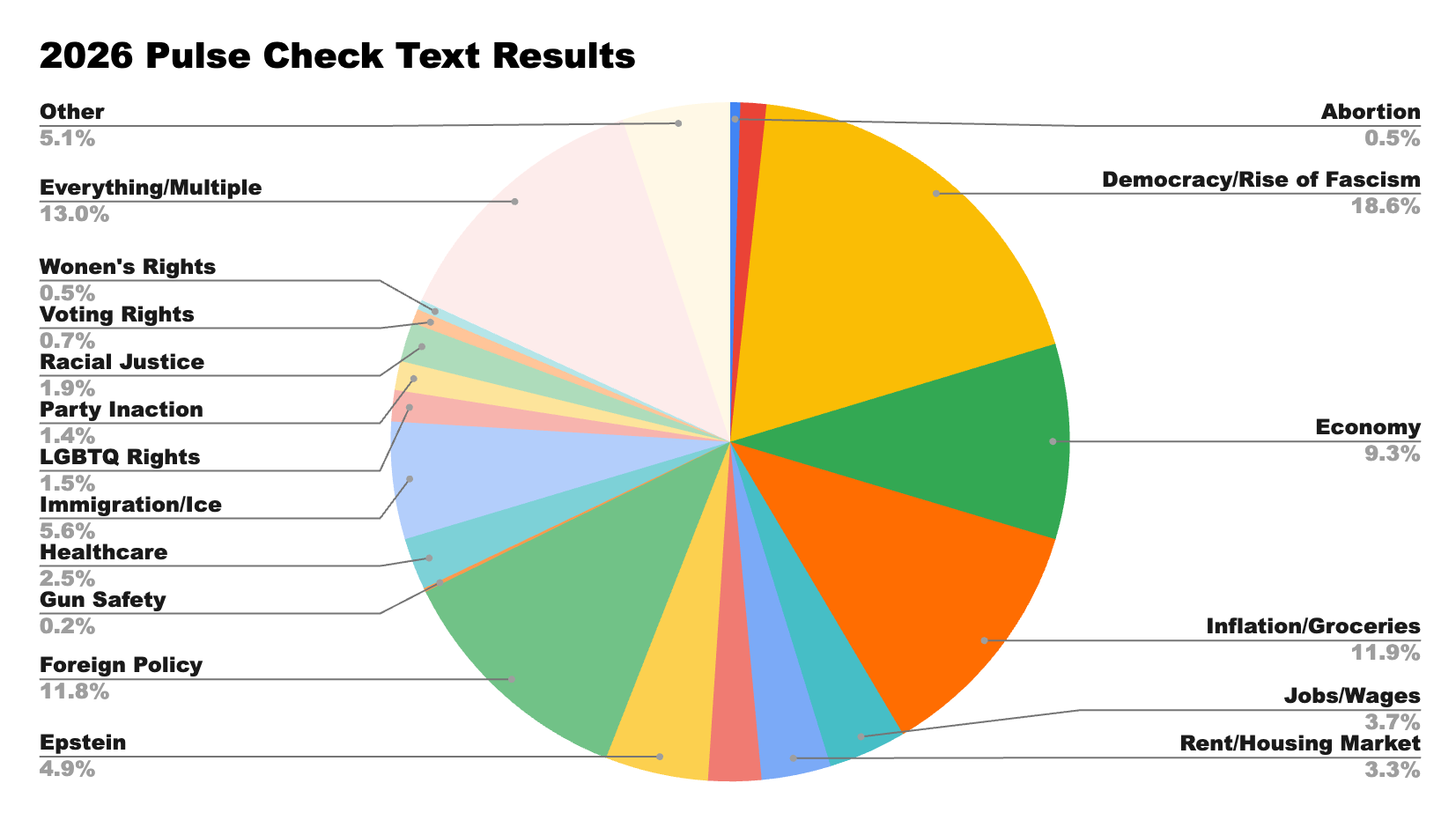
The top five issues identified were Economy (28%, with Inflation/ Groceries being most prevalent), Democracy/Rise of Fascism (19%), Multiple Issues (13%), Foreign Policy (12%), and Immigration (6%). A central throughline across all issues was corruption. Whether it’s billionaires buying our elections, this administration pardoning their buddies, or foreign influence on our government, young people’s trust in institutions is extremely low.
Here’s a breakdown of the issues:
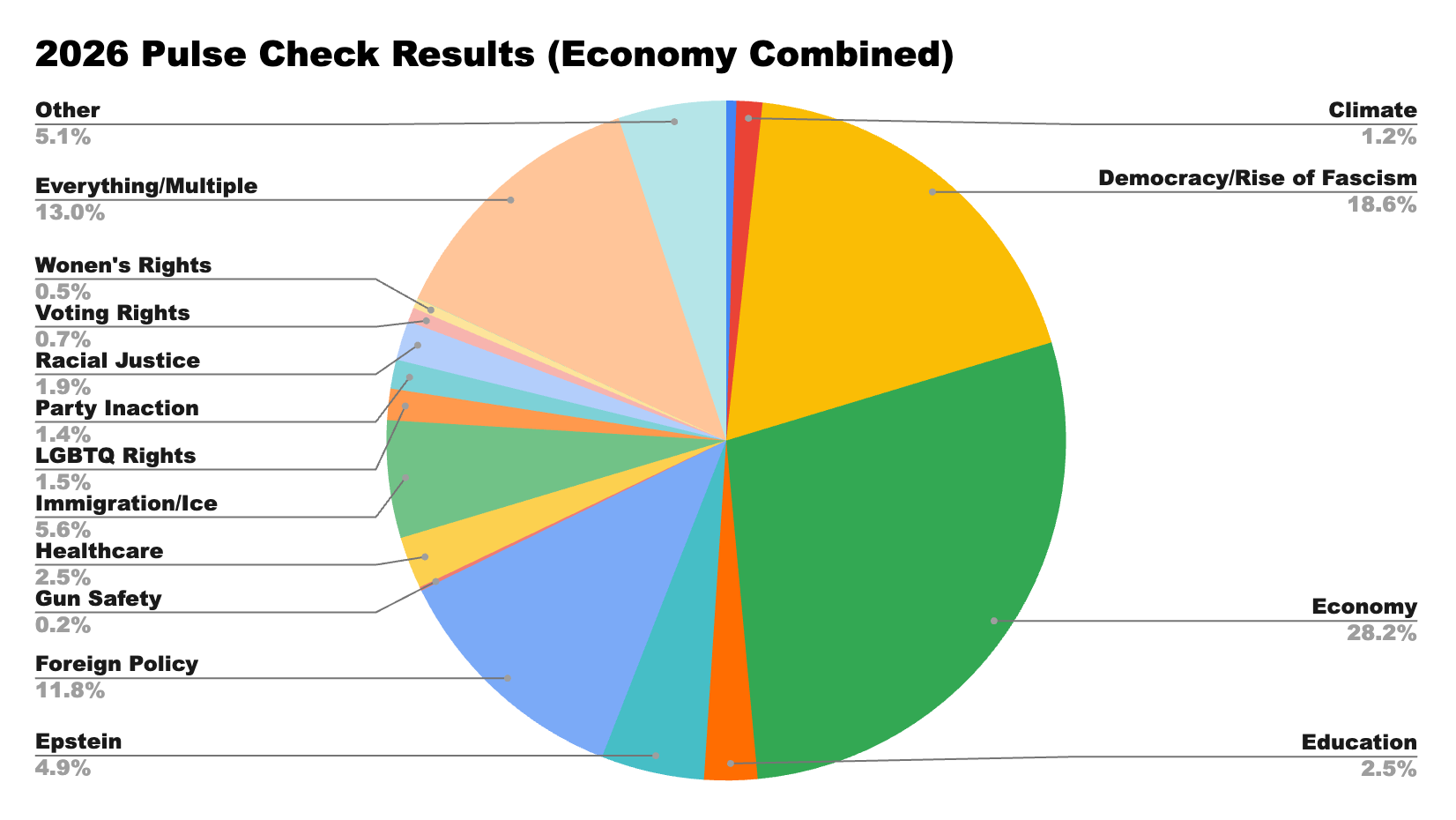
You can also see how the top issues changed per week:
Overall, the biggest thing we learned is that young people are not apathetic or disengaged. They are extremely knowledgeable and understand how their lives are directly affected by the actions of the Trump administration. From the attacks in Iran and Gaza to the cuts in healthcare, they clearly see how interconnected all the issues are, and they are angry, anxious, and frustrated.
If you’re planning on conducting similar text outreach, here are a few things to keep in mind:
Be anticipatory, not reactive. You don’t have to start from a blank slate; use polls, the news cycle, and social media to inform your writing. Your script will likely be longer than you’re used to, but that’s what will keep you from scrambling to answer complicated questions mid-shift or combing through responses that don’t fit neatly into any category. That said, you can’t anticipate everything, so flexibility and a willingness to add or edit responses are key.
Engage with care. It’s important to do this outreach authentically. We do this because we care and we understand the people we text are facing real issues. Centering the respondents and their situations, particularly when they’re struggling, should be top of mind, so we included two ‘Needs Assistance’ responses for Economy and Healthcare, linking folks to public assistance and resources.
Train your volunteers! This one is a given, but there will likely be a gap between them and your audience, whether by generation, race, or class. Provide a deep-dive training before each text shift, with multiple examples volunteers can access and reference throughout. Knowing Pulse Check would be more involved than a standard click-and-send campaign, we limited our efforts to seasoned volunteers, and you should do the same. This allowed us to have more nuanced conversations and send large lists with minimal strain on capacity.
So, once you’ve collected all this info from folks who were not only willing to respond but also trusted you with their stories, it’s your job to pore over the data and uplift their stories to advocate for them better.
Knowing what’s top of mind for your base means you’re able to make better strategic decisions in the future and build a stronger relationship with your list. Whether you want to post a social media series highlighting some compelling stories or name the issues they picked in your future text outreach, this type of campaign will improve how you organize digitally.
There will be subsequent phases of Pulse Check later this year. If you want to know more, stay tuned on our Substack!
That’s it for FWIW this week. This email was sent to 25,803 readers. If you enjoy reading this newsletter each week, would you mind sharing it on X/Twitter, Threads, or Bluesky? Have a tip, idea, or feedback? Reply directly to this email.

I wanted to thank you for your essay. I wrote about your findings (and gave you credit) in my latest substack. Notwithstanding a small reason, I think you findings combined with Navigator's research needs to get spread. https://ralphrosenberg.substack.com/p/what-america-at-250-is-actually-telling?r=9e9e3&utm_campaign=post-expanded-share&utm_medium=web
This is a sharp distinction: the problem is not the channel, but the posture behind it.
A text that asks for money feels like an interruption.
A text that asks what is actually happening in your life can become a small door.
That difference is easy to describe and apparently very hard to practice.