


Take the next step in your political career with Arena.

Hi again. I’m Danielle Butterfield, Executive Director of Priorities USA, back today for another week of FWIW. Before we get into our analysis of the media environment, we want to acknowledge that our country is in a very dark and scary place. There is no justification for what is happening in Minneapolis and other communities across the country. My team and I at Priorities are angry. We are grieving. And we’re thinking seriously about how we turn these emotions into action.
Standing up to protect our immigrant communities from indiscriminate violence is not only the right thing to do, but who are we as a party if we cannot stand against Trump gutting our health care and starving our children to fund a secret police force that terrorizes our communities? We know there’s a lot of work to do to consolidate voters behind a fair and humane immigration system, but what we’ve witnessed over the last few weeks shows us that the tides are turning and persuasion is possible.
We want to spend some time talking about how the political and media worlds are responding to this crisis. But before we get to the ICE and immigration messaging that is breaking through widely in earned and organic spaces, let’s touch on the paid media landscape.
Digital ad spending, by the numbers:
FWIW, U.S. political advertisers spent about $4.9 million on Facebook and Instagram ads last week. Here were the top ten spenders nationwide:
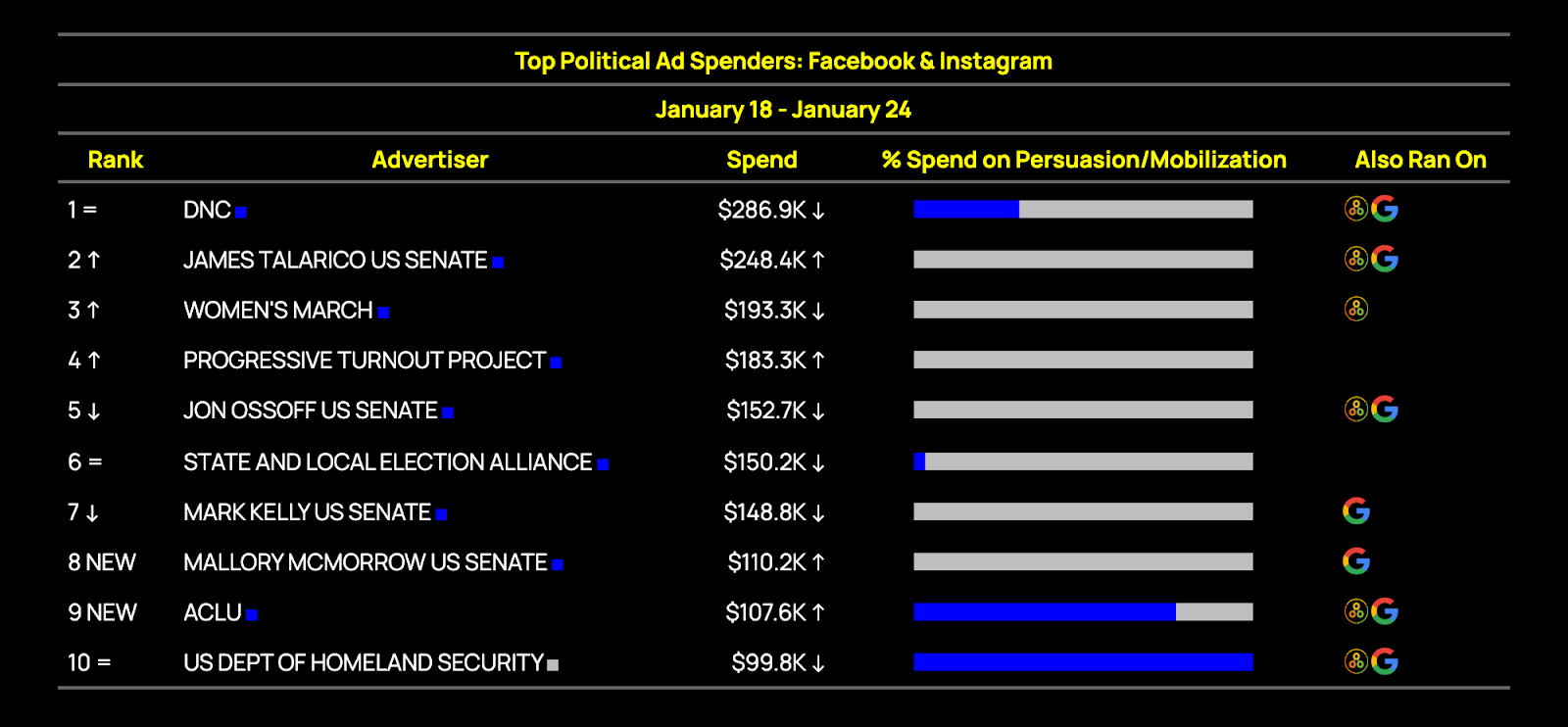
Of note, Lone Star Rising, the coordinated PAC arm of the Texas Democratic Party, has staked out a pro-Talarico stance in the tight Senate primary – even as the candidates remain laser-focused on fundraising. The group spent $26k on Facebook in this reporting period.
Meanwhile, political advertisers spent around $2.1 million on Google and YouTube ads last week. These were the top ten spenders nationwide:
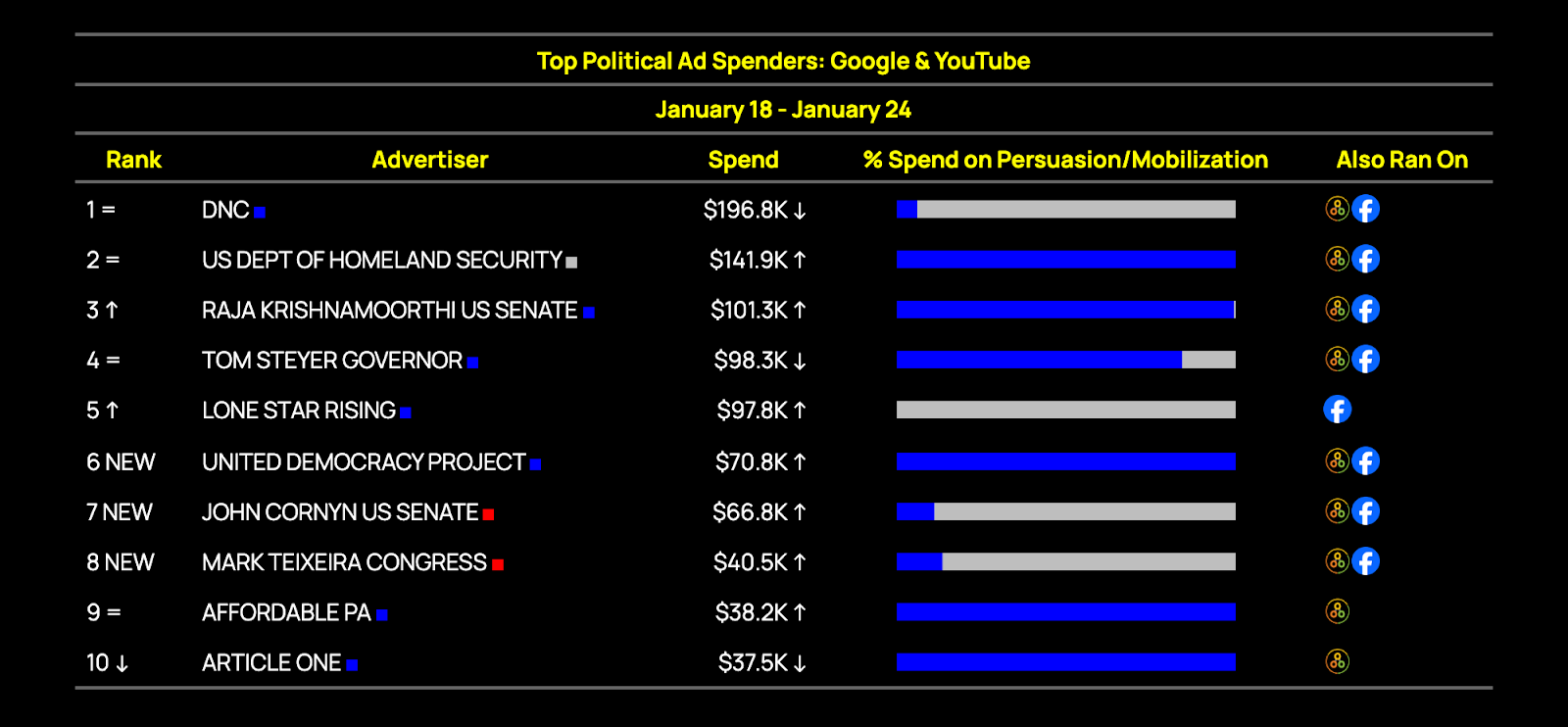
Lots of Google spend is happening in another heated Democratic primary, in Illinois’ 9th District, where Evanston Mayor Daniel Biss, State Senator Laura Fine, and activist Kat Abughazaleh are competing to win the safe Democratic seat. It’s one of few races in the country where a fight over ICE operations has already crystallized within the party: Abughazaleh ran spots with aggressive anti-ICE language while Fine and Biss spoke to their official actions responding to ICE activity in Illinois.
Another race worth highlighting on Google is the GOP Kentucky Senate primary, where Daniel Cameron, Andy Barr, and Nate Morris have taken up successive spots in recent polling. Morris is running a unique message to attract voters: his endorsement by Charlie Kirk.
It’s worth noting that DHS has remained a top advertiser across multiple platforms this week. Even as chaos reigns in the streets of Minneapolis, they are pulling out all the stops to recruit online.
And this week, courtesy of AdImpact, we’re adding estimated CTV to the mix. Political advertisers spent $9.8 million across streaming platforms.
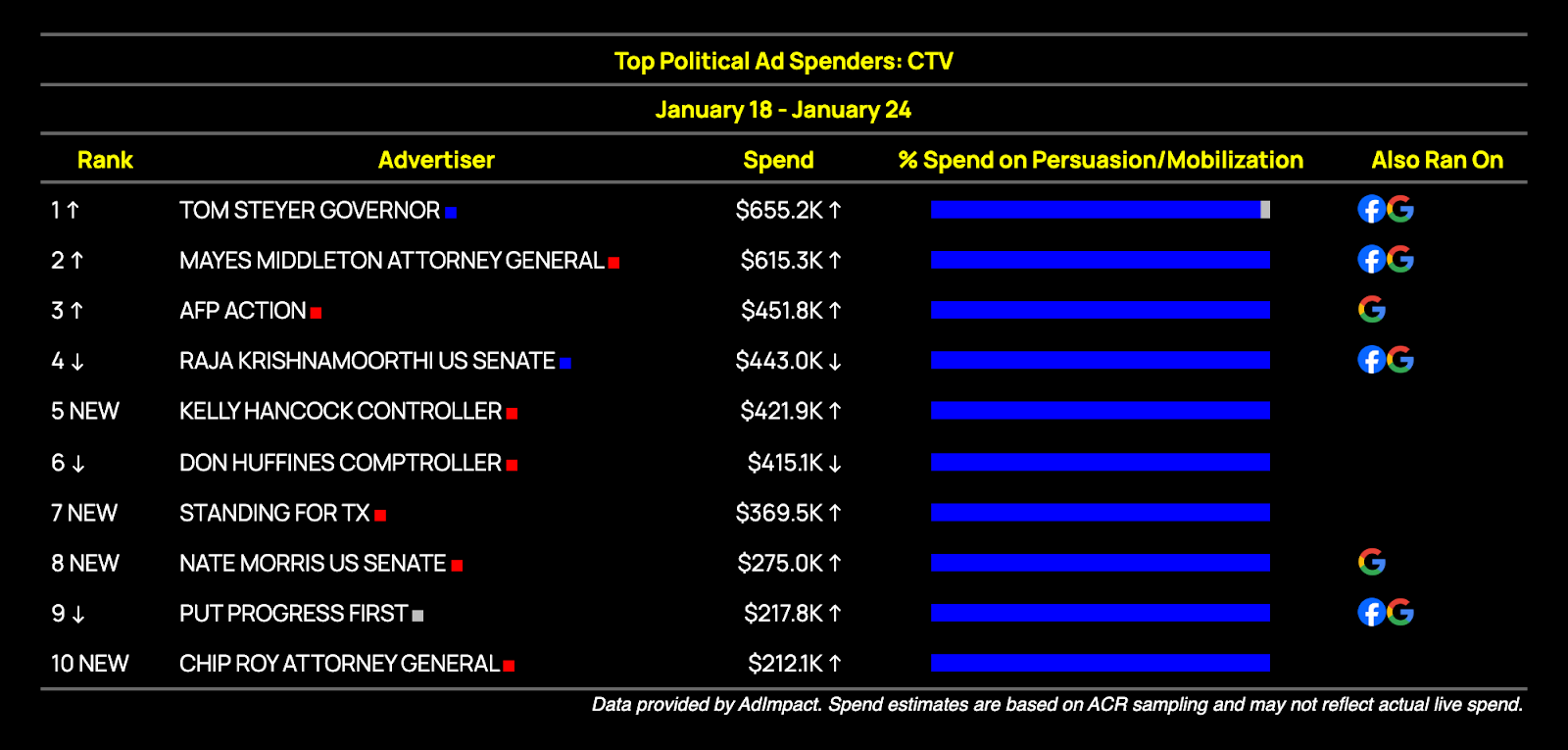
While the Texas primaries heat up ahead of their early March date, one special election this Saturday has captured substantial attention as a potential harbinger for the midterms. The once-ruby red Senate District 9 has seen ads from national spenders while both candidates have run generalist digital campaigns. There’s good reason for the GOP to be concerned: Former Representative Beto O’Rourke carried the county in 2018, Biden won it in 2020, and the area has been a flashpoint for Patriot Mobile’s school board activism spearheaded by the Republican candidate who previously served as the group’s spokesperson and as executive director of its PAC.
Take the next step in your political career with Arena.
Get trained. Get hired. Grow your network.
This spring, Arena is hosting virtual trainings for campaign and nonprofit staff ready to level up management, digital, AI, and core campaign skills. Learn from top operatives and join a powerful peer network. Apply now.
On X (formerly Twitter), political advertisers have spent approximately $533k in 2026. Here are the top spenders year to date:
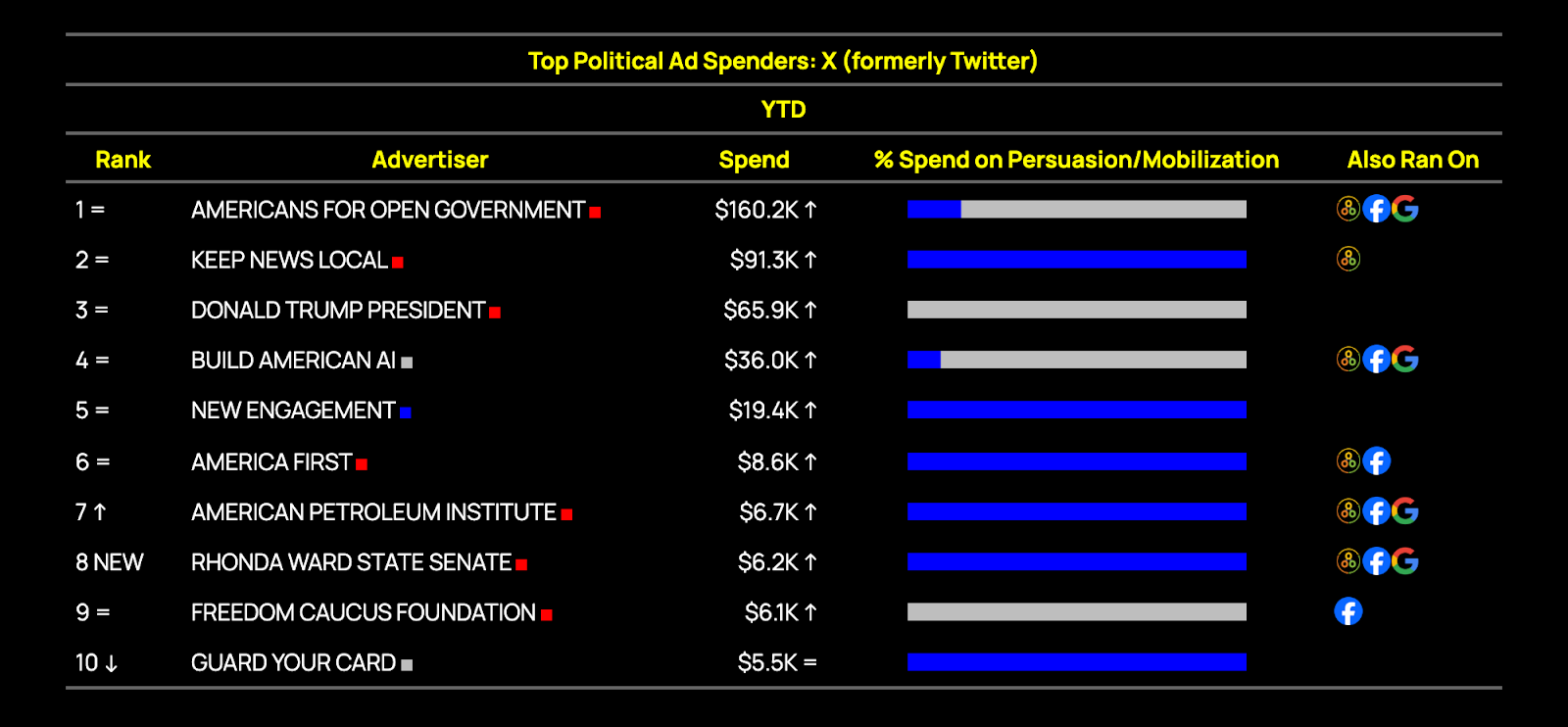
It’s not often we see a non-partisan, non-lobbying entity advertise on X, but No Labels has returned to the platform with commentary on the protests in Iran. It’s their first active spot since the end of 2025. While the group remained sporadically active through last year, it hasn’t run an ad on a non-X platform since August.
Finally, on Snapchat, political spenders have placed about $35k in ads so far this year. Here are the top 10 spenders year to date:
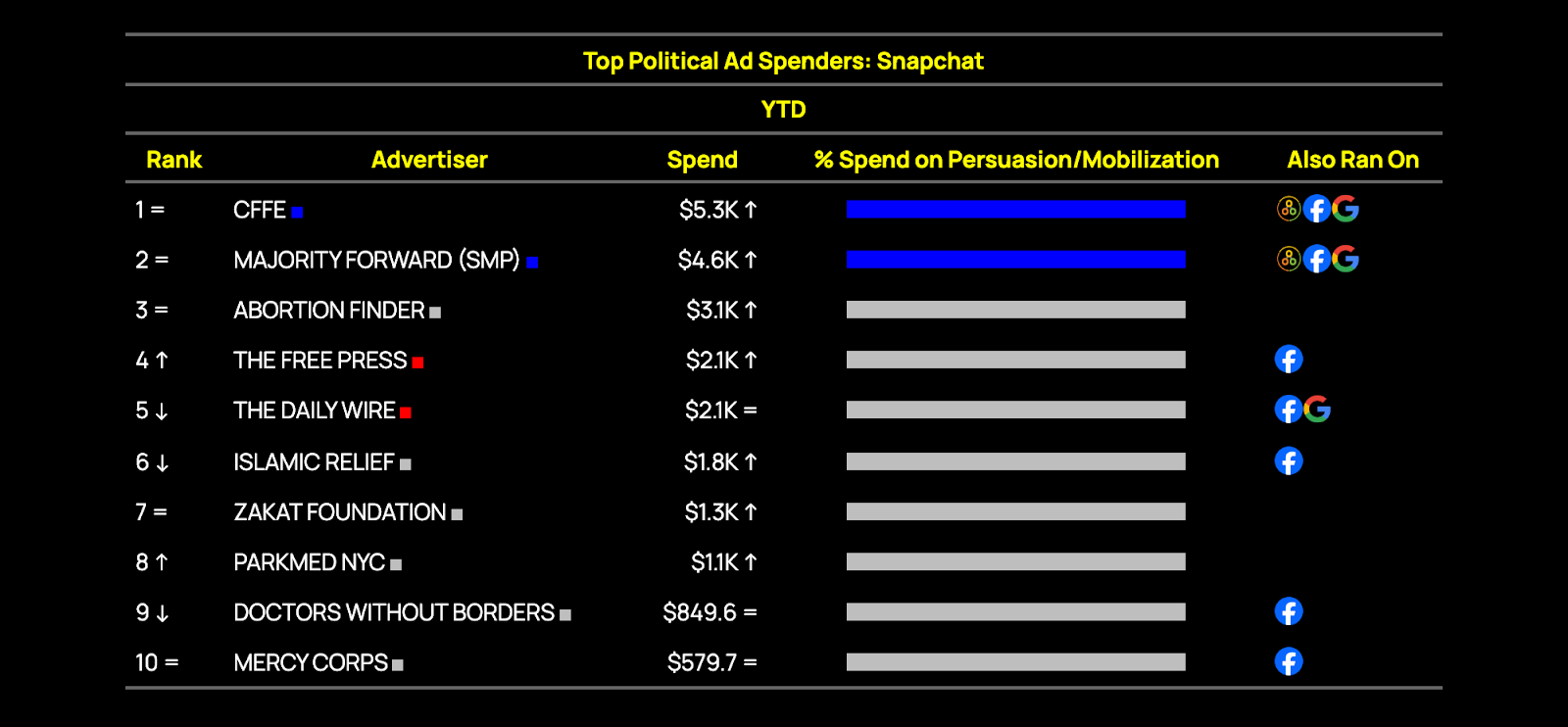
Snapchat remains the quietest platform in 2026, though not without its highlights. The two highest GOP-aligned spenders on the platform are both media groups: The Free Press promoted an Epstein-related story and the Daily Wire hawked Jordan Peterson’s Biblical Collection. While we speculate their goal is audience expansion using a youth-centric platform, the targeting doesn’t imply a specific strategy: both are broadly aimed at 18+ audiences across the United States.
The disappearing line between MAGA trolls and federal policy
The role of the manosphere in Trump’s 2024 victory has been joked about and studied ad nauseam, but what deserves closer attention is how much that same manosphere serves as a constant pulse on what’s resonating online and, increasingly, as an upstream driver of federal policy.
The relationship between viral, alt-right creators and direct government action is one that allows the GOP to shape their actions based on what’s garnering online attention, rather than waiting for polling results. In December 2025, ICE launched Operation Metro Surge in response to fraud allegations pushed by right-wing activists, like Christopher F. Rufo, who claimed that Somali communities were stealing millions in taxpayer dollars. Those claims were picked up and amplified by officials like Kristi Noem and Scott Bessent. Then, the day after Christmas, right-wing troll and online provocateur Nick Shirley went viral – with help from MAGA-sphere staples like Elon Musk – claiming that Somali daycares were sitting empty. The video racked up a hundred million views. JD Vance said Shirley deserved a Pulitzer.
In the wake of that video, the Trump administration froze federal funding for early childhood education across the country. Days later, it sent a surge of troops to Minneapolis, adding more than 2000 agents on January 6, 2026.
What followed marks a turning point.
ICE brutality has captured attention. Attention shapes culture. Culture shapes politics. And all of this is unfolding online.
In less than a month, we’ve witnessed the very public murders of Renee Good and Alex Pretti and the kidnapping of children at the hands of ICE on all of our screens. We’ve seen the victims’ parents and spouses issue statements through their anger and grief. And we’ve seen members of Congress get attacked at town halls. The same internet that Trump used to his advantage to win two elections is now spreading his most brutal moments as president far and wide in a matter of minutes.
On Monday, January 26, following the killing of Alex Pretti that Saturday, Resonate reported: “The murder of Alex Pretti and widespread backlash against ICE is still by far the top story on social media.”
We know what comes downstream of this attention: public opinion. A rapid realignment is taking shape and it is opening up new opportunities to reframe and win on immigration – long one of the most entrenched partisan issues. Broadly, support for ICE’s actions and Trump’s management is eroding. Per The New York Times, net approval for Trump on immigration (-17) and the economy (-18) lag behind his overall approval rating (-16).
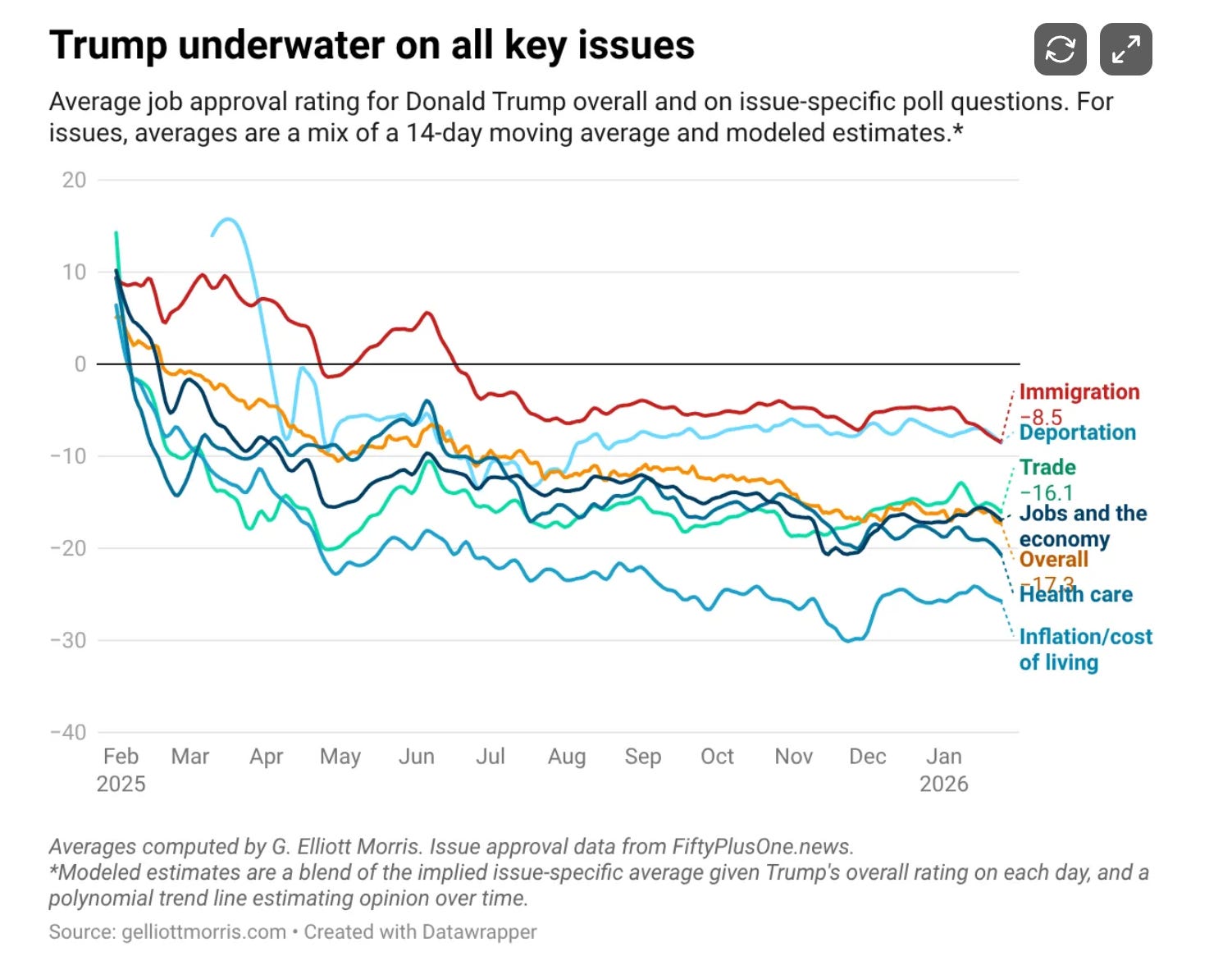
But we didn’t need a poll to tell us this.
Americans are sending clear, real-time signals about culture shifts through their online behavior. On the day Renee Good was killed, search traffic on related topics surpassed even sports queries. Creators who never normally touch politics are now talking about Minnesota instead of the NFL.
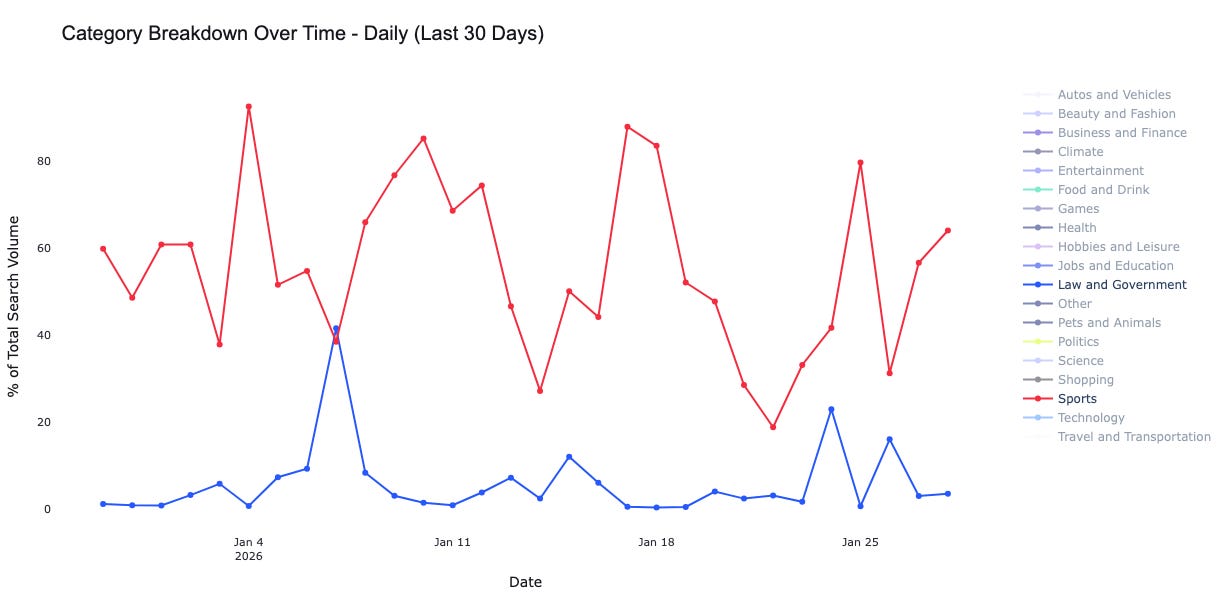
This is a good opportunity to circle back to the most poignant lesson from our loss in 2024: persuasion starts with attention. It’s not enough to craft a compelling message. That message has to break through, a much tougher battle in today’s media ecosystem and attention economy.
As Chris Hayes argues in his book The Siren Call, voters can only recall so many things when they head to the ballot box. We can no longer assume that pouring millions of dollars into a poll-tested ad will automatically lead to views, let alone move the needle.
Money alone doesn’t buy attention. Creativity does.
That means we need to be taking seriously the very real signals voters give us through what they watch, share, search for, and talk about online. The GOP understands this and uses it to shape policy. Hayes recounts Trump’s persistent calls to “build the wall” even though 66% of voters were opposed to it. Still, the slogan drew loads of attention to an issue that at its core, Republicans held an advantage on. They capitalized on the attention and turned it into a persuasion opportunity.
Today, we have folks’ attention. The question is what we do with it.
The number one thing we need is for the violence to stop.
The second thing we need is for voters to lay the blame for what’s happened on Trump and his party.
And the third thing we need is for voters to see the Democratic Party as a home, and a solution for the anger they feel.
All three of these things are possible – at the same time – if we reject false choices. Too often, our work forces us to choose between saying what we want to say and saying what we think will work best. Activists are pitted against strategists. We often want to make the smartest choice, waiting for the polling to guide us. We stay away from issues that feel uncomfortable and stick to the lowest common denominator.
But this moment demands something different.
Activism and strategy must go hand-in-hand. The anger people feel about what’s going on right now will not automatically convert into Democratic support unless Democrats show up alongside them with the level of outrage that is warranted.
Our partners at Equis and Somos have been doing this work for a long time and can point electeds, strategists, and other allies in the right direction when it comes to framing and delivery. But what the data makes clear is the need to have conviction. We need to be tough, have a point of view, and present a real alternative to the world Trump is building. We need to be bold in our anger and righteous in our desire to offer new solutions.
Showing up as leaders who genuinely care – and are willing to fight – is the strongest way to show voters we are in their corner, and eventually earn their support.
Take the next step in your political career with Arena.
Get trained. Get hired. Grow your network.
This spring, Arena is hosting virtual trainings for campaign and nonprofit staff ready to level up management, digital, AI, and core campaign skills. Learn from top operatives and join a powerful peer network. Apply now.
That’s it for FWIW this week. This email was sent to 25,384 readers. If you enjoy reading this newsletter each week, would you mind sharing it on X/Twitter, Threads, or Bluesky? Have a tip, idea, or feedback? Reply directly to this email.
Support COURIER’s Journalism
With newsrooms in eleven states, COURIER is one of the fastest-growing, values-driven local news networks in the country.
We need support from folks like you who believe in our mission and support our unique journalism model. Thank you.

This is exactly right:
>We need to be tough, have a point of view, and present a real alternative to the world Trump is building. We need to be bold in our anger and righteous in our desire to offer new solutions.<
That's why we're urging everyone to tell their Representatives to Abolish ICE.
https://actionnetwork.org/letters/tell-congress-to-abolish-ice-2/