


Hey there! I’m Chanda Daniels, a former Congressional aide and longtime communications strategist for mission-driven causes, working for organizations such as the Mayor’s Office, the UN, Human Rights Watch, and more. I write the newsletter ok so hear me out…, where I explore the intersection of politics, culture, and identity through a personal lens, because the personal is political. Most days you can find me documenting my life in NYC and writing my first book of essays on TikTok (which I think is allowed since I’m a native New Yorker). I'm excited to be today's FWIW guest author!
Digital ad spending, by the numbers:
FWIW, U.S. political advertisers spent about $14.5 million on Facebook and Instagram ads last week. Here were the top ten spenders nationwide:
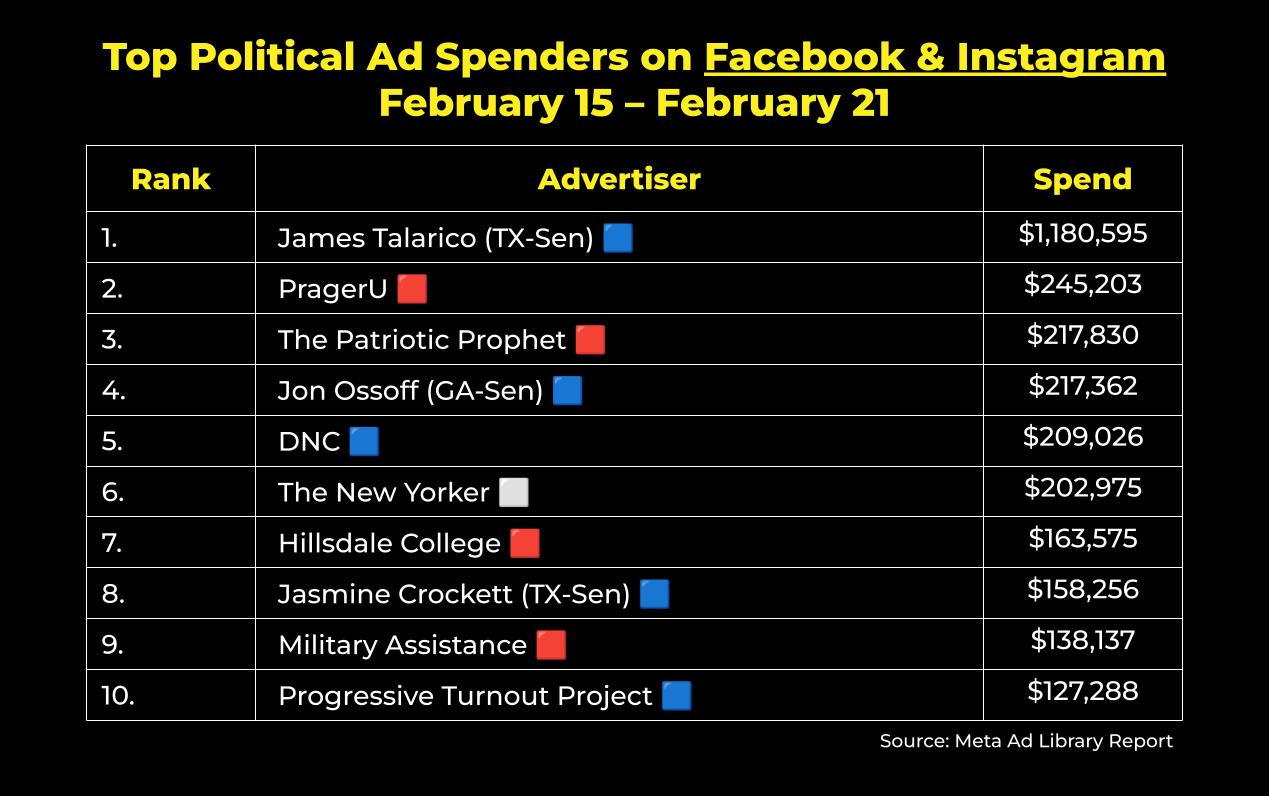
The Texas Democratic Senate primary has had no shortage of drama and, well, that continues to be the case. Last Monday night, Stephen Colbert (of canceled “Late Show” fame) shared that he was told “in no uncertain terms” by CBS lawyers that his interview with James Talarico would not be allowed to air on the network. CBS later claimed that was not the case… but let’s back up for a second.
CBS’ parent company, Paramount Skydance, is run by David Ellison, who, along with his dad, Larry, is besties with Trump. Until yesterday, Paramount had been in a battle with Netflix to buy Warner Bros. Discovery — either deal requiring regulatory approval from the Justice Department and since the Justice Department is basically in Trump’s pocket, it’s safe to say the winning company would benefit from having a favorable relationship with the president. Whether you believe Colbert or CBS’ version of the story, Paramount has been known to cave to Trump in the past, so it wouldn’t be surprising if they did so again.
Either way, Colbert posted the interview as an “online exclusive” and Talarico made a pretty penny after the incident, raking in $2.5M in 24 hours, the best fundraising day of his campaign. He turned around and spent over $1M on Meta ads last week alone, more than 7x that of his opponent, Jasmine Crockett. If recent polls are to be believed, Democrats’ high early voting turnout is encouraging and either of them has a shot at winning the nomination. At this time next week, the contentious primary will (hopefully) have come to an end, BUT if neither candidate receives at least 50% of the vote, they will advance to a May 26th primary runoff… fun times.
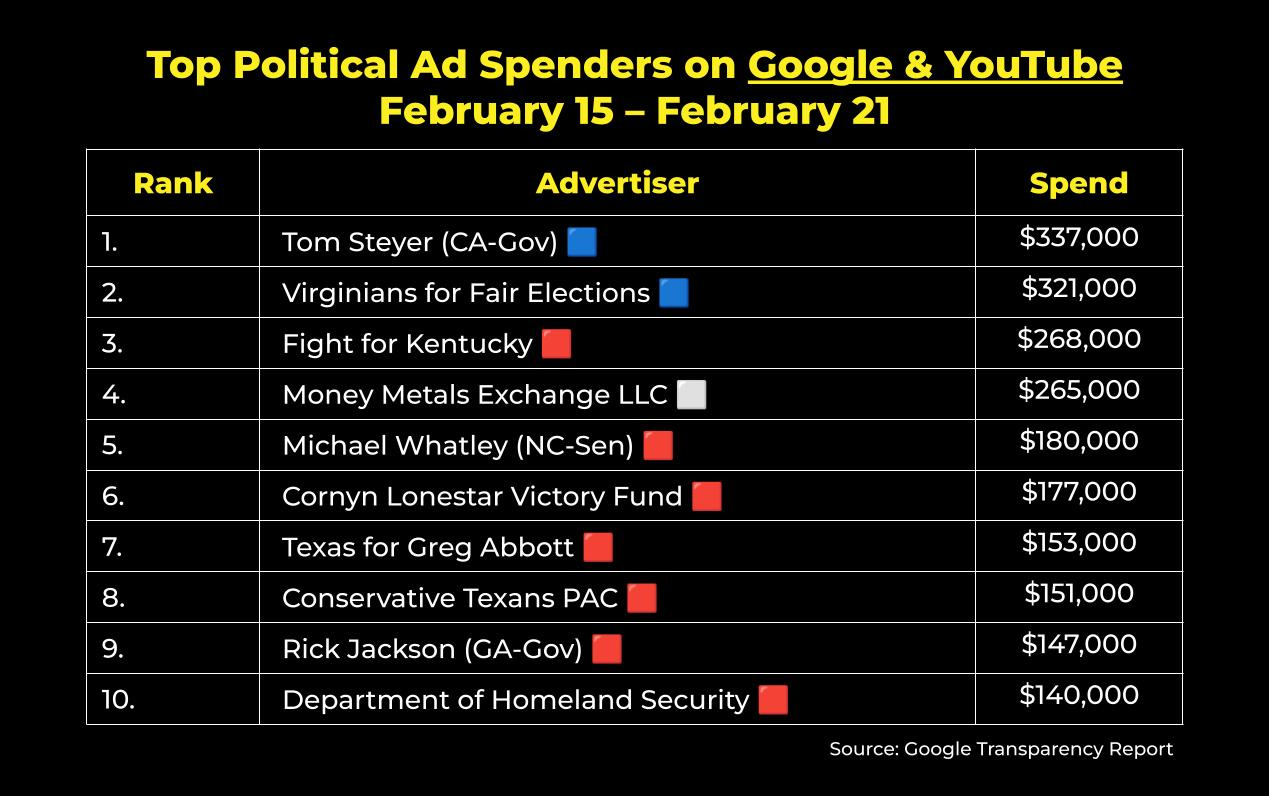
Meanwhile, political advertisers spent nearly $7.4 million on Google and YouTube ads last week. These were the top ten spenders nationwide:
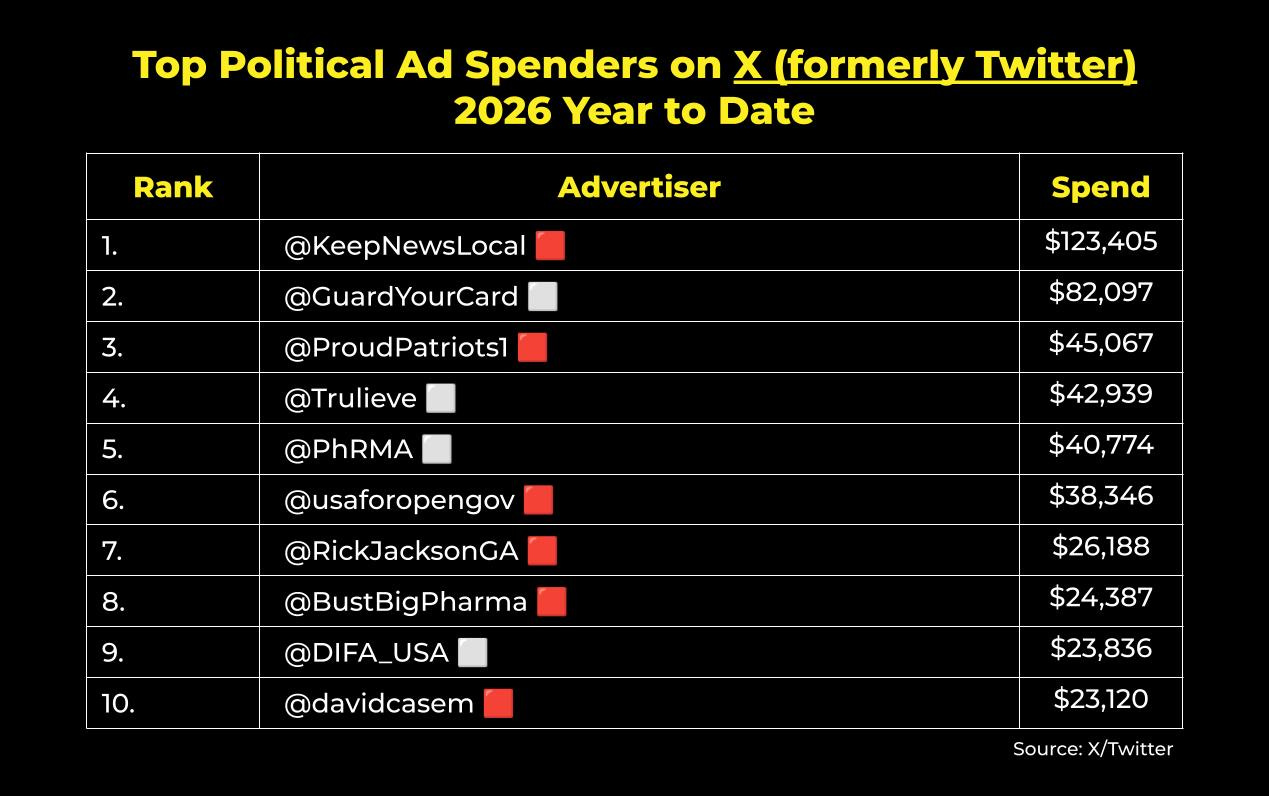
On X (formerly Twitter), political advertisers in the U.S. have spent just over $1 million on ads so far in 2026. According to X’s political ad disclosure, here are the top spenders year to date on the platform where Democrats’ presence continues to dwindle:
…and lastly, on Snapchat, political advertisers in the U.S. have spent nearly $232,000 on ads in 2026. Here are the top spenders year to date:
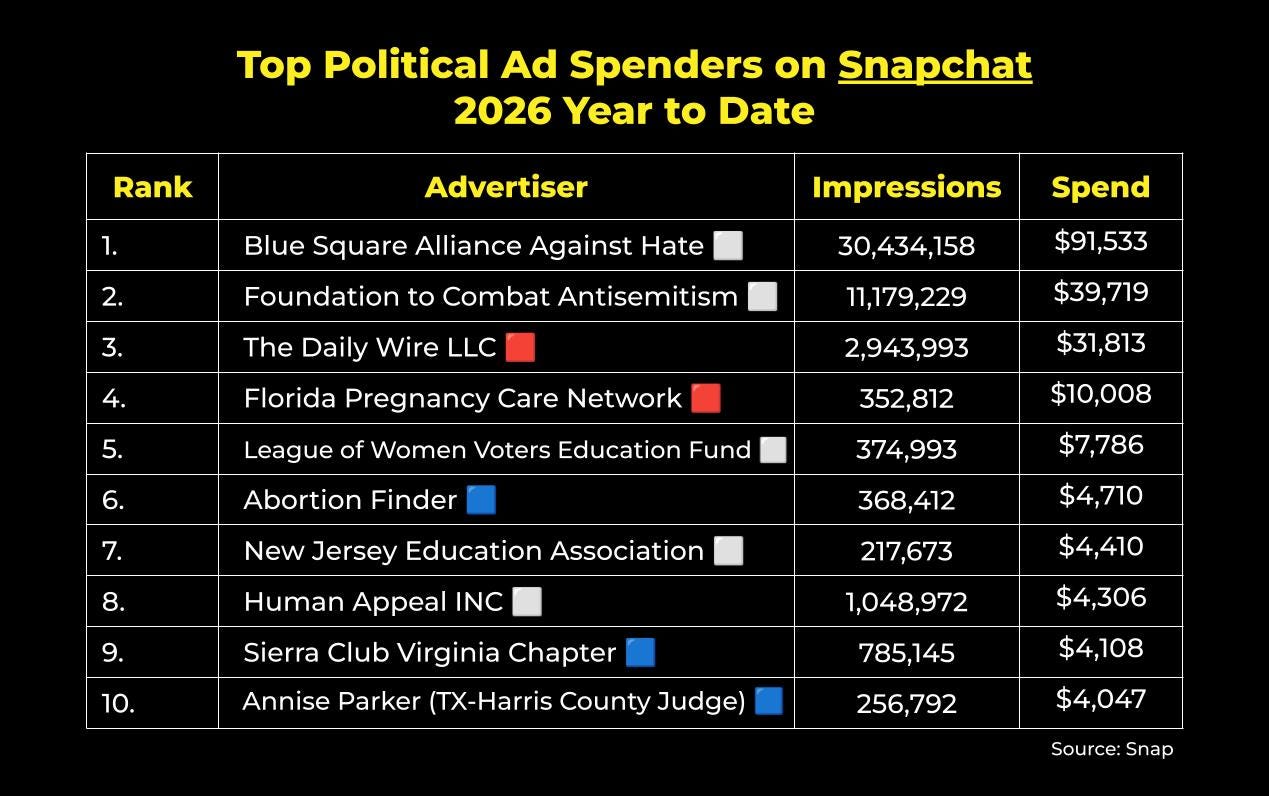
It’s rare to see a candidate running in a local election on any list of top US political ad spenders, but former Houston mayor Annise Parker came in at #10 on Snapchat last week. Polls have her as the frontrunner in the Democratic primary for Harris County judge.

Join COURIER and 3.14 Action on March 12 for MAHA & the Midterms: How Trump and RFK Jr.’s Agenda Costs Americans.
This live conversation will examine how political choices are reshaping healthcare access ahead of the midterms. We’ll break down how Trump, RFK Jr., and the broader MAHA agenda are impacting public health, who benefits, and what’s at stake for families across the country.
Featured Speakers include:
Hank Green, Author + Creator
Dr. Mary Trump, Psychologist + Author
U.S. Representative Lauren Underwood, Member of Congress + Registered Nurse
Shaughnessy Naughton, 314 Action President
Dr. Vin Gupta, Physician + Medical Analyst
Stay tuned for more speaker announcements.
Don’t miss this conversation. RSVP today!
Minaj and the Midterms
After 2016, I thought very little could still shock me, until the rise of MAGA Minaj.
As someone who can recite her entire verse in Monster by heart, it was disappointing to reach the third strike I needed to finally delete my “Feeling Myself” playlist from 2014 (Kanye and Drake were the first two). Nicki Minaj’s stark turn from Trump skeptic to his ‘biggest supporter’ and Turning Point USA headline speaker was odd and alarming.
This week, a new report revealed that something nefarious has been at play with Minaj (aside from being on stage with Erika Kirk and Donald Trump), in the form of bots deployed to prop up Minaj’s social media accounts, manipulating the algorithm to push out a coordinated MAGA narrative on a massive scale. Cyabra’s analysis details the rapid speed at which Nicki Minaj’s X account led her to become a conservative culture maker.
Over a three-month period, nearly 19,000 fake accounts accounted for 33% of her overall engagement. While we know bots are everywhere, this level of usage is unusually and extremely high.
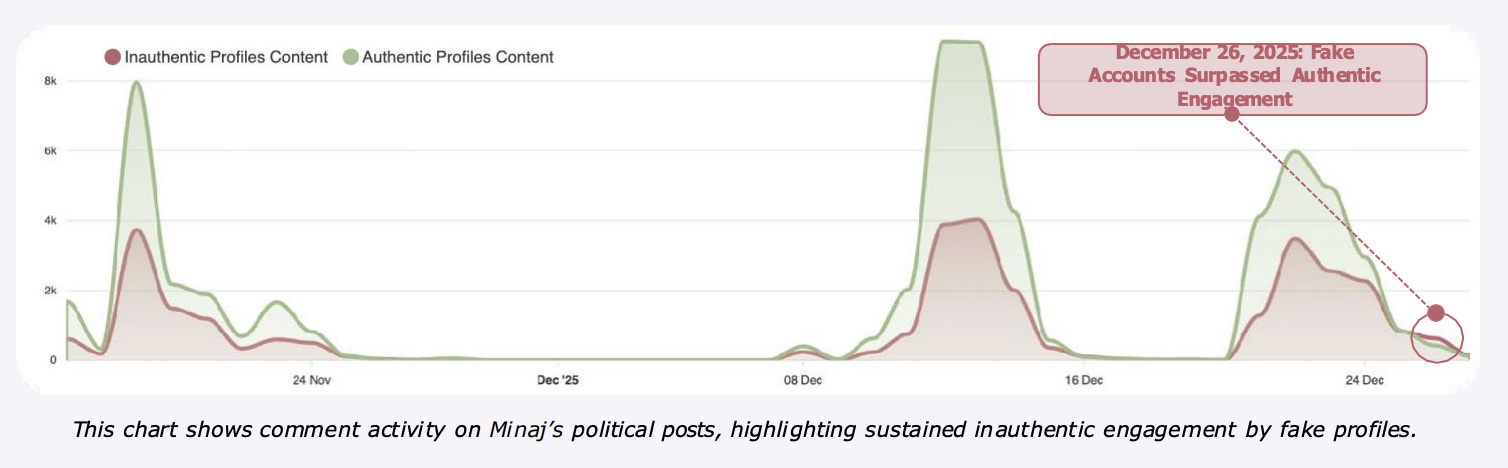
Source: Cyabra, ‘Inauthentic Amplification Of Political Discourse On Nicki Minaj’s X Account’
The report exposes a cluster of synchronized messaging such as “I’m proud of you queen,” “mad respect Nicki,” and “you gained some new fans.” These comments weren’t just repetitive; they were posted within the same 2-3 hour period, overall generating more than 31,701 (!) fake interactions.The goal was clear: flood the zone, manipulate the algorithm, manufacture momentum.
But if you don’t have your own “Feeling Myself” playlist, why should you care? Because this is a preview of how the 2026 midterms will be fought online – algorithmic preconditioning shaping feeds months, even years, in advance so that certain narratives feel normal, popular, and culturally inevitable.
While Democrats budget for boosted posts and consultant-produced videos only during election season, the right was playing the long game and has already infiltrated the algorithm. Republicans post year-round and go viral more often than Democrats. Their messaging is woven into fandoms, lifestyle content, and online discourse so stealthily that it often doesn’t register as politics at all. It just feels like the vibe.
Public opinion is shaped and reinforced in the comment section. And now as we see through Minaj’s account, the right is also bolstering their narrative through fake conversations. Coordinated bot engagement doesn’t just inflate numbers — it creates the illusion of consensus and owns the online discourse.
This is the next evolution of digital campaigning: embedding political messaging inside organic ecosystems and influencer networks long before voters see a campaign ad. If Democrats continue their digital strategy as is, they’ll be stuck in the past while the right has already adapted to this new reality (while also owning the majority of social platforms).
There’s still room to maneuver… but we have to move now.
As bot networks and disinformation attacks scale up, Democrats need to enact a digital literacy campaign. Acknowledge and help voters understand that everyone online may not be as they seem. Encourage people to consider whether conversations are real. And if it all seems eerily repetitive and oddly-timed, it probably is.
Another tactic to help win the algorithmic war is one that Democrats have started using, but not nearly at the level they should be. We need to create and activate an ecosystem of influencers, credible voices, and podcasts with their own loyal fanbases to engage in cultural epicenters we are often left out of. It’s time to build authentic relationships across movies, media, Substack, podcasts, and more. Sporadic engagement and sole reliance on traditional media are no longer enough in this current digital landscape.
The right has spent years building an ecosystem of quiet narrative control through their own podcasts, trad wife and other influencers, plus big internet personalities like Candace Owens and Joe Rogan. Democrats, by contrast, often show up only when it’s time to ask for a vote.
That must change.
While it may be too late to build from scratch, it’s not too late to activate existing allies and integrate our messaging into lifestyle content that audiences already engage with. With the recent 2016 nostalgia and reminiscing of the Obama-era circulating online, there’s an opening to regain cultural capital.
Voters shouldn’t first encounter Democrats when it’s time to head to the polls. They should encounter them between pilates and Erewhon lunches. We need to be embedded in the culture, not just parachute in for election season.
The right may have already spent years priming the algorithm to bolster their narrative, but Democrats can still infiltrate if we’re willing to think outside the box and meet the moment.
If we do, we just might, as Nicki once said, “win again.”
That’s it for FWIW this week. This email was sent to 25,530 readers. If you enjoy reading this newsletter each week, would you mind sharing it on X/Twitter, Threads, or Bluesky? Have a tip, idea, or feedback? Reply directly to this email.
Support COURIER’s Journalism
With newsrooms in eleven states, COURIER is one of the fastest-growing, values-driven local news networks in the country.
We need support from folks like you who believe in our mission and support our unique journalism model. Thank you.

I’m disappointed to say goodbye to Super Bass! Are there any lefty lifestyle influencers / podcasters that you recommend?
I hope progressive politicians do well in the upcoming elections. I hope , Jasmine Crockett wins the election. My problem is they are both very good candidates. I’m glad I don’t live in Texas, I understand that a large amount of Democrats cast their ballots. According to MS Now. Please subscribe to FWIW.