


Hi fellow FWIW readers! I’m Ben Sheehan, creator and host of the new series Civics Made Easy on PBS and bestselling author of What Does the Constitution Actually Say?. I’m excited to be your guest author today because the topic is one of my faves. I also write the Substack Politics Made Easy where I simplify complex issues, of which gerrymandering is one. In the past I’ve explained it using jewelry shaped like some of the most gerrymandered districts in America.
More on gerrymandering below, but first…
Digital ad spending, by the numbers:
FWIW, U.S. political advertisers spent just under $12.7 million on Facebook and Instagram ads last week. Here were the top ten spenders nationwide
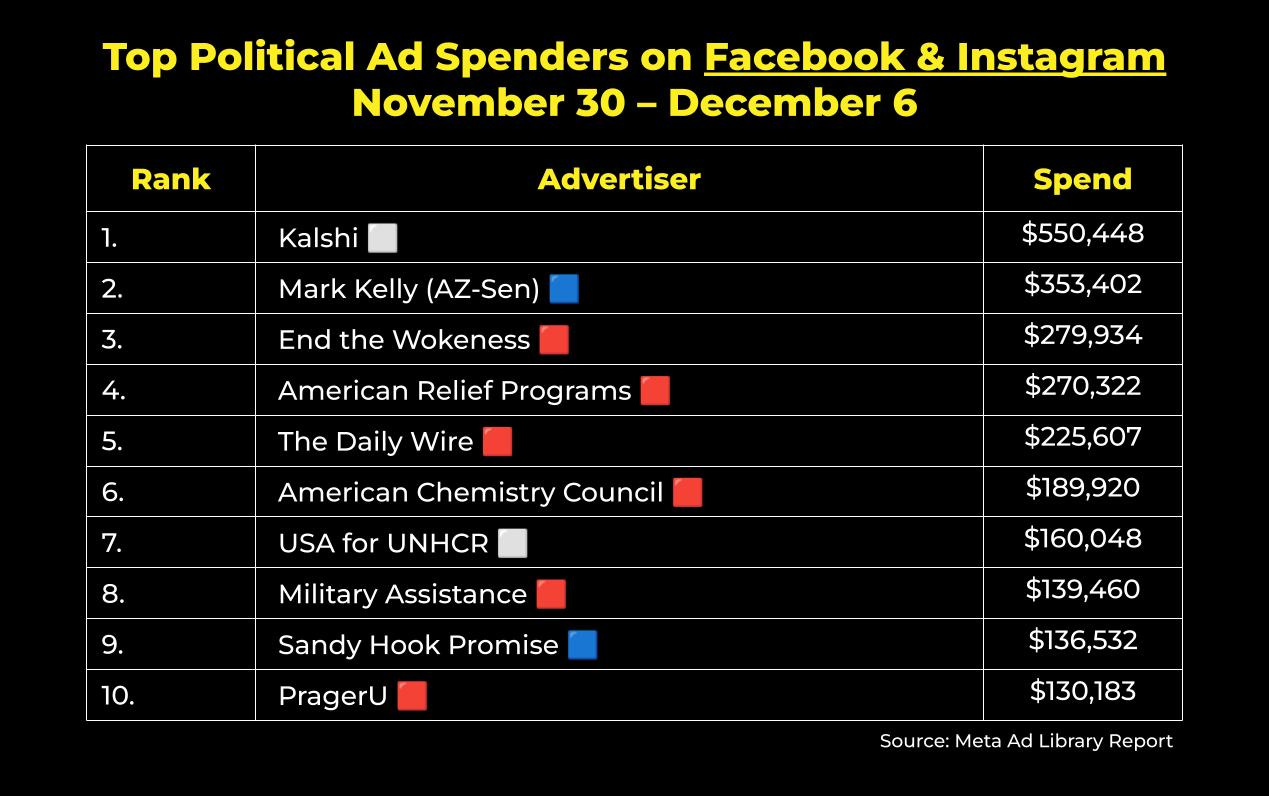
Fresh off the heels of their prediction data partnership deal with CNN, Kalshi jumped to the top of the list, running ads to let people know that they can trade on ANYTHING, including Rotten Tomato scores. Surely nothing bad can come of this...
Meanwhile, political advertisers spent around $2.3 million on Google and YouTube ads last week. These were the top ten spenders nationwide:
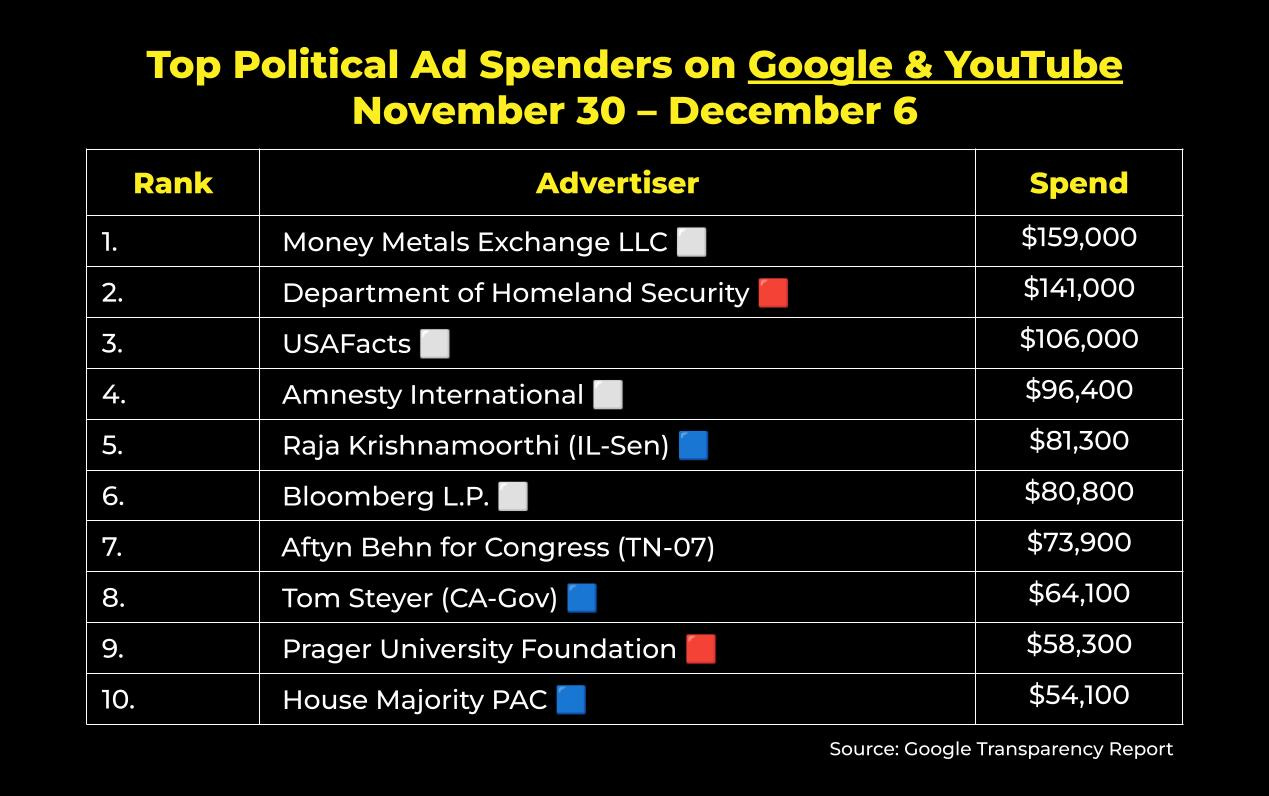
Last week, Democrat Aftyn Behn made her final push online before the December 4th special election in TN-07. Sadly, while she didn’t flip the seat, she lost by just 9% in a district Trump won by 22% last year, and that’s a win in and of itself. The voters continue to make their voices heard at the polls this year and the message they’re sending is loud and clear: Donald Trump is deeply unpopular.
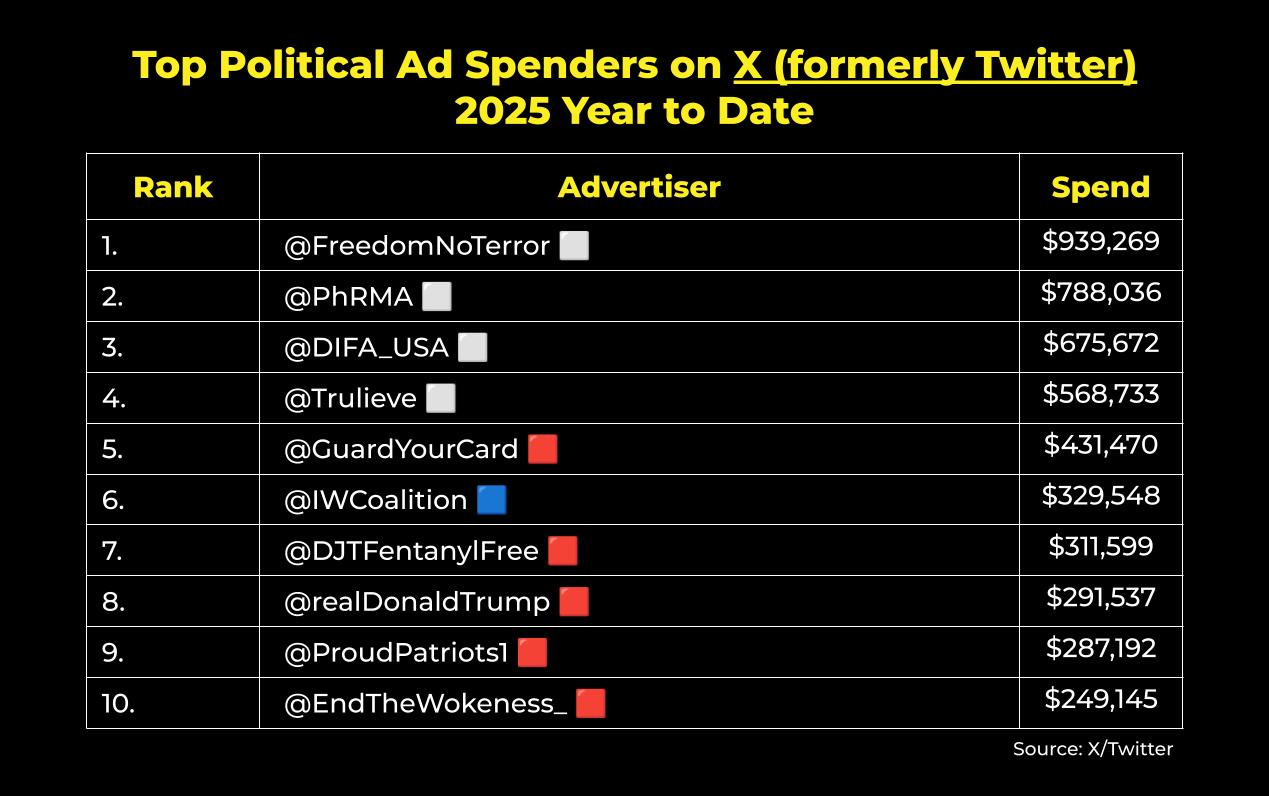
On X (formerly Twitter), political advertisers in the U.S. have spent around $12 million on ads in 2025. According to X’s political ad disclosure, here are the top spenders year to date:
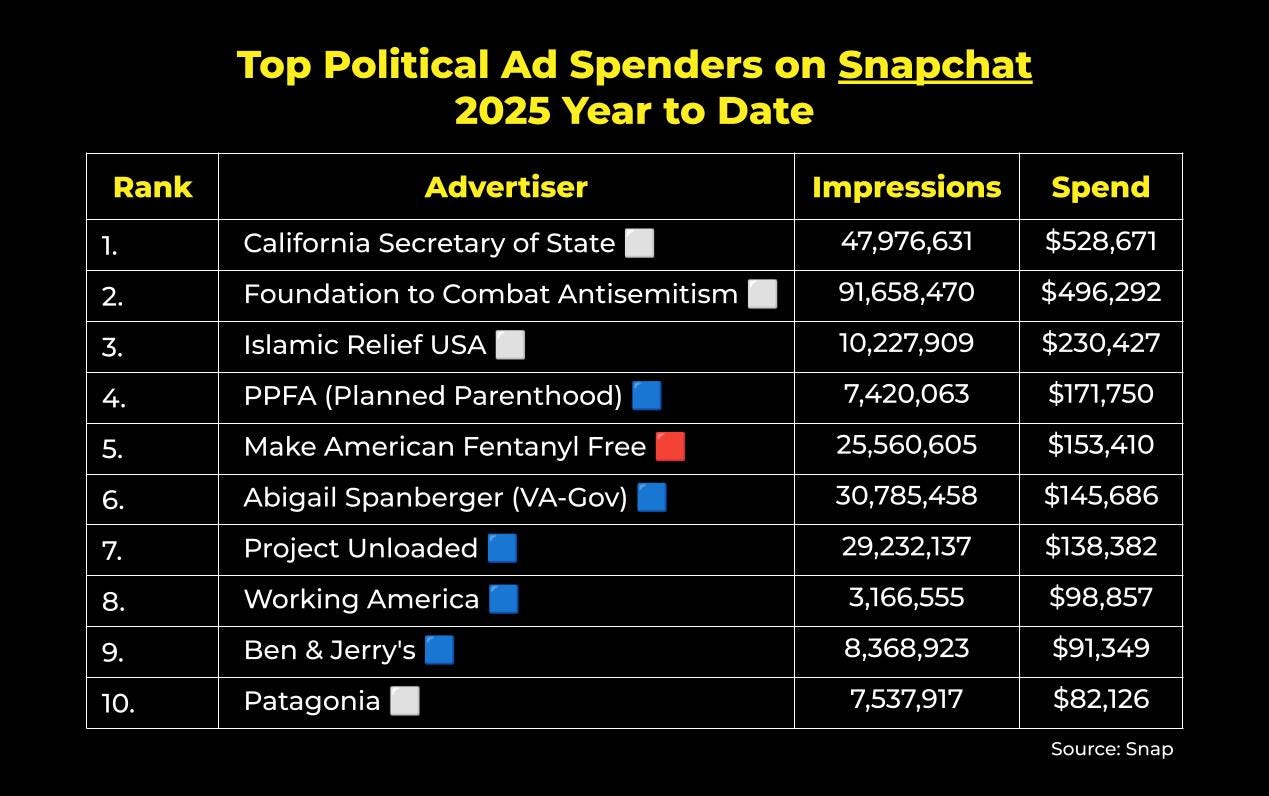
…and lastly, on Snapchat, political advertisers in the U.S. have spent around $3.4 million on ads in 2025. Here are the top spenders year to date:
Are you a mission-aligned company or organization?
COURIER would love to partner with you and amplify your work to our engaged audience of 190,000+ policy influencers and high-information active news consumers. Send a note to advertising@couriernewsroom.com for more.
Mid-Decade Redistricting: Bigger than Labubus
In case you haven’t been following (because you’ve been living your life), here’s the latest gerrymandering news…
In August, at Trump’s request, the Texas governor and legislature redrew the state’s congressional map to swing five blue districts red (to help Republicans hold the House in 2026). Normally, redistricting occurs every decade – after the Census – to ensure fair congressional representation via equally populated districts. And while elections have yet to take place, the new map nearly guarantees five blue-to-red flips in Texas.
So, then what happened?
California.
Instead of posting a stern letter to X (as Democrats are wont to do), Newsom pushed the state legislature to redraw California’s map to swing five red districts blue, neutralizing Texas’ gains. And unlike Texas, Newsom asked the legislature to refer the map to California voters as a ballot measure (a state constitutional amendment – ‘Prop 50’ – you may have heard of it) instead of having the legislature pass it themselves. This was likely done to strengthen the amendment against subsequent challenges, as it was California voters, not politicians, who approved it.
Anyway, Prop 50 requires that the new legislature-drawn map be used for the next three congressional elections. And then in 2031, California will return to having its independent Citizens Redistricting Commission draw its congressional districts.
And…Prop 50 passed! By (*checks notes*) thirty points.
But not without cash. At more than $167 million ($123 million for, $44 million against), Prop 50 became the fourth most expensive ballot measure in California history. Per the California Fair Political Practices Commission, which tracks state-level campaign spending, the largest donors in favor of Prop 50 were Democrats’ House Majority PAC ($16.5 million) and George Soros’s Fund for Policy Reform ($10 million). Tom Steyer also spent nearly $13 million on ads for Prop 50 (of which I personally received a whopping $1,500 for an Instagram Reel). On the ‘No’ side, Charlie Munger Jr. – who helped create California’s Citizen Redistricting Commission in 2008 and 2010 with Governor Schwarzenegger – was the largest spender with $33 million in contributions.
But here come the challenges...
In Texas, a federal court initially struck down the state’s new map, but the Supreme Court later reversed the decision. In California, on December 15th, a federal court will hear the Republican challenge to Prop 50, which claims the new map helps Latinos too much (a group we can all agree has had it too good under Trump).
As for other red states, North Carolina and Missouri redrew a seat each for Republicans, while Ohio redrew two (all are being challenged). Florida could potentially net Republicans five additional seats, but the state’s GOP is divided on whether to try this. And a similar conflict played out in Indiana where just yesterday the state senate rejected a map that would’ve given Republicans two extra seats.
On the Democratic side, Utah’s Supreme Court let a blue district stand (which was drawn to combat GOP gerrymandering). Maryland’s state senate leader is currently blocking Democrats’ plans to swing the state’s only red district blue. And Wisconsin Democrats are challenging the state’s Republican-leaning maps while Virginia decides whether to enter the fray.
Isn’t this fun?!
What’s ironic is that some of these maps could backfire. In North Carolina, the GOP had to shrink its existing margins in districts to create a new red one. In a blue wave election, Republicans may have accidentally tipped all those districts blue (it’s called ‘dummymandering’). There’s also the fight against time – states are low on it as deadlines approach for candidate filings and primary ballots.
Last but not least, the Supreme Court could blow everything up by ending ‘majority-minority’ (primarily Black or Hispanic) districts on the grounds that they are too kind to minorities. This would upend gerrymandering to the GOP’s advantage.
What makes all of this so dumb is that…it’s brazen! The maps are obviously being drawn for partisan reasons. But because SCOTUS ruled in 2019 that partisan gerrymandering is no longer ‘justiciable’ (able to be heard) by federal courts, all these gerrymandering challenges claim racial animus (because racial gerrymandering is still judiciable). The maps are either too bad, or too good, for minorities or white people.
In short, we’ll have to see how this plays out. Maybe when Democrats retake the House, Senate, and White House (January 2029?) they’ll pass a federal law banning partisan gerrymandering for congressional districts. It would be nice to not have to deal with this every 5-10 years for the rest of our lives.
Here’s hoping.

Thank you for supporting COURIER and local, fearless journalism. This holiday season, your purchases contribute to fueling our newsrooms to keep holding the powerful accountable and making sure the truth reaches the people who need it most.
That’s it for FWIW this week. This email was sent to 25,170 readers. If you enjoy reading this newsletter each week, would you mind sharing it on X/Twitter, Threads, or Bluesky? Have a tip, idea, or feedback? Reply directly to this email.
