


Hi, it’s me again — I’m Jiggy Geronimo, a progressive narrative strategist, consultant, and budding content creator. But before politics, I was a neuroscientist so I think a lot about how messaging and persuasion actually work in our brains 🧠. I recently co-authored Feelings Over Facts, a strategy for embracing emotions-first narratives. Spoiler alert: The brain and algorithm both reward emotion, surprise, belonging, efficacy, visuals, stories, and repetition.
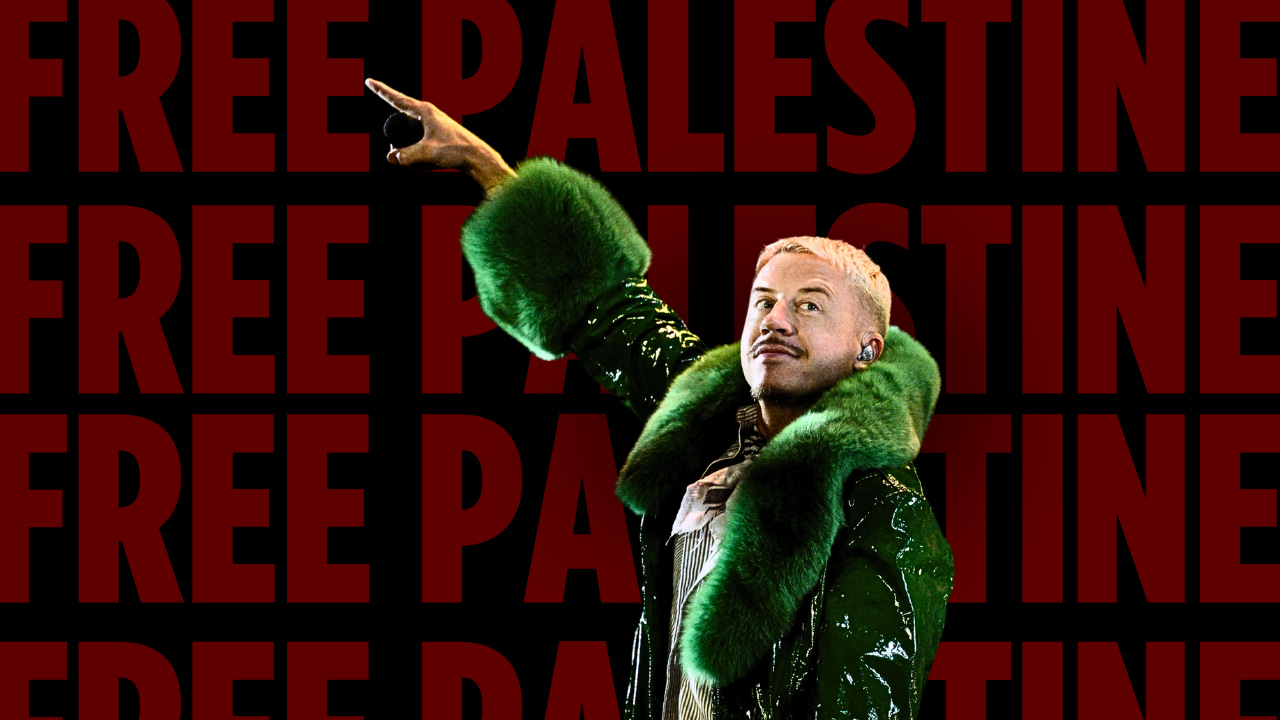
Our brains are constantly trying to regulate threat and discomfort — which is one reason it’s so hard to change someone’s mind. Conflicting information registers as discomfort and our emotional brain works to protect us from the psychological pain of being wrong. What helps is knowing that other people like you believe something. And that’s where Macklemore comes in.
More on that below, but first…
Digital ad spending, by the numbers:
FWIW, U.S. political advertisers spent around $17.2 million on Facebook and Instagram ads last week. Here were the top ten spenders nationwide:
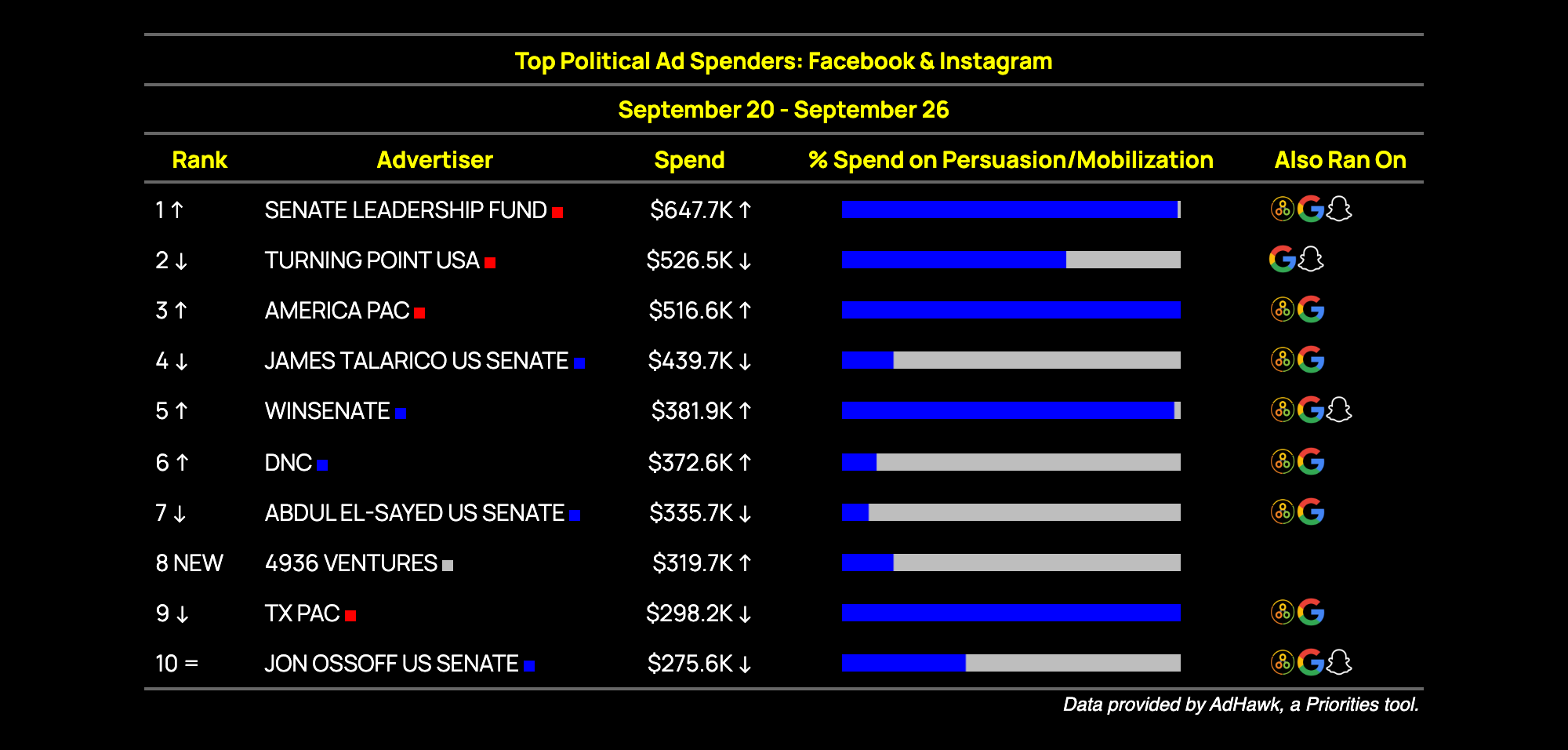
The Senate map has expanded, so this week we’re looking at which races are heating up—even if they haven’t cracked the top ten. The new map is broad; it includes old reach states like Florida, recent state-level wins like Kansas, and even stretch goals in Mississippi and South Carolina. But, as any operative knows, the money tells us where the party really thinks we can win.
South Carolina and Nebraska have seen some of the biggest increases in Democratic (or Independent) spending in recent weeks, relative to other Senate battlegrounds. In South Carolina’s digital landscape, only Democrat Annie Andrews is live. Her spending grew from $294k the week of September 13 to $455k the week of September 20. Nebraska Values, a super PAC supporting Independent Dan Osborn, made headlines for its aggressive messaging attacking incumbent Republican Sen. Pete Ricketts. The PAC spent $206k from September 20 to 26, outspending Ricketts. That’s small potatoes in the grand Senate scheme, but both states are ramping up faster than many top-tier races.
That’s not to say those top-tiers have fallen by the wayside (though in the cases of Georgia and North Carolina, the GOP does appear to have given up). In fact, Sen. Jon Ossoff (D-GA) has redirected some of his fundraising efforts to support Texas Senate candidate James Talarico through a rare cross-candidate joint fundraising committee.
Meanwhile, political advertisers spent around $47 million on Google and YouTube ads last week. These were the top ten spenders nationwide:
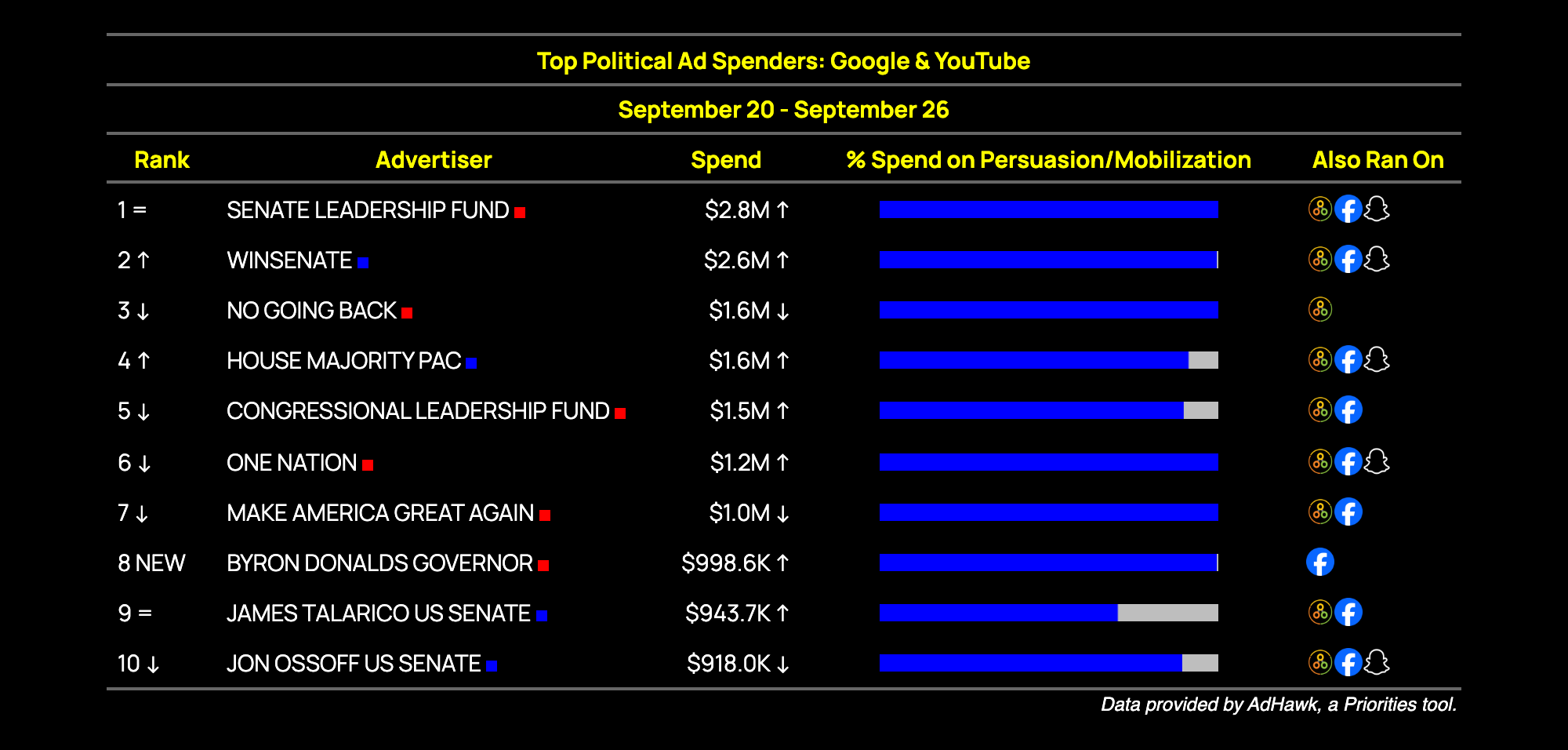
When it comes to high-ballot races, the House is the Wild West: There are more than 80 races to watch, the dynamics shift quickly, and a race flush with spending one week can go quiet the next. With House Majority PAC (D) spending heavily on Google, it’s clear that understanding the battleground means understanding outside spenders.
So have Democratic outside groups pushed further on offense? Short answer: yes. You can tell by looking at whether their average dollar has gone to redder House races than it did in prior weeks.
In the week of August 2, the average Democratic outside spender’s dollar went to a D+3 district. By September 20, it had moved five points to an R+2.2 district. Also that week, 37% of Dem outside group digital spending was going to R+4 or higher seats, up from just 18% at the end of August.
Republican spending has remained remarkably steady, though. Their outside group share of spending in R+4 or higher seats has held steady between 34-39% since mid-August, while their average dollar has remained solidly in the R+2.0 and R+2.5 range.
On CTV platforms, U.S. political advertisers spent an estimated $92 million last week. Here were the top ten spenders nationwide:
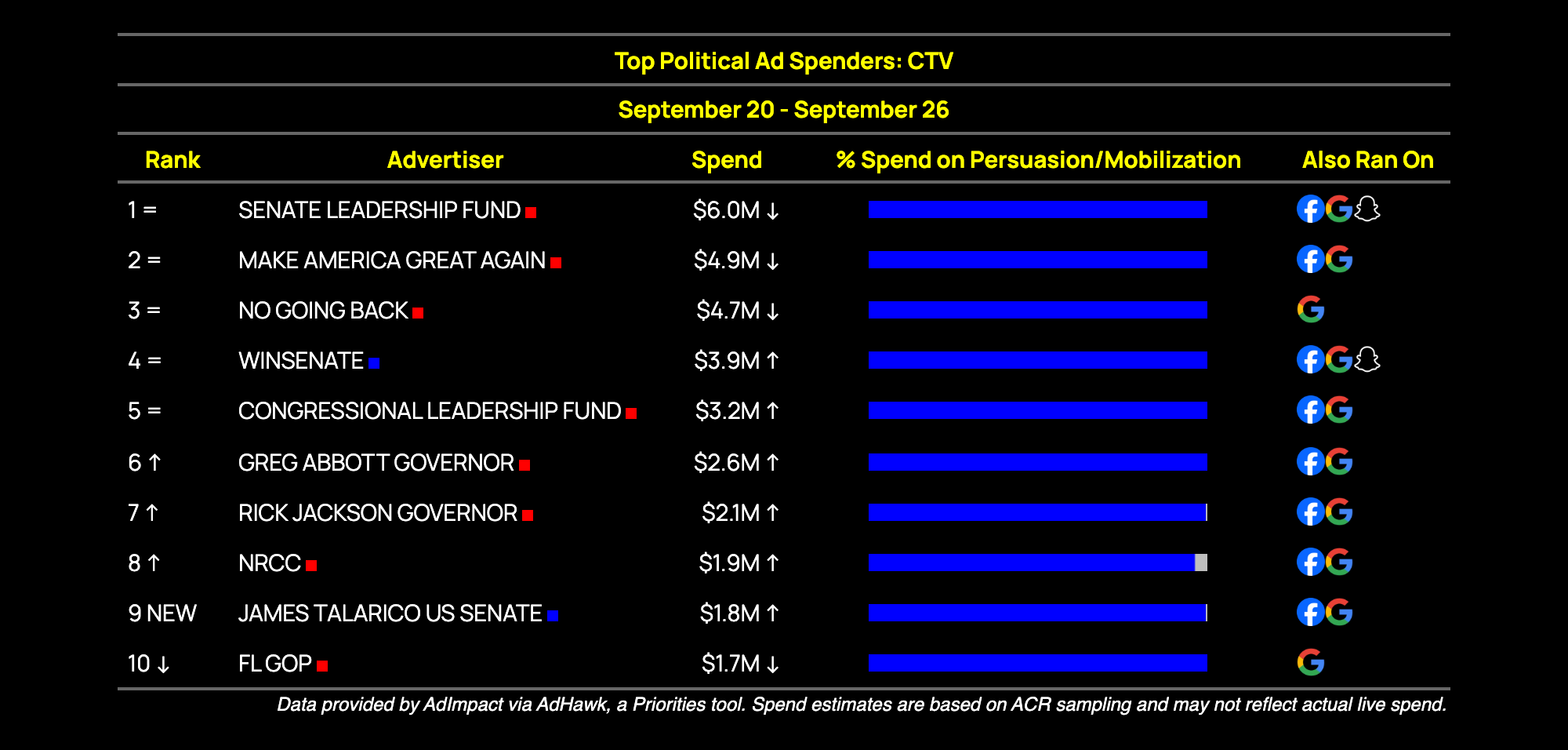
We’re going back to No Going Back PAC, which launched in four new places: the Texas Senate race ($22k) and three House races. Between September 20 and 26, they spent $50k in FL-14 (R+4), $50k in MT-01 (R+5), and $33k in AL-02 (R+7). All three are fairly red seats—whether that means No Going Back is playing more defense or simply going after Democrats in redistricted territory and open seats, we’ll see.
But wait, there’s more! Trump’s Safety & Affordability PAC has finally launched on CTV and Google. So far they’re live in AZ-01, WI-03, and PA-07.
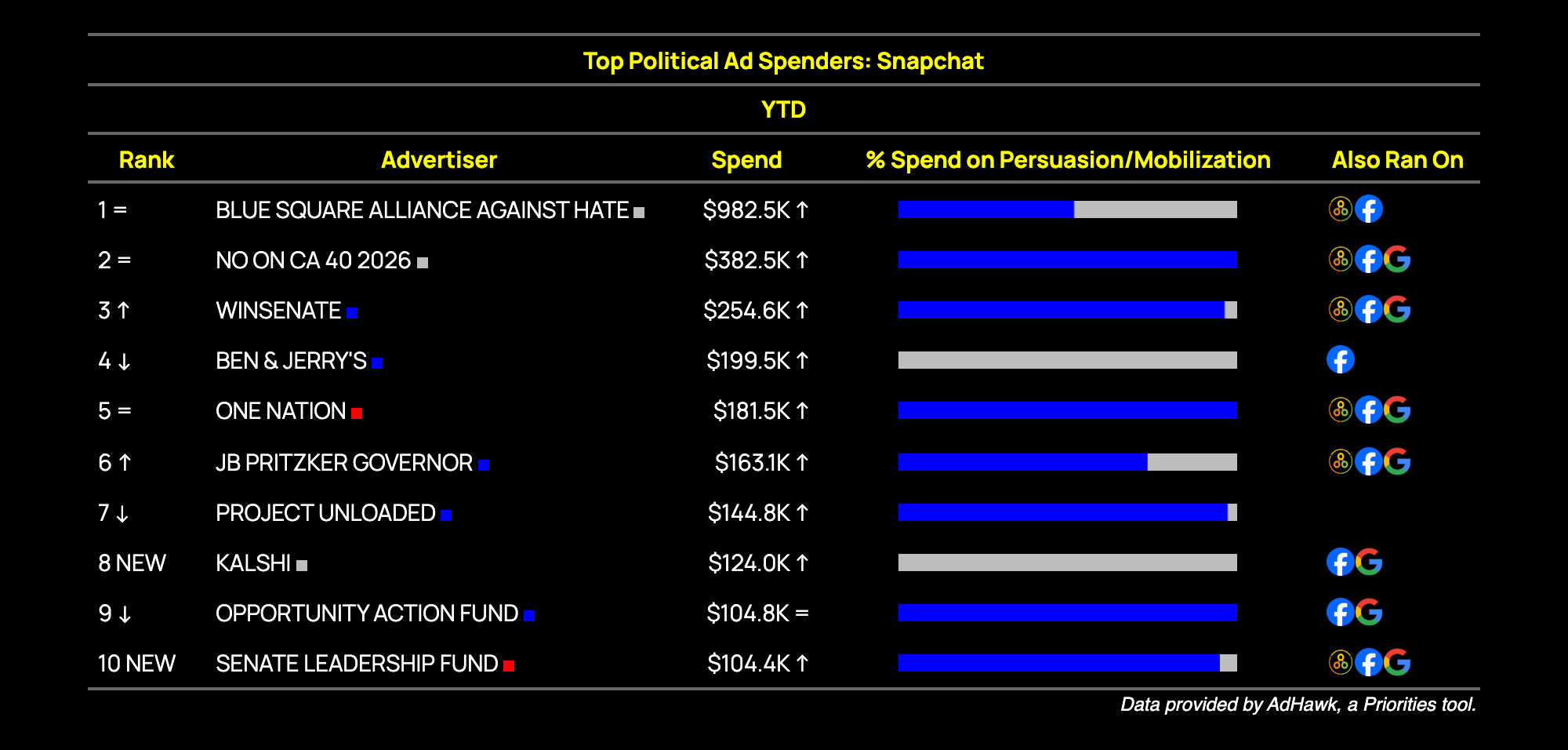
…and lastly, on Snapchat, here’s YTD data for the top 10 spenders:

What’s really happening at the Supreme Court?
Join COURIER and Americans United on October 20 for Weaponizing Faith: Christian Nationalism at the Supreme Court. Featuring Rachel Laser, Stasha M. Rhodes, Michael Podhorzer, and moderator Lisa Graves, this panel uncovers how political allies are reshaping our legal system and what we must do to reclaim it.
Attend in person at The Milton Theatre in D.C. or watch the live stream online. RSVP today!
Macklemore shows us that passion is persuasion
Macklemore is kind of having a moment. His songs leapt up the billboard charts, his streams of ‘Hind’s Hall’ jumped over 1000% in two days, and his recently announced Free Palestine concert tour sold out within minutes.
We all know why. Macklemore announced his support for Palestine while opening for Ed Sheeran and got kicked off the tour following pressure from billionaire Robert Kraft. Then all of Ed Sheeran’s opening acts — including his own band — dropped out in solidarity. Other celebrities, the internet, and the American public began their outpouring of support for both Macklemore and Palestine. And this wasn’t just passive support: donations to a humanitarian aid group were 3x their average.
You might think it’s just because people and the internet love controversy (which they do), but there’s more to the story than that. Three years ago, this same situation would not have catapulted Macklemore’s career to center stage in quite the same way.
So what changed?
Between February 2023 and February 2026, public sympathies swung a whopping 28 points toward Palestinians. Importantly, the shift isn’t confined to the Democratic base — in just one year, independents swung 19 points from +8 pro-Israel to +11 pro-Palestine. And yet, even as this massive shift was taking place, only 2% of survey respondents organically named Israel/Palestine as one of their top 5 issue priorities.
So how then did an issue that would never rise to the top of any poll create such a gigantic cultural shift?
The answer: passion ❤️🔥
Pollsters ask people what matters to them, and the answers are stable and predictable (spoiler: always costs). The advice then says that to persuade the masses, you should just talk about whatever rises to the top of the poll, usually by presenting a message that the largest number of people already agree with.
But what actually persuades people isn’t how many other people check a box saying an issue is important. It’s how many feel it passionately enough to become evangelists for a cause.
A political ad that conveys a message you nod and agree with is not what really changes your mind. It’s your friend’s repeated passionate posts online, the heated conversations at dinner with your family, and the feeling that other people like you believe something.
This is social proof. And social proof can persuade the people in the middle who aren’t sure what to think. Because people who aren’t experts (and let’s be real, most people are not political nerds like us) think, “Wow, if everyone around me that I know and trust believes this thing, then it must be the right thing to believe.”
Anat Shenker-Osorio has argued this idea for over a decade, recently coining the term Magnetism to describe it. She asserts that political belief spreads through relationships and repeated, trusted conversation, not through ads repeating whatever a poll says voters want to hear. She rejects the notion that messaging to your base is “preaching to the choir” and asserts that it is actually the choir — not the candidate — who carries the most credibility to persuade. And there is proof that she is right.
Let’s start with ICE, which went from net-positive approval to underwater by a swing of 30 points within one year, one of the fastest and sharpest reversals of public opinion we’ve ever seen. Immigration was Trump’s so-called strongest issue. And yet, a base of Americans, when faced with ICE’s brutality and moral violations, were passionate enough to show up on street corners with whistles, set up mutual aid hubs and school patrols, and share and scream loudly on the internet. That passion, coupled with a clear villain and an igniting moment of ICE murders, set off a storm of social proof that actively moved public opinion.
The right, as usual, has always understood this. They’re constantly throwing red meat to their base because they know their base will serve as credible messengers to spread their ideas.
Take trans athletes: between 2021 and 2025, support for letting athletes compete under their current gender identity fell 10 points overall — including double-digit drops among Democrats and independents. This was a relatively small, but very loud base that kept talking about the issue until it moved public opinion beyond the base.
As the polls tell us, cost matters too, of course — but talking about it with bland messaging doesn’t ignite enough passion. Kamala Harris built her entire 2024 closing argument around cost-of-living and an “opportunity economy” because that’s what the polling said most voters cared about. She still lost economy-focused voters 81 to 18.
Meanwhile, Trump’s closing message wasn’t about the economy at all. Roll Call counted his rally speeches mentioning “border,” “migrant,” or “immigration” about 100 times more than “economy,” “inflation,” or “prices” combined.
One campaign talked about the poll. The other gave its base a villain and red meat. Which one worked?
Zohran Mamdani’s mayoral campaign is the real proof in the pudding. He entered the 2025 Democratic primary polling in low single digits against a former governor with statewide name recognition. Within five months, he surged from 1% to 32% and then won 56-44. The engine for his rise was 104,000 volunteers who were out preaching the Mamdani gospel through relational organizing.
And yes, Mamdani also ran on economic issues, the same #1 problem that Harris did. The difference wasn’t the topic. It was that one version gave 104,000 people a real villain (billionaires and landlords) and concrete outcomes (frozen rent, free buses, free childcare) which inspired them to activate and evangelize — and the other gave them a sterile ad.
Conventional wisdom says you can take your base for granted and focus on the “moveable middle.” But when you abandon your base, you lose the most free and credible advertising you could have.
Ignoring the base has a cost. While ICE and Gaza were swinging hard toward the Democratic positions, the party’s own approval hit record lows, driven mostly by its own voters souring on leadership they felt wasn’t fighting hard enough.
You can be on the right side of a real, fast-moving shift in public sentiment, and still fail to capture it if your own posture is too cautious, too poll-tested, and too bland for your own base to want to evangelize on your behalf.
Which brings us back to Macklemore. A passionate base changed the temperature of that stadium. And Ed Sheeran just looked like a fool wearing a jacket in the July sun.

Get the full receipts every Monday in The Cover-Up
COURIER's Contradictions Tracker puts officials' Epstein testimony next to the files, with every entry linked to its primary source. Updated weekly in The Cover-Up.
That’s it for FWIW this week. This email was sent to 25,836 readers. If you enjoy reading this newsletter each week, would you mind sharing it on X/Twitter, Threads, or Bluesky? Have a tip, idea, or feedback? Reply directly to this email.

"Christian Nationalism" is a nonsense term. It goes against "Go ye into all the world and preach the Gospel to all nations!"