


This newsletter is brought to you by the donor acquisition approach that helps you turn $1 into $2.
Hello there – it’s Ashwath, one of the co-founders at Social Currant, and I’ll be taking over today’s edition of FWIW. Since 2023, Social Currant has built an ecosystem of thousands of creators and helped over a hundred organizations reach audiences more effectively. Most recently, we’ve been expanding on our organizing work in partnership with Double Tap Democracy.
Over the past few years, the role of content creators in politics has become hard to ignore. Since 2024, more and more Democrats have begun to see creators — and the deep, authentic trust they build with their audiences — as a key piece for rebuilding relationships with voters. But much of the conversation still stops at vanity metrics such as likes and impressions. This week, we’ll explore what more meaningful impact measurement looks like for creator work in 2026.
More on that below, but first…
Digital ad spending, by the numbers:
FWIW, U.S. political advertisers spent around $13.3 million on Facebook and Instagram ads last week. Here were the top ten spenders nationwide:
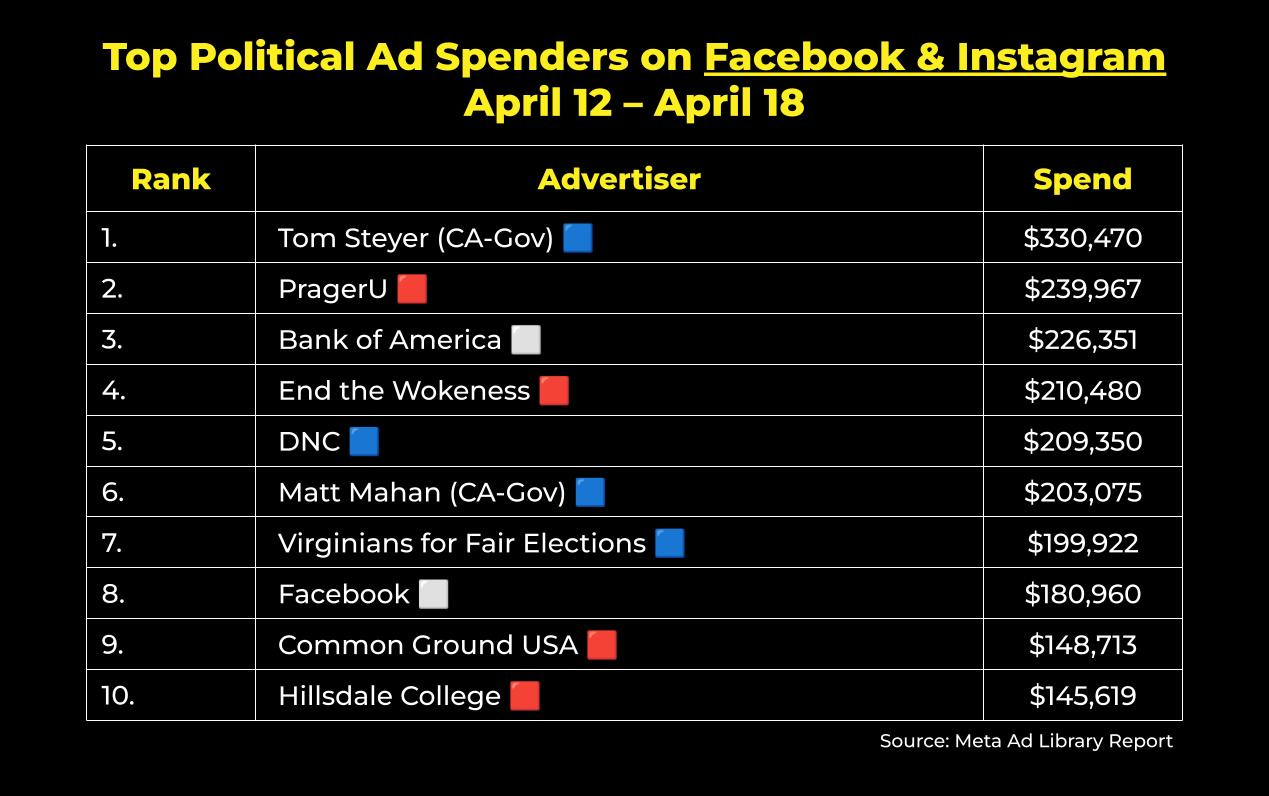
Tom Steyer is (shockingly) at the top of this list and he invested around $40K more on Meta platforms than he did the week before. His gubernatorial campaign’s overall spend has exceeded $115M with a little over 5 weeks to go until Primary Day.
Matt Mahan—also in the running to succeed Gavin Newsom as governor of California—is the first candidate whose initials aren’t T.S. to make it on the list this year.
Steyer’s polling has been holding steady in the teens, while Mahan has yet to break out of single digits. A clear frontrunner has yet to emerge in this race so it’s impossible to say where things will land on June 2. We’ll find out soon enough.
Meanwhile, political advertisers spent around $11.5 million on Google and YouTube ads last week. These were the top ten spenders nationwide:
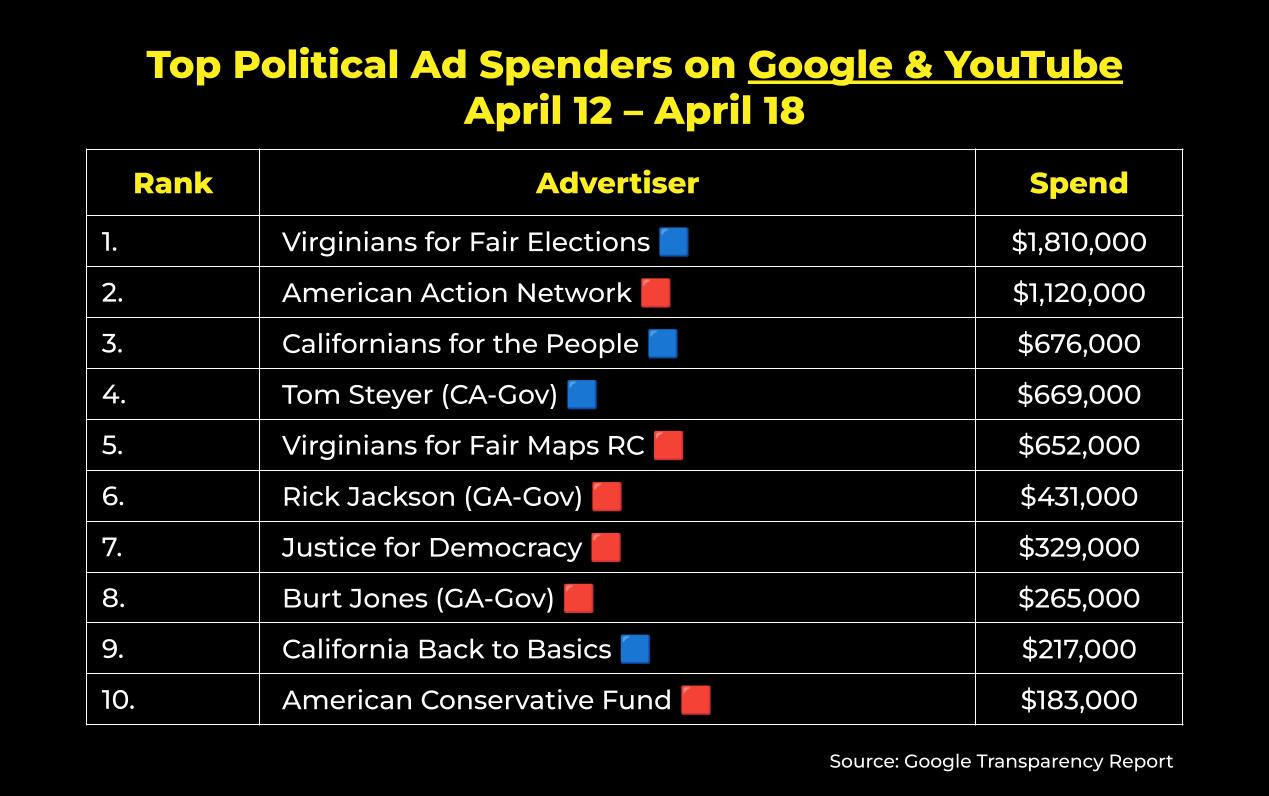
Last week was the last full week before Virginia’s April 21 special election, so it makes sense that the state was on the receiving end of about 25% of Google and YouTube’s targeted spend ($2.9M). Tough times for democracy-hater Peter Thiel’s Justice for Democracy PAC, which invested nearly $700K this month on 38 ads attempting to convince Virginians to vote “no” on the redistricting referendum—only for it to pass by a margin of about 3%.
On the plus side, at least Republicans seem to be taking it well.
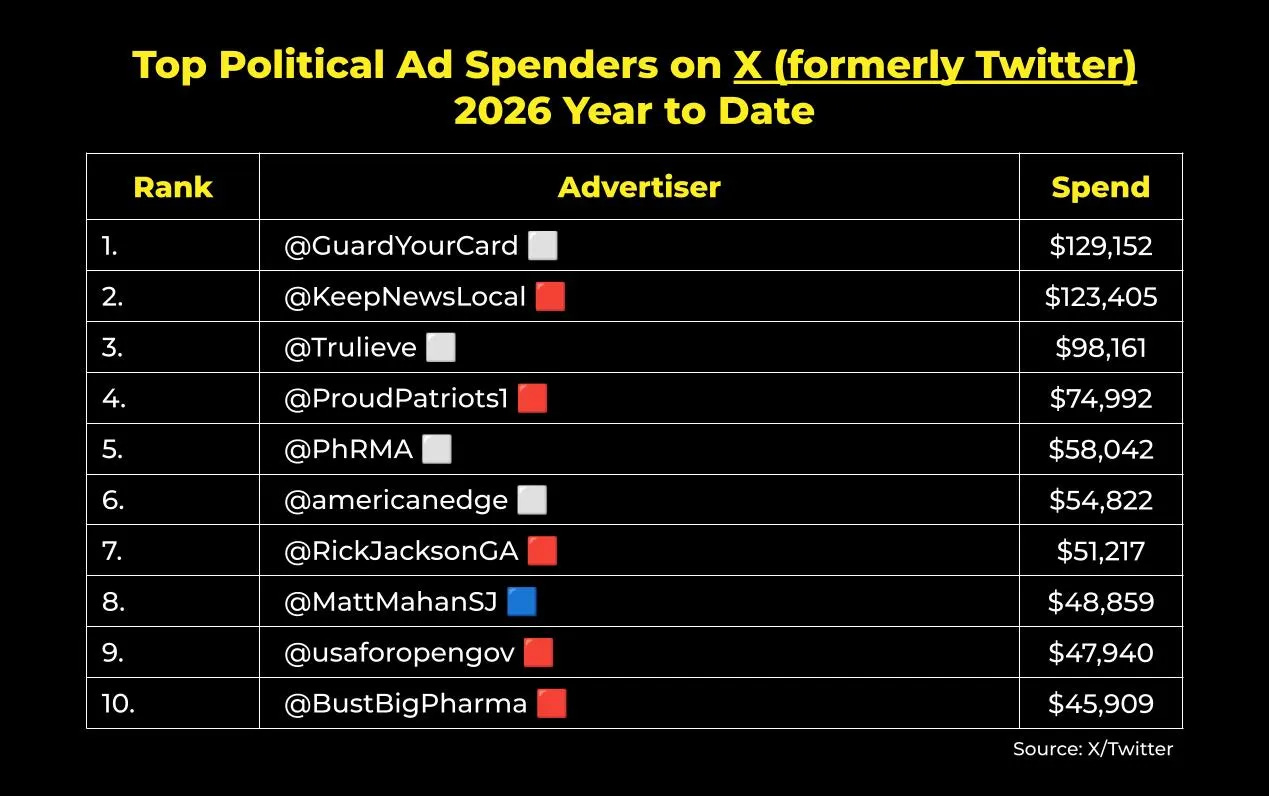
Twitter/X’s reporting is still glitching… so as of last month, political advertisers in the U.S. had spent just over $1.8 million on ads in 2026. Here were the top spenders year to date:
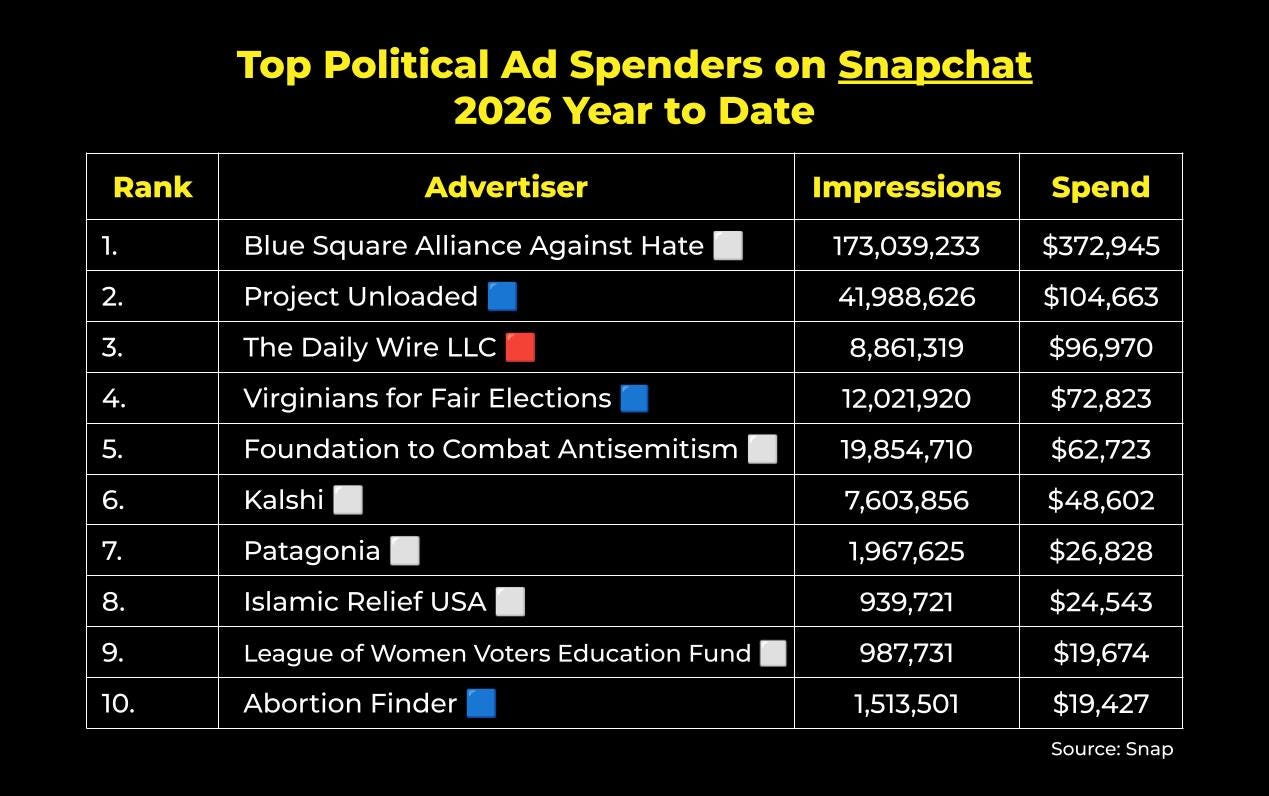
…and lastly, on Snapchat, political advertisers in the U.S. have spent just over $1.02M on ads in 2026. Here are the top spenders year to date:
Please take our money…
We’ve actually heard this before, and you’d say this too if you finally found an ethical list-growth platform that helped you turn $1 into $2 like clockwork. Join over 900 groups like Everytown, Amnesty International, and Mercy Corps that have found a better way to nail their fundraising goals. Learn more >

Creator Campaigns: Moving Beyond Vanity Metrics
Before we dig into how to measure creator campaigns, it’s important to understand why creators are effective messengers in the first place: the bond their audience builds with them over time.
Audiences often form parasocial relationships with creators, developed through months or years of consistently watching content, resulting in high levels of trust and credibility that no ad can replicate. In other words, the value of a creator can’t be boiled down to one post. It’s the relationship and reputation they’ve built over time. Add to that the fact that according to Pew Research Center, 2 in 5 Gen Z-ers get their news from creators, and you start to understand why they’ve become such a central piece of our media ecosystem. Working with them allows political organizations to engage audiences through the existing relationships of trust and credibility that creators have built.
This is a new way of reaching people, but the way most campaigns measure this work is stuck in the past — outdated frameworks from paid media and brand marketing at best, and totally vibes-based at worst. It’s understandably hard to measure how creator campaigns work, but we’re also repeatedly optimizing for the wrong things.
So what might better measurement look like?
Optimizing for Shares & Saves, not Likes & Views: We look at metrics to understand how content is performing, but we also go beyond views and likes to focus on engagement. Shares & saves are inherently more meaningful because they’re active, not passive. Saves mean a user intends to return to the post in the future, and shares mean that they are either putting their personal stamp of approval on the content to their own community or using it to start a conversation. Both tell you something views never can: that the content actually meant something to the person who saw it.
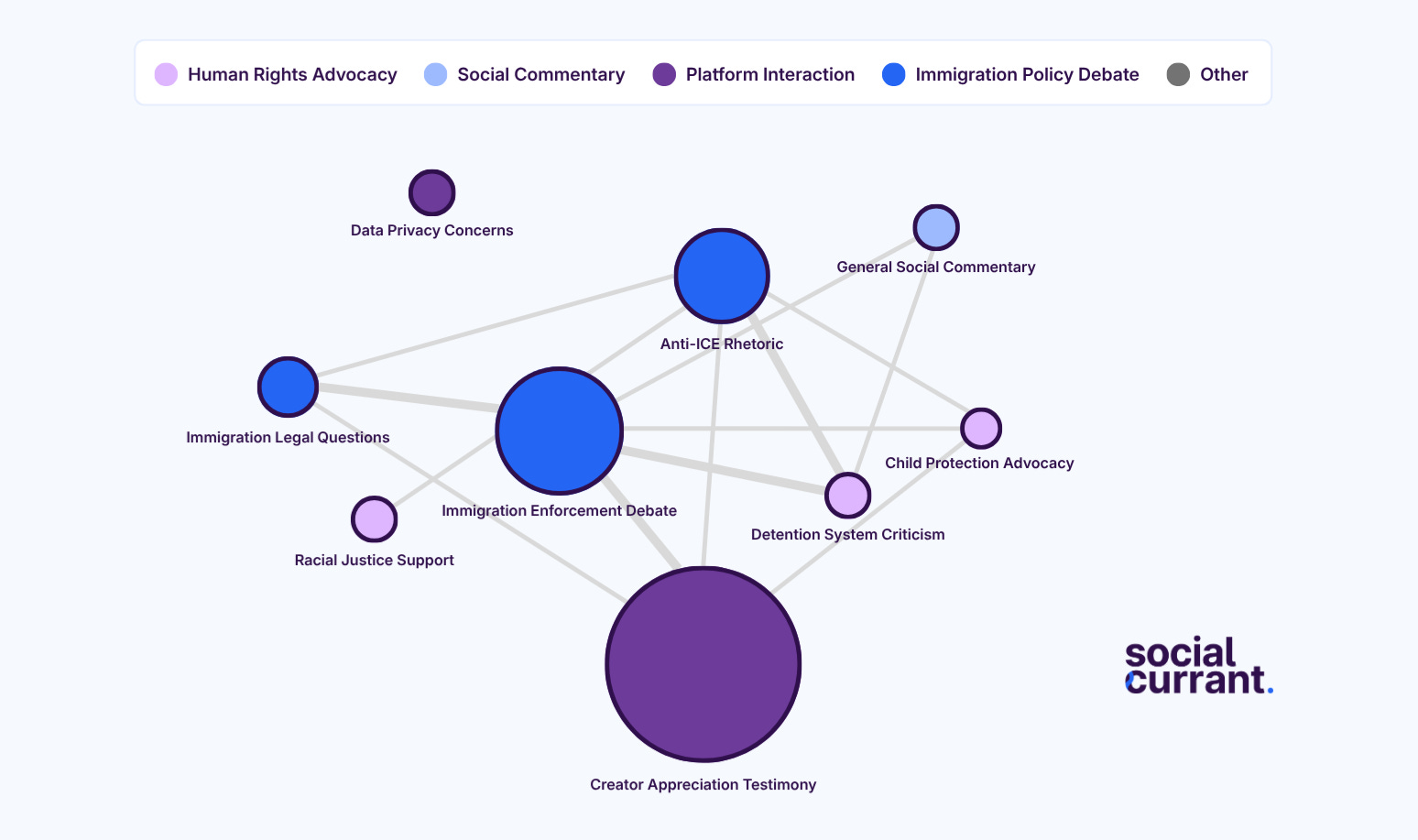
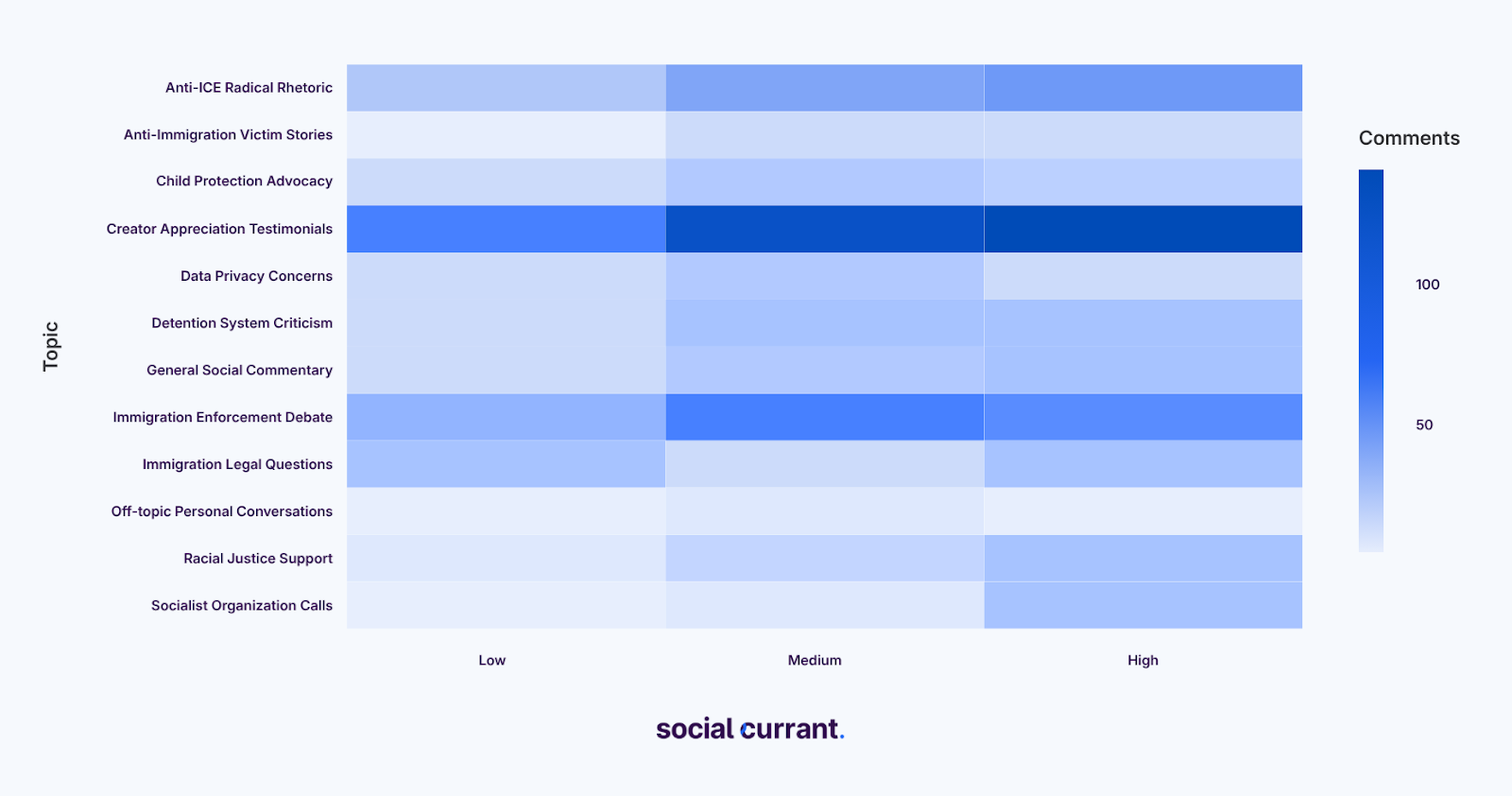
Understanding the Comment Section: While comments are a small percentage of engagement, they’re one of the richest sources of information available online about what people really think and why, especially when analyzed at scale. We started evaluating comment sections, going beyond sentiment analysis into topic modelling to understand not just what audiences are saying, but how well it aligns with what the campaign wants them to believe. From the health of a conversation to the intensity of certain topics, the comment section helps us better understand whether a message is landing as intended.
The chart below depicts content we produced in partnership with creators around immigration enforcement – there were over 2,000 comments across posts.
We then tracked the “intensity” of those topics: how long, deep, and emotionally engaged the conversations got.
Measuring The Impact of a Program on Creators: Beyond metrics and audience impact, it’s also important to understand how this work affects creators themselves — in particular, whether working with mission-aligned organizations makes them more politically active both online and off. We know creator campaigns reach audiences, but do they actually move creators – making them more confident, more vocal, and more engaged on issues that matter? That’s a harder question to answer, but it’s one of the more meaningful signals we have about whether this work is building something lasting.
When it comes to politics, viewers trust the message because they trust the messenger — not the other way around. The ecosystem has spent years measuring the message. It’s time to start measuring the relationship.
Please take our money…
We’ve actually heard this before, and you’d say this too if you finally found an ethical list-growth platform that helped you turn $1 into $2 like clockwork. Join over 900 groups like Everytown, Amnesty International, and Mercy Corps that have found a better way to nail their fundraising goals. Learn more >

COURIER’s newly-launched Epstein investigation project
For too long, the Epstein Class has dealt in wealth, power, and politics to avoid accountability and deny victims & survivors their due justice. The public deserves the truth, but the Trump Administration is failing its legal obligation to deliver it.
That’s why we’re expanding our coverage to follow the money and investigate the power players in and outside the government. With a new database by Thorian AI, we have unprecedented access and ability to navigate more than 1.2M files and we’re sharing access—and what we’re finding—with you.
Subscribe to The Cover-Up and get one concise, easy-to-read email a week that cuts through the noise with the headlines you need and the breakdowns you want.
By staying plugged in and leveraging our reporting to make your own calls-to-action louder, together, we can turn information into justice.
That’s it for FWIW this week. This email was sent to 25,736 readers. If you enjoy reading this newsletter each week, would you mind sharing it on X/Twitter, Threads, or Bluesky? Have a tip, idea, or feedback? Reply directly to this email.
Support COURIER’s Journalism
With newsrooms in eleven states, COURIER is one of the fastest-growing, values-driven local news networks in the country.
We need support from folks like you who believe in our mission and support our unique journalism model. Thank you.
