



Hi everyone! I’m Sarah Stamper, a neuroscientist turned civic data nerd and previous FWIW guest author—excited to be back. Currently, I lead research and data at Murmuration, where my team constructs a holistic view of civic life in America, bringing together data on people, places, and perspectives. I also write State of Us on Substack, where I share insights on what it feels like to live, hope, and participate in democracy today.
For today’s FWIW, I’m writing about how “horizon loss”—the feeling that the future is closing rather than opening—is reshaping Americans’ emotional lives, civic behavior, and expectations of political leadership.This shift has real political consequences, shaping how people respond to campaigns and messaging, and how willing they are to stay engaged.
More on that below, but first…
Digital ad spending, by the numbers:
FWIW, U.S. political advertisers spent about $12.5 million on Facebook and Instagram ads last week. Here were the top ten spenders nationwide:
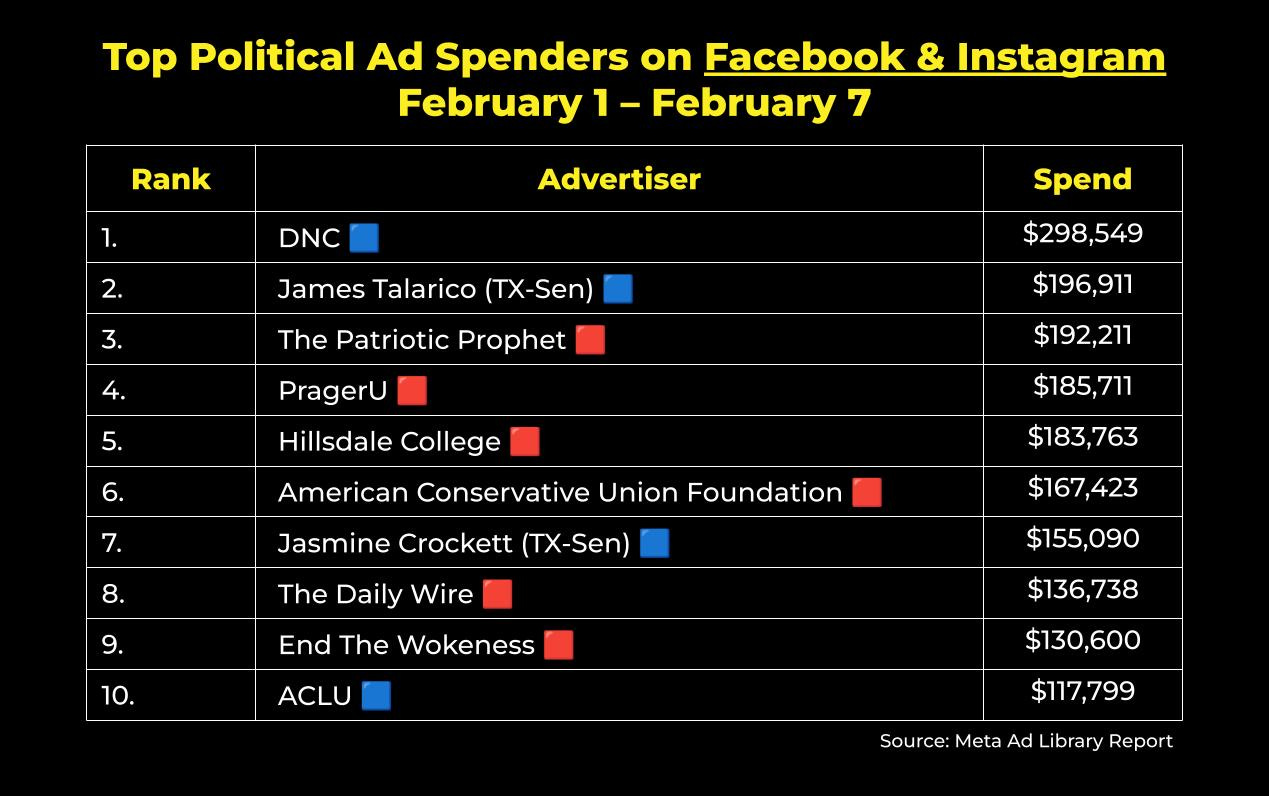
With less than a month to Primary Day, both Jasmine Crockett and James Talarico made six-figure investments on Meta platforms last week. Combined, that’s over $350,000 in seven days from just those two campaigns alone. The DNC still leads the board at nearly $300K, but the Texas candidates aren’t far behind individually, and together, they rival any single national player.
Democrats have not won a statewide election in Texas since 1994 and the last time a Democrat was elected to the U.S. Senate from Texas was in 1988. Could this be the year that changes? Only time will tell…
Meanwhile, political advertisers spent around $4.5 million on Google and YouTube ads last week. These were the top ten spenders nationwide:
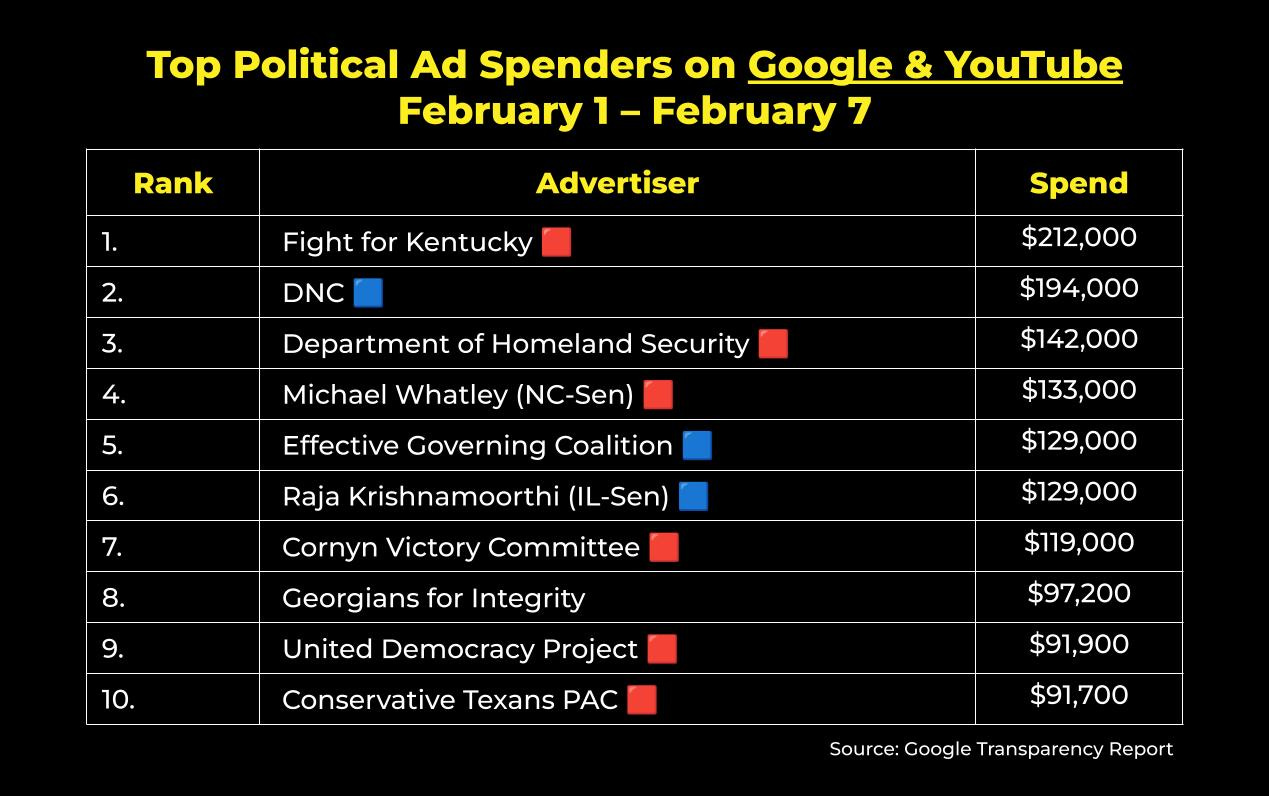
The big mystery spender on this list is “Georgians for Integrity,” an anonymous group registered in Delaware, running attack ads against gubernatorial candidate Lt. Gov. Burt Jones. Are they Democrats? Are they Republicans? No one seems to know.
What we do know is that Jones, who boasts Trump’s endorsement, is so pissed about these ads that he asked the FCC to step in and help. The Georgia Republican Party is on a similar crusade to get the organization to disclose its donors. When Jones’ campaign called for TV stations to pull these ads from their rotations, the PAC’s lawyer responded that the Lt. Gov. seeks to “halt a healthy discussion about his record by cutting off his critics’ access to the airwaves.” The girlies are fighting!
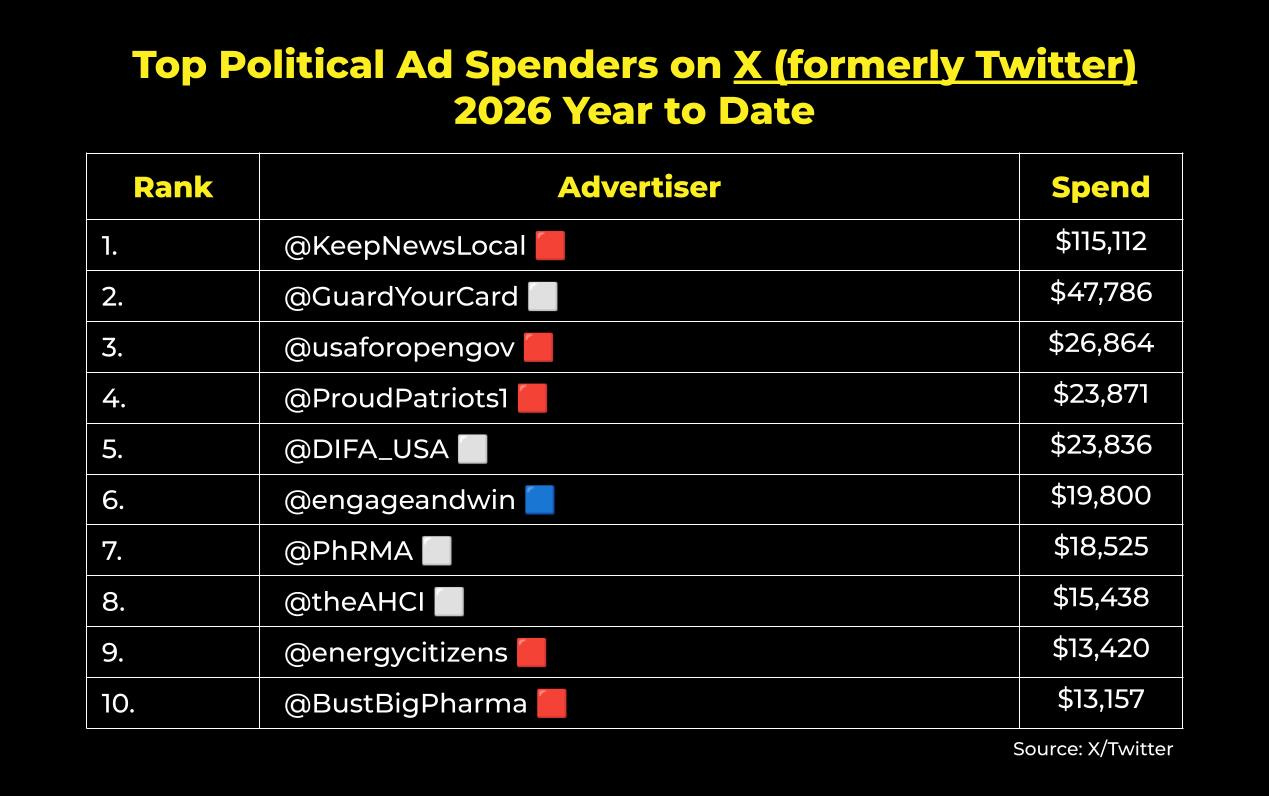
On X (formerly Twitter), political advertisers in the U.S. have spent around $627K on ads so far in 2026. According to X’s political ad disclosure, here are the top spenders year to date:
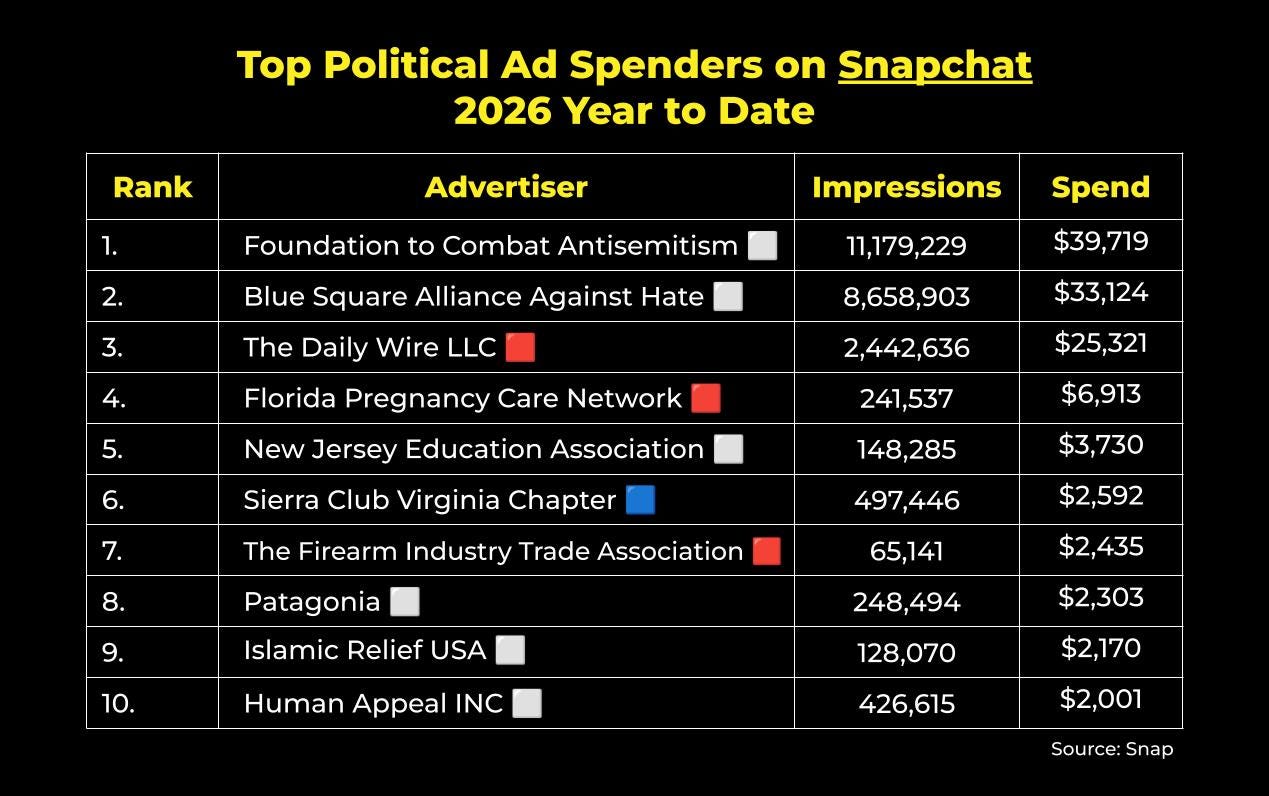
…and lastly, on Snapchat, political advertisers in the U.S. have spent just under $132K on ads in 2026. Here are the top spenders year to date:

Join us for the State of the Swamp
Join DEFIANCE.org and COURIER at the National Press Club in Washington, D.C. on February 24th for the State of the Swamp, a rebuttal to Trump’s State of the Union.
Opposition figures, current and former elected officials, celebrities, and other leaders will gather to tell the truth and to counter Donald Trump’s lies. Speakers include Robert DeNiro, Jim Acosta, Mehdi Hasan, and Senator Ron Wyden.
Use discount code COURIER15 for 15% off tickets
Breaking the Doom Loop
In Murmuration’s latest Civic Pulse, many Americans describe a sense that the future is closing rather than opening. When we ask people how they feel about the next five years, the dominant mood is not confidence or optimism. It is uncertainty paired with a belief that no matter who is in charge, things won’t really get better.
What stands out is not just pessimism, but the scale of what people fear.
When Americans are invited to describe what could most disrupt their lives this year, many jump quickly to macro-scenarios of societal breakdown: violence, war, collapse, the country unraveling. These are not abstract political complaints or partisan grievances. They are anchored in lived and witnessed events: an insurrection at the U.S. Capitol, federal troops deployed in American cities, high-profile political killings, and highly visible immigration raids. Together, they reflect an Overton Window that has shifted so far that once-unthinkable outcomes feel plausible. But, the feelings reported by people also signal a public imagination stuck in threat response and bracing for what could go wrong rather than planning for what could go right.
When fear operates at this scale, it doesn’t just heighten anxiety, it reshapes civic behavior, narrowing people’s willingness to plan, participate, or believe political action will meaningfully change outcomes.
Across multiple questions, Americans describe a future that feels compressed, fragile, and difficult to imagine beyond the near term. A majority believe life for the next generation will be worse than it is today (51%), far outpacing the share who expect it to be better (18%), down dramatically from 2022.
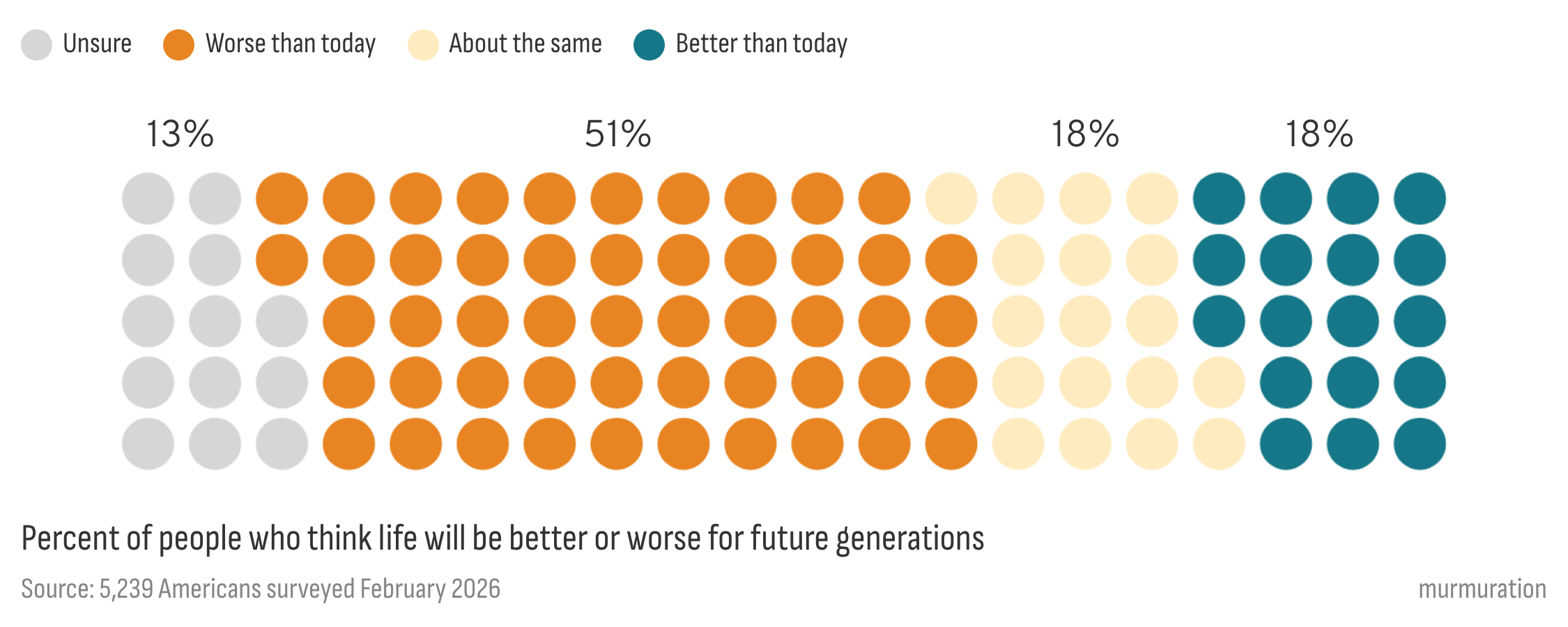
More people say their own future feels uncertain rather than stable (44% vs. 30%), and this sense of constraint shows up in how far ahead they can look: fewer than one in four can imagine their lives beyond the next five years (23%), while almost double say they are only focused on getting through the next few weeks or months (44%). When asked how they feel about the next five years in the United States, the most common response is not hopeful or determined—it is worried.
It’s tempting to treat all of this as a mood shift or another data point in America’s long-running pessimism cycle. But horizon loss—the feeling that the future is too unstable or inaccessible to plan for—is not just emotionally taxing, it’s costly to our communities and detrimental to Americans’ sense of unity. It is also costly politically. Movements and parties that rely on sustained participation, long-term reform, and belief in incremental progress are especially vulnerable when people lose the ability to imagine a future worth working toward.
People who can maintain a longer horizon, who feel the future is more open for them and who believe that with the right leadership things can improve over time, are more likely to believe:
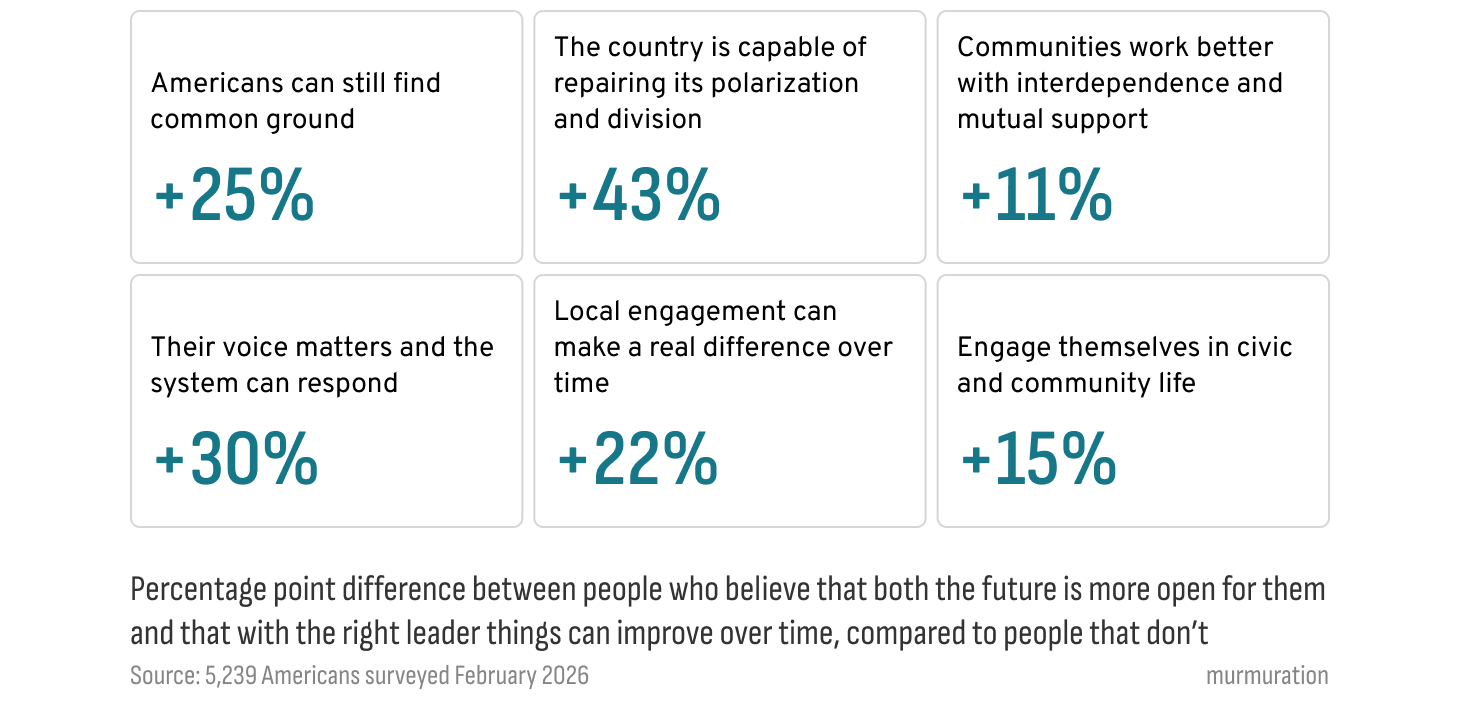
This is one of the deepest risks of perpetual crisis: not just that people become more scared or angrier, but that they become shorter-term and stop believing in their own agency. That loss of agency is inseparable from today’s crisis of political trust.
In this moment, a majority of Americans are deeply skeptical that political leaders care about them or will meaningfully respond to their problems, which only reinforces the sense that planning for the future is futile.
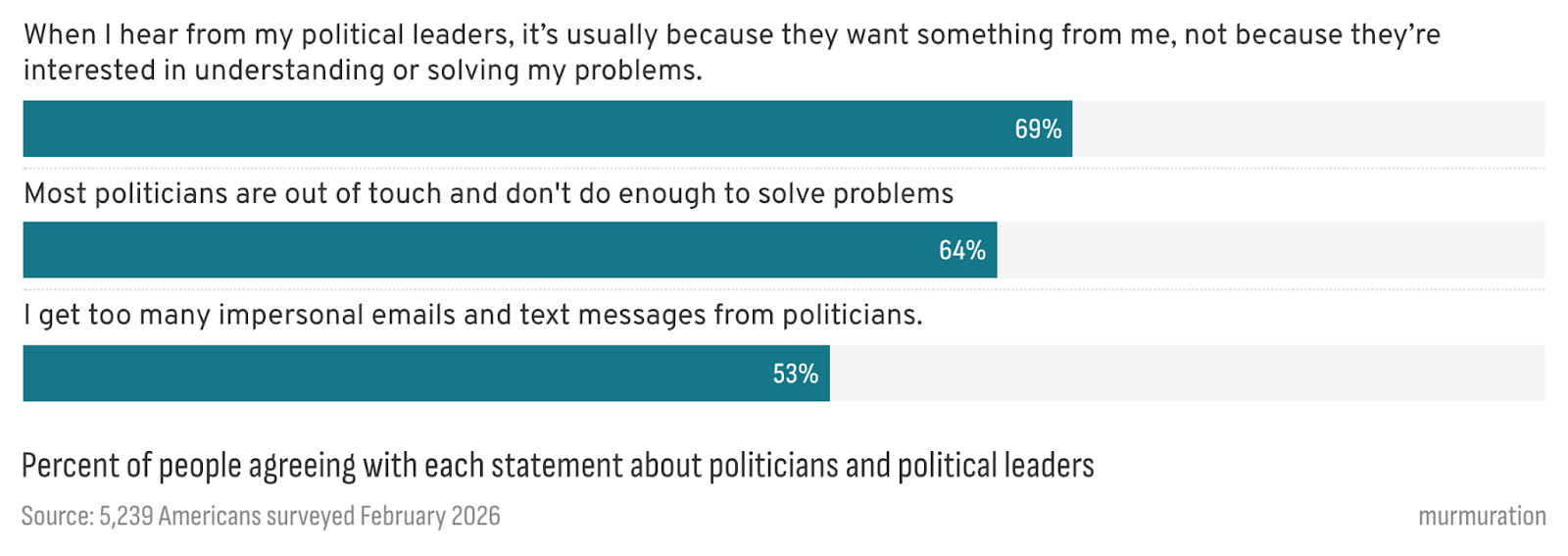
When leadership feels transactional, distant, or perpetually reactive, it shortens people’s time horizons even further. But, people aren’t disengaged because they don’t care; they’re disengaged because they’re conserving energy in a world that feels extractive, unstable and unresponsive.
Reopening the Horizon
So what does leadership need to do to meet this moment?
First, it lengthens the timeline without diminishing urgency. People continue to see today’s threats as real and immediate, but much of modern political and campaign messaging treat every moment as an existential emergency: “Act now before it’s too late,” “This is our last chance to stop Trump,” “Donate in the next 24 hours to save democracy,” or “Everything hinges on what happens today.” That framing can be effective to mobilize people in bursts, but when it becomes constant, it traps people in crisis mode and becomes a recipe for burnout and eventually disengagement. Murmuration data shows that people who believe the future is more open are more trusting, more collaborative, and more likely to stay engaged. Leadership that is more honest and helps people see longer arcs and believe in a future can begin to reopen that horizon.
Second, it lowers the temperature rather than fueling division. When Americans are asked what they want most from political leaders right now, the answer is not someone singularly focused on defeating opponents (only 12%) but a leader who inspires people to find common ground (72%). In a moment defined by horizon loss, people aren’t looking for escalation or constant conflict, but for leadership and messaging that reduces threat, restores a sense of shared fate, and makes it possible to imagine a future that extends beyond the next battle. They are looking for leaders who help them extend their horizon.
Third, it restores agency by making progress visible. When the future feels inaccessible, people disengage not out of apathy but exhaustion. And importantly, Murmuration data indicates most Americans do believe change is possible somewhere: at the local level (70%) and the national level (48%), including 37% who believe change is possible at both. Just 11% believe change is not possible at any level. Messaging that is honest and transparent, closes feedback loops, and points to concrete changes, even small ones, meets people where that belief still exists.
In practice, this means showing people what happened because they participated: documenting how a local ordinance changed because residents organized; reporting back when a school board reversed or amended a decision after community input; explaining clearly, after a vote or campaign, which demands were met, which were not, and why; and pointing to tangible outcomes such as expanded early voting hours, new tenant protections, a stalled policy finally moving forward, a harmful proposal delayed, a new clinic opening, or funding secured for a specific community need. It helps counter the feeling that nothing ever improves and reminds people that participation can still lead to real, visible outcomes over time.
You can see glimpses of this posture in some visible political moments: Mamdani drawing attention early in his campaign by physically showing up to protest ICE enforcement actions; Whitmer conducting on-site visits and public briefings following major infrastructure failures in Michigan; Moore structuring his first year in office around specific workforce development and service initiatives with publicly stated benchmarks; Warnock holding “community office hours” across Georgia to discuss federal policy impacts; Beshear delivering regular, detail-oriented updates during COVID and natural disasters; Wu pairing housing and public health proposals with neighborhood-level engagement processes in Boston; Murphy convening ongoing community conversations in Connecticut around gun violence prevention; Murkowski holding statewide town halls about appropriations and infrastructure projects affecting Alaska communities; Massie providing detailed floor explanations of his votes and publishing legislative analysis for constituents in Kentucky; and Cox convening statewide policy forums in Utah and promoting cross-partisan civic initiatives such as “Disagree Better.”
Horizon loss is not inevitable, and it is not permanent. But rebuilding a sense of future will require leadership that resists constant crisis and instead helps people imagine themselves as part of something longer, steadier, and shared. It also requires an intentional commitment to rebuilding that future together.
The encouraging signal in the data is that most Americans still believe in each other and that change is possible, especially close to home. At a moment when the future feels hard to picture, leadership that makes progress visible, lowers threat, and stays oriented toward the long term may be one of the most important civic interventions we have.
The COURIER team is growing and we need you!

These new hires will have the opportunity to shape how we launch in new regions and build trust from the ground up. You can see the full job descriptions on our Careers Page here.
If you know of anyone who might be a strong fit—or could help spread the word—let us know! Email info@couriernewsroom.com.
That’s it for FWIW this week. This email was sent to 25,477 readers. If you enjoy reading this newsletter each week, would you mind sharing it on X/Twitter, Threads, or Bluesky? Have a tip, idea, or feedback? Reply directly to this email.
Support COURIER’s Journalism
With newsrooms in eleven states, COURIER is one of the fastest-growing, values-driven local news networks in the country.
We need support from folks like you who believe in our mission and support our unique journalism model. Thank you.

Thank you for the article. I will listen in. This sounds interesting.