


This newsletter is brought to you by the donor acquisition approach that helps you turn $1 into $2.

Hey y’all! I’m Katie Serrano, the DFW Political Correspondent for Courier Texas. I’ll be your guest author for today’s edition of FWIW.
I live in Dallas and cover local politics throughout North Texas. Over the last year and a half, I’ve spoken with local leaders and community members, looking at policies implemented by the Trump administration and breaking down how they impact everyday Texans.
I also write a free, weekly newsletter called The TexEd Report (subscribe here!) focusing on the intersection between politics and education throughout Texas.
For today’s FWIW, I’m recapping the Texas primary election that took place on March 3 and sharing my perspective on the chaos and confusion that took place in Dallas County on election night.
More on that below, but first…
Digital ad spending, by the numbers:
FWIW, U.S. political advertisers spent just under $12.9 million on Facebook and Instagram ads last week. Here were the top ten spenders nationwide:
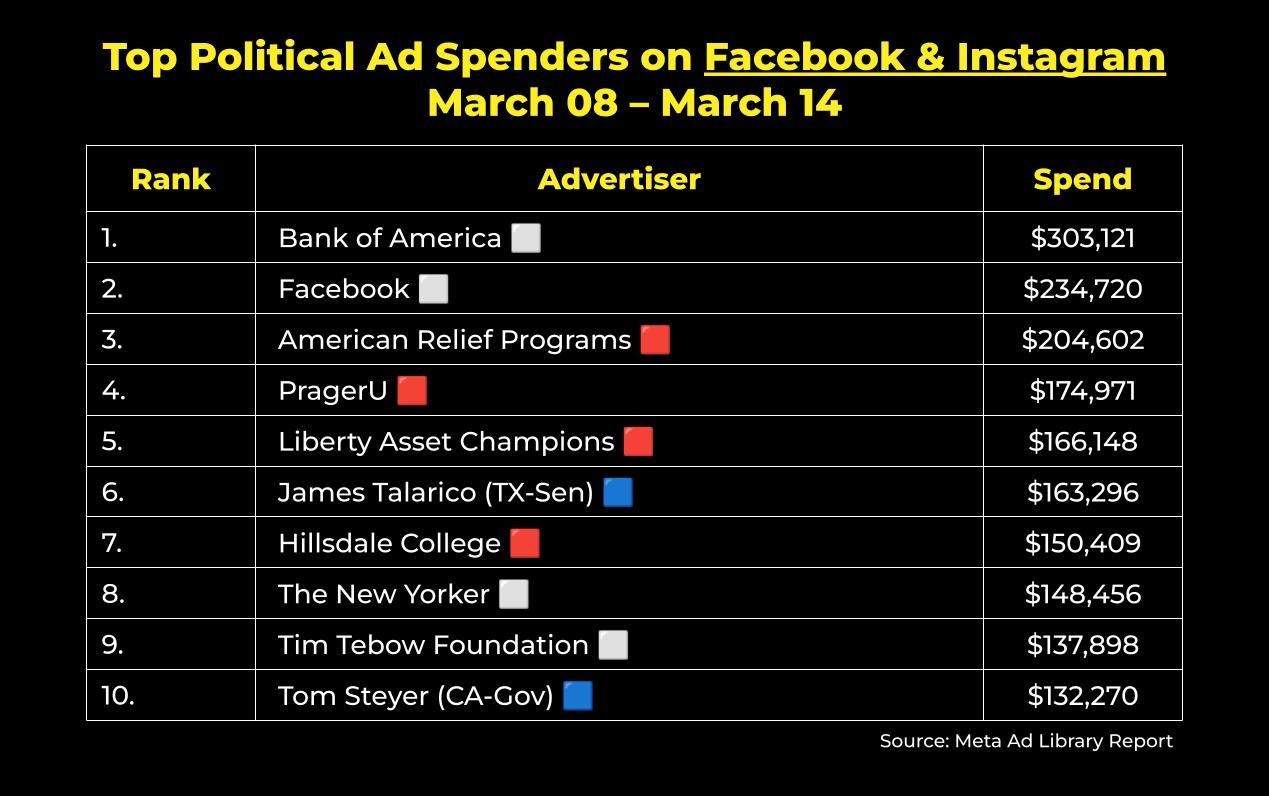
If you’re wondering what the heck “Liberty Asset Champions” is, well… the entity, listed as a “fan page” on Facebook, has been running ads telling people that they “don’t need to wait” to claim their stake in Elon Musk’s anticipated SpaceX IPO. The lengthy ad copy sings Donald Trump’s praises and reads like a creepy ChatGPT fanfic.
The Texas Democratic nominee for US Senate, James Talarico, comes in at #6 on this list as he gears up to face the winner of the May runoff election between Republicans Ken Paxton and John Cornyn. If you’ve been following our commentary here the last few weeks, you won’t be surprised to see billionaire Tom Steyer as the only California gubernatorial candidate on this list.
Meanwhile, political advertisers spent just over $6.8 million on Google and YouTube ads last week. These were the top ten spenders nationwide:
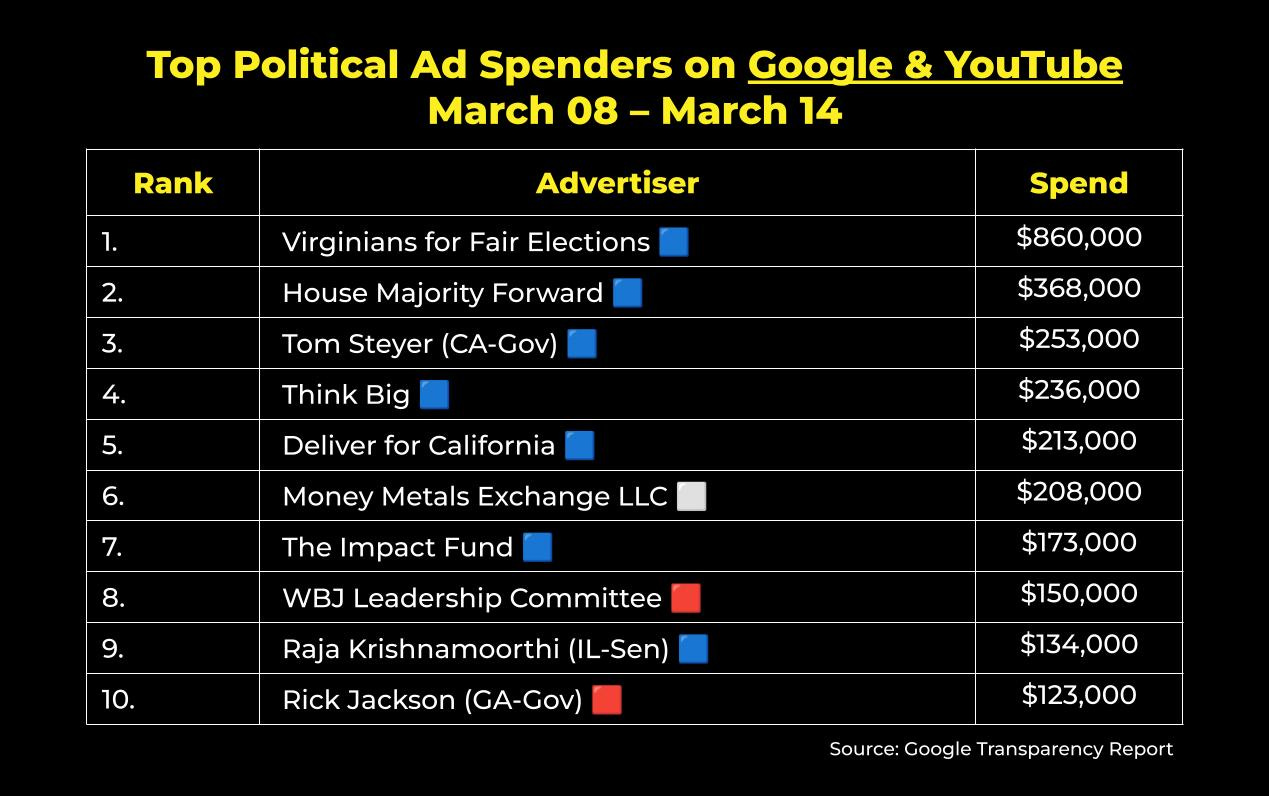
Interestingly, Democrats and left-leaning organizations seem to be really over-indexing on Google and Youtube investments these days. Billionaire Tom Steyer is joined on this list by Deliver for California, an independent expenditure committee aimed at boosting Steyer’s fellow California gubernatorial candidate San Jose Mayor Matt Mahan.
Think Big (not to be confused with Illinois Governor JB Pritzker’s nonprofit Think Big America) is a PAC supporting Democratic candidates “dedicated to advancing AI innovation in America.” Nearly all of their $236K ad spend last week was thrown behind congressional candidates Jesse Jackson Jr. and Melissa Bean, who were running in IL-02 and IL-08 respectively. ICYMI: Jackson Jr. lost his race to Cook County Commissioner Donna Miller, while Bean won hers and will face off against Republican Jennifer Davis in November.
On X (formerly Twitter), political advertisers in the U.S. have spent $1.65M on ads so far in 2026. According to X’s political ad disclosure, here are the top spenders year to date:
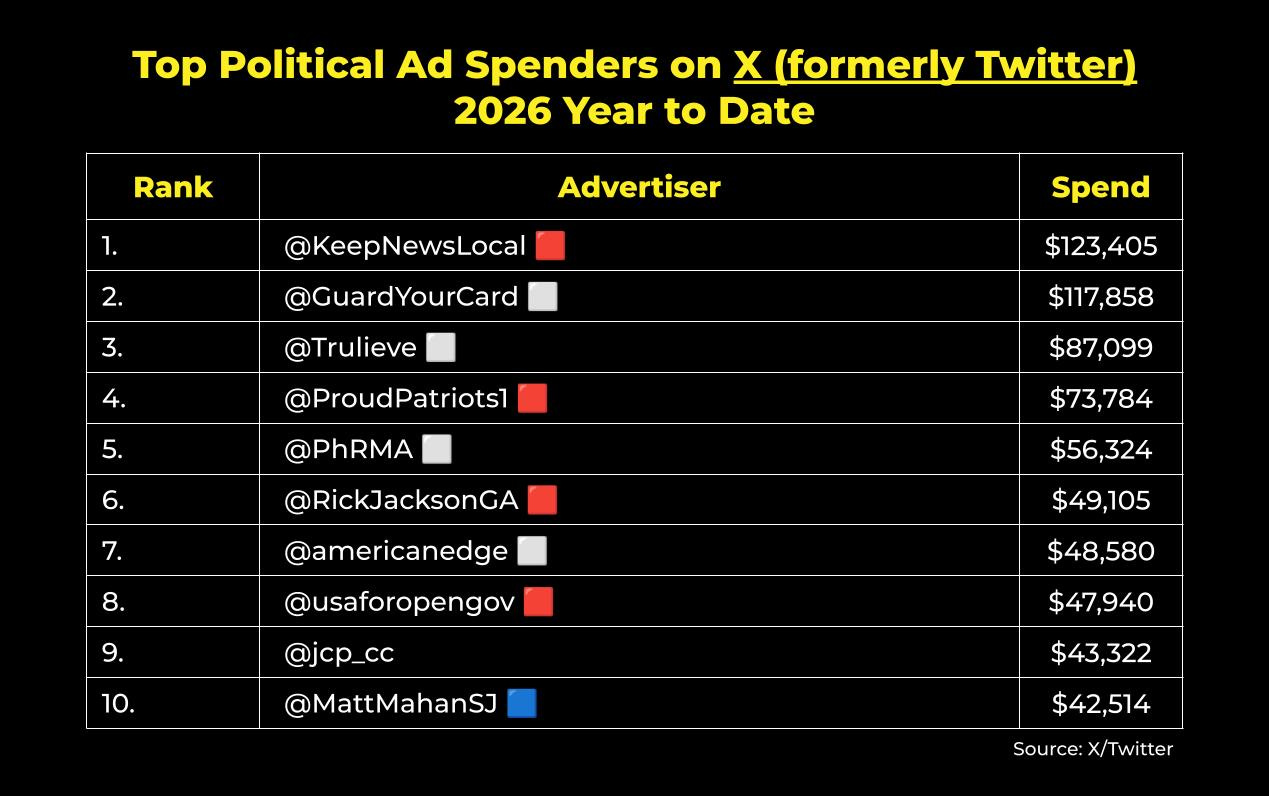
One blue square! We see you, Matt Mahan.
…and lastly, on Snapchat, political advertisers in the U.S. have spent just over $506,000 on ads in 2026. Here are the top spenders year to date:
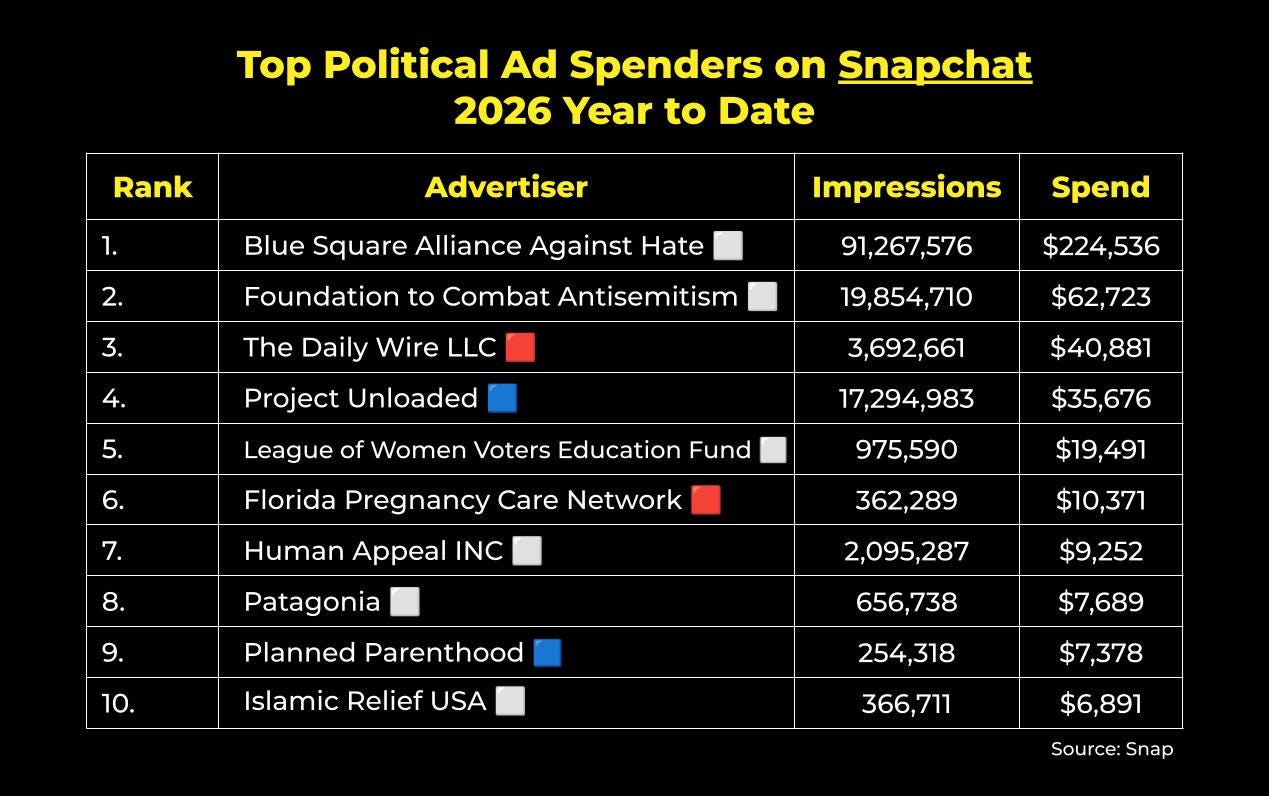
Please take our money…
We’ve actually heard this before, and you’d say this too if you finally found an ethical list-growth platform that helped you turn $1 into $2 like clockwork. Join over 900 groups like Everytown, Amnesty International, and Mercy Corps that have found a better way to nail their fundraising goals. Learn more >

An exclusive look at the most expensive US Senate primary in history
Over the last three months, it didn’t matter if you lived in Texas or halfway across the country—everyone, from celebrity podcasters to musicians to the President, seemed to have something to say about our US Senate race.
While covering campaign launches and town halls for Democratic candidates James Talarico and Jasmine Crockett, I watched crowds grow from hundreds to thousands leading up to the primary.
As support for both candidates surged, one thing became clear: Texas Democrats were happy to finally have a hard decision to make on Election Day. (Democrats outvoted Republicans by 140,000 votes.)
On the Republican side, it didn’t take long for the race between Sen. John Cornyn and Attorney General Ken Paxton to get ugly. Cornyn delivered personal blows to Paxton, while Paxton leveraged his MAGA support to quickly close any substantial lead Cornyn was projected to have as the incumbent.
So, it’s no surprise that these competitive and contentious races not only drew national attention, but resulted in Texas setting a national record for the most expensive Senate primary in US history.
Advertising spending exceeded $120 million across the two races, according to a report from the media tracking firm Ad Impact. And it’s about to get even more expensive, as the majority of that money was spent by Cornyn, who’s headed to a runoff election on May 26 against Paxton.
Cornyn received nearly $70 million in ad support ahead of Election Day, yet landed just one percentage point ahead of Paxton, who received around $12 million in the lead up.
With the runoff set, Cornyn wasted no time going back on the offensive, releasing a bizarre AI attack ad taking aim at Paxton’s alleged affair and infidelity.
On the Democratic side, Talarico defeated Crockett by six percentage points and outspent her nearly five-to-one. His campaign spent over $25 million on ads leading up to Election Day, including a splashy six-figure Super Bowl ad that aired in Houston.
Both candidates largely refrained from direct attack ads created by their own camps, remaining fairly positive and staying focused on their own policies and experiences.
Still, that didn’t stop tensions from boiling over online between their supporters.
Political influencers shaped campaign discussions and discourse on social platforms like Threads and TikTok, sparking several think pieces about the impact influencers—and the free advertising they provide—have on today’s political landscape.
But as a reminder: Twitter isn’t real life.
And although online discourse remained heated leading up to Election Day, it didn’t match what I saw on the campaign trail or at the polls.
I attended several events for both candidates and nearly every constituent I spoke to said that even though they were voting for one candidate in March, they would still vote for the other in November if they ended up being the Democratic nominee.
Ultimately, Talarico’s positive, populist campaign strategy focused on fighting billionaires and corruption while leaning into his faith as a Presbyterian seminarian paid off.
“ He’s just got something special that I think we haven’t seen in a politician in a really long time,” Katie Ryan, a voter in Frisco, told me. “He’s got a kind of special sauce of being young and being able to speak to those of us who are under the age of 50. He hits people where we are. He’s reclaiming my faith in a way that realigns who I am with my values in a political way.”
Chaos, confusion, and voter suppression in Dallas
Election night began on a high note at Crockett’s campaign watch party in downtown Dallas, where I was waiting with a few hundred supporters for results to start trickling in.
But the night quickly took a sour turn before any races were even called. To understand why, we need to back up a few months.
In January, both the Dallas County GOP and Williamson County GOP decided to ditch countywide voting. That meant that although Republican and Democratic voters could vote anywhere across the county during early voting, they were required to cast their ballot at one specifically assigned neighborhood polling location on Election Day.
(In case you didn’t know, Dallas is Crockett’s home base; Round Rock—located in Williamson County—is Talarico’s.)
Although the change was led by Republicans, Texas law requires both state parties to run their primaries exactly the same way, meaning that if Republicans weren’t offering countywide voting locations, Democrats couldn’t either.
So to put it plainly, both Republican party chairs in Dallas and Williamson counties decided to make voting more difficult in the places where Crockett and Talarico would have the most support. They claimed the move would make voting more secure—despite there being no evidence of fraud due to countywide voting.
Democrats warned that the change would cause chaos and confusion on Election Day—and tried their best to warn residents to vote early.
But despite their best efforts, chaos and confusion came out on top.
Over 10,000 voters in Dallas County, unaware of the changes, were turned away from their usual polling sites on Election Day.
Because of the widespread confusion, the Dallas County Democratic Party obtained an order from Judge Clay Jenkins to extend voting hours to 9 p.m. But by 8 p.m., Attorney General Ken Paxton (...who was also on the ballot himself) filed a petition with the Texas Supreme Court to block the extension, which was granted.
The Texas Supreme Court ordered all polling locations to set aside ballots from anyone who got in line after 7 p.m., leaving a number of votes in limbo and delaying results from Dallas County.
“People have been disenfranchised,” Crockett told attendees at her watch party to a chorus of groans and boos. She told guests that she would wait until the morning to make any further announcements about her race, given Dallas County’s size and importance as a voting bloc. Talarico shortly followed suit.
Even with the delays, the margin was wide enough to declare Talarico the winner on election night. Still, nearly 1,800 ballots cast in Dallas County won’t be counted.
But here’s the kicker: After defending the shift to precinct-based voting ahead of the primary election, the Dallas County GOP has now changed course, reversing its decision for the May 26 runoff.
“After causing chaos on Election Day, Republicans are now scrambling to undo the damage they created,” Texas Democratic Party Chairman Kendall Scudder said in a statement following the news. “For months, Democrats warned that forcing a return to a precinct-only system during Election Day would confuse voters, create long lines, and turn people away from the polls, and that’s exactly what happened. This was a completely avoidable failure that wasted taxpayer dollars and undermined voter confidence.”
Let what happened in Dallas County be a warning sign for Democrats across Texas leading up to the general election in November.
At a time when all eyes are on Texas—and when Democrats are trying to win a statewide race here for the first time in 32 years—Republicans wouldn’t be trying so hard to take your vote away if it didn’t matter so much.
Please take our money…
We’ve actually heard this before, and you’d say this too if you finally found an ethical list-growth platform that helped you turn $1 into $2 like clockwork. Join over 900 groups like Everytown, Amnesty International, and Mercy Corps that have found a better way to nail their fundraising goals. Learn more >
ICYMI: MAHA & the Midterms
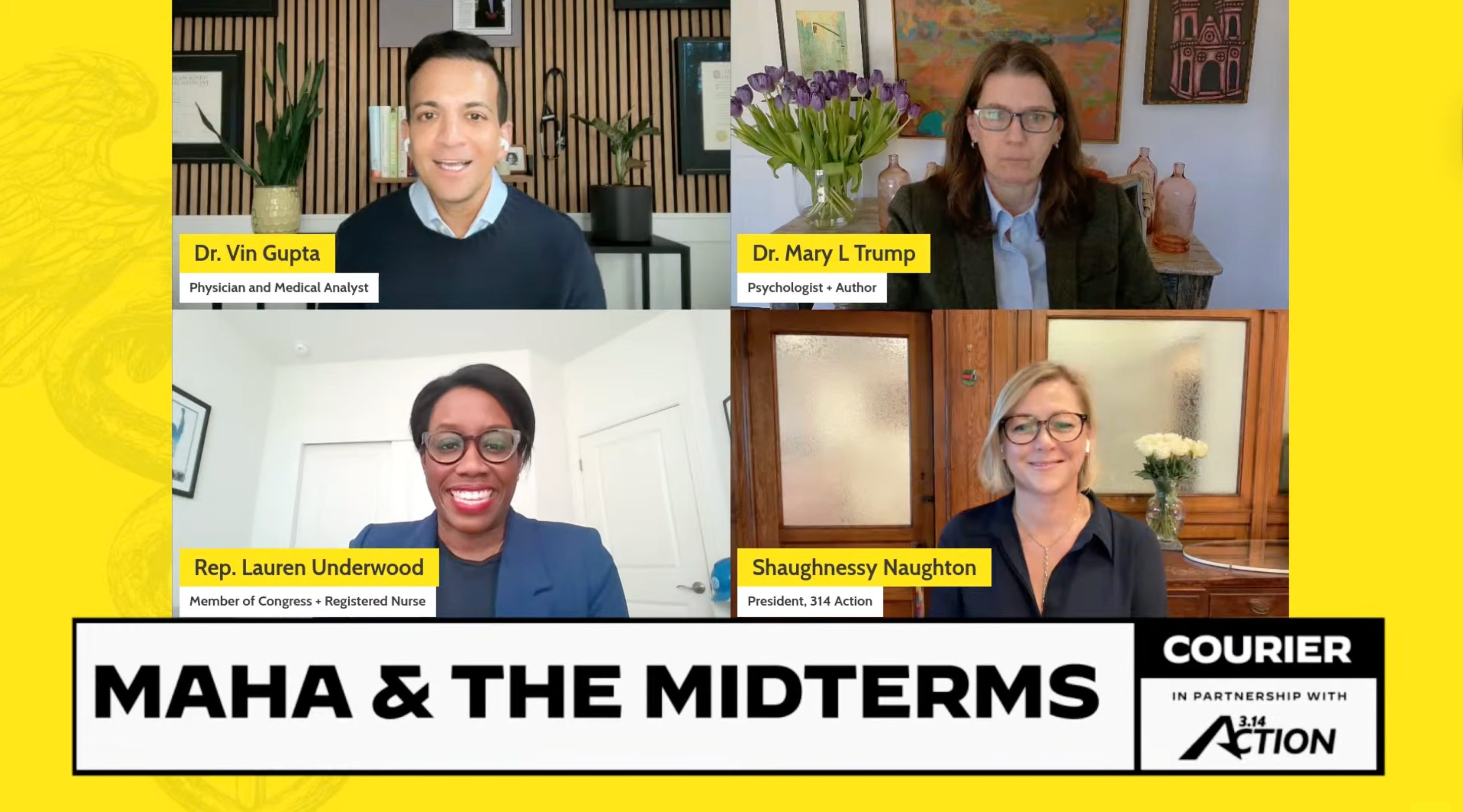
Last week, COURIER’s virtual event in partnership with 3.14 Action drew 22K+ live viewers across platforms. The event featured Hank Green, Dr. Mary Trump, Representative Lauren Underwood, Shaughnessy Naughton, and Dr. Vin Gupta discussing how misinformation and policy decisions affect healthcare access and costs in the U.S. Missed it? Watch the full replay on YouTube.
This event is part of a broader series on science, health, and public policy in American democracy. Our next conversation, Facts vs. Fiction: The Fight for Science in American Democracy, is happening Thursday, June 11. RSVP today!
That’s it for FWIW this week. This email was sent to 25,645 readers. If you enjoy reading this newsletter each week, would you mind sharing it on X/Twitter, Threads, or Bluesky? Have a tip, idea, or feedback? Reply directly to this email.
Support COURIER’s Journalism
With newsrooms in eleven states, COURIER is one of the fastest-growing, values-driven local news networks in the country.
We need support from folks like you who believe in our mission and support our unique journalism model. Thank you.

Thank you for the article. Mr. Talarico ran a brilliant campaign. He brought young people together of every dimension. As for Representative Crocker she has a secure future in democratic politics. If you like Independent Media and are thinking of not wanting to watch regular media please subscribe to FWIW.